 listicle
5 Best Basketball Training Exercises for Skill Development
Table of Contents
- Why These 5 Basketball Training Exercises Build Real Skill
- 1. Ball Handling and Dribbling Drills That Build Control
- 2. Shooting Mechanics and Finishing Exercises
- 3. Footwork and Agility Ladder Drills
- 4. Defensive Positioning and Reaction Time Drills
- 5. Game-Speed Simulation and Court Awareness Exercises
- Basketball Conditioning Exercises That Protect Skill Quality
- Basketball Drills for Intermediate Players Ready to Level Up
- Frequently Asked Questions
Last Updated: September 24, 2026
Why These 5 Basketball Training Exercises Build Real Skill
Most young players don't lack effort. They lack a plan. Walk into any gym and you'll see kids hoisting shots from deep or racing through layup lines at full speed, and it looks like practice. It isn't. It's repetition without purpose, and it builds bad habits that take months to undo.
1. Ball Handling and Dribbling Drills That Build Control
Ball handling is the foundation every other skill sits on. A player who can't control the ball under pressure can't shoot, pass, or finish reliably, no matter how good their form looks in warmups.
Stationary Ball Handling Progression
Start every session with two minutes of stationary work. Pound the ball hard with your fingertips, not your palm, and keep your eyes up.
- Waist wraps: Pass the ball around your waist, then your head, then your knees
- Figure eights: Weave the ball through and around both legs
- Pound dribbles: Dribble as hard as you can with one hand for 30 seconds, then switch
- Crossovers: Low and tight, alternating hands without looking down
Change-of-Direction Dribbling on the Move
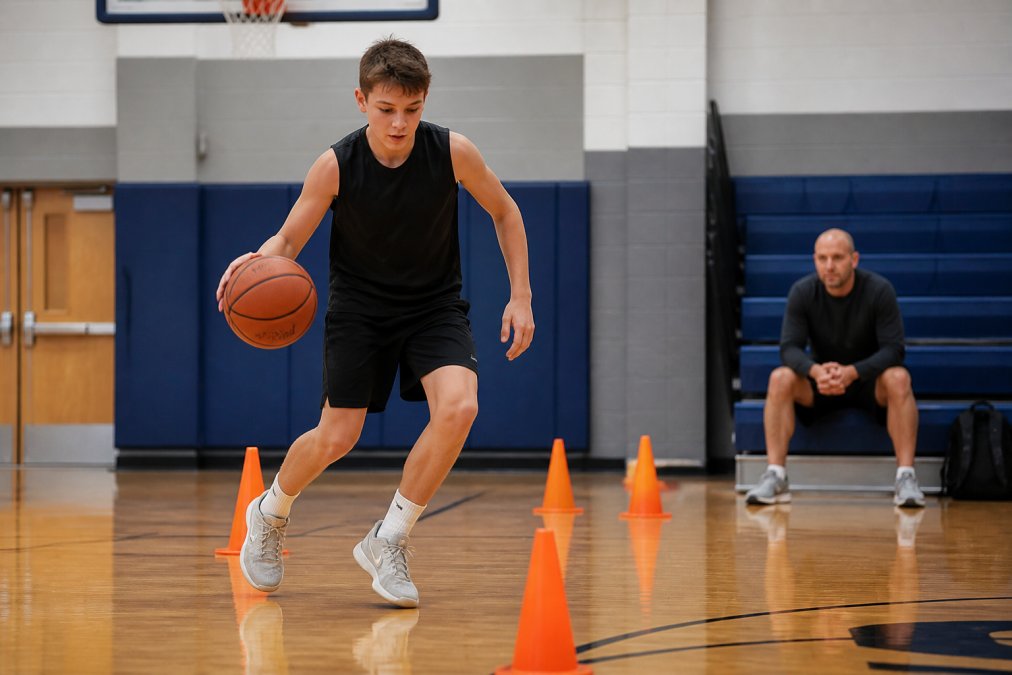
Once stationary work feels easy, add movement. Set up cones two metres apart in a line and practice crossover, between-the-legs, and behind-the-back moves at each one. Walk through it first, then jog, then go full speed.
2. Shooting Mechanics and Finishing Exercises
Shooting mechanics are the repeatable sequence of footwork, hand placement, and release that determines whether a shot goes in. Consistency comes from repeating the same motion, not from shooting volume alone.
Form Shooting and Close-Range Repetition
Stand one metre from the basket. Shoot with one hand, elbow under the ball, and hold your follow-through until the ball hits the net. Make ten in a row before stepping back. This feels tedious. It works.
Mikan and Layup Finishing Series
The Mikan drill builds touch around the rim. Start under the basket, shoot a right-handed layup, catch it out of the net, then shoot left-handed without letting the ball hit the floor. Alternate for 30 seconds per set.
3. Footwork and Agility Ladder Drills
Footwork determines how fast a player can change direction, and change-of-direction speed is what separates players who get open from players who get stuck. Agility ladder drills train the feet to move quickly and precisely.
Ladder drills to rotate through:
- One-foot hops: Fast, light contacts through each square
- In-out: Both feet in, both feet out, moving forward
- Lateral shuffle: Side-to-side through the ladder, staying low
- Icky shuffle: In-in-out pattern, hips facing forward
4. Defensive Positioning and Reaction Time Drills
Defensive positioning is the ability to stay between your opponent and the basket while reacting to their movement. It depends on stance, footwork, and reaction time, and it's the most undertrained skill in youth basketball.
5. Game-Speed Simulation and Court Awareness Exercises
Game-speed simulation means practicing skills at the pace and pressure of an actual game. It's the bridge between drills that look good in an empty gym and plays that work when someone is guarding you. The key is adding constraints that force decisions, not just running scrimmage.
Constraint-Based Small-Sided Games
Constraints change behavior faster than instruction. Rotate through these and track one measurable outcome per session.
- Three-dribble three-on-three: Half court, no player may dribble more than three times before passing or shooting. Forces off-ball movement and quick reads. Track turnovers per 10 possessions.
- Two-on-one continuous fast break: Start with two attackers and one defender. After each possession, the defender joins the attack and a new defender enters. Run for 90 seconds. This trains transition decision-making under fatigue.
- Advantage/disadvantage: Coach calls out a scoreline (for example, down two with 20 seconds left) before each possession. Players must recognize time, score, and shot quality. This is the closest thing to late-game pressure you can rehearse.
- No-dribble half court: Four-on-four, no dribbling allowed. Every catch must be a pass, cut, or shot. Exposes players who rely on the ball to be effective.
Court Awareness and Scanning Drills
Court awareness is a trainable skill, not a personality trait. Build it deliberately.
- Head-on-a-swivel: During any scrimmage, require players to call out the jersey number of the nearest defender every time they catch the ball. Missed calls are a turnover.
- Two-ball passing: Two players, two balls, pass simultaneously while moving down the court. Trains peripheral vision and hand-eye coordination.
- Numbers call-out: Coach holds up fingers behind the offense. The ball handler must call the number before making a pass. Forces eyes off the ball.
Measuring Game-Speed Progress
- Turnovers per 10 possessions in three-on-three
- Assist-to-shot ratio in constrained scrimmage
- Free-throw percentage while fatigued (after a sprint circuit)
Players who only drill in isolation often freeze in games. Simulation fixes that, but only when the constraints are tight enough to force real decisions.
Basketball Conditioning Exercises That Protect Skill Quality
Conditioning should build game fitness without wrecking your shooting form. The trick is sequencing: do skill work first, conditioning second, so fatigue doesn't degrade technique.
- Suicides: Baseline to free throw line and back, then half court, then full court
- Defensive slide circuits: 30 seconds on, 30 seconds off, six rounds
- Sprint and shoot: Full-court sprint, then two free throws, repeated five times
Basketball Drills for Intermediate Players Ready to Level Up
Intermediate players, roughly ages 11 to 16, need progression, not more of the same drills. If your workout hasn't changed in six months, your improvement has probably stalled too. The fix is to segment training by skill level and to build recovery into the plan instead of treating it as an afterthought. Integrating functional fitness training into these sessions ensures that the body remains resilient enough to handle the increased intensity required for long-term athletic growth.
Skill-Level Progression Framework
Use this three-tier structure to decide what a player should actually be doing this month. Move up a tier only when the player can complete the lower tier's benchmark cleanly, not when the calendar says so.
Beginner (ages 4 to 10)
- Focus: coordination, ball comfort, basic footwork
- Benchmark to advance: 20 consecutive stationary pound dribbles with eyes up, and 5 form shots in a row from one metre
- Weekly volume: 3 sessions, 30 minutes each, skill only
Intermediate (ages 11 to 14)
- Focus: change-of-direction dribbling, both-hand finishing, defensive stance endurance
- Benchmark to advance: 10 clean crossover-to-layup reps at jog speed, and 60 seconds of defensive slides without crossing feet
- Weekly volume: 4 sessions, 45 minutes each, skill plus light conditioning
Advanced (ages 15 to 16+)
- Focus: game-speed decision-making, shooting off the move, reading screens
- Benchmark to advance: shooting 60 percent from the free-throw line in a fatigued state, and completing a 3-on-2 fast break with a correct read on every rep
- Weekly volume: 5 sessions, 60 to 75 minutes, skill, conditioning, and film review
Sample Weekly Schedule (Intermediate Tier)
| Day | Focus | Duration | Key Drill |
|---|---|---|---|
| Monday | Ball handling and shooting | 45 min | Stationary progression plus form shooting |
| Tuesday | Footwork and agility | 30 min | Ladder drills and defensive slides |
| Wednesday | Active recovery | 20 min | Mobility flow, light ball work, no jumping |
| Thursday | Shooting and finishing | 45 min | Mikan series and close-range reps |
| Friday | Game-speed simulation | 45 min | Three-on-three with constraints |
| Saturday | Conditioning | 30 min | Sprint and shoot circuits |
| Sunday | Full rest | , | Sleep, hydration, no structured training |
Recovery and Injury Prevention Integration
Most training guides stop at the workout. Recovery is where adaptation actually happens, and for youth players it is the difference between a full season and a mid-season shutdown.
- Sleep: Aim for 9 to 10 hours for players under 16. Sleep is the single biggest recovery lever and the one most often sacrificed for extra reps.
- Post-session mobility: 5 to 10 minutes of hip flexor, ankle, and calf work after every session. Tight ankles are a common precursor to knee issues in growing athletes.
- Load management: Avoid back-to-back high-jump days. If Saturday is conditioning, Friday should not also be a max-effort plyometric day.
- Deload weeks: Every fourth week, cut volume by roughly 30 percent while keeping skill work intact. This is standard practice in most structured youth programs.
Mental Performance and Focus Drills
None of the top training guides address the cognitive side of the game, and it is a genuine differentiator for players who already have the physical tools.
- Free-throw routine rehearsal: Before every free throw in practice, run the exact same breath, bounce, and release sequence. The routine is the skill.
- Scanning drill: During three-on-three, call out the position of every teammate and defender once per possession. This builds the head-on-a-swivel habit that separates good passers.
- Pressure reps: End every session with two free throws where a miss means the whole group runs. Simulated consequence trains focus under stress.
- Film review: 10 minutes of self-review per week. Players who watch their own decisions improve faster than players who only drill.
Frequently Asked Questions
What are the 5 most important skills in basketball?
The five core skills are ball handling, shooting, footwork, defense, and court awareness. Ball handling lets you create space and beat pressure. Shooting turns possessions into points. Footwork powers pivots, closeouts, and change-of-direction moves. Defense keeps you on the floor in close games. Court awareness ties it together by helping you read the play before it happens. The basketball training exercises in this guide target each of these areas so you build them together instead of one at a time.
How often should athletes practice these basketball exercises to see results?
Three to four focused sessions per week works well for most youth players. Each session should run 45 to 60 minutes with high repetition and short rest periods. Skill gains come from quality reps, not marathon practices. A weekly basketball training schedule that mixes ball handling, shooting, and conditioning on separate days helps players stay fresh and avoid burnout. Players preparing for rep tryouts often add one extra shooting-only session on weekends.
Can young athletes improve their basketball fundamentals at home?
Yes. Ball handling drills, form shooting with a small hoop or wall target, and footwork patterns all work in a driveway or basement. Home sessions build muscle memory and repetition without needing a full court. Players aged 7 to 10 can do 15 to 20 minutes of dribbling and finishing work daily. Combining home practice with a structured program accelerates progress because coaches can correct habits early before they become hard to change.
What role does conditioning play in basketball skill development?
Conditioning lets you repeat skills at game speed without your form falling apart. A player who is winded will rush shots and lose defensive positioning. Basketball conditioning exercises like suicides, lateral shuffles, and interval sprints build the anaerobic capacity needed for fast breaks and defensive pressure. Train conditioning after skill work, not before, so your technique stays sharp during drills. Two conditioning sessions per week is enough for most youth athletes.
How do basketball drills for intermediate players differ from beginner drills?
Intermediate drills add speed, decision-making, and defenders. A beginner practices a crossover standing still; an intermediate player performs it against a live defender or after a sprint. Intermediate work also adds combo moves like a between-the-legs into a step-back, plus finishing through contact. Players at this stage should track reps and push pace. Basketball drills for intermediate players should feel challenging but still allow clean technique at least 70 percent of the time.