 Listicle
Tips for Making an Elite Basketball Team
Last Updated: November 14, 2026
Quick Summary
Making an elite basketball team starts with a six-week tryout preparation plan that builds conditioning, sharpens skills at game speed, and simulates real tryout conditions. Coaches evaluating an elite basketball team look for effort, coachability, decision-making, and team play like defense and passing over scoring alone.
- Build a conditioning base with sprint intervals, defensive slide ladders, and full-court suicides two to three times a week.
- Practice drills at game pace, because half-speed reps train half-speed habits.
- Sprint everywhere, talk on defense, make the extra pass, and hustle for loose balls to stand out.
- Aim for benchmarks like 7 or more free throws out of 10 and 6 or more catch-and-shoot makes out of 10.
- After a mistake, take one slow breath, use a cue word like next, and refocus on the following possession.
Table of Contents
- Start With a Week-by-Week Tryout Preparation Plan
- Basketball Tryout Tips That Separate You From the Pack
- What Coaches Look for at Basketball Tryouts
- Basketball Tryout Drills to Practice Beforehand
- Position-Specific Advice and Measurable Benchmarks
- Managing Nerves and Responding to Mistakes
- Is Rep Basketball Worth It for Your Family?
- Getting Your Player Tryout-Ready at Tier 1 Sports
- Frequently Asked Questions
Start With a Week-by-Week Tryout Preparation Plan
Making an elite basketball team rarely happens by accident. It happens when a player shows up to tryouts already in shape, already sharp, and already comfortable playing at game speed. The players who prepare with a plan tend to stand out from the first whistle.
Here's the core idea: evaluators aren't just scoring your best moment. They're scoring your average. A structured plan raises your average before you ever step on the floor.
Weeks 1-2: Build the Conditioning Base
The first two weeks are about lungs and legs, not highlight plays. Players who fade in the third drill get remembered for the wrong reasons. Build a base with sprint intervals, defensive slide ladders, and full-court suicides two to three times a week, then add ball-handling and shooting reps while tired. For a deeper set of conditioning options, see our breakdown of the best basketball conditioning drills for stamina.
Weeks 3-4: Sharpen Skills at Game Speed
Skill work only counts if it transfers. Practice your handles, shooting, and finishing at the pace you'll actually face in a tryout, not at a comfortable jog. A common mistake is drilling slowly and looking sharp in an empty gym, then rushing everything under pressure. Push the tempo in every rep so game speed feels normal by week four.
Weeks 5-6: Simulate Tryout Conditions
Now you rehearse the real thing. Run full-court scrimmages, timed drills, and one-on-one defense with someone watching and keeping score. Invite a coach or parent to evaluate you honestly. This is where nerves get exposed and fixed before they cost you. If you want the complete version of this plan, our youth basketball rep tryout preparation guide walks through it step by step.
Basketball Tryout Tips That Separate You From the Pack
The players who get noticed do the small things loudly. Coaches remember the kid who sprinted to every line, talked on defense, and made the extra pass. Common tryout advice tends to repeat the same themes: arrive early, warm up on your own, and treat every water break as a chance to show focus.
Here's what separates a good tryout from a great one:
- Sprint everywhere. Transition effort is the cheapest way to stand out.
- Talk on defense. Calling out screens and help shows basketball IQ.
- Make the extra pass. Unselfish play signals coachability.
- Hustle for loose balls. A dive on the floor says more than a highlight crossover.
The Coaching Association of Canada's coach education resources emphasize that effort and attitude are among the first things evaluators track, because they're the hardest to teach and the easiest to spot.
What Coaches Look for at Basketball Tryouts
Coaches evaluate far more than scoring. They're building a team, so they watch for effort, coachability, decision-making, and how a player fits with others. A player who scores 20 but never passes can lose a roster spot to a player who defends, communicates, and makes everyone around them better.
Effort, Hustle, and Coachability
Effort is the great equalizer. A less talented player who competes on every possession often beats a talented player who coasts. Coachability matters just as much: when a coach corrects you, do you nod, adjust, and apply it on the next rep? That response tells evaluators whether you'll grow within their system.
Team Play: Defense, Passing, Screens, and Rebounding
Elite teams are built on the unglamorous stuff. Locking in on defense, getting back in transition, making the extra pass, setting a real screen, and crashing the boards all signal a player who understands winning basketball. These habits show team unity and basketball IQ, and they're exactly what coaches picture when they imagine a reliable rotation player.
Basketball Tryout Drills to Practice Beforehand
Basketball tryout drills should mirror what evaluators actually run: defensive slides, closeouts, three-man weave passing, shell defense, and full-court transition drills.
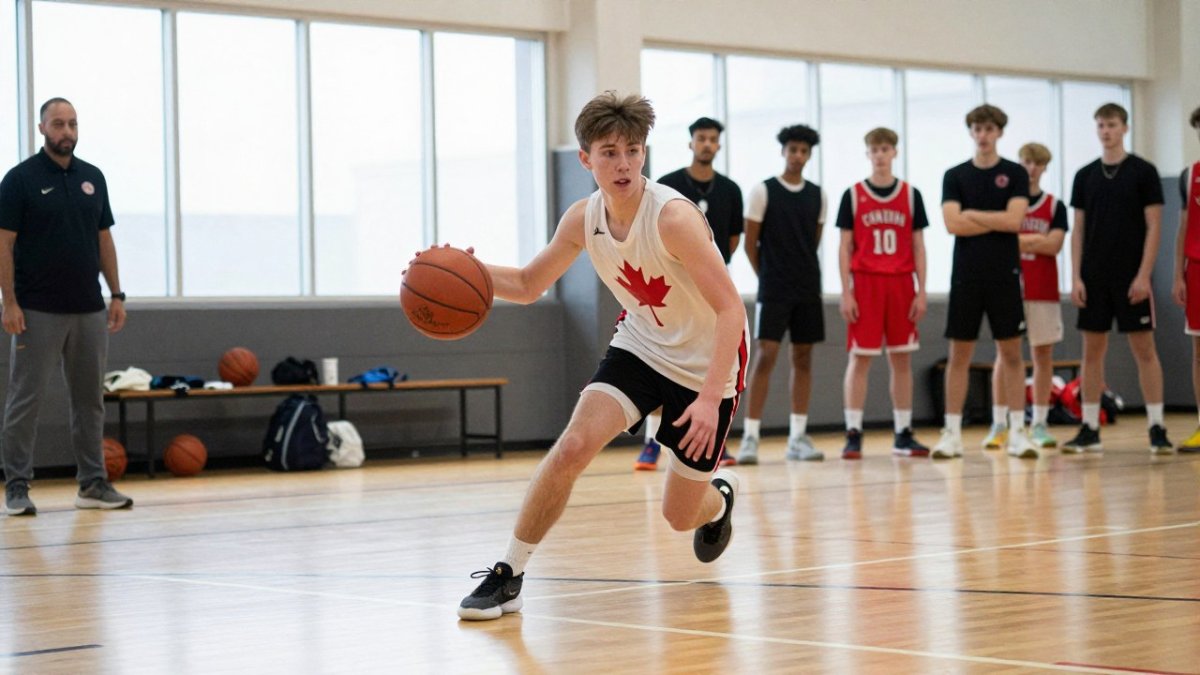
Build a short weekly circuit that hits every area evaluators test. Run it two to three times per week, and keep each drill to a fixed work-to-rest ratio so you adapt to tryout tempo:
- Ball handling: two-ball dribbling and change-of-direction moves at speed. Work 30 seconds on, 30 seconds rest, four sets. Cue: keep your eyes up and your dribble below the knee on change-of-direction moves.
- Shooting: catch-and-shoot reps from game spots, then off the dribble. Take 10 shots from five spots (corner, wing, top, wing, corner) and record makes. Then run five reps of one-dribble pull-ups from each wing.
- Defense: slide ladders, closeouts, and one-on-one stops. Do three sets of 10 slides each direction, then five closeouts where you sprint to the shooter and chop your feet. Cue: stay low, do not cross your feet, and contest without fouling.
- Conditioning: sprint intervals and full-court runs. Run 10 full-court sprints with 30 seconds rest between, then finish with three suicides. Track your times weekly.
Run each drill with a purpose and track one measurable per session, such as made shots or clean stops. Progress you can see builds confidence.
Watch out: practicing drills at half speed trains half-speed habits. If you cannot complete a drill at game pace with clean form, drop the rep count rather than slowing down.
Position-Specific Advice and Measurable Benchmarks
Every position rewards different habits, so tailor your prep to the role you want. Guards need ball handling, decision-making, and on-ball defense. Wings need shooting, closeouts, and the ability to finish in transition.
Here is how to translate each role into a weekly focus and a measurable target. Use these as self-assessment guides, not as official standards, since every program sets its own bar.
Guards
Prioritize ball handling under pressure, decision-making in pick-and-roll and transition, and on-ball defense. A practical weekly focus: two-ball dribbling at speed three times per week, 10 pick-and-roll read reps twice per week, and one-on-one defensive stops in every session. Track your assist-to-turnover ratio in scrimmages and your clean two-ball reps in 30 seconds.
Wings
Prioritize catch-and-shoot shooting, closeouts, and transition finishing. A practical weekly focus: 50 catch-and-shoot attempts from game spots three times per week, 10 closeout reps twice per week, and transition layup and pull-up reps in every session. Track your shooting percentage from five spots and your closeout contest rate.
Bigs
Prioritize rebounding, screening, and interior defense. A practical weekly focus: box-out and rebound reps three times per week, screen-and-roll reps twice per week, and verticality and help-defense reps in every session.
Set benchmarks you can actually measure before tryouts:
| Skill | Benchmark to Aim For | Why It Matters |
|---|---|---|
| Free throws | 7 or more makes out of 10 | Shows composure under pressure |
| Defensive slides | 10 clean reps per direction without crossing feet | Signals ready defense |
| Sprint intervals | Repeatable full-court times within 1 second across 10 reps | Proves conditioning |
| Catch-and-shoot | 6 or more makes out of 10 from game spots | Demonstrates reliable scoring |
| Ball handling | 20 or more clean two-ball reps in 30 seconds | Shows control under pressure |
Track these weekly. Numbers give you honest feedback and a confidence boost when you see them climb.
Watch out: chasing benchmarks outside your likely role wastes prep time. A post player who spends tryout season perfecting two-ball dribbling may neglect the rebounding and screening habits evaluators actually want in a big.
Managing Nerves and Responding to Mistakes
Nerves are normal, and mistakes are guaranteed. What evaluators notice is how fast you reset. A player who misses a shot and then sprints back on defense shows resilience; a player who sults and hangs their head shows the opposite.
A practical routine helps: take one slow breath before each drill, pick a single cue word like "next," and move on the moment a play ends. For more tools, our guide on how to build mental toughness for basketball players covers exercises you can practice before tryout day.
Watch out: dwelling on a single bad rep is the fastest way to lose a coach's attention. Evaluators are watching your response, not just your result.
Is Rep Basketball Worth It for Your Family?
Rep basketball may suit a player who wants a higher competitive level and more structured development. It's a bigger commitment in time and cost than recreational play, so families should weigh the schedule, travel, and fees against what the player wants from the game.
Rep programs generally offer competitive experience and more structured practices. The tradeoff is time. Our parent's guide to whether rep basketball is worth it digs into the full picture so you can decide with clear eyes.
What to Do If Your Child Is Cut
Being cut stings, but it isn't a verdict on talent. Treat it as feedback: ask the coach what to work on, write it down, and build the offseason around it. Many players use a cut season as fuel and come back noticeably stronger. Keep the focus on development and love of the game, and the next tryout becomes a chance to show the growth.
Getting Your Player Tryout-Ready at Tier 1 Sports
Preparation is the whole game, and it's easier with the right program behind your player.
If your player is aiming at rep tryouts, our prep for rep program is designed to get them ready through expert coaching and advanced drills.
The gap between wanting a roster spot and earning one comes down to preparation, effort, and the habits coaches can see.
Frequently Asked Questions
How do you prepare for elite basketball tryouts?
Start at least six weeks out. Build a conditioning base with sprinting and change-of-direction work, then sharpen ball handling, shooting, and defense at game speed. In the final weeks, simulate tryout conditions: scrimmage full court, play against older or stronger players, and practice performing under fatigue. Arrive early on tryout day, bring water and proper footwear, and warm up before check-in. Coaches notice preparation in how you move and how consistently you execute.
What skills should you practice before basketball tryouts?
Prioritize the skills coaches see in every drill: ball handling under pressure, finishing around the rim, catch-and-shoot shooting, defensive stance and slides, and accurate passing. Add rebounding and transition sprinting, since effort plays show up immediately in scrimmages. Basketball tryout drills that mirror game situations, like three-on-two breaks and closeout drills, help you look comfortable at game speed. Spend extra time on your weaker hand and on decisions, not just repetitions.
How important is defense at basketball tryouts?
Defense is often the fastest way to earn a roster spot. Coaches watch for stance, footwork, closeouts, help positioning, and transition defense because these habits signal coachability and team-first attitude. A player who communicates on defense and sprints back every possession stands out even without scoring. If your shot is off during a tryout, defense and hustle keep you visible. Make defense the part of your game you never take a possession off from.
How do you handle nerves during basketball tryouts?
Nerves are normal, so plan for them. Warm up thoroughly before the session, use a consistent pre-drill routine, and focus on the next action rather than the outcome. If you make a mistake, reset immediately: sprint back on defense or call for the ball on the next possession. Coaches expect errors; what they evaluate is your response. Deep breathing between drills and arriving early to get comfortable in the gym both help settle the first-ten-minutes rush.
Is rep basketball worth it for a young athlete?
Rep basketball suits players who want a higher competitive level, more practices, and stronger coaching, and families ready for the time and cost commitment. Before committing, ask about practice frequency, travel, total fees, and the coaching philosophy around mistakes and playing time. If your child thrives on challenge and wants to develop toward elite basketball team play, rep can be a strong fit. If they are still building confidence, a skill-development program can be the better bridge.