 Listicle
7 Indoor Basketball Games for Family Practice at Home
Last Updated: November 16, 2026
Quick Summary
Indoor basketball games for family practice turn a hallway, basement or cleared living room into a real training space at no cost. Run a 30-minute plan three times a week: a five-minute warm-up, ten minutes of skill games, ten minutes of a team game like Sharks and Minnows, and a five-minute cool-down.
- Clear roughly three metres of space in front of any hoop and use a soft foam or mini ball indoors.
- Adjust the ball, distance and scoring for mixed ages, never the effort.
- Ages 4-6 use a size 3 or soft foam ball; ages 7-10 use a size 5.
- Dribble Knockout needs three or more players and a two-metre square per player.
- Run the same 30-minute plan for two weeks, then swap one game.
Table of Contents
- Why Indoor Basketball Games Work for Family Practice
- Indoor Basketball Practice for Kids: Rules for Mixed Ages and Abilities
- Basketball Dribbling Games for Beginners
- Basketball Games for Kids Besides HORSE
- Family Basketball Drills at Home: No-Hoop and Low-Equipment Options
- Building a 30-Minute Family Practice Plan
- Choosing a Program That Builds on Home Practice
- Frequently Asked Questions
Why Indoor Basketball Games Work for Family Practice
Indoor basketball games for family practice turn a hallway, basement or cleared living room into a real training space, and they cost nothing but time.
Winter makes this matter more. Outdoor courts sit under snow for months, and a young player's touch on the ball fades fast without repetition.
Below, you will find indoor basketball games for family practice, with rules, player counts, scoring and age adjustments, along with safety checks and a 30-minute practice plan you can run tonight.
Setting Up a Safe Indoor Space
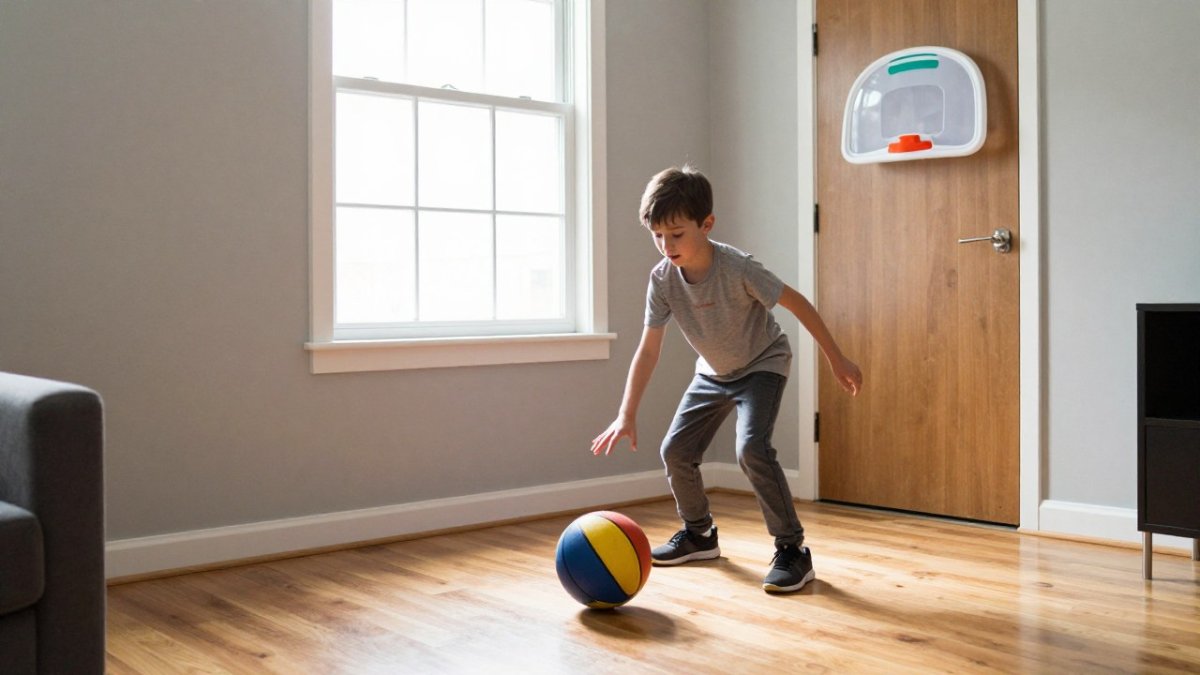
Clear the floor first. Push furniture to the walls, remove area rugs that slide, and check for table corners at knee height. A hard floor is fine; carpet slows the bounce but protects against slips.
You need roughly three metres of clear space in front of any hoop, real or makeshift. A soft foam or mini ball protects lamps, televisions and younger siblings. If you have a portable hoop, weigh the base down before anyone shoots.
Watch out: a lightweight portable hoop tips when a child hangs on the rim. Teach players to tap the rim and land, never grab it.
Indoor Basketball Practice for Kids: Rules for Mixed Ages and Abilities
Mixed-age practice works when the rules bend to the youngest player, not the oldest. Indoor basketball practice for kids falls apart when a nine-year-old dominates a five-year-old and the little one quits by week two.
A useful rule for mixed-age practice: adjust the ball, the distance and the scoring, never the effort. Here is how to level the floor with concrete handicaps a family can apply tonight.
Handicaps That Actually Equalize
A handicap only works if both players feel it is fair. Use one adjustment per matchup, not three, or the older player feels punished and stops trying.
- Ball size: ages 4-6 use a size 3 or a soft foam ball; ages 7-10 use a size 5; teens and adults use a size 7. A smaller ball in small hands produces cleaner dribbles and truer shots.
- Shooting distance: younger players shoot from a tape line one metre from the hoop; older players shoot from three metres or must use their weak hand inside that line.
- Scoring spots: in Around the World, give the youngest player three close spots and the oldest five spots around the key.
- Possession rule: the stronger player must complete two passes before shooting in any small-sided game. This slows the game down and forces the older player to involve the younger one.
Team Formats for Mixed Ages
Even teams beat handicap stacking. Two formats work reliably indoors:
- Balanced pairs: pair each younger player with an older player and play 2-on-2. The older player is the passer and screener; the younger player is the shooter. Rotate partners every five minutes.
- Handicap ladder: split into two teams, then assign each older player a personal restriction (weak hand only, no dribbling, shoot from farther out). The restrictions stay secret until tip-off, which keeps the game playful rather than punitive.
Give Every Player a Job
The youngest can be the scorekeeper, the shot-clock caller, or the referee for one game. That keeps them involved without forcing them into a physical mismatch, and it teaches the rules from the other side of the whistle.
Watch out: stacking every handicap on the oldest player in the room reads as punishment and kills effort. Spread restrictions across the older players and rotate them each session so no one carries the load every week.
A Quick Fairness Check
Before tip-off, ask each player one question: "Do you think this is fair?" If either side hesitates, remove one handicap. A game that feels fair gets played again tomorrow; a game that feels rigged gets abandoned by week three.
Basketball Dribbling Games for Beginners
Basketball dribbling games for beginners should feel like play, not a drill line. Ball control comes from touches, and touches come from fun. If a child laughs while dribbling, they will do it again tomorrow without being asked.
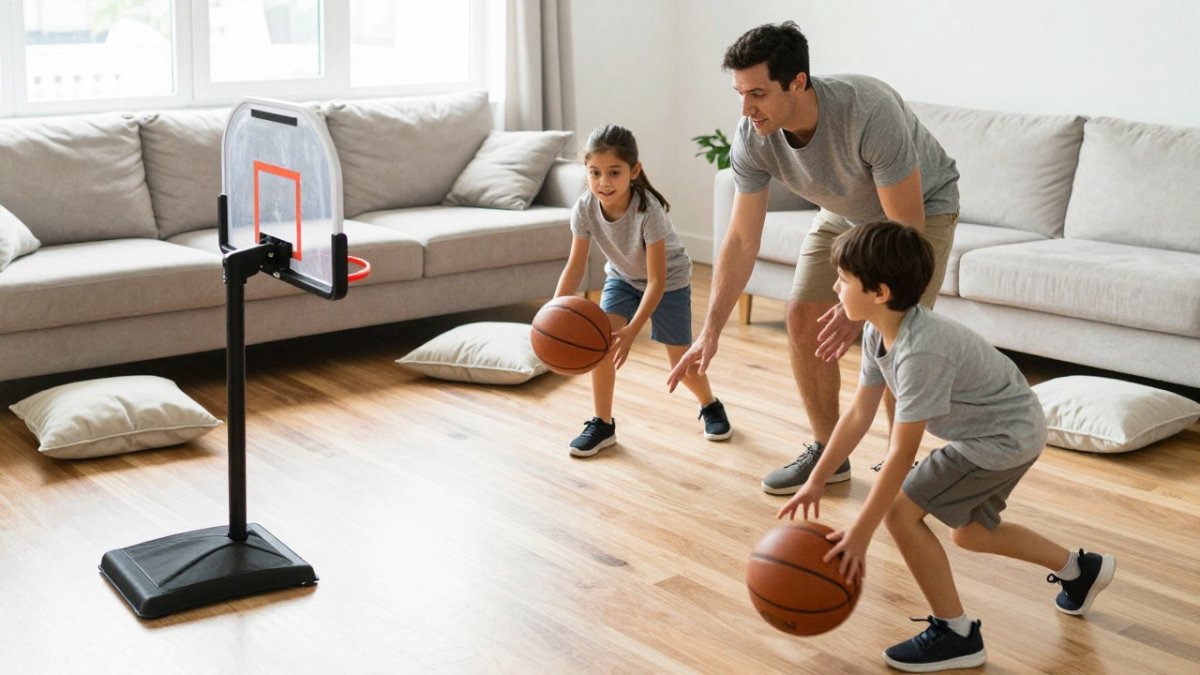
Dribble Knockout and Ball-Control Challenges
Dribble Knockout is the anchor game for any indoor session.
- Players: 3 or more
- Space: a two-metre square per player
- Scoring: last player dribbling wins the round
- Mixed ages: younger players get a larger safe zone
Add one-minute challenges for solo practice: count dribbles with the weak hand, then try to beat that personal best. Ball handling improves fastest when kids chase their own record.
For more structured ideas, our coaches point families to these indoor basketball training games for kids, which add seven drills that work in tight spaces.
Basketball Games for Kids Besides HORSE
Basketball games for kids besides HORSE keep practice fresh, because HORSE gets old by the third week. The classics still work: Knockout, Around the World, Sharks and Minnows, and Firing Squad all teach shooting, passing and movement without a single drill cone.
Sharks and Minnows is the family favorite. One player is the shark in the middle; the minnows dribble across the space. Tagged minnows become sharks. It builds ball control under pressure and needs no hoop at all.
Shooting and Passing Games for Small Groups
Around the World works with any hoop. Players shoot from marked spots around the key and move on when they score.
- Players: 2-6
- Setup: five spots marked with tape or shoes
- Scoring: first to complete the circuit wins
- Adjustment: younger players shoot from closer spots
Firing Squad splits players into two lines. The first shooter in each line races to score before the other. It teaches quick release and focus.
Families with five-year-olds often ask for simpler options. These fun basketball games for 5 year olds give seven easy ideas that need almost no equipment.
Family Basketball Drills at Home: No-Hoop and Low-Equipment Options
Family basketball drills at home do not require a hoop. Wall passes, form shooting with a rolled sock, and dribbling relays build real skill in a hallway, and they are the fallback when the portable hoop is folded away or the weather keeps everyone inside.
Here are five no-hoop games with setup, player count, scoring and a progression, so a family can run them without inventing rules on the spot.
1. Wall Passing Ladder
- Players: 1-4
- Setup: a solid wall, a metre of clear floor, tape a target square at chest height
- Play: chest-pass and catch 20 times, then bounce-pass 20 times, then one-hand pass 20 times with each hand
- Scoring: count consecutive clean catches; a drop resets the count
2. Sock Shot Arc Drill
- Players: 1-4
- Setup: roll a sock into a ball, tape a doorframe target at standing reach plus 30 centimetres
- Play: shoot 10 shots focusing on a high arc; the sock must hit the top half of the target
- Scoring: one point for a hit, two for a hit on the top edge
3. Dribble Relay Through Shoes
- Players: 2 or more
- Setup: place five shoes as cones in a line, one metre apart
- Play: weave through the shoes and back, switching hands at each shoe
- Scoring: first team to finish three clean runs wins; a knocked shoe adds two seconds
4. Household Target Shooting
- Players: 1-4
- Setup: a laundry basket on a chair, a bucket on the floor, and a cushion as a backboard
- Play: assign each target a point value (bucket 1, basket 2, cushion bank shot 3) and take 10 shots
- Scoring: highest total after 10 shots wins
5. Dribble Tag in a Small Square
- Players: 3 or more
- Setup: tape a two-metre square per player on a hard floor
- Play: every player dribbles inside their own square; on the call, players try to knock a neighbour's ball away while keeping their own alive
- Scoring: last player still dribbling wins the round
For a fuller set of beginner drills that need only a ball and a small space, this guide to essential basketball drills for beginners at home covers footwork, finishing and ball handling.
Watch out: a rolled sock shot at a doorframe can knock picture frames off the wall. Clear the wall above and beside the target before the first shot, and use a soft foam ball if the room has glass or a television in the firing line.
Building a 30-Minute Family Practice Plan
A 30-minute plan beats a 90-minute plan that never happens. Short, repeatable sessions build the habit, and the habit builds the skill.
Here is the structure we recommend to families:
- Warm-up (5 minutes): jogging in place, arm circles, light dribbling
- Skill block (10 minutes): one dribbling game and one shooting game
- Team game (10 minutes): Sharks and Minnows or Dribble Knockout
- Cool-down (5 minutes): free shooting and personal-best challenge
Run the same plan for two weeks, then swap one game. Track personal bests on a sheet on the fridge. Progress players can see keeps them coming back.
Here is the 30-minute structure the article recommends for families.
| Block | Time | What to do |
|---|---|---|
| Warm-up | 5 minutes | Jogging in place, arm circles, light dribbling |
| Skill block | 10 minutes | One dribbling game and one shooting game |
| Team game | 10 minutes | Sharks and Minnows or Dribble Knockout |
| Cool-down | 5 minutes | Free shooting and personal-best challenge |
Time
Choosing a Program That Builds on Home Practice
Home practice builds the habit; coached practice builds the technique. Once a child is dribbling daily and asking for more, a structured program adds the instruction and competition that a living room cannot.
At Tier 1 Sports, our Skills and Drills program is built for exactly that moment. Parents comparing options can browse all available programs, from introductory sessions for ages 4 to 6 through developmental leagues and competitive rep basketball for older athletes.
Every program is generously sponsored by Real Estate Broker David Robbio.
The gap between a child who plays once a week and one who plays daily shows up fast on the court.
Frequently Asked Questions
What equipment do you need for indoor basketball games?
A junior-size basketball for younger kids and a regulation ball for older players cover most games. Add a portable hoop or an over-the-door mini hoop if you have one, plus painter's tape for floor lines and a few cones or water bottles as markers. Many indoor basketball games need no hoop at all, which helps on rainy days or in tight spaces. Clear breakables first and check that the ceiling height allows safe shooting.
How long should a family basketball practice last?
Aim for 20 to 30 minutes for kids aged 4 to 6 and 30 to 45 minutes for ages 7 to 10. Break the session into short blocks: a warm-up, two or three games, and a cool-down. Young attention spans fade fast, so switch activities every five to seven minutes. Ending on a game the kids enjoy keeps them asking to play again, which matters more than total minutes.
How can you adapt indoor basketball games for different ages and skill levels?
Change one variable at a time: lower the hoop, shorten the shooting distance, use a smaller ball, or give younger players a head start. In dribbling games, older kids can dribble with their weaker hand while beginners use both freely. Pair an older child with a younger one in passing drills so each has a role. These adjustments keep indoor basketball games fair and fun for everyone in the family.
What skills can family basketball games help develop?
Games build ball handling, shooting accuracy, passing, coordination, and agility without feeling like drills. Dribbling games sharpen ball control, target games improve shooting form, and passing games teach teamwork and communication. Short challenges, like a one-minute dribble count, also build focus and let kids track a personal best. For kids who want more structure, a skill-development program can build on what they practice at home.