 listicle
7 Essential Basketball Skills for 10 Year Olds
Table of Contents
- Why the Age of 10 Is a Critical Window for Basketball Skill Development
- 1. Ball Handling and Dribbling Mechanics
- 2. Shooting Form and Finishing Around the Rim
- 3. Passing Accuracy and Receiving Techniques
- 4. Defensive Stance, Footwork, and Body Control
- 5. Rebounding, Positioning, and Court Awareness
- 6. Building a Youth Basketball Practice Plan at Home
- 7. Mental Toughness, Sportsmanship, and Basketball IQ
- Frequently Asked Questions
Last Updated: September 11, 2026
Why the Age of 10 Is a Critical Window for Basketball Skill Development
The seven essential basketball skills for 10 year olds are ball handling, shooting form, passing accuracy, defensive footwork, rebounding, court awareness, and mental toughness, and this guide covers the basketball skills for 10 year olds that matter most. Age 10 sits inside what youth coaches call the "Golden Window" of motor skill development, when the brain builds movement patterns faster than at almost any other stage of childhood. This guide breaks down each skill, why it matters at this exact age, and how to practice it at home. Get these fundamentals right now, and every season that follows gets easier.
Fundamental movement skills are the foundation. Balance, coordination, agility, and body control developed at 10 carry into every sport a child plays for the rest of their life. Skip them, and advanced skills collapse under pressure later.
1. Ball Handling and Dribbling Mechanics
Ball handling is the first skill to build because every other skill depends on it. A player who cannot control the ball while moving cannot shoot, pass, or drive with confidence.
Start with the triple threat position: ball at the hip, elbows out, knees bent. From there, practice the pivot, keeping one foot planted while the other moves in any direction. Court awareness starts here, not with advanced plays.
Two-Ball Dribbling and Control Drills
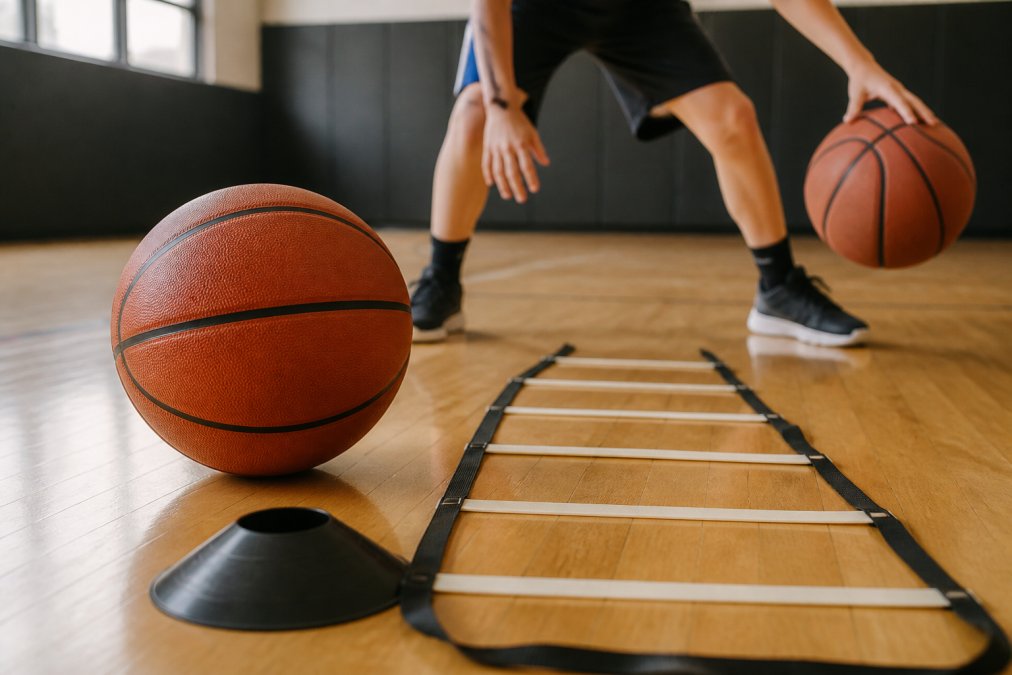
Two-ball dribbling is the fastest way to build coordination and hand independence. Have your child dribble both balls at waist height, then alternate heights, then alternate hands. Ten minutes a day builds real control. For more structured progressions, USA Basketball's foundational skills drills offer age-appropriate progressions that parents can run at home.
- Stationary two-ball dribble: 30 seconds
- Alternate-hand two-ball dribble: 30 seconds
- Walking two-ball dribble: 30 seconds
- Crossovers with one ball: 1 minute each hand
2. Shooting Form and Finishing Around the Rim
Shooting form is the skill most 10 year olds get wrong, and it is the hardest to fix later. At this age, players are strong enough to shoot from five to eight feet but not yet strong enough to shoot consistently from the three-point line (usab.com). That is why many youth programs keep 10-year-olds close to the basket and builds range slowly over the next two to three seasons.
The key is the BEEF framework: Balance, Eyes on the rim, Elbow under the ball, Follow-through. Walk through each piece with your child:
- Balance: Feet shoulder-width apart, shooting foot slightly forward, weight even.
- Eyes: Eyes locked on the rim before the ball leaves the hands, not on the ball.
- Elbow: Shooting elbow tucked directly under the ball, not flared out to the side.
- Follow-through: Wrist snaps down, hand finishes in the basket, hold the pose for a full second.
Start every shooting session within three feet of the basket. Distance comes later. A 10-year-old who makes 20 close shots with clean form is building more than one who chucks 20 long shots with a hitch.
Form Shooting Progression
Run this sequence in order. Do not move to the next step until the previous one looks repeatable:
- One-hand form shooting. Shooting hand only, ball starts at the hip, finish with a held follow-through. Ten makes from each side of the block.
- Two-hand form shooting. Guide hand joins, same distance, same finish. Ten makes.
- Step-in shots. One dribble into the shot, footwork clean. Ten makes.
- Game-speed catch-and-shoot. Partner passes, player catches in triple threat, shoots. Ten makes.
Mikan Drill and Layup Progression
The Mikan drill teaches touch around the rim. Stand under the basket, shoot right-handed, catch, shoot left-handed, and repeat. Thirty makes is a good target for a 10 year old. Keep the ball above the shoulders the whole time and use the backboard on every shot.
Layup progression follows four steps:
- Right foot, left foot, shoot right-handed. No dribble, no defense. Walk through the footwork first.
- Reverse layup. Same footwork on the other side of the rim.
- Add a dribble. One dribble into the layup from the wing.
- Add a defender. A parent or partner contests without fouling.
Common Shooting Mistakes to Correct Early
- The slingshot. Kids who are not strong enough to shoot properly push the ball from the chest. Fix it by moving closer and reinforcing the elbow-under-the-ball cue.
- The guide hand flick. The non-shooting hand should guide, not push. Watch for a thumb flick that sends the ball sideways.
- Landing off-balance. A shooter who lands sideways or backward is not balanced at the start. Reset the feet.
- Shooting flat. A flat shot has no arc and no chance. Aim for a shot that enters the rim at roughly a 45-degree angle.
3. Passing Accuracy and Receiving Techniques
Passing accuracy is the skill that makes teammates better, and it is the most under-coached skill at this age. The chest pass and bounce pass are the two foundations. A chest pass travels fast and straight; a bounce pass beats a defender's arms.
Receiving technique matters just as much. Teach players to meet the ball with two hands, form a target, and pivot into triple threat position on the catch. Ten minutes of partner passing per session builds both.
4. Defensive Stance, Footwork, and Body Control
Defensive stance is where footwork and body control come together. Feet wider than shoulders, knees bent, weight on the balls of the feet, one hand up and one hand low. From this stance, players learn to slide without crossing their feet. athletic gear for kids.
Agility drills like the lane slide and the zigzag slide build the balance and coordination that defense demands. Ten year olds who learn to move their feet early become the players coaches trust in close games.
5. Rebounding, Positioning, and Court Awareness
Rebounding is positioning first and jumping second. Teach players to find their opponent, make contact, then go get the ball with two hands. Court awareness grows from there: knowing where the ball is, where teammates are, and where the next pass should go.
Spacing is the visible result of court awareness. A team that spreads the floor properly creates open shots without running a single set play.
6. Building a Youth Basketball Practice Plan at Home
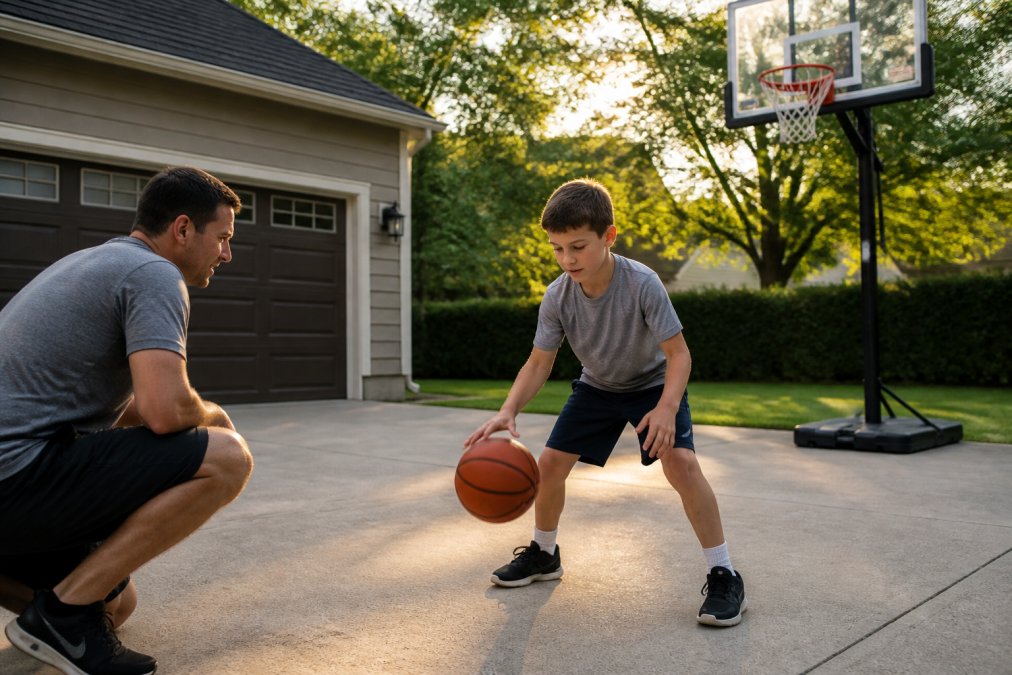
A youth basketball practice plan does not need a full court, a coach, or expensive equipment. Twenty to thirty minutes, four days a week, in a driveway or garage is enough to build real skill. The key is structure: warm up, work one skill, finish with a game.
Most parents searching for these skills are working with a driveway hoop, a park with no lines, or a garage with a concrete floor. That is fine. The drills below are built for those spaces.
The Weekly Plan
| Day | Focus | Time | Drill |
|---|---|---|---|
| Monday | Ball handling | 20 min | Two-ball dribbling, crossovers |
| Wednesday | Shooting | 25 min | Form shooting, Mikan drill |
| Friday | Footwork | 20 min | Defensive slides, pivots |
| Sunday | Mixed | 30 min | Passing, layups, free play |
No-Court and No-Hoop Variations
When you have no hoop, no partner, or no space, the session still works. Swap in these:
- No hoop: Form shooting against a wall. Same BEEF cues, same follow-through, ball bounces back. Twenty reps per hand.
- No partner: Wall passing. Chest pass, bounce pass, one-hand pass, catch, pivot. Two minutes per pass type.
- No space: Stationary ball handling. Figure-eights around the legs, crossovers, behind-the-back, between-the-legs. Ten minutes builds real control.
- Small space: Defensive slide drills in a hallway or garage. Five slides right, five left, repeat.
- Driveway with hoop: Mikan drill, form shooting, layup progression. All three fit in a 20-minute window.
How to Keep Practice Fresh
Rotate the focus every session. A 10-year-old who does the same drill four days in a row will lose interest by day three. Keep a list of eight to ten drills and cycle through them so no single one appears twice in the same week.
This is long-term athlete development in practice: consistent, low-pressure repetition beats occasional intense sessions. For more on how to improve basketball dribbling for kids, Basketball for Coaches' youth drill database organizes drills by category so parents can rotate activities and keep practice fresh.
7. Mental Toughness, Sportsmanship, and Basketball IQ
Mental toughness at 10 does not mean aggression. It means bouncing back after a missed shot, encouraging a teammate after a turnover, and playing hard when the score is not going your way. Basketball IQ is the ability to read the game: when to pass, when to shoot, when to slow down.
Sportsmanship is coached, not caught. Praise effort over outcome, correct mistakes calmly, and model the behavior you want to see. Players who learn this at 10 become the teammates every coach wants at 16.
Frequently Asked Questions
What are the 7 basic skills in basketball for 10-year-olds?
The seven essential basketball skills for 10 year olds are ball handling and dribbling, shooting form, passing accuracy, defensive stance and footwork, rebounding and positioning, layup finishing, and court awareness. At this age, players should also develop fundamental movement skills like balance, coordination, and agility. These skills form the foundation for more advanced play as they grow. A structured youth basketball practice plan that touches on all seven each week gives players the best chance to improve steadily.
How many hours per week should a 10-year-old practice basketball?
Most youth sports organizations suggest two to three sessions per week, each lasting 45 to 60 minutes. That works out to roughly two to three hours weekly. At 10, variety matters more than volume. Players who also run, swim, or play other sports develop better overall coordination and agility. Short, focused practices that cover ball handling, shooting, and footwork are more valuable than long sessions that lead to fatigue and poor habits.
How do you improve basketball dribbling for kids at home?
Start with stationary two-ball dribbling drills in a driveway or garage. Ten minutes of alternating hand dribbles, figure eights, and crossover repetitions builds muscle memory fast. Once comfortable, add movement by walking while dribbling. Use a smaller ball if a regulation one feels too large. Consistency beats duration. Five short sessions per week will improve ball handling more than one long weekend session. These drills require minimal equipment and no full court.
What is long-term athlete development and why does it matter for basketball?
Long-term athlete development is a framework that matches training to a child's stage of physical growth. Around age 10, kids are in a phase where coordination and motor skills respond quickly to practice. Teaching proper shooting form, defensive stance, and footwork now prevents bad habits later. Programs that follow this approach focus on skill development over winning, which keeps kids engaged and builds confidence. This foundation supports both recreational play and competitive pathways as athletes mature.
What common mistakes should parents and coaches avoid with 10-year-old basketball players?
Two mistakes stand out. First, overloading practices with conditioning drills instead of skill work. At 10, kids need touches on the ball, not laps. Second, emphasizing winning over learning. Players who fear mistakes stop taking risks and stop improving. Keep practices game-based and fun. Rotate through dribbling, passing, shooting, and defensive drills so no single skill dominates. Praise effort and decision-making, not just results. This approach builds confidence and keeps players coming back.
Building these seven skills takes patience, consistency, and the right environment. Tier 1 Sports runs programs tailored for specific age groups from 4 to 16, with a focus on both skill development and a lifelong passion for the game. Our recreational and rep basketball pathways give every player, whether just starting or chasing a competitive spot, a clear route forward. Get started with Tier 1 Sports and watch your child realize their individual potential on and off the court.