 listicle
8 Ways to Prepare for Youth Basketball Season
Table of Contents
- 1. Establish a Pre-Season Warm-Up and Stretching Routine
- 2. Build Ball-Handling Skills Through Dribbling and Footwork Drills
- 3. Develop Youth Basketball Conditioning Drills for Game Readiness
- 4. Master Shooting Mechanics and Form Before Season Starts
- 5. Use a Youth Basketball Practice Plan Template to Structure Sessions
- 6. Implement Basketball Tryout Preparation Tips for Competitive Players
- 7. Create an Equipment and Logistics Checklist
- 8. Prepare Mentally and Teach Sportsmanship Values
- Frequently Asked Questions
Last Updated: October 1, 2026
There are 8 ways to prepare for youth basketball season, and they require more than just showing up to the first practice. The window between now and opening tip-off is when foundational habits form, confidence builds, and skills solidify. The difference between teams that prepare strategically and those that wing it often shows immediately in game performance.
This guide covers 8 ways to prepare for youth basketball season that work across age groups and skill levels. Whether you're coaching beginners or competitive rep players, these preparation methods address the physical, mental, and logistical sides of getting ready. Below, you'll find ideas on how to structure warm-ups, build conditioning, organize tryouts, and create the conditions where young athletes can grow.
1. Establish a Pre-Season Warm-Up and Stretching Routine
A proper warm-up routine primes the body for basketball-specific movement and reduces injury risk. Most youth coaches skip this or rush through it, which costs time and safety later in the season.
The ideal warm-up takes 10-15 minutes and includes three phases: general cardio, dynamic stretching, and basketball-specific activation. Start with 2-3 minutes of light jogging or jumping jacks to elevate heart rate. Follow with dynamic stretches that move through a full range of motion: leg swings, walking lunges, arm circles, and torso rotations. Finish with basketball-specific movements: lateral shuffles, forward and backward sprints, and footwork drills that mimic game patterns.
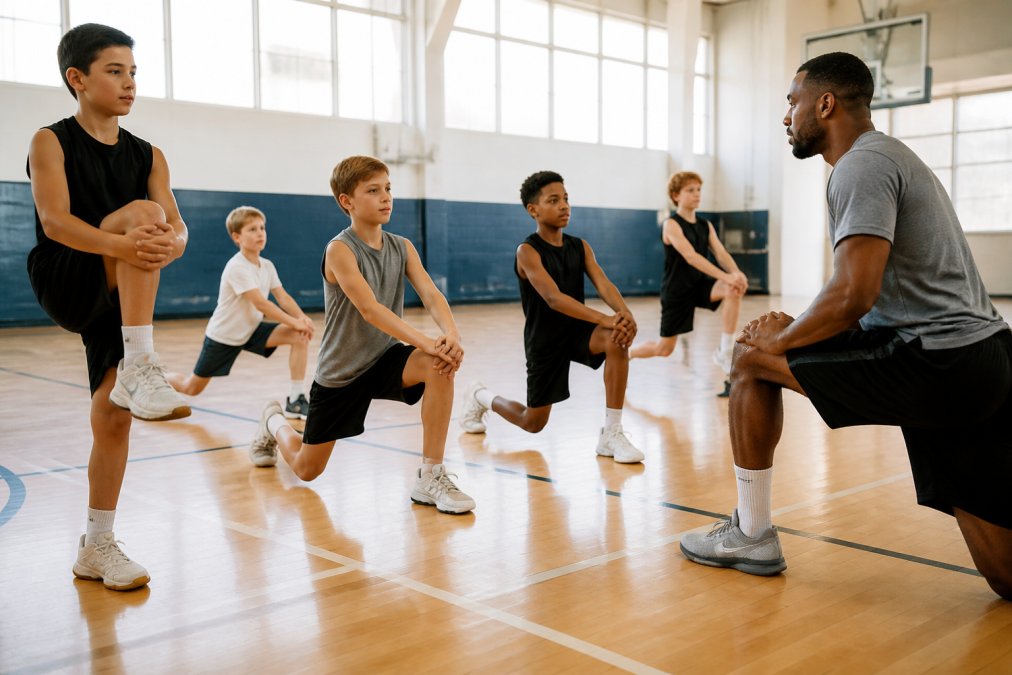
Static stretching (holding a stretch) belongs at the end of practice, not the beginning. Save it for cool-down when muscles are warm and pliable. A consistent warm-up routine signals to players that practice is serious, builds team cohesion, and creates muscle memory that carries into games.
2. Build Ball-Handling Skills Through Dribbling and Footwork Drills
Ball-handling separates confident players from tentative ones. Young players who can't dribble without looking down will struggle under defensive pressure and miss scoring opportunities.
Dribbling drills should progress from stationary to moving to game-speed. Start with two-ball dribbling: players hold a basketball in each hand and bounce them simultaneously. This builds coordination and teaches rhythm. Progress to figure-eight dribbling around the legs, crossover dribbles, and behind-the-back dribbling. Footwork drills, jump stops, pivot steps, and explosive first steps, teach body control that translates directly to offensive moves.
Dedicate 8-10 minutes per practice to ball-handling work. The repetition compounds over weeks. Players who spend pre-season developing these fundamentals will execute more efficiently when defensive pressure increases in games.
A common mistake is treating ball-handling as a drill to "get through" rather than a skill that requires focus. Demand that players keep their eyes up while dribbling, even during stationary drills. This habit prevents the tunnel vision that leads to turnovers.
| Drill |
|---|
| Two-Ball Dribbling |
| Figure-Eight Dribbling |
| Crossover Dribble Walks |
| Game-Speed Dribble Moves |
| Duration |
|---|
| 2 minutes |
| 2 minutes |
| 2 minutes |
| 3-4 minutes |
| Focus |
|---|
| Coordination |
| Control |
| Footwork |
| Application |
| Best For |
|---|
| All ages |
| Ages 7+ |
| Ages 9+ |
| Ages 11+ |
3. Develop Youth Basketball Conditioning Drills for Game Readiness
Basketball conditioning isn't just about running laps. Game-specific conditioning builds the aerobic base and explosive power that players need to execute in the fourth quarter when fatigue sets in.
Youth basketball conditioning drills should mimic game intensity: short bursts of high-speed movement followed by brief recovery. Suicide drills (sprinting to baseline, halfcourt, opposite baseline, and back) teach court coverage and build leg strength. Transition drills that combine defensive positioning with sprinting to the other end replicate actual game flow. Agility ladder work improves footwork and change-of-direction speed.
The key is progressive overload. In early pre-season, keep intensity moderate and focus on movement quality. As the season approaches, increase speed and add defensive pressure. This progression reduces injury risk while building the conditioning base that peaks at the start of the season.
4. Master Shooting Mechanics and Form Before Season Starts
Shooting form is a habit. Players who develop poor mechanics early will struggle to correct them later. Pre-season is the ideal time to establish proper form before bad habits calcify.
Shooting mechanics follow a consistent sequence: feet shoulder-width apart, knees bent, elbow under the ball, release at the peak of the jump, and follow-through with a "cookie jar" hand position. Beginners should start with form shooting close to the basket (1.5-2 meters) without defenders. Progress to mid-range shooting, then three-point range as form improves.
A structured shooting progression keeps players engaged and tracks improvement. Shooting drills should include spot shooting (shooting from set locations), catch-and-shoot (receiving a pass and shooting immediately), and game-speed shooting (shooting after dribble moves). Reviewing shooting form (for example, by watching it on video) can help players see their mechanics and understand corrections.
What most guides miss is the mental side of shooting. Players who miss early in practice often lose confidence. Frame shooting drills as skill-building, not performance evaluation. Celebrate effort and form, not just makes.
5. Use a Youth Basketball Practice Plan Template to Structure Sessions
Structure separates effective practices from chaotic ones. A youth basketball practice plan template organizes the session into time blocks, assigns drills to each block, and ensures you hit all skill areas without wasting time.
A typical 60-minute practice follows this structure:
- Warm-up and stretching: 10 minutes
- Ball-handling and footwork drills: 10 minutes
- Shooting and offensive skill work: 15 minutes
- Defensive fundamentals: 10 minutes
- Scrimmage or game-centered activity: 12 minutes
- Cool-down and sportsmanship debrief: 3 minutes
This template ensures balance between skill work and game application. Young players need both repetition of fundamentals and the chance to apply skills in game-like scenarios. A session that's all drills feels disconnected from actual basketball. A session that's all scrimmage doesn't build the skills needed to compete.
Adjust time blocks based on age. Younger players (4-6) need shorter practices with more variety and game-like activities. Older players (13-16) can handle longer skill-work blocks and more complex tactical concepts.
6. Implement Basketball Tryout Preparation Tips for Competitive Players
For players pursuing rep basketball, tryout preparation differs from recreational skill-building. Competitive players need to understand what coaches evaluate and practice under game-like conditions.
Coaches assess basketball IQ, effort level, coachability, and specific skill execution. Before tryouts, teach players to anticipate defensive pressure, make quick decisions, and communicate on court.
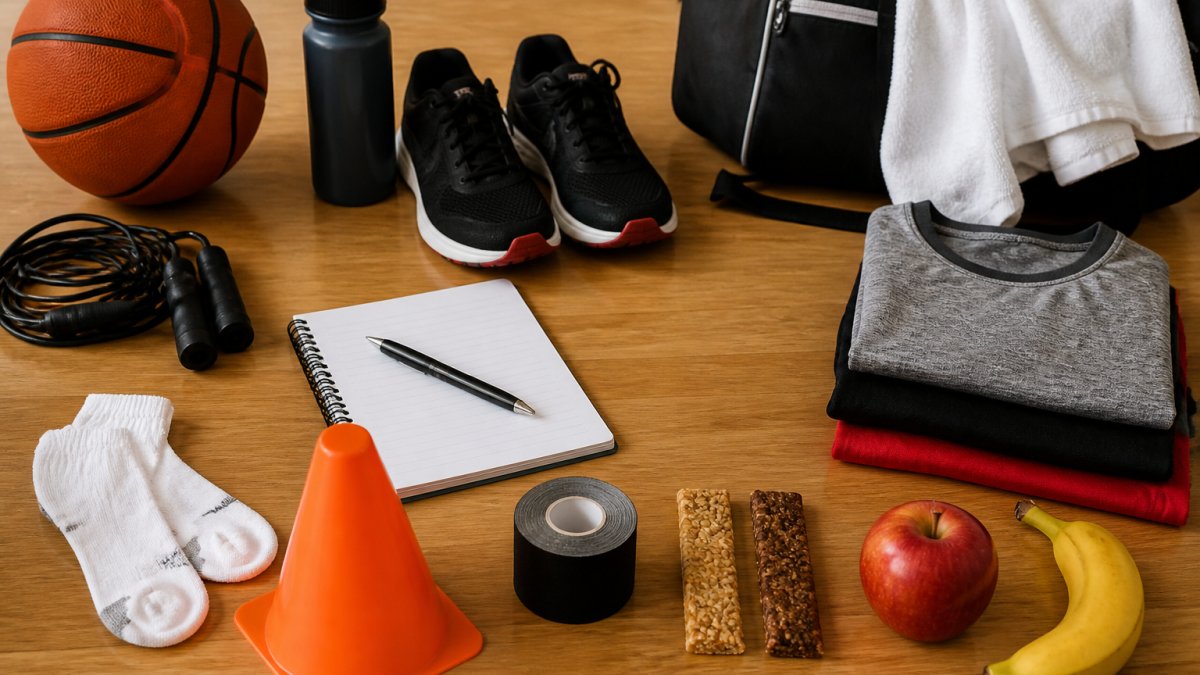
7. Create an Equipment and Logistics Checklist
The logistical side of pre-season preparation often gets overlooked, but it determines whether practice runs smoothly or falls apart. An equipment and logistics checklist ensures nothing is forgotten.
| Item |
|---|
| Basketballs |
| Cones |
| Air Pump |
| First-Aid Kit |
| Practice Pinnies |
| Quantity |
|---|
| 8-10 |
| 20+ |
| 2 |
| 1 |
| 20 |
| Status |
|---|
| ✓ |
| ✓ |
| ✓ |
| ✓ |
| ✓ |
| Assigned To |
|---|
| Coach |
| Assistant |
| Equipment Manager |
| Coach |
| Assistant |
8. Prepare Mentally and Teach Sportsmanship Values
The mental side of basketball separates good players from great ones. Pre-season is when you establish the culture and values that define your team.
Frequently Asked Questions
How can I prepare my child for basketball tryouts?
Start by building fundamental skills: ball handling, shooting form, and defensive footwork. Practice conditioning drills at least three times weekly to build endurance. Work on game-speed decision-making through scrimmages. Mentally prepare your child by discussing what to expect, emphasizing effort over perfection, and practicing positive self-talk. Ensure proper nutrition and sleep in the weeks leading up to tryouts. Most importantly, focus on skill development rather than making the team; this builds confidence and resilience.
What should a youth basketball practice plan template include?
A solid template covers warm-up (5-10 minutes), skill-specific drills (15-20 minutes), team concepts and tactical work (15-20 minutes), game simulation or scrimmage time (10-15 minutes), and cool-down with stretching (5 minutes). Include clear time blocks, specific drill progressions matched to your players' age and skill level, and a balance between individual skill work and team play. Adjust duration based on age: younger players (4-6 years) need shorter, more playful sessions, while competitive youth (11-16) benefit from 60-90 minute structured practices.
What is the best age to start competitive basketball?
Recreational basketball can start as early as age 4-5 with basic coordination and fun-focused activities. Competitive rep basketball typically begins around age 11-12 when players have developed fundamental skills, better decision-making, and the maturity to handle tryout environments. However, the 'golden window' for motor skill development runs from ages 7-10, making this the ideal period to focus on intensive skill development and athletic foundation-building. Starting earlier with fundamentals creates a stronger base for competitive play later.
How do I improve my child's basketball skills at home?
Focus on ball-handling drills: dribbling stationary, dribbling while moving, and two-ball dribbling exercises. Set up a shooting station if you have a hoop, practicing form shooting from close range before moving back. Work on footwork drills like jump stops, pivots, and lateral movement. Use a wall for passing drills to improve accuracy and catch technique. Keep sessions short (20-30 minutes) and fun, especially for younger players. Consistency matters more than intensity; three 20-minute sessions weekly beats one long, exhausting session.
How do I help my child build confidence for the basketball season?
Build confidence through progressive skill mastery: start with achievable drills and celebrate small improvements. Provide honest, specific feedback ('great footwork on that jump stop') rather than generic praise. Expose your child to game situations gradually, start with one-on-one play, then small-sided games, then full-court scenarios. Discuss mistakes as learning opportunities, not failures. Ensure they feel part of a supportive community, like a program that emphasizes development over winning. Consistent practice and visible progress are the strongest confidence builders.