 ultimate-guide
Basketball Benefits for Young Children: A Complete Guide
Table of Contents
- Why Basketball Matters for Young Children
- Physical Health Benefits: From Cardiovascular Endurance to Bone Density
- Motor Skills and Coordination Development Through Basketball
- The Youth Basketball Golden Window Explained
- Basketball Drills for 5-Year-Olds: Building Foundations Early
- Social, Emotional, and Cognitive Growth on the Court
- Long-Term Athlete Development Model: Pathways From Age 4 to 16
- Getting Started: Finding the Right Program for Your Child
- Frequently Asked Questions
Last Updated: August 31, 2026
Why Basketball Matters for Young Children
Basketball builds foundational skills that shape how kids move, think, and interact with peers during critical developmental years. At Tier 1 Sports, we are dedicated to fueling a lifelong passion for the game, offering everything from engaging introductory sessions for beginners to competitive rep basketball, all designed to develop essential skills in a supportive environment.
The window between ages 4 and 10 is particularly important. During this period, young brains wire neural pathways for motor coordination, decision-making, and emotional regulation at a pace that won't happen again (peer-reviewed research). Basketball accelerates this development because it demands all three simultaneously: a child must dribble (coordination), read the court (decision-making), and manage frustration when they miss a shot (emotional regulation), often within the same 30-second sequence. Many parents notice their children become more coordinated, focused, and socially confident within weeks of starting basketball.
Physical Health Benefits: From Cardiovascular Endurance to Bone Density
Basketball demands continuous aerobic movement, building cardiovascular endurance naturally and strengthening the heart without the monotony of running laps. The weight-bearing nature of basketball is equally important for growing bodies. Every jump, lateral movement, and step triggers bone density development (the NIH). Children who engage in regular weight-bearing exercise during their growth years build stronger skeletal systems that protect them from injury throughout life.
Basketball also develops functional strength across the entire body. Shooting requires arm and core strength. Defensive positioning demands leg strength. Jumping builds explosive power in the calves and quadriceps. A typical basketball practice burns significant energy, establishing healthy metabolic patterns early. Children who develop a habit of regular physical activity tend to maintain that habit as adults, reducing the risk of obesity and related health conditions.
Motor Skills and Coordination Development Through Basketball
Motor coordination is the foundation for every physical skill a child will learn. Basketball accelerates this development because it requires kids to coordinate their eyes, hands, and feet simultaneously while moving through space. Dribbling while running demands hand-eye coordination. Catching a pass requires spatial awareness. Shooting combines fine motor control with gross motor movement.
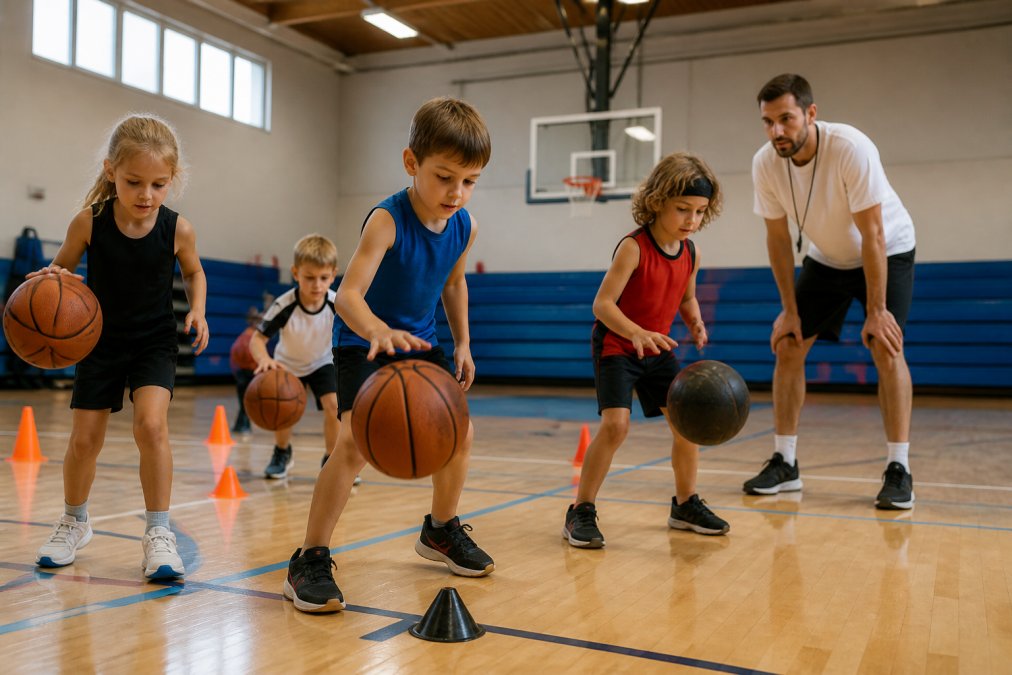
When a child practices the same shot 50 times, they're building neural pathways that make complex physical movements automatic. This neuromuscular adaptation is fastest during early childhood. Balance and agility develop naturally through basketball gameplay, transferring directly to injury prevention. A child with good balance and agility is less likely to fall or get hurt during everyday activities.
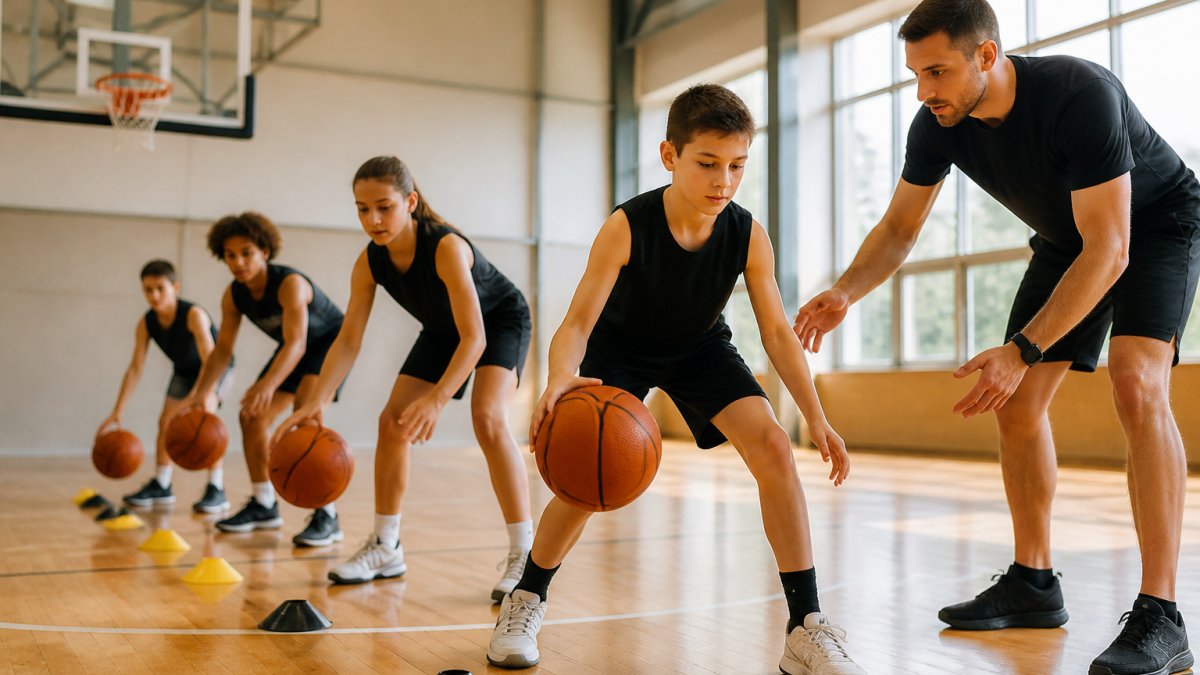
A five-year-old should focus on basic ball-handling: dribbling in straight lines, catching stationary passes, shooting at a lower hoop. By age seven or eight, kids can handle more complex footwork and multi-directional movement. By age ten, they're ready for genuine game situations with defensive pressure. This progression ensures motor skills develop in the right sequence, building confidence at each stage.
The Youth Basketball Golden Window Explained
The "golden window" refers to the period when children's brains are most receptive to motor skill development, opening around age 4 and remaining wide open through age 10. During these years, children's nervous systems develop at their fastest rate, making it ideal to introduce complex motor skills like basketball.
A skill learned during the golden window becomes automatic and deeply ingrained. A child who learns proper shooting form at age 7 will maintain that form for life, even if they stop playing for years. After age 10, the window narrows. Teenagers can still learn basketball skills, but it takes more repetition and effort. The advantage of starting early is that fundamental skills become second nature, freeing mental energy for strategy and game intelligence later.
This is why programs like those at Tier 1 Sports emphasize age-appropriate skill development. A four-year-old isn't ready for complex defensive concepts, but they're perfect for learning basic dribbling and hand-eye coordination. By age eight, that same child can handle tactical decision-making. The golden window also applies to social and emotional learning. Children who play team sports during these years develop communication skills, resilience, and self-discipline that become part of their personality.
Basketball Drills for 5-Year-Olds: Building Foundations Early
Five-year-olds are just beginning to understand rules, follow instructions, and coordinate their bodies in space. Basketball drills at this age should be simple, fun, and focused on basic ball-handling and fundamental movement patterns.
The dribble-walk drill is foundational. Kids walk forward while bouncing a ball, learning to keep their eyes up and maintain control. This teaches hand-eye coordination and spatial awareness simultaneously. Catch and pass drills introduce kids to receiving and releasing the ball. Stand a few feet away and roll the ball to your child, who catches it and rolls it back. Progress to gentle tosses that require catching.
Shooting at a lower hoop (six or seven feet) is crucial. A regulation ten-foot hoop is completely inaccessible to five-year-olds, creating frustration. A lower hoop allows them to experience the satisfaction of making shots, building confidence and motivation. Games like knockout or around-the-world (shooting from different spots around the hoop) keep five-year-olds engaged while building shooting consistency.
Social, Emotional, and Cognitive Growth on the Court
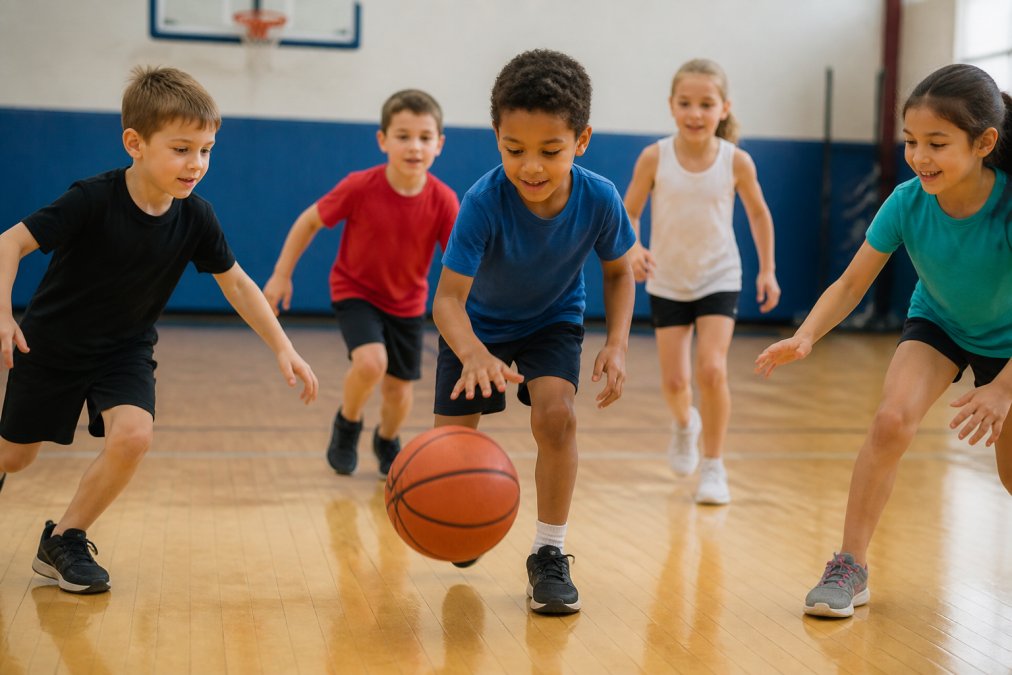
Basketball is fundamentally a team sport, creating a powerful environment for social development. Kids learn to communicate with teammates, read their body language, and adjust their play based on what others are doing. These peer communication skills develop through repeated interaction in structured settings.
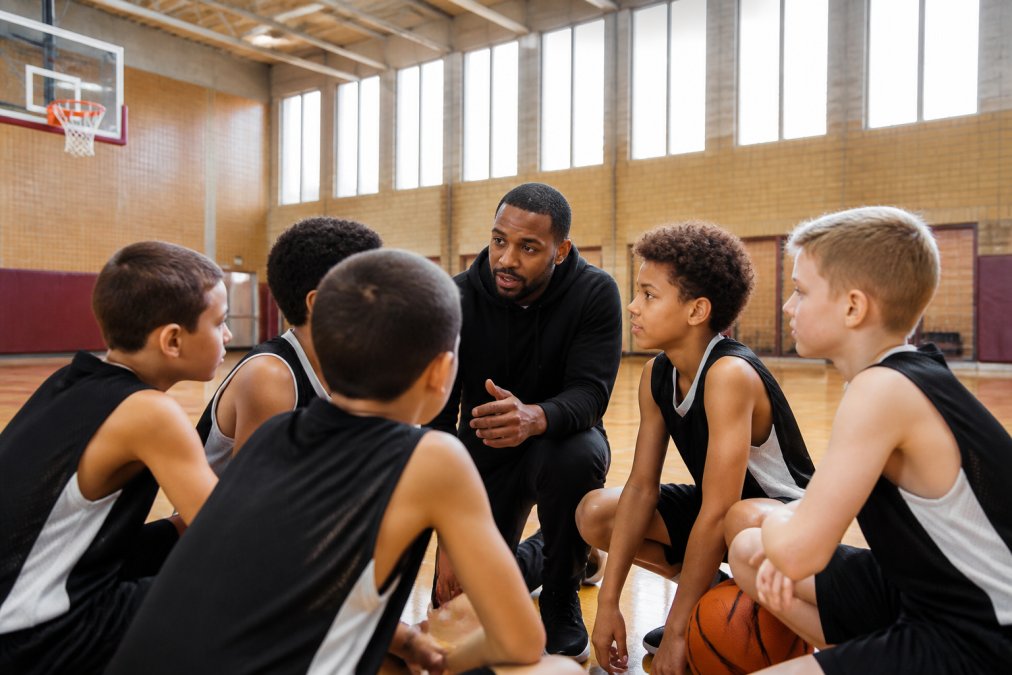
Emotional regulation improves through basketball because the sport creates situations where kids must manage frustration, disappointment, and pressure. Missing a shot, making a turnover, or losing a game are emotionally charged moments. When coaches and teammates respond supportively, kids learn that mistakes are part of learning. This builds resilience and self-discipline that extends far beyond basketball.
Decision-making develops rapidly in basketball. A child playing defense must constantly decide: should I guard this player or help a teammate? Should I pass or shoot? These micro-decisions happen dozens of times per game, training the brain to process information quickly under pressure. This cognitive skill transfers directly to academic performance and problem-solving.
Leadership naturally emerges in team settings. Some children become vocal leaders, calling out plays and encouraging teammates. Others lead by example through consistent effort and good decision-making. Basketball creates space for different leadership styles to develop. Sportsmanship and respect for rules develop through structured gameplay. Kids learn that rules exist to make the game fair and safe for everyone.
Long-Term Athlete Development Model: Pathways From Age 4 to 16
Long-term athlete development (LTAD) is a framework that guides how children progress through basketball at different ages, ensuring they develop skills in the right sequence and at the right pace. This model prevents burnout, reduces injury risk, and maximizes the chance that children will develop genuine love for the sport.
Ages 4-6 focus on physical literacy and fundamental movement. Kids learn basic coordination, balance, and agility through play-based activities. Basketball is one of many sports they might explore. The emphasis is on developing broad motor skills, not basketball-specific techniques.
Ages 7-9 introduce sport-specific fundamentals. Kids focus on basketball skills: dribbling, passing, shooting, and basic defensive positioning. Competition begins, but it's friendly and emphasizes participation over winning. Skill development matters more than results.
Ages 10-12 represent a critical transition. Kids develop the cognitive ability to understand tactics and strategy. They can now learn complex concepts like pick-and-roll defense, spacing, and ball movement. Physical development is accelerating, and kids are ready for more intense training. This is when serious skill development accelerates, though enjoyment and development should still be prioritized over winning.
Ages 13-16 include competitive pathways. Some children pursue rep basketball (competitive travel teams), while others continue recreational play. For those pursuing competitive basketball, training intensity increases significantly. Strength and conditioning become important. Tactical knowledge deepens.
The LTAD model emphasizes that earlier isn't always better. A four-year-old doesn't need intensive basketball training, they need broad movement experiences. A six-year-old forced into competitive basketball before mastering fundamentals will develop poor habits and likely lose interest.
Getting Started: Finding the Right Program for Your Child
Choosing a basketball program is one of the most important decisions a parent makes for their child's athletic development. The right program can ignite a lifelong passion for basketball and build confidence that extends far beyond the court.
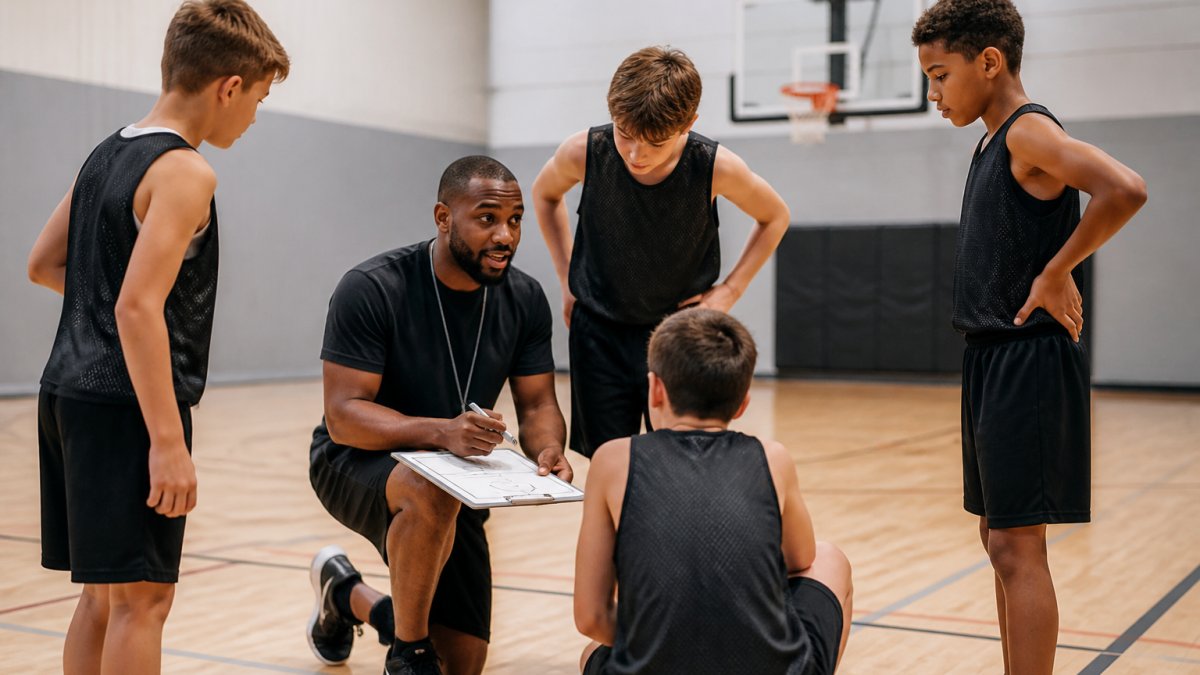
Look for programs that prioritize age-appropriate skill development over winning. Programs should have clear progressions with different levels or age groups with different focuses and expectations. Coaching quality matters enormously. The best programs have coaches who understand child development, communicate clearly with parents, and create a supportive environment where mistakes are treated as learning opportunities.
Consider the program structure. Does it offer both recreational and competitive pathways? A child might start recreational and progress to competitive later, or they might prefer recreational play their entire athletic life. Both paths are valid.
Tier 1 Sports offers programs tailored for specific age groups from 4 to 16, with both recreational and competitive rep basketball pathways. Our approach focuses on developing passion alongside skill, ensuring every player finds their pathway to success.
Ask about community and culture. Does the program feel welcoming and inclusive? Do kids seem to enjoy being there? The best programs create a sense of belonging where children want to come back week after week. Consider logistics: Can you get your child to practices consistently? What's the time commitment? Reliable attendance is crucial for skill development. Ask about communication. How will you know how your child is progressing? Will coaches provide feedback? Good programs maintain open communication with parents.
Starting your child in basketball is an investment in their physical health, social development, and confidence. The benefits extend far beyond the court, into academics, relationships, and how they approach challenges throughout their lives. The key is finding a program that respects your child's developmental stage, prioritizes skill-building alongside enjoyment, and creates a supportive community where young athletes can thrive.
At Tier 1 Sports, we're committed to fueling that passion and helping every young athlete discover their potential. Whether your child is taking their first steps on the court at age four or pursuing competitive basketball at age fourteen, we create pathways where skill development and genuine love for the game go hand in hand. Learn more about how youth basketball programs support long-term athletic development
Frequently Asked Questions
At what age should a child start playing basketball?
Children can begin basketball as early as age 4 with introductory programs that focus on basic ball familiarity and fun movement. Ages 5-6 are ideal for foundational skill development, while ages 7-10 represent a critical period for motor coordination advancement. Starting early during this window maximizes the developmental benefits of basketball, though children can begin at any age and still gain significant physical and social benefits.
How does the youth basketball golden window explained affect my child's development?
The golden window refers to ages 4-10, when children's brains are most receptive to learning motor coordination and spatial awareness. During this period, basketball drills create neural pathways that improve balance, agility, and decision-making more efficiently than at other ages. Introducing basketball during this window doesn't mean missing out later, but it does mean maximizing the natural learning capacity your child has at this stage. Programs designed around this science can support skill acquisition.
What specific basketball drills for 5-year-olds should my child be doing?
Age-appropriate drills for 5-year-olds emphasize fun and basic fundamentals: dribbling with both hands using smaller basketballs, rolling balls to develop hand-eye coordination, and simple passing games with partners. Drills should include movement games like 'follow the leader' with a ball and relay races that build spatial awareness. Avoid complex shooting techniques at this age; instead, focus on comfort with the ball, basic footwork, and enjoying the game. Short, varied activities (10-15 minutes each) work best before attention spans wane.
How does the long-term athlete development model guide basketball progression for young children?
The long-term athlete development model emphasizes age-appropriate skill progression across stages: ages 4-6 focus on play and fundamental movement, ages 7-10 build sport-specific skills and coordination, and ages 11-16 develop tactical awareness and competitive pathways. This framework prevents early specialization burnout while ensuring children develop physical literacy. Programs aligned with this model balance competitive and recreational play, adjust intensity gradually, and prioritize enjoyment alongside skill development, creating sustainable engagement with basketball throughout childhood.
This article was written using GrandRanker