 ultimate-guide
Age-Appropriate Basketball Training for Motor Skill Growth
Table of Contents
- Why Motor Skill Growth Matters in Youth Basketball
- Motor Development Milestones by Age
- Basketball Drills for 4-6 Year Olds: Building Coordination and Balance
- Basketball Drills for 8-10 Year Olds: Footwork, Passing and Ball Handling
- Basketball Training for 12 Year Olds: Shooting, Defense and Skill Progression
- How Long Should a Basketball Practice Be for Young Children?
- Safety, Workload and Recovery in Age-Appropriate Basketball Training
- Adapting Drills for Different Abilities and Developmental Needs
- Frequently Asked Questions
Last Updated: October 12, 2026
Why Motor Skill Growth Matters in Youth Basketball
Basketball training for young players works best when it builds the body's movement system first and the basketball moves second.
Motor skills are the coordinated movements the body produces on purpose, from running and jumping to catching and throwing.
Here is the tension most parents miss: a drill that looks impressive on a highlight reel is often wrong for a 6-year-old.
Gross Motor Skills vs Fine Motor Skills on the Court
Gross motor skills use the large muscle groups: running, jumping, hopping, and changing direction. Fine motor skills use smaller, more precise movements, such as fingertip control on a pass or wrist action on a shot.
Basketball leans on both, but the order matters. Young children develop gross motor control first, which is why a 5-year-old can sprint across a gym but struggles to snap a crisp chest pass.
Motor Development Milestones by Age
Motor development follows a broadly predictable sequence, though the pace varies from child to child. The Canadian Paediatric Society and other child-development bodies describe these stages in general terms; coaches should treat them as a guide, not a strict timetable.
- Ages 4-6: Running, hopping, and basic balance. Children can catch a large, slow ball and follow simple one-step instructions.
- Ages 7-9: Improved coordination, agility, and the ability to combine movements, such as dribbling while walking.
- Ages 10-12: Faster reaction time, better body control, and the capacity to learn sport-specific technique with real accuracy.
This is why a single practice plan cannot serve every age. The Canadian Paediatric Society guidance on physical activity for children recommends plenty of varied, active play in the early years, which supports exactly the movement foundation basketball depends on.
Basketball Drills for 4-6 Year Olds: Building Coordination and Balance
At this age, the goal is not basketball skill but coordination, balance, and a love of moving. Sessions should feel like organized play, with short, simple activities and almost no standing in line.
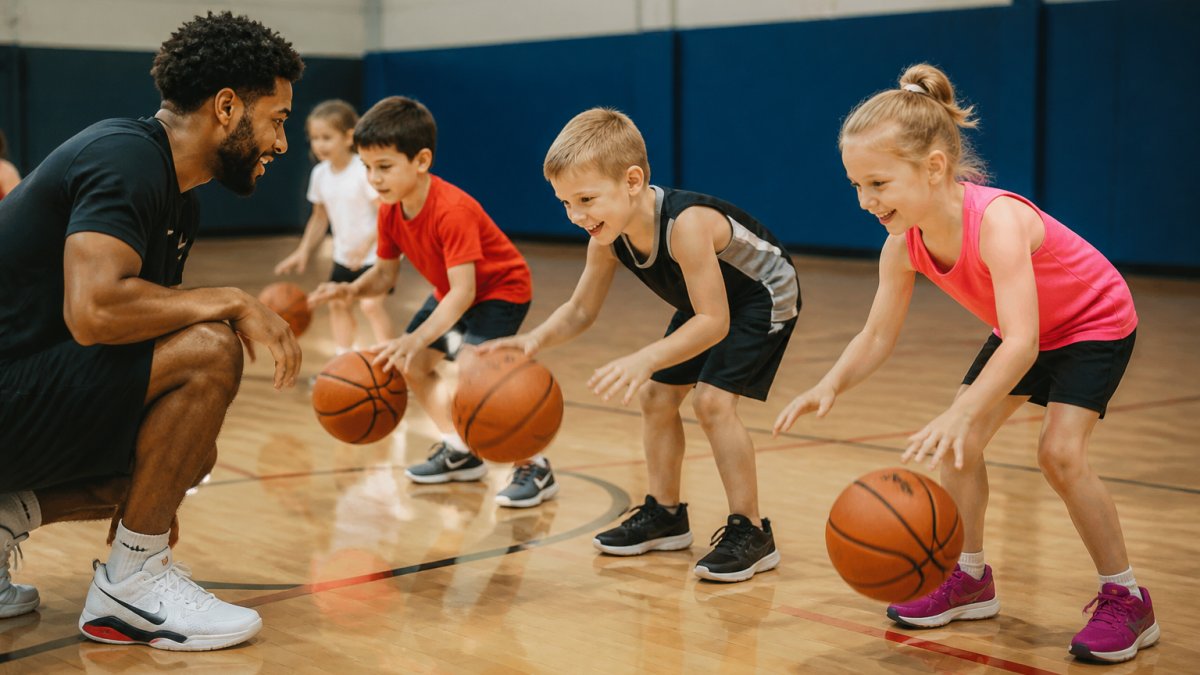
Try these basketball drills for 4-6 year olds:
- Red Light, Green Light Dribble: Children dribble and freeze on command, building ball control and listening skills.
- Animal Walks: Bear crawls, frog jumps, and crab walks develop gross motor skills and body control.
- Balance Beanbag: Stand on one foot while passing a beanbag, improving balance and focus.
- Big Ball Catch: Toss a large, soft ball to build hand-eye coordination and catching confidence.
- Follow the Leader: Mimic the coach's movements to develop attention skills and coordination.
Keep each activity to a few minutes and rotate often. Attention spans are short, and variety keeps young players engaged.
Basketball Drills for 8-10 Year Olds: Footwork, Passing and Ball Handling
By ages 8 to 10, children can handle more structure. This is the sweet spot for building footwork, passing, and ball handling, the technical base that everything else rests on. Our skill-development groups at Tier 1 Sports spend most of their time here, because this stage shapes how a player moves for years.
These basketball drills for 8-10 year olds work well:
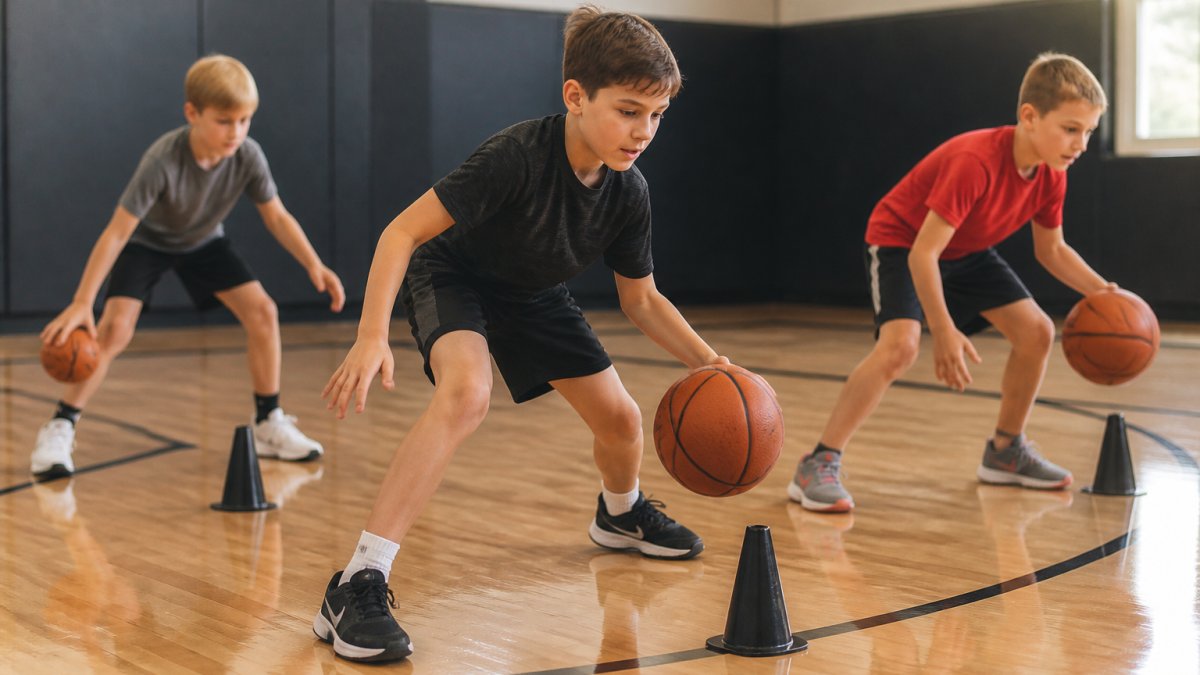
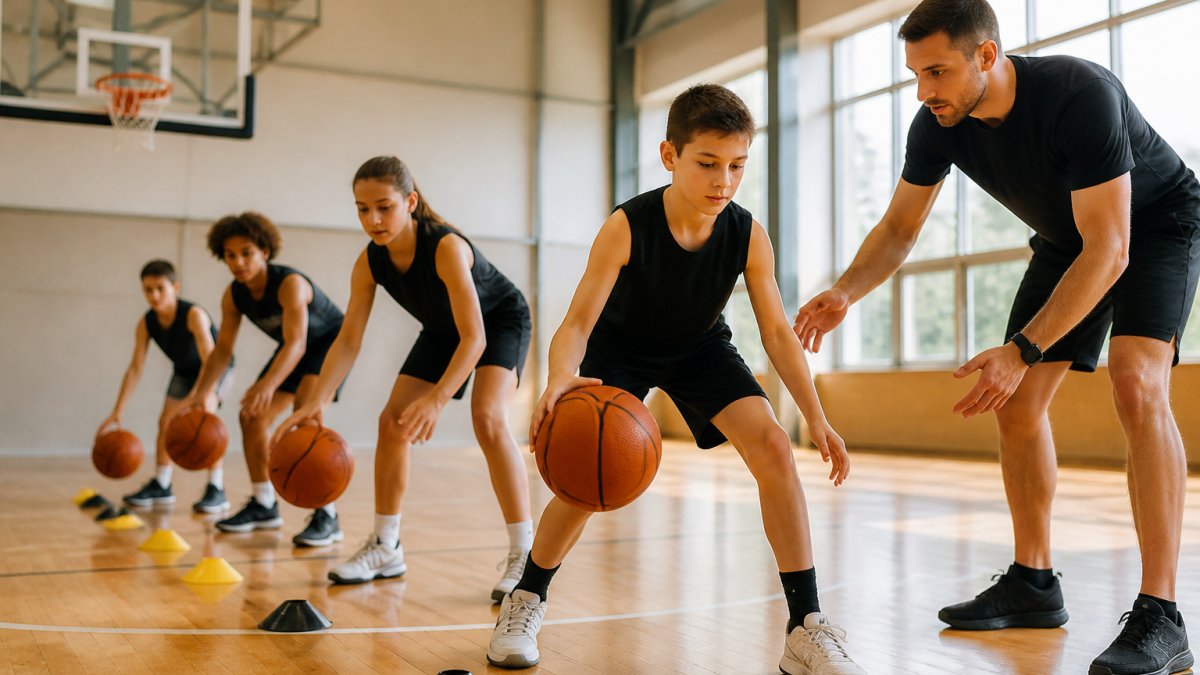
- Cone Weave Dribble: Dribble through cones to build ball control and change of direction.
- Partner Passing: Chest, bounce, and overhead passes develop passing accuracy and catching.
- Defensive Slide Ladder: Lateral slides along a line improve footwork, balance, and defense.
- Jump Stop and Pivot: Practice stopping and pivoting to build body control.
- Two-Ball Dribble: Alternating hands sharpens coordination and hand-eye skills.
Repetition turns these movements into muscle memory, and short, frequent practice beats one long session.
Basketball Training for 12 Year Olds: Shooting, Defense and Skill Progression
Basketball training for 12 year olds can finally push into real technique, because coordination and body control have matured. Most players can now combine movements, track a ball in flight, and adjust mid-action, the motor foundation that makes sport-specific coaching stick. This is also the window where structured progression separates players who plateau from those who keep improving.
What changes at this stage
Around ages 10 to 12, reaction time shortens, balance under movement improves, and the ability to learn a technical skill with real accuracy takes hold. A 12-year-old can be coached on shooting form in a way a 7-year-old cannot. The trade-off: this is also when early specialization and heavy workloads start causing overuse problems, so progression must be paired with recovery.
Shooting: build form before volume
Teach a consistent stance, elbow alignment under the ball, and a full follow-through. Accuracy improves through correct repetition, not sheer volume, 50 focused shots with good form beat 200 with a hitch. A practical progression:
- Form shooting close to the hoop, one hand, focus on release and follow-through.
- Game-speed catch-and-shoot, footwork into the shot, no dribble.
- Shooting off the dribble, one or two dribbles into a pull-up.
- Shooting off a screen or movement, catch on the move, square up, release.
Defense and movement
Defensive slides, closeouts, and recovery steps build the agility that separates effective defenders. The key mechanism is the hip turn and first step, a defender who can flip their hips and recover without crossing their feet stays in front of the ball. Drill controlled slides, then add a live closeout where the player reacts to a ball handler.
Skill progression: layer, don't stack
Layer skills so players combine moves at game speed, dribble into a pull-up, pass off a drive, shoot off a cut. Introduce one new layer every two to three weeks, then review the previous layer so it stays sharp. Muscle memory is built on short, frequent, correct repetitions, not one long session.
A sample weekly structure for this age
- Two skill sessions (60-75 minutes) focused on shooting form and ball handling.
- One team practice (60-75 minutes) with defense, passing, and small-sided games.
- One free-play or pickup session where the player chooses what to work on.
This structure gives enough repetition to build skill without the workload that drives overuse injuries. The goal is steady progress, not a fixed timeline, when a drill is matched to a child's stage, skill development and confidence grow together.
How Long Should a Basketball Practice Be for Young Children?
A good rule is to match practice length to age, and how long should a basketball practice be for young children depends heavily on attention span. Shorter, focused sessions beat long ones at every age, but how the time is structured matters just as much.
The attention-span principle
A useful guideline: a child's focused attention span in minutes roughly tracks their age in years, plus or minus a few. A 5-year-old can sustain focused activity for about 5 to 10 minutes before needing a change; a 10-year-old for about 10 to 20. That is why a 45-minute session for a 5-year-old should be broken into short blocks, not one long drill.
Practice length by age
| Age Group | Practice Length | Focus | Activity Block Length |
|---|---|---|---|
| 4-6 years | 30-45 minutes | Coordination, balance, fun | 3-5 minutes per activity |
| 7-9 years | 45-60 minutes | Footwork, passing, ball handling | 5-8 minutes per activity |
| 10-12 years | 60-75 minutes | Shooting, defense, skill progression | 8-12 minutes per activity |
| 13-16 years | 75-90 minutes | Tactics, conditioning, rep preparation | 10-15 minutes per activity |
How to structure a session
A well-built practice follows a predictable arc:
- Warm-up (5-10 minutes): Dynamic movement, jogging, skipping, lateral shuffles, arm circles, to raise heart rate and prepare joints. Avoid static stretching before activity.
- Skill block (10-20 minutes): One or two focused skills, taught with demonstration and short repetitions.
- Game or drill block (10-25 minutes): Small-sided games or competitive drills that apply the skill under light pressure.
- Cool-down (5 minutes): Light movement and a brief review of what was learned.
Rest and recovery within the session
Rest is not wasted time. A common pattern is a 1:2 or 1:3 work-to-rest ratio for young children, for every minute of high-intensity activity, two to three minutes of lower-intensity movement or instruction. For the youngest players, more frequent short sessions work better than one long weekly practice. ParticipACTION's guidance on children's activity supports regular daily movement, and basketball practice should count toward that, not replace free play.
Signs a session is too long
Watch for these signals that a practice has run too long:
- Technique degrades, passes go wild, shots lose form.
- Children stop listening or start goofing off.
- Complaints of tired legs or requests to sit out increase.
When any appear, end on a positive note rather than pushing through. A child who leaves wanting more will come back ready to learn.
Safety, Workload and Recovery in Age-Appropriate Basketball Training
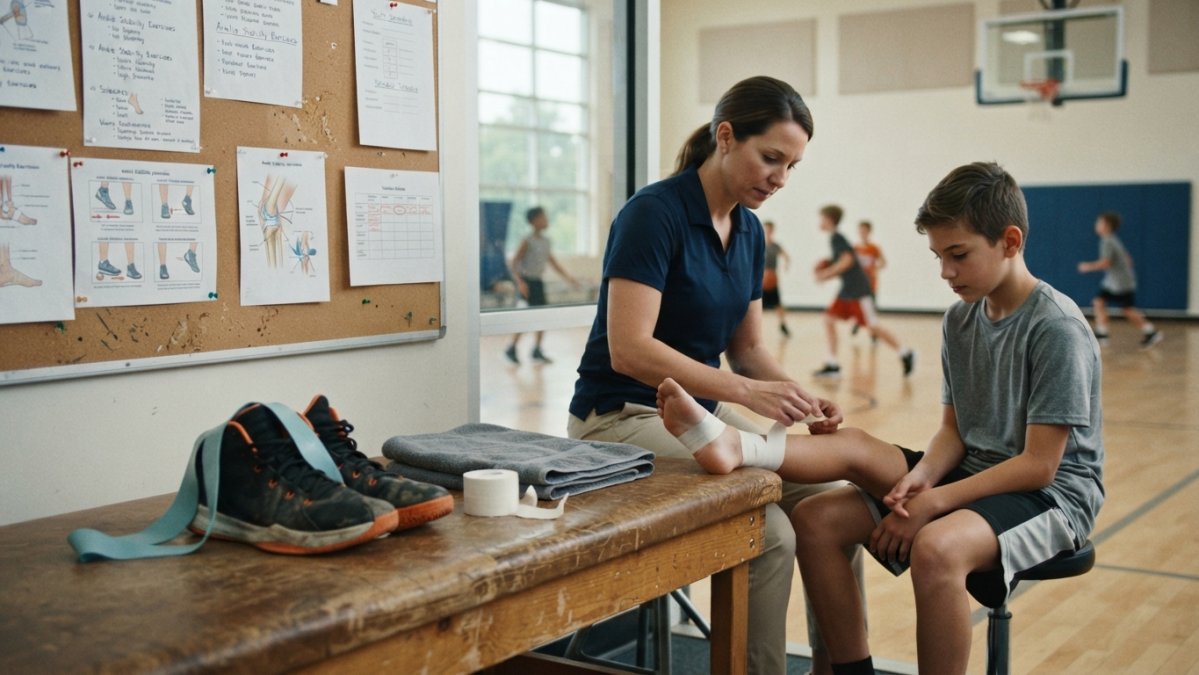
Safety comes down to workload management. Young athletes need rest days, sleep, and variety, and coaches should watch for fatigue rather than pushing through it.
- Build in at least one or two rest days each week.
- Avoid back-to-back high-intensity sessions for the same muscle groups.
- Warm up before every practice and cool down after.
A structured, age-appropriate plan reduces injury risk and keeps players enjoying the game. That enjoyment is what keeps them in the sport long enough to improve.
Adapting Drills for Different Abilities and Developmental Needs
Every child develops at their own pace, and a good program adapts rather than forces a single standard. At Tier 1 Sports, our coaches adjust drills so players of different abilities and developmental needs can take part and progress together.
Simple adaptations make a real difference:
- Slow the drill down: Reduce speed before reducing complexity.
- Change the equipment: Use a lighter ball or lower hoop to build confidence.
- Shorten the distance: Smaller spaces make success easier to reach.
The goal is steady progress, not a fixed timeline.
Building motor skills takes patience, the right drills for each age, and a program that meets kids where they are. Tier 1 Sports offers age-specific basketball programs from ages 4 to 16, with introductory sessions for beginners, skill-development groups for growing players, and competitive rep pathways for those ready to push further.
Frequently Asked Questions
What skills does basketball develop in young children?
Basketball builds gross motor skills like running, jumping and balance alongside fine motor skills such as hand-eye coordination and ball control. Children also develop listening skills, attention skills and the ability to follow instructions during structured play. The repeated movements of dribbling, passing and shooting build muscle memory that supports coordination and body control in everyday life, not just on the court.
Can a 3-year-old play basketball?
Most 3-year-olds lack the attention span and coordination for structured basketball training. Programs designed for ages 4 to 6 use modified equipment like smaller balls and lower hoops to make the sport accessible. If your 3-year-old shows interest, focus on simple fun activities at home like rolling and catching a soft ball. Formal basketball drills for 4-6 year olds are usually a better starting point once your child can follow basic instructions.
How can basketball drills improve a child's coordination and balance?
Drills that combine movement with ball handling force the brain to coordinate multiple body parts at once. Dribbling while walking, passing to a partner and hopping on one foot all build gross motor skills and balance. Repetition strengthens the neural pathways behind these movements, which is why short, frequent practice sessions work better than one long session each week for young players.
How long should a basketball practice be for young children?
Children aged 4 to 6 do best with 30 to 45 minute sessions that mix drills with games. Players aged 7 to 10 can handle 45 to 60 minutes, while ages 11 and up often train for 60 to 90 minutes. Watch for signs of fatigue like losing focus or slowing down, and keep water breaks frequent. Shorter, more frequent practices build motor skills more effectively than long sessions.
Which basketball skills should children learn at different ages?
Ages 4 to 6 focus on running, jumping, balance and basic ball handling. Ages 7 to 10 add dribbling with both hands, passing, catching and simple shooting form. Ages 11 to 16 refine footwork, defensive movement, shooting accuracy and game awareness. Matching skills to developmental stage keeps training age-appropriate and prevents frustration or injury.
How long does it take to get conditioned for basketball?
General conditioning for youth basketball typically takes 4 to 6 weeks of consistent training. Young players build stamina through repeated court movement, agility drills and structured play rather than long runs. For ages 11 and up, adding two or three conditioning sessions per week alongside skill work supports both endurance and motor skill growth without overloading growing bodies.