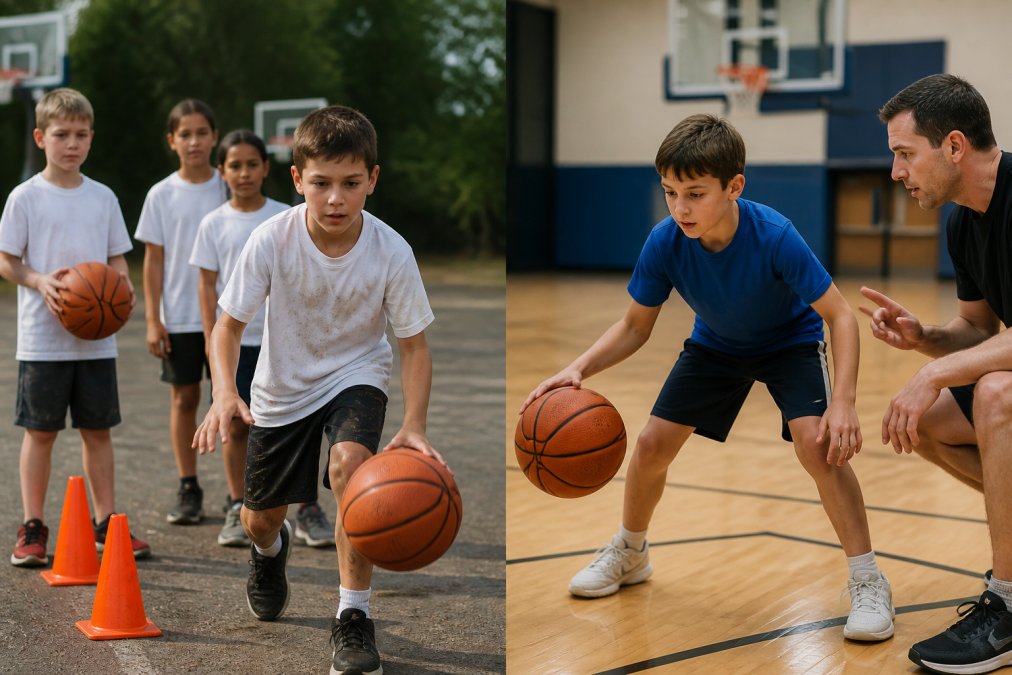
 comparison
Basketball Camps vs Weekly Classes for Kids: 2026 Guide
Table of Contents
- Basketball Camps vs Weekly Classes for Kids: The Core Differences
- Format, Duration, and Intensity at a Glance
- Quick Comparison: Camps and Weekly Classes Side by Side
- The Youth Basketball Golden Window Explained
- Benefits of Consistent Basketball Training
- Cost-Per-Hour Analysis: What You Actually Pay For
- Skill Retention and Long-Term Athlete Development
- Matching the Format to Your Child's Personality and Age
- Frequently Asked Questions
Last Updated: September 10, 2026
Basketball Camps vs Weekly Classes for Kids: The Core Differences
Basketball camps vs weekly classes for kids is the decision most parents face once their child shows real interest in the game. The short answer: camps deliver intensity and rapid exposure, while weekly classes deliver repetition and steady skill retention. We've watched both formats work, but rarely for the same child at the same age. This guide breaks down format, cost, and long-term development so you can match the choice to your kid, not the marketing.
The distinction matters because youth sports participation in Canada keeps climbing, and parents now have more program options than ever. Choosing wrong wastes money and, worse, can burn a child out before the fundamentals ever stick.
Below, we'll show you exactly how each format performs across six decision factors, including two most guides skip entirely: cost-per-hour and skill retention.
Format, Duration, and Intensity at a Glance
Camps compress training into short, high-frequency blocks. A day camp might run five consecutive days, three hours per session, while weekly classes spread the same total hours across eight to twelve weeks.
That structural difference drives everything else. Intensive training builds sharp short-term gains but fades without follow-up. Weekly training sessions build slower, stickier progress. Most reputable programs, including ParticipACTION's youth sport guidance, recommend matching intensity to a child's age and attention span rather than chasing volume.
Quick Comparison: Camps and Weekly Classes Side by Side
Here's the direct comparison. Camps win on immersion and scheduling flexibility; weekly classes win on retention, coaching ratio consistency, and cost predictability.
| Factor | Basketball Camps | Weekly Classes |
|---|---|---|
| Format | Consecutive days, day camp or overnight | 1-2 sessions per week |
| Duration | 1-2 weeks | 8-12 weeks |
| Intensity | High, immersive | Moderate, steady |
| Skill retention | Lower without follow-up | Higher through repetition |
| Coaching ratio | Varies, often larger groups | Typically smaller, consistent |
| Cost-per-hour | Higher upfront | Lower per session |
| Best for | Skill bursts, exposure | Long-term development |
The Youth Basketball Golden Window Explained
The youth basketball golden window is the developmental period, roughly ages 6 to 12, when children absorb motor skill development and physical literacy fastest (peer-reviewed research). During this window, fundamental basketball skills like dribbling mechanics and shooting form wire in more easily than at any later age.

This is why age-appropriate drills matter more than program prestige. A five-year-old doesn't need tactical complexity; he needs coordination, balance, and fun. A ten-year-old can start layering basketball IQ and game strategy on top of that base. Programs that ignore the window, pushing competitive play too early, tend to produce kids who quit by thirteen.
Benefits of Consistent Basketball Training
The benefits of consistent basketball training compound over months, not days. Repetition builds muscle memory, and muscle memory is what separates a kid who can dribble under pressure from one who can't.
Consistency also delivers the less visible wins: teamwork and sportsmanship, on-court decision making, and the confidence that comes from measurable player progression. A child who trains weekly for a full season typically retains more than one who attends a single intensive camp and then stops.
That's the trap with camps. They feel productive because the gains are visible fast. But without year-round programming to reinforce them, those gains erode within weeks.
Cost-Per-Hour Analysis: What You Actually Pay For
Sticker price is the worst way to compare a camp and a weekly class. The number that actually tells you which format gives your child more training per dollar is cost-per-hour, and almost no program advertises it, because the two formats hide their true cost in different places.
Here is the formula, and it works for any program you're evaluating:
- Camps: Total fee ÷ total on-court training hours = cost per hour
- Weekly classes: Total fee ÷ (number of sessions × hours per session) = cost per hour
Run it on a typical five-day day camp that runs three hours per day. That's 15 training hours. If the fee is $300, you're at $20 per hour. Now run it on a 10-week weekly class at one hour per session, 10 training hours. If the fee is $180, you're at $18 per hour. Suddenly the "cheap" weekly class and the "expensive" camp are within a couple of dollars of each other, and the camp delivered its hours in a single week.
That's the first trap: camps front-load their hours, so the per-hour number looks competitive, but you're paying for a compressed window, not a season.
The second trap is what the fee doesn't cover. When you compare programs, add these to the camp side of the ledger:
- Extended care: Most day camps charge extra for before-care and after-care, which many working parents need.
- Equipment and apparel: Camps frequently require a specific jersey, shorts, or ball. Weekly classes often let kids bring what they already own.
- Travel and meals: A five-day camp can mean five round trips and five packed lunches; a weekly class is one trip per week.
- Sibling and multi-week discounts: These usually favor weekly programs, because camps rarely stack discounts across sessions.
On the weekly side, the hidden cost is commitment. You're signing up for 8 to 12 weeks, so a mid-season schedule conflict or a child who loses interest still costs you the full fee unless the program offers a prorated withdrawal. Ask about the refund and make-up policy before you pay, not after.
Here's the decision rule most parents find useful: if you want the lowest total outlay for a season of training, weekly classes usually win. If you want the lowest cost per hour of concentrated instruction and you can absorb the upfront hit, a camp can match or beat it, but only if you actually use every hour you paid for. A child who misses two of five camp days has just watched their cost-per-hour jump by roughly 40 percent. choosing youth programs.
One more variable: age group. Programs typically charge more for older, competitive streams than for introductory sessions, so compare like with like. A rep-level weekly class and a recreational camp are not the same product, and their per-hour numbers shouldn't be read side by side.
Because program pricing varies widely by region, age group, and session length, the only reliable number is the one you get directly from the provider. Request current rates and total training hours for the specific age group your child would join, then run the formula yourself.
Skill Retention and Long-Term Athlete Development
Skill retention is where weekly classes quietly win, and the reason is mechanical, not marketing. Motor skills are consolidated through repeated exposure with sleep and rest between sessions (peer-reviewed research). A child who practices a crossover once a day for ten weeks gets ten consolidation cycles. A child who practices it five times in one week gets five, compressed, with less spacing, and then nothing for months.
That spacing effect is why a camp can introduce a new move in five days and still see it disappear by fall. The camp didn't fail; it just didn't have enough repetitions spread across enough time to move the skill from short-term to long-term memory.
Long-term athlete development (LTAD) frameworks, the staged models used by national sport organizations, describe this progression in phases. The early years focus on physical literacy: running, jumping, balancing, catching, and handling a ball. The middle years build sport-specific skills on top of that base. The later years add training load, tactics, and competition. Camps and weekly classes serve different phases differently:
- Physical literacy phase: Weekly, play-based sessions are the better fit. Short, frequent exposure matches a young child's attention span and builds the movement vocabulary that every later skill depends on.
- Skill-building phase: Weekly classes carry the load, with camps used as a focused boost, a week of concentrated work on one skill, then back to weekly reinforcement.
- Competition phase: Year-round weekly programming becomes essential. Camps alone can't build the conditioning, tactical understanding, or team chemistry that competitive play demands.
The practical takeaway is that camps and weekly classes aren't competitors in the retention column, they're sequenced. A camp is an accelerant. A weekly class is the engine. Used together, the camp's gains get reinforced instead of lost.
There's also a readiness question hiding inside the retention data. A child who has trained weekly for a full season arrives at a camp with the base to absorb advanced instruction. A child who shows up cold spends the first two days relearning fundamentals. That's why the strongest camp experiences usually follow a season of weekly training, not the other way around.
If you're deciding between the two, ask what your child needs right now: a burst of exposure to see if they love the game, or a steady season of repetition to make the skills stick. Most families end up using both, weekly classes as the foundation, camps as the occasional push.
Matching the Format to Your Child's Personality and Age
The right format depends on temperament as much as age. Extroverted kids often thrive in the group dynamics of a busy camp; introverted children may find the same environment overwhelming and learn better in smaller, consistent weekly settings.
Age guides the baseline:
- Ages 4-6: Introductory, play-based weekly sessions build physical literacy without pressure
- Ages 7-10: Weekly skill clinics plus an occasional camp for a focused boost
- Ages 11-16: Competitive play and rep pathways reward year-round programming
For the child between recreational and competitive, the middle ground is a skill-development stream that raises basketball IQ without the cutthroat pressure of rep tryouts. Programs can be structured across this full range, from introductory sessions to competitive rep basketball, so a player can move up as readiness grows.
Frequently Asked Questions
What age is best for a child to start basketball camp?
Most basketball camps for kids start accepting children around age 5 or 6, though some introductory programs begin at age 4. The best age depends on your child's attention span and comfort in group settings. Younger children often do better in shorter sessions with a lower coaching ratio. If your child is 4 to 6 and new to the sport, look for programs that group by age and focus on fundamental basketball skills through play rather than competition.
How do weekly basketball classes differ from intensive summer camps?
Weekly classes spread instruction across months, giving kids time to absorb skills between sessions. Intensive camps compress training into a few days or weeks with longer daily hours. Camps can accelerate skill introduction, but weekly classes tend to build stronger long-term habits because repetition happens consistently. Many families combine both: weekly classes for year-round programming and a summer camp for a focused boost.
Does my child need consistent weekly training to improve basketball skills?
Consistency matters more than intensity for most young athletes. Weekly training sessions allow coaches to correct dribbling mechanics and shooting form before bad habits set in. Research on motor skill development suggests that spaced repetition over time leads to better retention than cramming. If your child attends a camp but does not practice regularly afterward, much of what they learn may fade within weeks.
How do I determine if my child is ready for competitive basketball training?
Look for three signs: your child asks to practice outside of scheduled sessions, handles basic fundamental basketball skills like dribbling and passing with some confidence, and shows interest in game strategy or competitive play. Most rep programs start around age 8 to 10. If your child is between recreational and competitive levels, look for a middle-ground program that blends skill development with game situations before committing to tryouts.
What are the benefits of choosing a basketball camp over a weekly program?
Camps offer concentrated time with coaches, often with a lower coaching ratio than weekly classes. That means more individualized coaching and faster feedback on fundamental basketball skills. Camps also introduce athletes to new teammates and game strategy in a short window. The trade-off is cost: camps usually have a higher upfront price, and the skills learned may not stick without follow-up training at home or in a weekly class.
Choosing between basketball camps vs weekly classes for kids isn't about picking a winner; it's about matching format to your child's age, temperament, and goals. Tier 1 Sports offers programs tailored for specific age groups from 4 to 16, with both recreational and competitive rep basketball pathways designed to develop skills and fuel a lifelong passion for the game. Get started with Tier 1 Sports and find the pathway that helps your young athlete realize their full potential.