 ultimate-guide
Basketball Coaching Philosophy for Beginners
Table of Contents
- What Is a Basketball Coaching Philosophy and Why It Matters
- Defining Your Core Values and Team Identity
- Coaching Philosophy Examples for Youth Sports
- Best Practices for Coaching Kids Aged 4-16
- Building Your Basketball Practice Plan Template for Beginners
- Communication, Accountability, and Handling Adversity
- Mentorship and Long-Term Player Development
- Conclusion
Last Updated: August 19, 2026
What Is a Basketball Coaching Philosophy and Why It Matters
A basketball coaching philosophy is the set of core principles, values, and beliefs that guide how you teach the game, develop players, and lead your team. It answers fundamental questions: What does winning mean to you? How do you balance competition with learning? What kind of people do you want your players to become?
Without a clear philosophy, coaching becomes reactive. With one, every practice drill, substitution, and conversation aligns toward the same goal. This consistency builds trust with players, parents, and staff.
At Tier 1 Sports, we've found that coaches who articulate their philosophy early create environments where young athletes thrive. They understand why they're doing drills and feel part of something intentional. This guide walks you through defining yours step by step, with practical examples and a template you can start using immediately.
Defining Your Core Values and Team Identity
Your core values are the non-negotiable principles that define your program. They're about what behavior, character, and approach you demand from every player, regardless of talent or playing time.
Common core values include accountability, respect, coachability, effort, and integrity. The specific values you choose should reflect what matters most to you and what you want your community to know your program stands for.
Identify yours by thinking about the last time you felt genuinely proud of a player, not for a big shot, but for how they carried themselves. What character trait showed up? That's a clue to your values.
Once you've identified 3-5 core values, define what each looks like in action. "Accountability" means players own their mistakes, ask for feedback, and show up ready to work. "Coachability" means listening without defensiveness, adjusting based on instruction, and asking questions when something doesn't make sense.
Write these definitions down. Share them with parents during recruitment. Reference them in practice. When a player displays one of your core values, call it out by name. This reinforces the culture you're building and makes your philosophy tangible.
Coaching Philosophy Examples for Youth Sports
Different coaches build different philosophies based on their personality, players' ages, competitive level, and community.
Player-Development-First Philosophy: This coach prioritizes long-term skill growth and player confidence over winning games. Practices emphasize fundamental skills, individual improvement, and understanding the game. Playing time is distributed to give every player meaningful minutes. This works well for recreational programs and younger age groups.
Competitive-Excellence Philosophy: This coach believes players develop fastest in a competitive environment where standards are high and expectations are clear. Practices are intense. Playing time is earned through effort and execution. This suits rep basketball and older competitive players who thrive on challenge.
Balanced-Development Philosophy: This coach blends skill development with competitive intensity. Players are pushed to improve and compete, but the coach ensures every player feels valued and has opportunities to contribute. This is often the most sustainable approach for middle-ground programs.
Mentorship-Focused Philosophy: This coach sees basketball as a vehicle for teaching life lessons: resilience, teamwork, decision-making, character. Practices include reflection time and regular one-on-one conversations. The goal is developing people who happen to play basketball.
Your philosophy doesn't have to fit neatly into one category. Many coaches blend elements. The key is being intentional about which principles guide your decisions and communicating them clearly.
Best Practices for Coaching Kids Aged 4-16
Coaching philosophy looks different at different ages because children develop differently. Here's how to adapt your approach by age group.
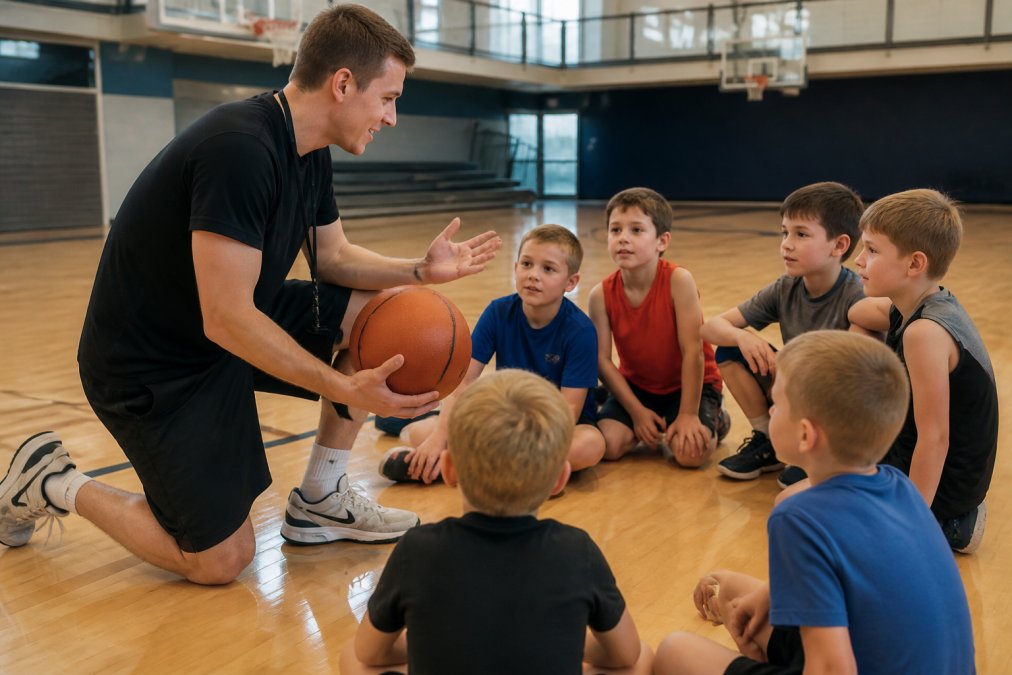
Ages 4-6: Building Fundamentals and Love of the Game
At this age, most kids have never held a basketball. Your philosophy should prioritize fun, movement, and basic coordination over skill mastery or winning.
Practices should be 30-45 minutes maximum. Include varied activities: shooting, dribbling, passing, and games. Rotate activities every 5-10 minutes to match short attention spans. Use smaller basketballs and lower rims so kids experience success.
Discipline is light. Mistakes are learning opportunities. Praise effort and participation. The goal is building positive associations with basketball so they want to return.
Ages 7-10: Developing Skills and Team Chemistry
This is when skill development accelerates. Kids can focus longer, understand instruction better, and grasp basic strategy. Your philosophy should emphasize skill-building, teamwork, and positive reinforcement.
Practices should be 45-60 minutes. Include warm-ups, skill stations, competitive drills, and game play. Kids respond well to clear expectations and immediate feedback.
Include activities that build trust and communication: partner drills, small-sided games, team-building moments. Winning should matter, but not at the expense of player development. Rotate players and give everyone meaningful minutes. Frame winning as a byproduct of good effort and execution.
Ages 11-16: Competitive Development and Leadership
By this age, players are more self-aware and care about playing time and status. Your philosophy needs to acknowledge this reality while maintaining development.
For competitive rep basketball, standards are higher. Playing time should be earned through effort, execution, and coachability. But every player should feel the coach believes in their potential.
This is when leadership development becomes part of your philosophy. Older players should have roles: team captains, peer mentors, decision-makers in practice. They should understand not just what to do, but why. Ask them questions and develop their basketball IQ.
Handling adversity becomes crucial. Players will face setbacks: benching, losses, tough competition. Your philosophy should include how you respond with support, clear feedback, and belief that they can improve.
Building Your Basketball Practice Plan Template for Beginners
A practice plan brings your philosophy to life. It's where your values become actual drills, timing, and structure.
Here's a template you can adapt:
Practice Structure (60-minute session for ages 7-12):
| Component | Duration | Purpose | Your Notes |
|---|---|---|---|
| Warm-up & arrival | 5 min | Get moving, build energy | Light stretching, ball handling |
| Skill station 1 | 12 min | Focused development | Dribbling, footwork, or shooting |
| Skill station 2 | 12 min | Varied skill work | Different skill or game situation |
| Competitive drill | 15 min | Apply skills under pressure | Small-sided game or scrimmage |
| Cool-down & reflection | 6 min | Reinforce learning, close practice | Review what went well, what to work on |
For younger ages (4-6), reduce each block by 30-50% and include more variety and play. For older, competitive ages (13-16), extend skill work and competitive drills.
Every practice should reflect your philosophy. If you emphasize player development, spend time on skill stations where you can teach and give feedback. If you emphasize competitive intensity, include more game-speed situations.
Write your practice plan the night before. Include specific drills, objectives, and time blocks. This prevents wandering and keeps energy high. Share it with assistant coaches so everyone's aligned.
Communication, Accountability, and Handling Adversity
Your philosophy includes how you communicate with players, hold them accountable, and respond when things get hard.

Communication with Players: Be clear about expectations. In the first practice, tell players what you value and what you expect. Use specific language: "I value effort and coachability. That means I want to see you working hard every rep and being open to feedback."
Use feedback immediately after performance. Balance correction with encouragement. Have one-on-one conversations regularly, not just when there's a problem. Check in about how they're feeling, what they're working on, and what they need from you.
Accountability: Hold all players to the same standards, regardless of talent. If your philosophy values effort and coachability, enforce that with your best player and your newest player equally. Consistency builds credibility.
Consequences should match the infraction and be designed to teach, not punish. Missing practice has a consequence. Not listening to instruction has a consequence.
Handling Adversity: After a tough loss, acknowledge the disappointment. Then redirect: "We played well in these areas. Here's what we need to work on. We'll be better next time because we're going to practice these specific things."
When a player makes a mistake in a game, don't bench them immediately. Let them know you're there to support them. Players need to know that mistakes are part of learning, not reasons to lose faith.
Mentorship and Long-Term Player Development
The best coaching philosophy includes a vision for what happens after this season. How do you want your players to grow, not just as basketball players, but as people?
Mentorship means seeing each player as an individual with strengths, challenges, and potential. It means having conversations beyond basketball and believing in them even when they don't believe in themselves.
Long-term player development means thinking in years, not seasons. Your philosophy should include a progression of what skills and character traits matter at different ages.
Create regular one-on-one time with each player. Even 5-10 minutes per month makes a difference. Ask about their goals and what they're struggling with. Share feedback about their progress and let them know you see their potential.
Connect players to opportunities beyond your program. If a player is ready for the next level, help them get there. This is mentorship, seeing the whole person.
Developing a basketball coaching philosophy for beginners isn't about having all the answers. It's about being intentional about what you value, communicating it clearly, and showing up consistently to live it. Your philosophy will evolve as you gain experience. That's healthy. Starting with clarity about your core values, your approach to different ages, and how you'll handle challenges gives you a foundation that serves players, parents, and your program.
At Tier 1 Sports, we believe every young athlete deserves a coach with a clear philosophy and a genuine commitment to their development. If you're building a program or refining your approach, that clarity is your first step.
Frequently Asked Questions
What should be included in a basketball coaching philosophy statement for beginners?
A coaching philosophy statement should clearly define your core values (such as integrity, teamwork, and respect), your approach to player development, how you balance winning with learning, and your expectations for student-athlete behavior. Include your stance on practice intensity, game-day preparation, and how you build trust with players and parents. Keep it concise but specific enough to guide daily decisions.
How does a coaching philosophy impact player development differently across age groups?
A coaching philosophy shapes how players learn at each stage. For ages 4-6, philosophy emphasizes fun and fundamentals to build passion. Ages 7-10 benefit from philosophies focused on skill progression and team chemistry. Ages 11-16 require philosophies that balance competitive growth with character building and long-term athletic development. Your philosophy must evolve with player maturity while maintaining core values.
What are the key differences between a recreational and competitive coaching philosophy?
Recreational philosophies prioritize participation, enjoyment, and equal playing time to build confidence in all players. Competitive philosophies emphasize performance metrics, tactical depth, and selective playing time based on skill level. Both can develop fundamental skills, but competitive approaches typically demand higher practice intensity and game-day pressure management. Many coaches blend both approaches depending on the program level.
How should a coaching philosophy address conflict resolution with players and parents?
Your philosophy should establish clear communication channels, define how mistakes are handled during practice and games, and explain your approach to difficult conversations. Include principles for maintaining respect even during disagreements, how you make playing-time decisions transparently, and how you support parents in understanding your instructional approach. A strong philosophy prevents misunderstandings before they arise.
This article was written using GrandRanker