 How-to
Basketball Conditioning Workouts for Youth Players
Table of Contents
- Why Basketball Conditioning Matters for Young Athletes
- Essential Bodyweight Strength Exercises for Youth Basketball
- Youth Basketball Conditioning Drills for Speed and Explosiveness
- Basketball Agility Drills for Youth: Footwork and Change of Direction
- Building a Basketball Conditioning Workout Plan for Young Players
- Basketball Stamina Workouts for Kids: Endurance and On-Court Conditioning
- Tracking Progress and Measuring Basketball Performance Gains
- Common Mistakes to Avoid in Youth Basketball Conditioning
- Frequently Asked Questions
Last Updated: October 21, 2026
Why Basketball Conditioning Matters for Young Athletes
Basketball conditioning workouts for youth players build the foundation for athletic success. Young athletes who develop strength, speed, and endurance early gain confidence and perform better on the court. Structured conditioning transforms players, helping them move faster, recover quicker, and stay engaged for full games without fatigue. Visit Tier 1 Sports for more information on athletic development programs.
The early years matter most. Between ages 7 and 16, young athletes experience critical windows for developing motor skills and building athletic capacity. This is when habits form.
Conditioning isn't just about running laps. It's about teaching young bodies how to move explosively, change direction, and sustain effort. A well-designed basketball conditioning workout plan develops all three.
Essential Bodyweight Strength Exercises for Youth Basketball
Bodyweight exercises form the backbone of youth basketball conditioning. They require no equipment, can be done anywhere, and teach athletes how to control their own bodies. Young players should master these movements before adding resistance.
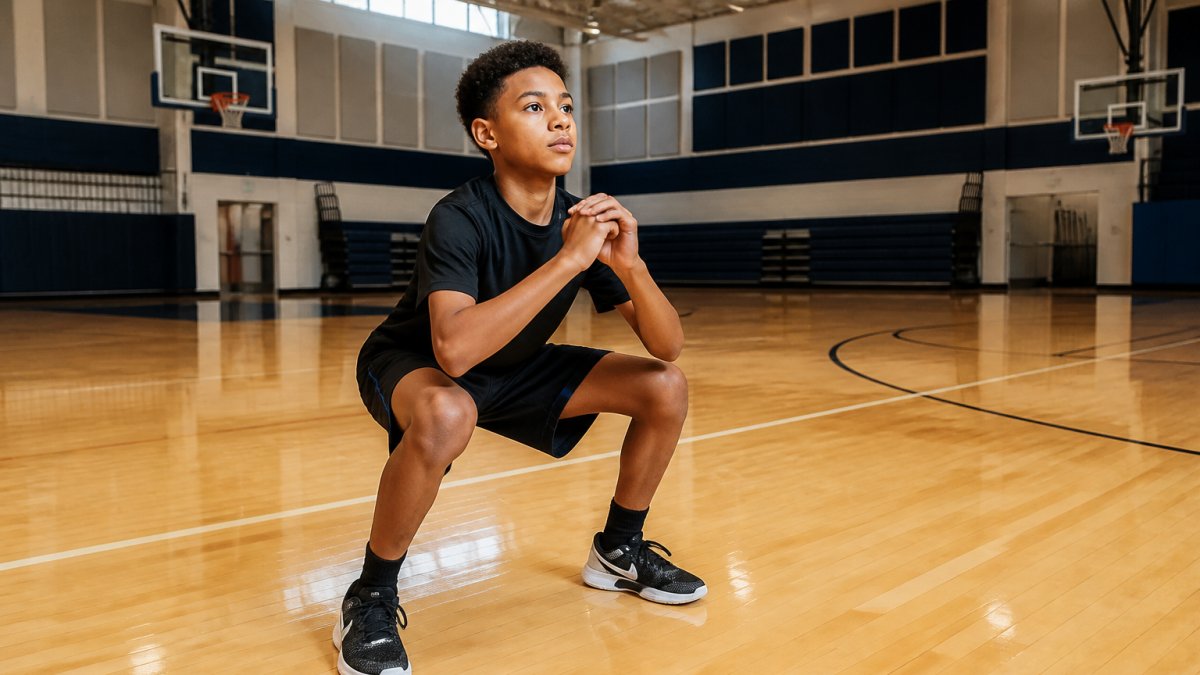
Lower-Body Strength: Squats and Lunges
Strong legs power every basketball movement: jumping, sprinting, stopping, and changing direction. Squats and lunges build the quad and glute strength players need.
Bodyweight Squats:
- Stand with feet shoulder-width apart
- Lower hips back and down, keeping chest upright
- Go as deep as comfortable, then drive through heels to stand
- Perform 3 sets of 12-15 repetitions
- Common mistake: knees caving inward. Keep them tracking over your toes.
Walking Lunges:
- Step forward with one leg, lowering hips until both knees bend at roughly 90 degrees
- Push back to standing and step forward with the other leg
- Perform 3 sets of 10 lunges per leg
- This movement mimics basketball's stopping and cutting motions
Upper-Body Strength: Push-Ups and Pull-Ups
Upper-body strength helps with ball control, passing, and shooting. Push-ups and pull-ups build the chest, shoulders, and back muscles young players need.
Push-Ups:
- Start in plank position with hands slightly wider than shoulder-width
- Lower body until chest nearly touches floor
- Push back up to starting position
- Perform 3 sets of 8-12 repetitions
- Modification: Start on knees if full push-ups feel too difficult
Pull-Ups:
- Grip bar with hands slightly wider than shoulders
- Pull body upward until chin clears the bar
- Lower with control back to starting position
- Perform 3 sets of 5-8 repetitions
- Modification: Use a resistance band looped under feet for assistance
Core Stability and Rotational Work
A strong core stabilizes the body during basketball movements and prevents injury. Rotational exercises mimic shooting, passing, and defensive positioning.
Planks:
- Start in push-up position, forearms on ground
- Hold body in straight line from head to heels
- Hold for 30-60 seconds
- Perform 3 sets
- This builds endurance in core muscles
Rotational Twists:
- Stand with feet shoulder-width apart, hands behind head or across chest
- Rotate torso side to side, keeping hips still
- Perform 3 sets of 20 rotations (10 each side)
- This mimics the rotation needed in shooting and passing
Youth Basketball Conditioning Drills for Speed and Explosiveness
Speed and explosiveness separate good players from great ones. These drills develop the power young athletes need to outpace defenders and finish at the rim.
Sprint Training and Suicides
Sprint training builds anaerobic capacity, the ability to perform at high intensity for short bursts. Suicides develop court-specific conditioning.
Court Sprints:
- Sprint the length of the basketball floor and back
- Walk back to starting position for recovery
- Perform 6-8 repetitions
- Rest 2 minutes between sets
Suicides (Baseline to Baseline):
- Start at baseline, sprint to first free-throw line and back
- Sprint to center court and back
- Sprint to far free-throw line and back
- Sprint to far baseline and back
- This is one repetition
- Perform 4-6 repetitions with 3 minutes rest between sets
Plyometric Jumps and Power Development
Plyometric exercises develop explosiveness. Young athletes should start with basic movements and progress gradually.
Box Jumps:
- Stand facing a low box (under 45 cm high for younger players)
- Bend knees and jump onto the box, landing softly
- Step down carefully
- Perform 3 sets of 8 repetitions
- This teaches athletes how to generate power from the ground
Broad Jumps:
- Stand with feet shoulder-width apart
- Swing arms back and bend knees
- Explode forward, jumping as far as possible
- Land softly and stick the landing
- Perform 3 sets of 6-8 repetitions
Basketball Agility Drills for Youth: Footwork and Change of Direction
Agility separates defenders from scorers. These drills teach young players how to change direction quickly while maintaining balance.
Ladder Drills and Cone Sprints
Ladder drills improve footwork and coordination. Cone sprints teach athletes to change direction at speed.
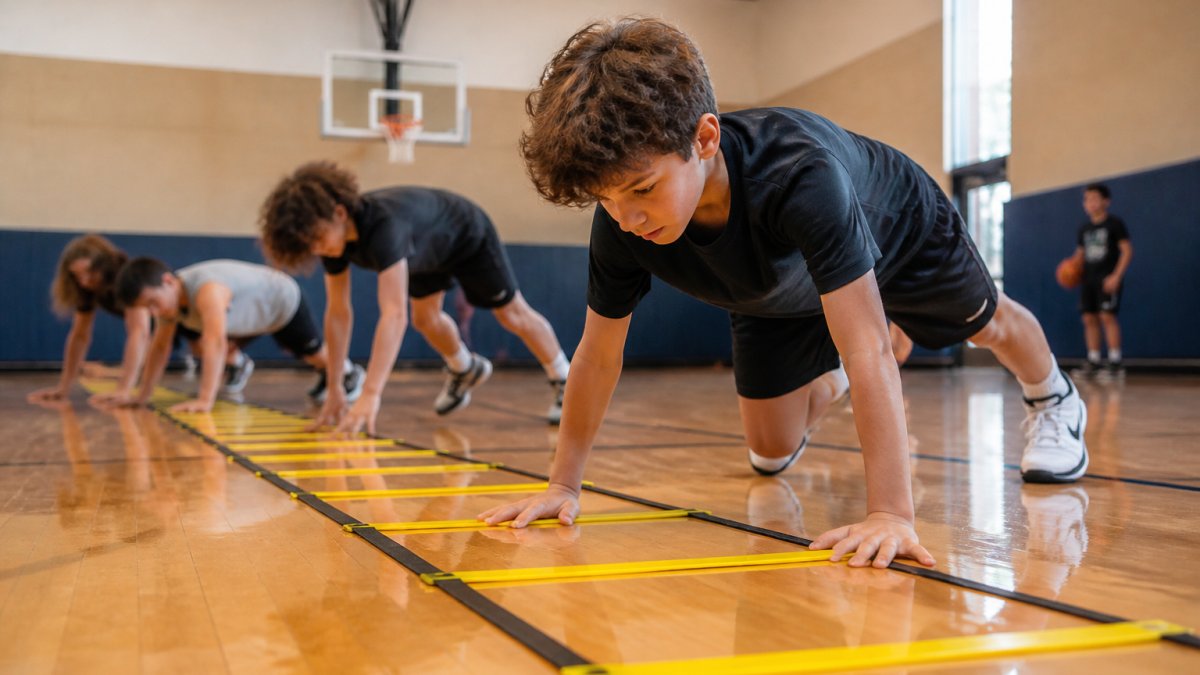
Ladder Drill Sequence:
- Place agility ladder on floor
- Step into each square with one foot, then the other
- Progress through ladder as quickly as possible while maintaining control
- Perform 4-6 passes through the ladder
- Focus on quick feet and low center of gravity
Cone Sprint Patterns:
- Set up three cones in a triangle (approximately 3 meters apart)
- Sprint from cone 1 to cone 2, then to cone 3, then back to cone 1
- This creates a triangle pattern
- Perform 6-8 repetitions with 90 seconds rest between sets
Shuttle Runs and Court Movement
Shuttle runs develop the ability to accelerate, decelerate, and change direction, core basketball movements.
Half-Court Shuttle Runs:
- Start at baseline, sprint to free-throw line and back
- Sprint to center court and back
- Complete in one continuous motion
- Perform 5-6 repetitions with 2 minutes rest between sets
Full-Court Shuttle Runs:
- Start at one baseline, sprint to opposite baseline and back
- This is one repetition
- Perform 4-5 repetitions with 3 minutes rest between sets
Building a Basketball Conditioning Workout Plan for Young Players
A structured plan ensures young athletes develop all components of conditioning systematically.
Work-to-Rest Ratios and Session Duration
Young athletes recover faster than adults but still need adequate rest. Work-to-rest ratios determine the intensity and purpose of each drill.
Session Structure:
- Warm-up: 5-10 minutes of light movement and stretching
- Main conditioning work: 20-30 minutes
- Cool-down: 5-10 minutes of walking and stretching
- Total session: 30-50 minutes depending on age and fitness level
Work-to-Rest Ratios:
- For speed and explosiveness drills: 1:2 or 1:3 ratio (30 seconds work, 60-90 seconds rest)
- For endurance drills: 1:1 ratio (60 seconds work, 60 seconds rest)
- For skill-based drills: 1:1 ratio with active recovery
- Younger players need more rest between high-intensity efforts
Age-Specific Progressions and Modifications
Young athletes develop at different rates. Progressions should match individual readiness, not just age.
Ages 7-10 (Introductory Level):
- Focus on movement patterns and coordination
- Use bodyweight exercises only
- Keep sessions to 30-40 minutes
- Emphasize fun and skill development over intensity
- Modify push-ups and pull-ups as needed
- Lower plyometric boxes to under 30 cm or less
Ages 11-13 (Intermediate Level):
- Add basic resistance training with light weights or bands
- Increase session duration to 40-50 minutes
- Introduce more complex agility patterns
- Begin tracking performance metrics
- Increase plyometric intensity gradually
Ages 14-16 (Advanced Level):
- Add progressive resistance training
- Extend sessions to 50-60 minutes
- Introduce more demanding plyometric exercises
- Develop specialized conditioning for position-specific demands
- Track metrics consistently to measure progress
In-Season Versus Off-Season Conditioning
Conditioning focus shifts based on the basketball calendar. Off-season builds capacity. In-season maintains it while supporting skill development.
Off-Season Conditioning (May-September):
- Build base strength and aerobic capacity
- Focus on movement quality and technique
- Increase training volume gradually
- Emphasize plyometric development
- Conditioning sessions 3-4 times per week
In-Season Conditioning (October-April):
- Maintain strength with 1-2 sessions per week
- Focus on sport-specific conditioning
- Shorter, more intense sessions
- Emphasize recovery and injury prevention
- Coordinate with team practice schedules
Basketball Stamina Workouts for Kids: Endurance and On-Court Conditioning
Basketball requires sustained effort with explosive bursts. Building stamina means young players can perform at high intensity throughout games.
Aerobic Conditioning and Game-Simulation Drills
Aerobic conditioning builds the aerobic base that supports basketball performance. Game-simulation drills teach athletes to perform under game-like conditions.
Continuous Running:
- Have young athletes run at moderate intensity for 8-12 minutes
- Maintain conversational pace (able to speak in short sentences)
- Perform 1-2 times per week during off-season
- This builds aerobic capacity without excessive fatigue
Game-Simulation Drills:
- Combine multiple basketball movements in one sequence
- Example: Sprint to baseline, defensive slide to wing, sprint to opposite corner, backpedal to top of key
- Perform 4-6 repetitions with 2 minutes rest
- This teaches young players how to sustain effort through varied movements
Warm-Ups, Cooldowns, and Injury Prevention
Proper warm-ups prepare bodies for conditioning work. Cooldowns aid recovery and reduce soreness.
Pre-Conditioning Warm-Up (5-10 minutes):
- Light jogging or walking for 2-3 minutes
- Dynamic stretches: leg swings, arm circles, walking lunges
- Movement preparation: gradual increase in intensity
- Never stretch cold muscles, save static stretching for cooldown
Post-Conditioning Cool-Down (5-10 minutes):
- Slow walking for 2-3 minutes
- Static stretching: hold each stretch 20-30 seconds
- Focus on legs, hips, and shoulders
- This reduces soreness and aids recovery
Injury Prevention Tips:
- Ensure proper form before increasing intensity
- Progress gradually, avoid sudden jumps in volume or intensity
- Allow adequate rest between sessions (at least one day)
- Address pain immediately, don't push through sharp pain
- Hydrate consistently throughout conditioning sessions
Tracking Progress and Measuring Basketball Performance Gains
Progress tracking motivates young athletes and guides training adjustments.
| Metric | How to Measure | Frequency | Target Improvement |
|---|---|---|---|
| Vertical Jump | Measure highest point reached on wall | Monthly | Add 2.5-5 cm |
| Sprint Time | Time 12-meter sprint | Monthly | Reduce time by 0.1-0.2 seconds |
| Shuttle Run Time | Time half-court shuttle | Monthly | Reduce time by 0.2-0.3 seconds |
| Push-Ups | Count reps in 60 seconds | Monthly | Add 2-3 reps |
| Plank Hold | Time how long plank can be held | Monthly | Add 10-15 seconds |
Keep a simple notebook or digital record. Record dates, exercises, reps, and times. Review progress monthly and adjust training based on results.
Young athletes respond well to visible progress. Seeing improvement motivates continued effort and builds confidence. Share progress with parents and coaches to celebrate gains.
Common Mistakes to Avoid in Youth Basketball Conditioning
Understanding what doesn't work prevents wasted effort and injury.
Skipping Warm-Ups: Young athletes often want to jump straight into conditioning.
Progressing Too Quickly: Adding too much volume or intensity too fast leads to burnout or injury.
Ignoring Form: Young athletes sometimes sacrifice form for speed or reps.
Neglecting Recovery: Rest is when adaptation happens.
One-Dimensional Training: Focusing only on running or only on strength misses important components.
Comparing Athletes: Young athletes develop at different rates.
Ready to develop your young athlete's conditioning? Sport for Life provides evidence-based guidance on youth athletic development to ensure training aligns with developmental stages.
Frequently Asked Questions
How often should young basketball players do conditioning workouts?
Most youth players benefit from 2-3 structured conditioning sessions per week, spread across different days to allow recovery. During the competitive season, conditioning often integrates into practice, while off-season training can be more focused. Younger players (ages 7-10) need shorter, less intense sessions with more rest days, while older youth (ages 11-16) can handle increased frequency and intensity. Always prioritize recovery and listen to your body to prevent overtraining.
What is the ideal length for a youth basketball conditioning workout?
A typical youth basketball conditioning session should last 30-45 minutes, depending on age and fitness level. Younger players (7-10 years) work best with 20-30 minute sessions including warm-up and cooldown, while competitive youth (11-16 years) can handle 40-50 minute workouts. Each session should include a 5-minute dynamic warm-up, 25-35 minutes of conditioning drills and strength work, and a 5-minute cooldown with stretching.
What conditioning exercises are safe for young basketball players?
Bodyweight exercises like squats, lunges, push-ups, and planks are safe when performed with proper form and age-appropriate modifications. Plyometric work such as controlled jump squats and box jumps should be introduced gradually, starting around age 10-11 with proper instruction. Always warm up thoroughly, use progressive overload (gradually increasing difficulty), and focus on movement quality over speed. Avoid heavy resistance training for younger players and always have qualified supervision during conditioning sessions.
How can youth basketball players improve their stamina and endurance?
Basketball stamina workouts for kids should combine aerobic conditioning (shuttle runs, suicide drills) with game-simulation drills that mimic on-court intensity. Interval training, alternating high-intensity efforts with recovery periods, builds anaerobic capacity specific to basketball. Gradually increase the duration and intensity of conditioning drills over weeks and months. Pair conditioning with proper nutrition, hydration, and sleep to support endurance gains. Consistent practice on the basketball floor with game-like movement patterns strengthens sport-specific stamina.