 ultimate-guide
Basketball Footwork for Young Players: Why It Matters
Table of Contents
- Why Basketball Footwork Is Essential for Young Players
- The Foundation: Balance, Stability, and Court Awareness
- Basketball Footwork Drills for Beginners
- Basketball Pivot Foot Rules and Triple Threat Positioning
- Youth Basketball Defensive Stance and Lateral Movement
- Preventing Common Footwork Mistakes and Injuries
- Age-Appropriate Progression: Building Footwork Confidence Over Time
- Frequently Asked Questions
Last Updated: September 28, 2026
Why Basketball Footwork Is Essential for Young Players
Basketball footwork young players need is the foundation that determines whether a child can move efficiently, stay balanced under pressure, and develop into a confident athlete. Proper footwork separates players who struggle with basic movement from those who control the court.
Proper footwork builds court awareness, prevents injuries, and creates the neurological pathways for instinctive reactions. Without it, talented kids hit a ceiling around age 10 or 11 when footwork gaps become impossible to hide.
Basketball footwork young players aged 6-10 learn is during the "golden window" for motor skill development. Skills learned now stick; skills ignored become habits that are exponentially harder to break later.
The Foundation: Balance, Stability, and Court Awareness
Balance and stability form the bedrock of every movement a basketball player makes. Poor balance prevents accurate shooting, effective defense, and directional changes.
Young players develop balance through repetition and proprioceptive feedback. When a 7-year-old practices pivoting or sliding laterally, their brain maps body movement through space. Without deliberate practice, young players remain clumsy on the court.
Court awareness grows alongside balance. A player who understands their body's position in space can track teammates and opponents without constantly looking down.
Basketball Footwork Drills for Beginners
Footwork drills must be sequenced to match neurological readiness and coordination level. The drills below are organized by developmental stage with progression markers.
Ages 6-8: Foundation Drills (Proprioceptive Awareness)
At this age, drills should be stationary or involve minimal movement, emphasizing balance and body awareness to build the proprioceptive foundation.
The two-foot stance drill teaches young players to recognize their center of gravity. Have them stand with feet shoulder-width apart, knees slightly bent, weight on the balls of their feet, and call out arm movements while they maintain the stance for 30 seconds.
The single-leg balance drill isolates ankle and hip stability. Players stand on one leg, lift the other knee to hip height, and hold for 15-20 seconds per side. Progress by having them catch a ball while balancing or stand on a foam pad.
The pivot foot drill introduces the concept of a planted foot. Have young players stand with one foot planted and rotate their body 180 degrees without moving that foot. Alternate sides, holding each rotation for 5-10 seconds. This teaches the rule of pivoting and the difference between the pivot foot (stationary) and the free foot (can move).
Progression marker: When a young player can hold a two-foot stance for 30 seconds without looking down, and can balance on one leg for 20 seconds while catching a ball, they are ready for dynamic movement drills.
Ages 9-11: Dynamic Movement Drills (Motor Control and Coordination)
Once proprioceptive awareness is established, young players can handle dynamic drills that teach footwork patterns used in games.
The defensive slide drill teaches lateral quickness without crossing feet. Players stand in a defensive stance and shuffle side to side for 10-15 seconds, keeping steps small and controlled. Progress by adding a coach who points a direction, forcing the young player to react and change direction mid-slide.
The stutter step drill develops the ability to plant and change direction explosively. Players take two quick steps forward, plant their outside foot, and push back to the starting position. Perform 10-15 repetitions per side, then progress by adding a defender.
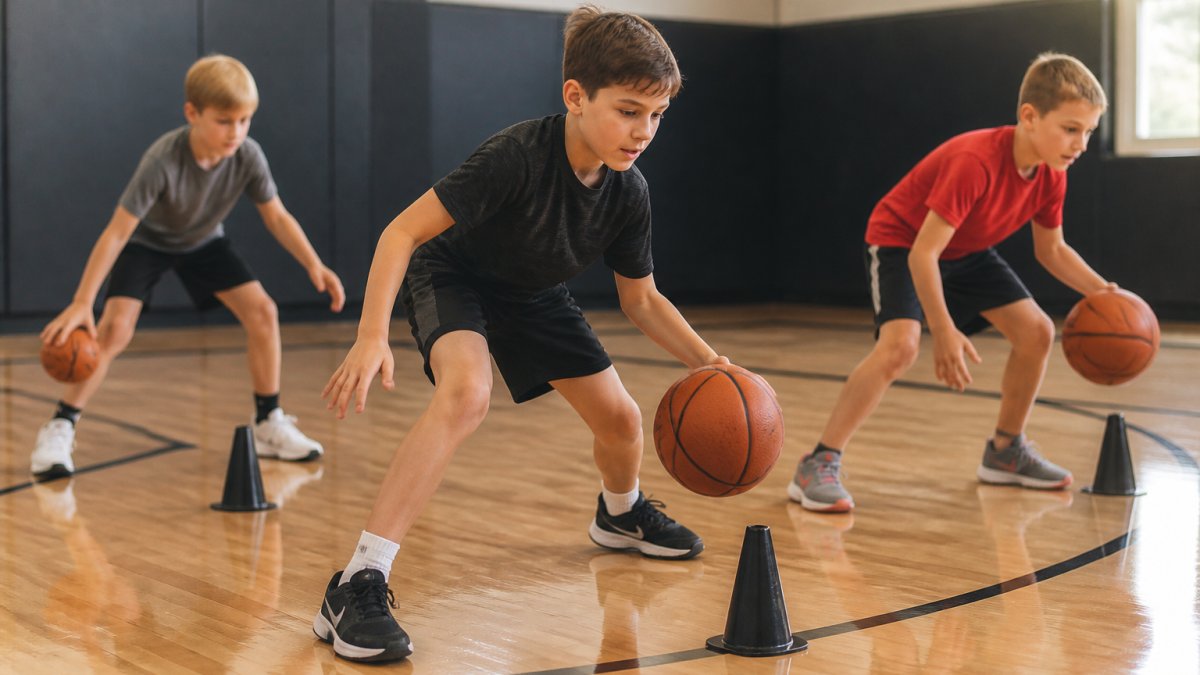
The figure-eight dribble drill integrates footwork with ball handling and court awareness. Players dribble around two cones in a figure-eight pattern, keeping their head up. Progress from 50% to 100% speed as coordination improves.
The cone weave drill teaches change of direction and foot placement. Players dribble in and out of a line of cones (spaced 1-1.5 metres apart), using a crossover dribble and planting the outside foot to push off explosively.
Progression marker: When a young player can execute a defensive slide for 30 seconds without crossing feet, and can perform a stutter step with a controlled plant and explosive push-off, they are ready for position-specific and game-speed drills.
Ages 12+: Position-Specific and Game-Speed Drills (Advanced Motor Control)
At this stage, young players can handle complex footwork patterns and game-speed intensity. Drills should be position-specific and simulate game situations.
The jab step and crossover drill teaches guards how to create space for shots.
| Drill | Age Range | Purpose | Key Cue | Progression |
|---|---|---|---|---|
| Two-foot stance | 6-8 | Body awareness | "Feel your weight on the balls of your feet" | Add arm movements |
| Single-leg balance | 6-8 | Ankle stability | "Keep your hips level" | Add ball handling |
| Pivot foot rotation | 6-8 | Pivot understanding | "Keep your foot planted; rotate your body" | Add defensive pressure |
| Defensive slide | 9-11 | Lateral quickness | "Push off your outside foot; don't cross your feet" | Add directional cues |
| Stutter step | 9-11 | Change of direction | "Plant and push; don't stomp" | Add defender pressure |
| Figure-eight dribble | 9-11 | Coordination | "Keep your head up; feet and hands work together" | Increase speed |
| Jab step and crossover | 12+ | Shot creation | "Quick jab; explosive crossover" | Add defender |
| Post footwork | 12+ | Post moves | "Quick plant; explosive spin" | Add defender |
Basketball Pivot Foot Rules and Triple Threat Positioning
The pivot foot rule is often misunderstood. A player may pivot on one foot without traveling, rotating their body while keeping that foot in contact with the floor.
Youth Basketball Defensive Stance and Lateral Movement
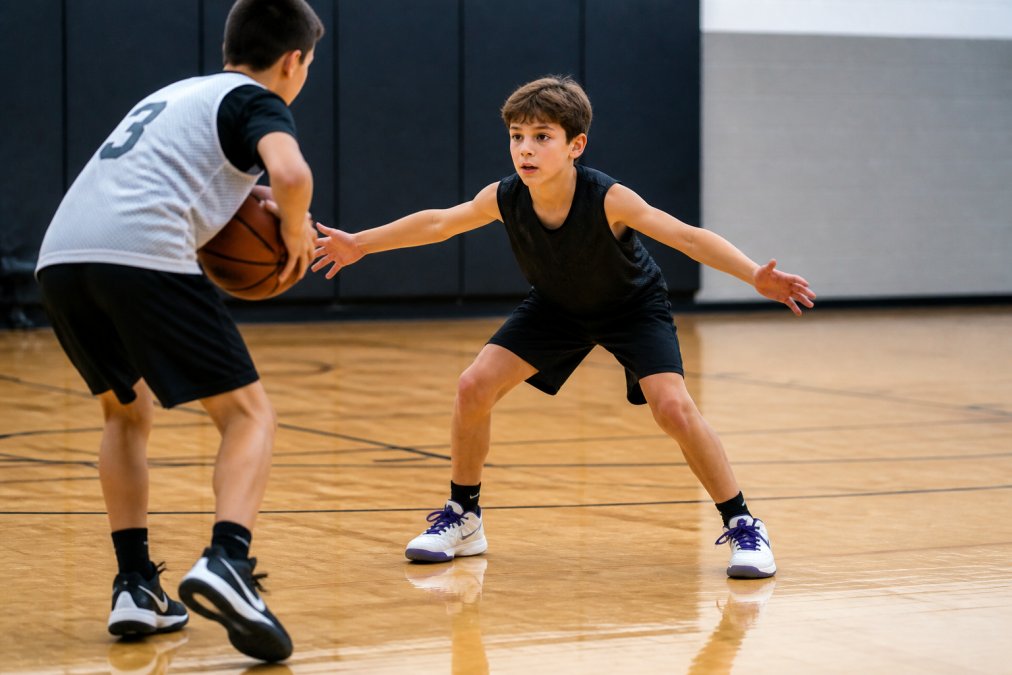
The defensive stance is the starting position for all defensive footwork: feet shoulder-width apart, knees bent, weight on the balls of the feet, arms extended for balance. Young players who master this stance can slide laterally without losing balance.
Preventing Common Footwork Mistakes and Injuries
Footwork mistakes are not just inefficient, they are injury risk factors. Understanding common mistakes and how to self-correct them is essential for long-term athletic health.
Common Footwork Mistakes and How to Self-Correct Them
Mistake 1: Planting feet before the body is ready to move ("False steps")
Mistake 3: Landing with locked knees or poor alignment
The Kinetic Chain: How Footwork Connects to Injury Prevention
The kinetic chain is the connection from the feet through the ankles, knees, hips, and core to the shoulders and arms. When footwork is poor, this chain breaks, forcing young players to rely on their arms and upper body to compensate. Proper footwork, with bent knees and aligned joints, distributes force across multiple joints, protecting each one.
Age-Specific Injury Prevention Through Footwork
Young players aged 6-10 are at risk for ankle sprains and minor knee injuries; footwork drills that emphasize balance reduce this risk. Young players aged 11-14 are at increased risk for growth-related injuries; footwork that emphasizes controlled landings reduces stress on growth plates. Young players aged 15+ are at risk for ACL injuries; research shows neuromuscular training programs that emphasize proper landing mechanics reduce ACL injury risk by 50-70%.
Self-Assessment: Is Your Young Player's Footwork Protecting Them?
Use these checkpoints to assess whether a young player's footwork is reducing injury risk: (1) Landing mechanics: knees bend, knees aligned over ankles; (2) Lateral movement: feet stay moving, no crossing feet; (3) Pivoting: pivot foot stays planted, body rotates smoothly; (4) Reaction time: reset to ready position before moving.
Age-Appropriate Progression: Building Footwork Confidence Over Time
Footwork development follows a natural progression based on age and coordination level. Ages 4-6: Focus on basic movement patterns and body awareness. Ages 7-9: Add complexity to footwork drills; this is the golden window for building motor skill foundations. Ages 10-12: Integrate footwork with game situations. Ages 13-16: Refine footwork for specific positions and playing styles.
Frequently Asked Questions
What are the most common footwork mistakes young basketball players make?
Young players often stand too upright with a narrow base of support, limiting agility and balance. They frequently fail to establish proper pivot foot positioning, leading to traveling violations. Many rush their movement without controlling their center of gravity, causing poor shot preparation and defensive vulnerability. Correcting these habits early, through deliberate drill repetition and coaching feedback, builds proper body control that transfers directly to game situations.
How does proper basketball footwork prevent injuries in young athletes?
Correct footwork develops neuromuscular control and landing mechanics that protect joints during change of direction and deceleration. Proper defensive stance distributes force evenly across the base of support, reducing strain on knees and ankles. Strong kinetic chain awareness helps young players absorb impact safely and maintain stability during explosive movements. This injury mitigation becomes critical during the developmental years when growth plates are still forming.
At what age should young players start focusing seriously on basketball footwork?
Ages 7-10 represent the golden window for motor skill development. During this phase, young players develop coordination and movement efficiency most rapidly. Starting footwork fundamentals at age 7 allows players to build automaticity by their early teens, when competitive demands increase. However, introductory footwork concepts, like basic balance and stepping patterns, can begin even earlier in recreational settings for ages 4-6.
What is the triple threat position and why does it matter for young basketball players?
The triple threat position combines proper footwork with ball handling readiness: feet shoulder-width apart, knees slightly bent, and the ball held at chest level. This stance gives players the option to shoot, pass, or dribble immediately. Mastering triple threat positioning teaches young players court awareness and offensive efficiency, as it forces them to think about spacing and shot preparation before receiving the ball. It's foundational for developing into a versatile player.