 Ultimate guide
How Should Intermediate Basketball Players Build Strength?
Last Updated: October 24, 2026
Quick Summary
Basketball strength and conditioning for intermediate players builds lower-body power, upper-body stability, and core strength through compound movements like squats, bench press, and pull-ups, integrated with basketball-specific conditioning drills using work-to-rest intervals that mirror game demands.
- Structure strength training around compound movements involving multiple joints rather than isolation exercises.
- Use a 1:3 work-to-rest ratio starting point, progressing to 1:2 or 1:1 as fitness improves over 6 weeks.
- Retest conditioning benchmarks every 4-6 weeks, including repeat sprint tests and defensive slide tests.
- In-season training reduces to 2-3 strength sessions per week to manage fatigue from games and practice.
- Perform skill work first when fresh, then strength training, then conditioning, separated by at least 6 hours if combined.
Table of Contents
- Why Basketball Strength and Conditioning Matters for Intermediate Players
- Understanding the Physical Demands of Basketball
- Building a Basketball Strength Training Program
- Integrating Basketball Conditioning Drills Into Your Routine
- Your Weekly Basketball Workout Plan for Intermediate Players
- In-Season Basketball Strength Training and Load Management
- Preventing Injury and Optimizing Recovery
- Start Your Basketball Development at Tier 1 Sports
- Frequently Asked Questions
Why Basketball Strength and Conditioning Matters for Intermediate Players
Intermediate players sit at a critical inflection point: past recreational play, not yet elite. This is where basketball strength and conditioning becomes the difference between stalling out and breaking through.
Raw athleticism alone won't cut it. Your body must handle the contact, repeated sprinting, and explosive movements that separate intermediate from recreational play.
Basketball strength and conditioning for intermediate players isn't about becoming a bodybuilder.
Understanding the Physical Demands of Basketball
Basketball is repeated explosive movements interrupted by brief recovery: sprinting, stopping hard, jumping, landing, and changing direction in seconds, then again.
Demands vary by position. A guard needs explosive first-step quickness and rapid direction changes. A forward needs lower-body power for rebounding and upper-body strength to hold position.
All positions share common demands: accelerate quickly, decelerate without injury, jump repeatedly without fatigue breaking down mechanics, and stay stable while pushed and pulled.
Building a Basketball Strength Training Program
A basketball strength training program for intermediate players needs three components: lower-body power, upper-body stability, and core strength. The goal is progressive overload, gradually increasing demands so your body adapts.
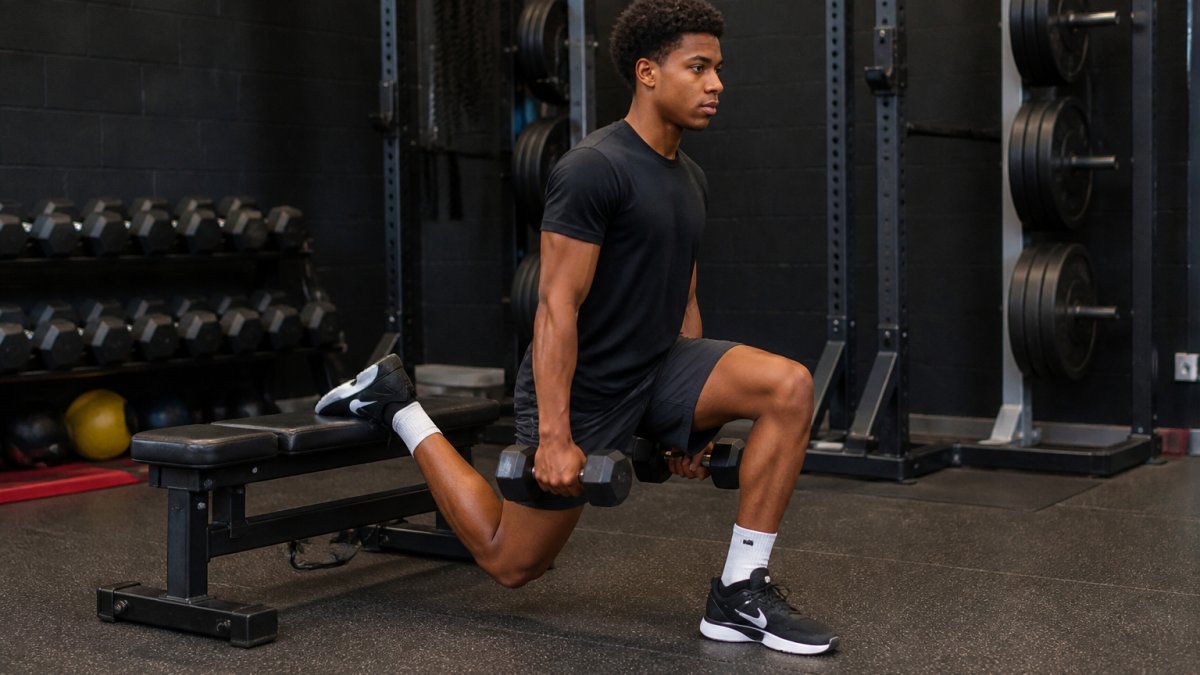
Structure your program around compound movements involving multiple joints and muscle groups, more basketball-specific than isolation exercises and more efficient for building real-world strength.
Lower-Body Strength Foundation
Lower-body strength is non-negotiable.
The rear-foot-elevated split squat is one of the best for basketball-specific lower-body development.
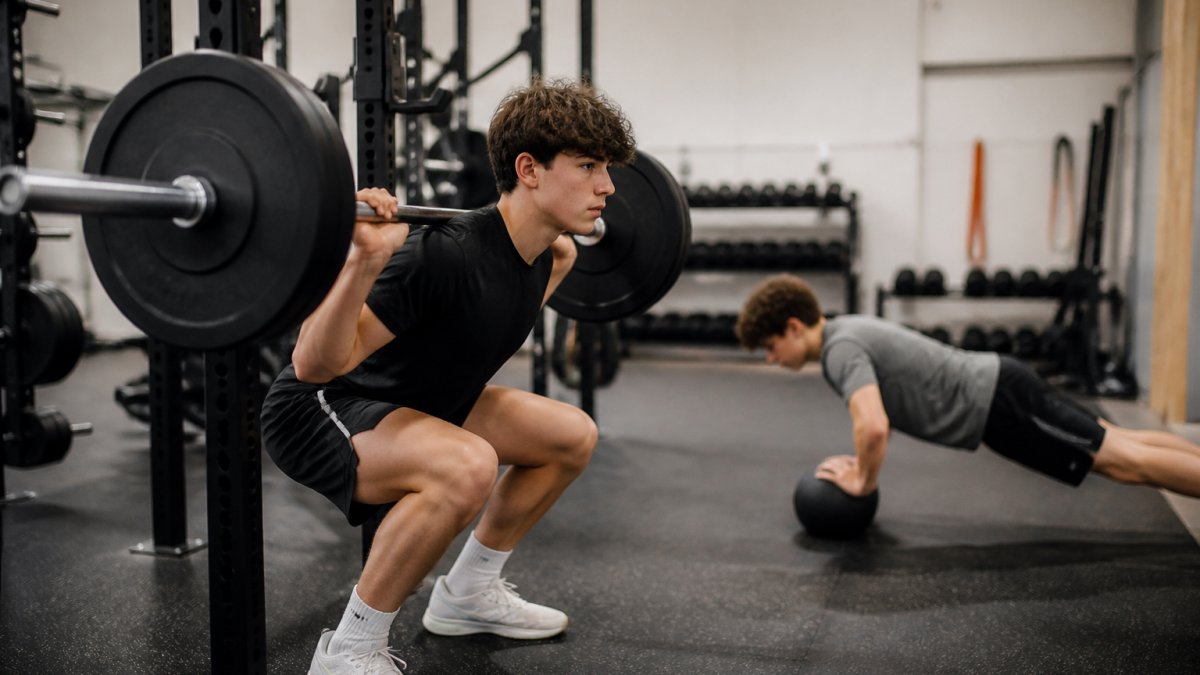
The back squat builds overall lower-body power. Load weight on your shoulders, bend at the knees and hips, and drive back up.
Depth jumps develop explosive power. Step off a low box (don't jump), land on both feet, and immediately jump as high as possible.
Upper-Body and Core Power
Upper-body strength matters more than many intermediate players realize: shoulder stability to shoot under pressure, chest strength to hold your ground, and back strength to maintain posture and generate force.
Push-ups and variations build chest and shoulder stability; bench press with a barbell or dumbbells adds serious strength; pull-ups and rows strengthen your back and pulling power for rebounding and holding position.
Core strength ties everything together. A weak core means lower-body power doesn't transfer efficiently, your vertical jump suffers, and shooting mechanics break down under fatigue.
Integrating Basketball Conditioning Drills Into Your Routine
Strength training builds the foundation, but basketball conditioning drills train you to use that strength in actual movement patterns. The goal isn't just to get tired, it's to repeat game-speed efforts without mechanics breaking down, using basketball-specific intervals, work-to-rest guidance, and benchmarks retested every 4-6 weeks.
Basketball-Specific Conditioning Intervals
Basketball is stop-start: a 2-5 second explosive action followed by 10-30 seconds of lower-intensity recovery, repeated for 30-40 minutes. Mirror that with these three interval templates, rotated across the week:
- Short-burst repeats (repeat sprint ability): 10-20 seconds of maximal effort (e.g., full-court sprint, defensive slide drill, or 17-second suicide) followed by 40-60 seconds of walking recovery. Perform 8-12 repetitions. This trains the phosphagen system and your ability to recover between possessions.
- Tempo runs with skill: 30 seconds at 70-80% effort (e.g., dribble weave, backpedal-to-sprint) followed by 30 seconds of active recovery (walking, light dribbling). Perform 10-15 rounds. This builds aerobic capacity without the joint stress of continuous running.
- Game-simulation circuits: 2-3 minutes of continuous basketball movement (sprint, shuffle, backpedal, jump, repeat) with 60-90 seconds rest. Perform 4-6 rounds. This mimics the fatigue of a full quarter and teaches you to execute skills under duress.
Work-to-Rest Guidance and Progression
Start with a 1:3 work-to-rest ratio (e.g., 15 seconds work, 45 seconds rest) and progress to 1:2 or 1:1 as fitness improves:
- Weeks 1-2: 8 rounds of 15s work / 45s rest.
- Weeks 3-4: 10 rounds of 15s work / 40s rest.
- Weeks 5-6: 12 rounds of 15s work / 30s rest, or add a second conditioning day.
If your performance drops by more than 10% within a set (e.g., sprint times slow noticeably or jump height decreases), end the set. Quality over quantity.
Measurable Benchmarks
Retest these every 4-6 weeks to confirm conditioning is improving:
- Repeat sprint test: 6 × 30-meter sprints with 20 seconds rest. Record the average and the drop-off between fastest and slowest. A drop-off under 5% indicates good repeat-sprint ability.
- Yo-Yo intermittent recovery test (Level 1): A validated field test for basketball. Track the distance covered; intermediate players should aim to improve by 1-2 shuttles per retest.
- Defensive slide test: 3 × 30-second defensive slides with 30 seconds rest. Count total slides; aim for consistent or increasing totals.
Log the results. If conditioning stalls, adjust the work-to-rest ratio or add one session per week, never at the expense of strength or skill work.
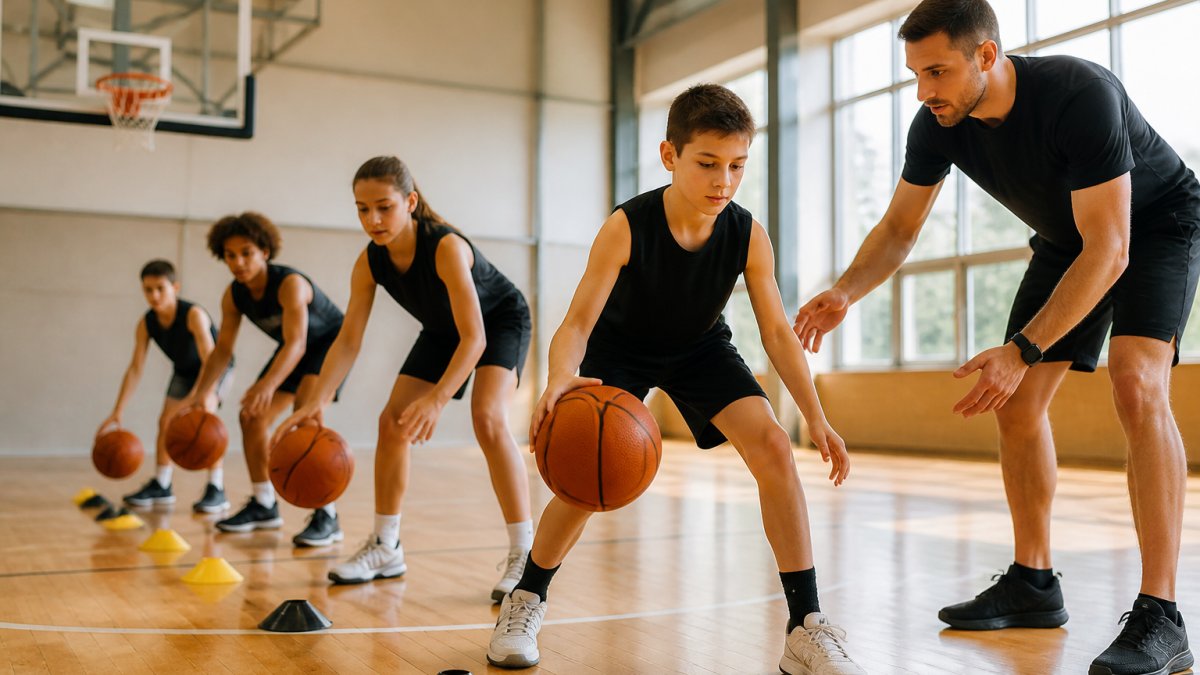
Court-Based Conditioning Drills
- Suicide sprints with push-ups: Run baseline-to-free-throw-line and back, then 5 push-ups; repeat to half-court, then 5 push-ups; repeat to far free-throw line, then 5 push-ups; repeat full court. Rest 90 seconds. Perform 3-5 rounds.
- Lateral shuffle to sprint: 10 meters lateral shuffle, plant, sprint 10 meters, backpedal 10 meters. Rest 30 seconds. Perform 6-8 rounds.
- Jump-and-recover: 5 consecutive maximal vertical jumps, then 20 seconds rest. Perform 6-8 sets. This trains jumping under fatigue, critical for rebounding late in games.
Your Weekly Basketball Workout Plan for Intermediate Players
A complete basketball strength and conditioning program must integrate lifting, conditioning, skill work, and rest into a realistic week. The biggest mistake intermediate players make is treating strength training as separate from basketball, then wondering why they're fatigued or not improving.
Weekly Schedule: Off-Season (No Team Practice)
This template assumes 4 strength sessions, 2 conditioning sessions, and 3-4 skill sessions. Adjust based on your schedule, but keep at least one full rest day.
| Day | Session | Focus | Notes |
|---|---|---|---|
| Monday | Strength A (lower) | Squat, split squat, depth jumps, core | Keep jumps low-volume (3×5) |
| Tuesday | Conditioning + skill | Short-burst intervals, shooting | Conditioning after skill, not before |
| Wednesday | Strength B (upper) | Bench/push-ups, rows, pull-ups, core | Add mobility work |
| Thursday | Skill + light agility | Shooting, ball-handling, ladder drills | Keep intensity moderate |
| Friday | Strength C (lower power) | Front squat, Bulgarian split squat, vertical jumps | Emphasize bar speed |
| Saturday | Conditioning + skill | Game-simulation circuits, live play | Full rest after |
| Sunday | Rest | Complete rest or light walk | Sleep and nutrition focus |
Weekly Schedule: In-Season (With Team Practice and Games)
In-season, prioritize maintaining strength and staying fresh. Reduce to 2 strength sessions per week, ideally on non-game days at least 48 hours before a game.
- Monday (post-game recovery): Light mobility, foam rolling, optional upper-body flush (high-rep, low-load).
- Tuesday (strength): Full-body session, squat or trap-bar deadlift 3×5, bench or push-ups 3×8, rows 3×10. Keep volume low.
- Wednesday (practice): Team practice counts as skill and conditioning.
If you have two games per week, drop to one strength session and focus on recovery. Load management is more important than maintaining every lift.
Progression for Intermediate Players
Intermediate means at least 6-12 months of consistent training and basic technique. Progress by adding weight or reps, not exercises. When you can complete all prescribed reps with 2 in reserve, increase the load 2.5-5% next session.
Every 4th week, reduce volume by 40-50% (deload) to manage fatigue. This is not optional for intermediate players, it's how you keep progressing without burning out.
Integrating Court Practice and Lifting
The order matters: skill work first (when fresh), then strength, then conditioning. If you must combine, separate strength and conditioning by at least 6 hours. Avoid heavy lower-body lifting the day before a game or intense practice, your legs need to be fresh for jumping and sprinting.
Adjusting for Limited Equipment
No barbell? Use dumbbells, kettlebells, or bodyweight progressions. Replace back squats with goblet squats or split squats, bench press with push-up variations, and pull-ups with inverted rows. The principles, progressive overload, compound movements, recovery, remain the same.
In-Season Basketball Strength Training and Load Management
In-season is about maintenance and managing fatigue. With games, travel, and cumulative competitive stress, your strength training must support recovery while maintaining what you built.
Reduce frequency and volume: drop from 4-5 strength sessions per week to 2-3. Focus on compound movements. A 30-minute session of heavy squats, bench press, and rows once or twice weekly is enough.
Watch load management. Playing 2-3 games per week already stresses your body; heavy lifting on top accelerates fatigue and injury risk.
Conditioning during the season comes from playing games and practice. You don't need additional sprint work on top of game demands.
Preventing Injury and Optimizing Recovery
Injury prevention starts with proper form and progressive overload. Don't jump into heavy weights before you're ready. Build movement quality first, then add load gradually.
Warm-up properly before every session. Dynamic stretching, activation work, and movement prep prepare your nervous system and muscles for training.
Recovery is where adaptation happens, muscles grow stronger while you rest, not during training. Sleep is non-negotiable: aim for 7-9 hours per night (The Sleep and Recovery Practices of Athletes).
Consider Sport Canada's guidance on youth athlete recovery for age-appropriate recovery protocols. Recovery strategies like foam rolling and stretching help manage muscle tension, but they're supplementary.
If you feel pain (not muscle soreness, but sharp or persistent pain), stop and assess. Review Common Basketball Injuries in Youth Athletes: Prevention Guide for basketball-specific prevention strategies.
| Training Phase | Strength Sessions | Conditioning Sessions | Primary Focus |
|---|---|---|---|
| Off-Season | 4-5 per week | 1-2 per week | Progressive overload, power development |
| Preseason | 3-4 per week | 2-3 per week | Strength maintenance, game-speed conditioning |
| In-Season | 2-3 per week | 0-1 per week | Strength maintenance, load management |
Start Your Basketball Development at Tier 1 Sports
Building basketball strength and conditioning as an intermediate player requires consistency, proper programming, and expert guidance.
At Tier 1 Sports, we work with intermediate players serious about progressing. Our coaching staff designs programs tailored to your needs. We assess where you are, build a program that matches your needs, and adjust it as you improve.
We integrate strength training, basketball conditioning, and court skill development into a cohesive plan. Every session builds toward on-court performance.
Beyond programming, we manage the mental side of development. Training smart is what separates players who progress from those who plateau. Prepare for REP tryouts and competitive play through expert coaching and advanced drills with our elite training program designed specifically for players ready to take the next step.
Frequently Asked Questions
How many days per week should intermediate basketball players strength train?
Most intermediate players benefit from 3-4 strength training sessions per week, spread across different muscle groups. This frequency allows sufficient recovery between sessions while building progressive overload. Off-season can support 4 sessions; during the competitive season, reduce to 2-3 maintenance sessions to prioritize game performance and avoid overtraining.
What's the best basketball strength training program structure for intermediate players?
A basketball strength training program should alternate between lower-body and upper-body focus days, incorporating compound lifts like back squats and Bulgarian split squats. Include plyometric training for explosive power, core stability work, and basketball-specific power movements. Periodize training into off-season (building phase), preseason (power phase), and in-season (maintenance phase) to match your competitive calendar.
How long should basketball conditioning drills last?
Basketball conditioning drills typically last 15-25 minutes, performed 2-3 times per week. Include interval-based work mimicking game intensity: short sprints (10-40 metres), change-of-direction agility drills, and sport-specific movement patterns. Conditioning should complement strength training, not replace it. Track measurable benchmarks like 40-metre sprint time or pro-agility test results to monitor progress.
Can intermediate players do in-season basketball strength training without getting fatigued?
Yes, in-season basketball strength training is essential for maintaining performance and preventing injury. Focus on 2-3 sessions weekly with reduced volume and intensity compared to off-season work. Prioritize movement quality, core stability, and lower-body maintenance. Allow adequate recovery between games and training, adjusting load based on game schedule and player fatigue levels to support both court performance and adaptation.
What basketball-specific power exercises should intermediate players prioritize?
Prioritize depth jumps, box jumps, and explosive variations of compound lifts to build basketball-specific power. Vertical jump development directly impacts rebounding and defensive positioning. Include lateral movements like lateral bounds and change-of-direction drills to develop agility. Combine these plyometric movements with strength training to translate raw strength into game-relevant explosive power and speed.
How should intermediate players balance strength training with court practice?
A complete weekly basketball workout plan integrates 3-4 strength sessions, 3-4 court practices, and conditioning work while maintaining recovery days. Avoid lifting on the same day as intense game preparation. Schedule heavy strength work on days with lighter court practice. Periodization helps: build strength off-season, develop power in preseason, and maintain fitness during the competitive season while prioritizing game performance.
The foundation you build now determines what's possible later. Basketball strength and conditioning for intermediate players isn't just about getting stronger. It's about building the physical resilience to compete at higher levels, stay healthy through a full season, and realize your potential as a player. Consistency beats intensity. Progressive overload beats heroic effort. And proper coaching beats trial and error every time.