 Ultimate guide
7 Benefits of Multi-Sport Play for Basketball Players
Last Updated: November 1, 2026
Quick Summary
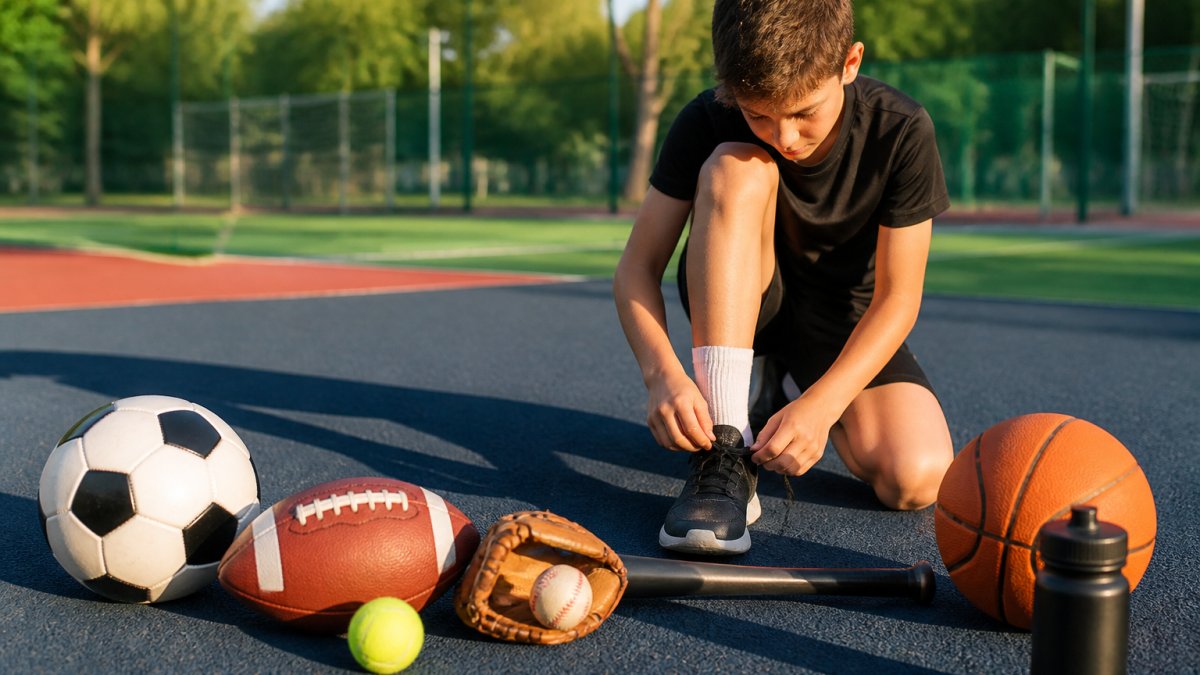
Multi-sport participation is the practice of playing several sports across a year rather than committing to one exclusively, and it builds better basketball players by developing movement vocabulary, coordination, and durability that single-sport training cannot supply. These benefits show up in footwork, decision-making, and injury resilience long before they show up on the scoreboard.
- Pick a second sport that trains a quality basketball underdevelops and loads the knees, ankles, and hips less aggressively.
- Map each sport's competitive season and flag any overlap before adding another sport to the schedule.
- Early specialization before adolescence is widely promoted but weakly supported by the research.
- During rapid growth, keep variety high and intensity moderate until coordination smooths out again.
- Tier 1 Sports offers programs for ages 4 to 16 focused on skill development and passion for the game.
Table of Contents
- Why Multi-Sport Participation Builds Better Basketball Players
- Physical and Athletic Development That Transfers to the Court
- Basketball Cross-Training Sports That Sharpen On-Court Performance
- How to Balance Multiple Sports Without Overtraining
- Youth Sports Specialization: What the Evidence Says About Early Focus
- Injury Prevention and Recovery Across a Multi-Sport Season
- Age-by-Age Guidance for Parents and Coaches
- Choosing the Right Basketball Program for a Multi-Sport Athlete
- Frequently Asked Questions
Why Multi-Sport Participation Builds Better Basketball Players
Multi-sport participation is the practice of playing several sports across a year rather than committing to one exclusively, and it builds better basketball players because it develops the movement vocabulary, coordination, and durability that single-sport training cannot supply. Readers who want the deeper framework behind this can explore long-term athletic development in youth basketball.
Here is the part most guides get wrong: they treat multi-sport play as a break from basketball. It is not a break. It is a second classroom.
Basketball rewards athletes who can stop, pivot, and change direction under control. Those qualities come from repetition across many movement patterns, not from one.
That is the throughline here: variety builds the athlete, and the athlete makes the player.
Physical and Athletic Development That Transfers to the Court
Playing multiple sports develops the strength, conditioning, and coordination that transfer directly to basketball performance. Each sport loads different muscle groups and joints, which produces a more balanced athlete than year-round basketball training alone.
Think about what basketball actually demands. Explosive jumps. Lateral slides. Repeated sprints with recovery. Soft landings. A single sport trains some of these well and neglects others. A second sport fills the gaps.
Movement Skills, Coordination and Body Control
Movement skills are the foundational patterns (running, jumping, throwing, catching, balancing) that underpin every sport, and they are best built through wide exposure during childhood. Physical literacy, the confidence and competence to move across many activities, comes from exactly this kind of variety.
Multi-sport athletes often adjust their bodies quickly when catching a pass in traffic. That adaptability is a motor skill built across many different sports, which is hard to coach directly and is largely developed through play. Broadening these physical experiences fosters a more resilient foundation, which is why it is essential to improve mobility for athletes who rely on fluid movement to dominate the court.
Basketball Cross-Training Sports That Sharpen On-Court Performance
The best basketball cross-training sports are those that demand quick direction changes, spatial awareness, and aerobic capacity while loading the body differently than basketball does. The useful question is not "which sport is best" but "which quality does my player need, and which sport trains it without duplicating basketball's load?" Here is how the transfer actually works, sport by sport.
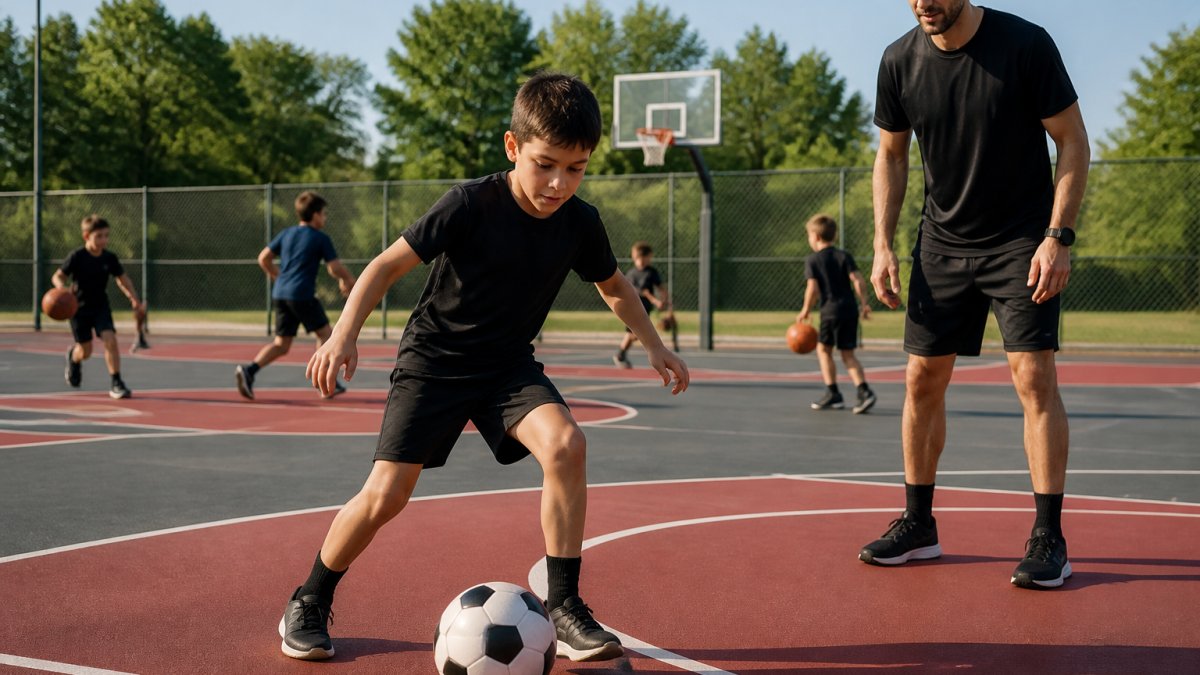
- Soccer builds footwork, conditioning, and the habit of scanning for space. Soccer forces constant small-step adjustments and head-up scanning, which carry over to basketball movement. Soccer's sprinting and cutting volume overlaps with basketball, so running both at full intensity in the same week adds up quickly.
- Track and field develops straight-line speed and jumping mechanics that translate to first-step quickness and rebounding. Sprint mechanics, arm drive, ground contact, posture, carry over to closeouts and transition runs. Field events such as the long jump and high jump teach takeoff and landing control that supports safer rebounding. Coaches who want to put this to work can use these track and field drills for basketball speed.
- Volleyball trains vertical jumping, timing, and hand-eye coordination at the net. The transfer is strongest for timing, reading a set and meeting the ball at peak, which maps to rebounding timing and catching passes in traffic. It also adds overhead shoulder work that basketball rarely trains.
- Swimming builds shoulder durability and aerobic fitness with low joint loading. It is the best complement when a player's weekly basketball and second-sport load is already high, because it adds conditioning without adding impact.
- Baseball and softball develop hand-eye coordination, rotational power, and throwing mechanics. The rotational pattern overlaps with shooting and passing, and the throwing volume is a useful change of pace, but monitor elbow and shoulder workload if the player also throws a lot in basketball.
- Martial arts and gymnastics build balance, body control, and landing mechanics. Gymnastics in particular teaches the falling and landing skills that reduce injury risk on the court.
A simple selection rule: pick a second sport that trains a quality basketball underdevelops (aerobic base, overhead strength, rotational power, landing control) and that loads the joints basketball already hammers, knees, ankles, hips, less aggressively. If your child already plays a heavy jumping, cutting sport, a low-impact option like swimming balances the load.
How to Balance Multiple Sports Without Overtraining
Balancing multiple sports comes down to managing total weekly load, protecting sleep, and scheduling real rest between seasons. The goal is not to play everything. It is to play deliberately.
A practical approach:
- Map the competitive season for each sport and flag any overlap.
- Cap organized training so recovery days stay genuinely free.
- Prioritize sleep over extra skill sessions during heavy weeks.
- Keep one low-demand activity in the mix for active recovery.
- Watch for mood changes, persistent soreness, and declining enthusiasm, which signal accumulated fatigue.
Burnout is real, and it often looks like a kid who suddenly stops caring. Parents can learn to spot the signs and respond with this guide to managing burnout in competitive youth sports.
Youth Sports Specialization: What the Evidence Says About Early Focus
Early specialization, committing to one sport year-round before adolescence, is widely promoted and weakly supported. The research position is more nuanced than the marketing around elite pathways suggests.
Many sports organizations and youth development bodies caution against intensive year-round single-sport training in childhood. The benefits of multi-sport participation for basketball players, particularly before puberty, rest on this foundation of varied movement.
That said, honesty matters. Multi-sport play is not a guarantee of elite status, and some athletes do specialize successfully. The evidence quality varies, and much of it is observational rather than experimental. Treat the benefits as well-supported tendencies, not certainties.
Injury Prevention and Recovery Across a Multi-Sport Season
Injury prevention across multiple sports means managing joint loading, building tendon and muscle durability, and scheduling recovery as deliberately as you schedule practices. Overuse injuries in youth athletes rarely come from one bad moment. They accumulate.
Repetitive stress on the same joints and tendons without adequate recovery can contribute to overuse injury. This prevention guide for common youth basketball injuries covers practical steps for reducing that risk. Spreading load across different movement patterns may lower that risk, provided total volume stays sensible.
Watch out: playing two sports at once with overlapping seasons can concentrate load rather than spread it. If both sports demand the same joints, you have doubled the stress, not diversified it.
Age-by-Age Guidance for Parents and Coaches
Age and development stage should shape how many sports a child plays and how structured that play becomes.
| Age range | Priority | Suggested approach | Basketball-specific example |
|---|---|---|---|
| 4-6 | Fun and fundamental movement | Free play plus one introductory program; no competitive pressure | A soccer or gymnastics class that teaches running, stopping, and landing, the same patterns behind a safe jump stop |
| 7-10 | Broad movement skills | Two to three sports, low structure, focus on coordination and balance | Soccer in the fall and basketball in the winter; the soccer scanning habit shows up as better off-ball movement |
| 11-13 | Skill refinement and athleticism | Two sports with one primary; begin strength foundations | Basketball plus volleyball or track; bodyweight strength and landing mechanics twice a week |
| 14-16 | Performance and pathway decisions | One primary sport with complementary training; specialization becomes reasonable | Basketball primary, with swimming or track for conditioning and recovery; structured strength program |
| 17+ | Performance specialization | Primary sport with deliberate recovery and cross-training blocks | Off-season cross-training in a low-impact sport to protect joints during heavy basketball volume |
The early years are for building physical literacy, the confidence and competence to move across many activities (Physical literacy). The middle years are often a good time for variety, since broad exposure supports coordination and balance. The teen years are when focused commitment can begin to make sense, while complementary training and rest still matter.
Two adjustments matter more than the table itself. First, adjust for the individual, not the birthday: a late-maturing 14-year-old may still benefit from a broad, multi-sport year, while an early-maturing peer may be ready for more focused training. Second, watch the growth spurt. During rapid growth, coordination can temporarily regress and injury risk rises, so keep variety high and intensity moderate until movement smooths out again.
Choosing the Right Basketball Program for a Multi-Sport Athlete
The right basketball program for a multi-sport athlete is one that accommodates a shared schedule, develops skills without demanding year-round exclusivity, and keeps the player's enjoyment intact. Tier 1 Sports offers programs for ages 4 to 16 focused on skill development and a passion for the game, from introductory sessions through competitive rep basketball.
Our coaching focuses on developing essential skills in a supportive environment, so a multi-sport athlete can keep growing without choosing between sports too early.
Frequently Asked Questions
What are the benefits of playing multiple sports for basketball players?
Multi-sport participation builds a wider movement base, which carries directly into basketball. Players who also swim, run track or play soccer develop coordination, balance and body control that show up in footwork, defensive slides and finishing at the rim. The variety also spreads joint loading across different muscle groups, lowering overuse injury risk compared with year-round basketball alone. Finally, mixing sports keeps motivation and enjoyment high, which matters for long-term development and staying in the game through the teen years.
How can other sports help improve basketball skills?
Different sports train different movement patterns that transfer to the court. Soccer builds lateral agility and change of direction. Swimming develops shoulder mobility and aerobic conditioning while sparing the knees. Track and field improves sprint mechanics and explosive power. Gymnastics or dance sharpen balance and body awareness. None of these replace basketball skill work, but they fill gaps that a single-sport schedule leaves open, so the athlete arrives at basketball training with more tools to draw on.
How can basketball players balance multiple sports and avoid overtraining?
Plan the year in blocks rather than stacking everything at once. Give each sport a primary season and treat the others as complementary, with at least one full rest day per week and a few weeks of lower intensity between seasons. Watch for signs of overtraining such as persistent soreness, falling performance, sleep problems or loss of enthusiasm. Communicate with each coach about total weekly load so no single program assumes the athlete is fresh. Recovery, sleep and nutrition are part of the training plan, not extras.
At what age should a young athlete specialize in one sport?
Most sport development guidance suggests delaying single-sport focus until the mid-teens, and many athletes benefit from sampling multiple sports well past that point. Early specialization before puberty narrows movement skills during the years when the body is most adaptable, and it raises overuse injury and burnout risk. For basketball players, a sensible approach is broad participation through childhood, gradually increasing basketball volume in the early teens, and only considering full specialization once the athlete is physically mature and genuinely wants it.
If you are weighing how to fit basketball around a busy multi-sport schedule, we can help you find the right fit. Tier 1 Sports offers age-specific programs from introductory sessions through competitive rep pathways, with coaching that develops skills and fuels a lifelong passion for the game. Explore our available programs for ages 4-17, and get started with Tier 1 Sports to help your young athlete realize their full potential.