 how-to
Basketball Skill Building for Beginners: A 2026 Guide
Table of Contents
- What Basketball Skill Building for Beginners Actually Looks Like
- The 4 Core Skills to Master First
- Basketball Drills for Kids: 5 Fun Exercises to Build Coordination
- Basketball Shooting Form for Beginners: Set the Right Habits Early
- Your First Youth Basketball Training Plan: 4 Weeks to Fundamentals
- Common Beginner Mistakes and How to Correct Them
- Practice at Home: No Hoop? No Problem
- Conclusion: Start Slow, Build a Foundation, and Stay Consistent
- Frequently Asked Questions
Last Updated: September 5, 2026
What Basketball Skill Building for Beginners Actually Looks Like
Basketball skill building for beginners is the process of developing fundamental movement patterns and ball control through deliberate, age-appropriate repetition rather than unstructured play. For a child aged 4 to 10, this means short, focused sessions that build coordination, confidence, and a love for the game before any thought of competition.
Most parents overestimate what a beginner needs. A 5-year-old does not need to learn a crossover dribble; they need to feel what it is like to control a ball while moving. The real work happens in small wins: a clean bounce pass, a made layup off two feet, a defensive slide that does not cross the feet.
Why the 'Golden Window' (Ages 4-7) Matters for Motor Skills
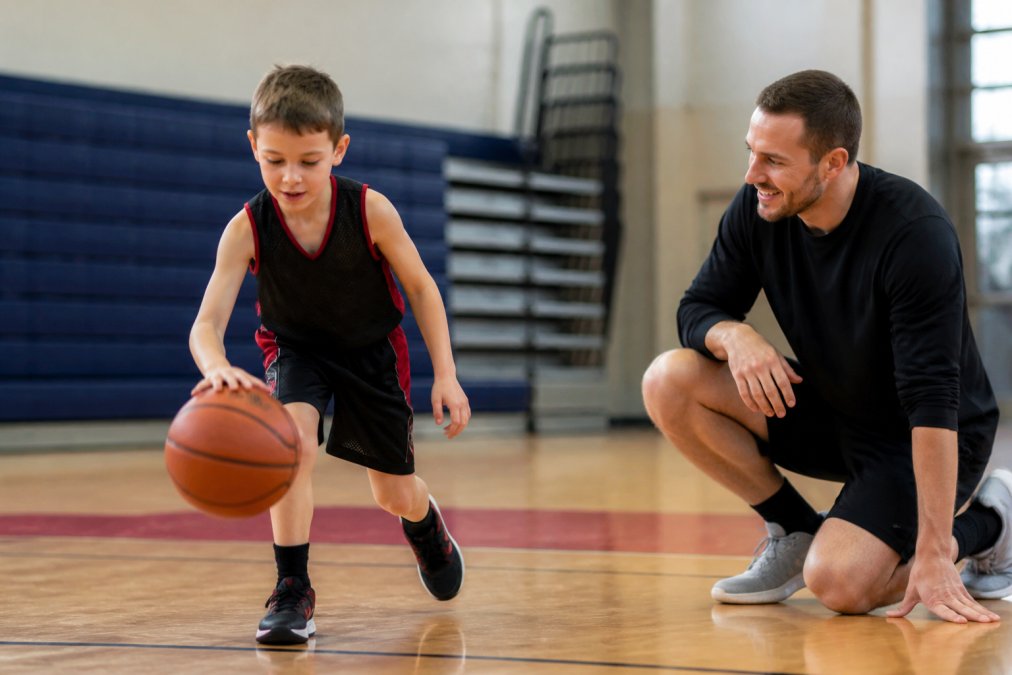
The "Golden Window" refers to the developmental period between ages 4 and 7 when a child's brain forms motor pathways most efficiently. During these years, basic coordination, balance, and hand-eye coordination develop faster than at any later stage (peer-reviewed research).
A 5-year-old learning to catch a chest pass is developing the same foundational coordination that a 12-year-old uses for a no-look pass. Respect the window, and the skill ceiling rises.
The 4 Core Skills to Master First
Basketball skill building for beginners should focus on four pillars: ball handling, passing, shooting form, and defensive footwork. These are the non-negotiables. While most beginner guides list defense as an afterthought, defensive habits formed in the first year of play determine how quickly a young athlete earns court time later.
Ball Handling and Dribbling
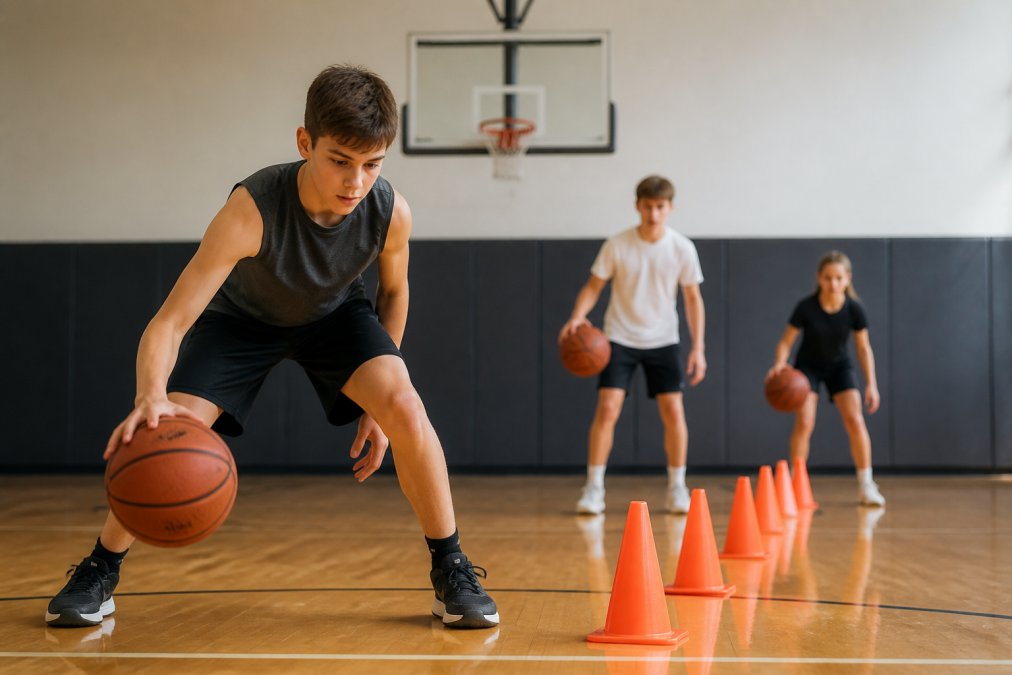
Ball handling is the ability to control the ball with either hand while stationary or moving. For beginners, dribbling should start with eyes up, knees bent, and the ball pushed with fingertips, not slapped with the palm.
Start with stationary dribbling at waist height, then progress to walking dribbles, then to jogging dribbles with changes of direction. A beginner who can dribble at full speed without looking at the ball has achieved functional ball handling. Most young players need 8 to 12 weeks of consistent practice to reach this point.
Passing and Catching
Passing and catching are the most underrated beginner skills. A crisp chest pass and a soft bounce pass create the rhythm of team play. Practice against a wall if no partner is available, focusing on stepping into the pass and following through toward the target.
For beginners, catching is actually the harder skill. Young players often fear the ball and turn their heads or trap it against their chest. Teach proper catching mechanics early: hands out in front, fingers spread and pointing up for chest passes, fingers pointing down for bounce passes. The ball should be absorbed by bending the elbows, not by clapping it between the palms.
Shooting Form
Shooting form for beginners is about creating one repeatable motion, not about making shots. The BEEF acronym covers the fundamentals: Balance, Eyes, Elbow, Follow-through. Set up close to the basket, even 1 to 1.2 metres away for the youngest players, and prioritize the release motion over distance.
Defensive Footwork and Positioning
Defensive footwork is the most neglected pillar in beginner training, yet it is the skill that separates players who can stay on the court from those who sit on the bench. The foundation is the defensive stance: feet slightly wider than shoulder-width, knees bent, back straight, arms out with palms up, and eyes on the offensive player's chest rather than the ball.
The two essential movements are the defensive slide and the drop step. In a defensive slide, the player pushes off the lead foot and slides the trail foot to meet it, never crossing the feet. The drop step is used when an offensive player drives past: the defender pivots on the back foot, opens the hips, and sprints to recover position.
A common beginner error is reaching for the ball instead of moving the feet. Reaching puts the defender off balance and creates fouls. Teach young players to stay in front of their opponent and contest shots with verticality, jumping straight up with arms raised rather than lunging forward.
Why the Order Matters
These four skills should be introduced in a specific sequence. Ball handling comes first because it builds hand-eye coordination and confidence with the ball. Passing comes second because it introduces the concept of teammates and timing. Shooting form comes third because it requires the coordination developed in the first two skills. Defensive footwork comes last because it demands body control and spatial awareness that younger players develop only after they are comfortable moving with the ball.
Basketball Drills for Kids: 5 Fun Exercises to Build Coordination
These basketball drills for kids take 10 minutes total and require no hoop. Run them 3 times per week for visible improvement in 4 weeks.
- Stationary Dribble Ladder (2 minutes): Dribble in place, right hand for 30 seconds, left hand for 30 seconds, then alternate hands. Keep eyes forward on a wall spot.
- Figure-8 Pass (2 minutes): Hold the ball between your legs, move it in a figure-8 pattern around each knee without dropping.
- Wall Chest Passes (2 minutes): Stand 1.5 metres from a wall, throw crisp chest passes, catch, and repeat. Count how many you can complete without a drop.
- Jump Stop and Pivot (2 minutes): Run two steps, jump stop (both feet land together), then pivot on one foot 5 times each direction.
- Defensive Slide Lines (2 minutes): Slide from one sideline to the other in a low defensive stance, staying in a straight line without crossing your feet.
Basketball Shooting Form for Beginners: Set the Right Habits Early
Set up on the free throw line or closer for younger players. Feet shoulder-width apart, shooting hand under the ball, guide hand on the side. The ball should release off the fingertips with a full wrist snap, finishing with the shooting arm extended toward the rim.
Your First Youth Basketball Training Plan: 4 Weeks to Fundamentals
A youth basketball training plan should prioritize frequency over duration. Two to three sessions of 30 to 45 minutes per week is the sweet spot for ages 6 to 10 (the WHO). For ages 4 to 5, shorten sessions to 15 to 20 minutes and focus entirely on play-based movement.
| Day | Focus | Duration | Drills |
|---|---|---|---|
| Session 1 | Ball handling + footwork | 35 min | Dribble ladder, jump stops, defensive slides |
| Session 2 | Passing + shooting form | 40 min | Wall passes, BEEF form shooting, layup footwork |
| Session 3 | Game-based fun | 30 min | Mini-games, 1-on-1, knockout (if hoop available) |
Age-Based Adjustments
This plan assumes a child aged 6 to 10. For younger beginners, the structure changes significantly:
- Ages 4 to 5: Sessions should be 15 to 20 minutes, with no more than 5 minutes on any single drill. Use games like "Red Light, Green Light" with dribbling, or "Follow the Leader" with movement patterns. The goal is exposure and fun, not skill mastery.
- Ages 6 to 8: The full 30 to 35 minute structure works, but keep drill complexity low. Each drill should have one instruction and one goal.
- Ages 9 to 10: This is the age where skill gaps start to appear between players who practiced consistently and those who did not. You can add light defensive pressure in Week 3 and introduce basic pick-and-roll concepts in Week 4 if the child is ready.
Week-by-Week Progression with Measurable Milestones
Week 1: Foundations. Focus purely on the four core skills. Each session should include at least 5 minutes of ball handling, 5 minutes of passing, 5 minutes of shooting form, and 5 minutes of defensive slides. The measurable milestone: your child can complete 10 consecutive wall chest passes without a drop and can hold a defensive stance for 20 seconds without standing up.
Week 2: Speed and Control. Add speed to the drills. Dribble ladders become timed, how many dribbles in 30 seconds without losing control? Wall passes increase in pace. Defensive slides add a change-of-direction cue. The measurable milestone: your child can dribble at a jogging pace for 30 seconds without looking at the ball, and can complete 15 consecutive wall passes.
Week 3: Skill Combination. Combine skills in sequence. Dribble into a jump stop into a pass. Dribble into a jump stop into a pivot into a shot fake. Defensive slides into a sprint recovery. The measurable milestone: your child can execute a 3-step sequence (dribble, jump stop, pass) with correct footwork 8 out of 10 attempts.
Week 4: Light Pressure. Introduce simple 1-on-1 play to test skills under light pressure. The defender should focus on staying in front rather than stealing the ball. The offensive player should practice the combinations from Week 3. The measurable milestone: your child can complete a full offensive sequence against a defender without traveling or double-dribbling.
Tracking Progress Without the Overwhelm
When to Push and When to Pause
A common pattern among parents is pushing too hard when a child shows early aptitude, then burning them out. The opposite problem is stopping the plan entirely when a child has an off week. The right approach is to read the signals. If your child is laughing and asking for "one more try," extend the session by 5 minutes. If they are frustrated, crying, or refusing to participate, cut the session short and return to a favorite game or drill.
The Psychological Barrier: Joining a Pickup Game
One aspect most training plans miss is the emotional hurdle of using these skills in a real game. For many beginners, especially those aged 8 to 12, the fear of looking foolish in front of peers is the single biggest barrier to skill application. If your child is nervous about joining a pickup game or trying out for a team, practice the social script at home. Role-play the moment of asking to join: "Can I play next game?" Practice what to say when a shot misses or a pass is dropped, a simple "my bad" and moving on is the standard.
A Note on Rest Days
Young athletes need recovery time. Two to three sessions per week is sufficient for skill building. On rest days, unstructured play, riding a bike, playing tag, swimming, builds the same athletic foundation that supports basketball skills.
Common Beginner Mistakes and How to Correct Them
The biggest mistake in basketball skill building is prioritizing games over fundamentals. Young players who only scrimmage develop bad habits because there is no repetition.
Avoiding Injury with Proper Footwork
Most beginner injuries in basketball come from poor landing mechanics, not contact. Teach your child to land on both feet after a layup or rebound, with knees bent to absorb the impact.
Practice at Home: No Hoop? No Problem
A lack of a backyard hoop should not stop skill development. Ball handling, passing, and footwork drills require only a ball and a flat surface. For shooting form, practice the motion without a ball, focusing on the release and follow-through.
Many families in Halton Hills start with our introductory programs precisely because home space is limited. Our coaches teach the same drills we recommend here, adapted for whatever space is available.
Conclusion: Start Slow, Build a Foundation, and Stay Consistent
Basketball skill building for beginners is a marathon, not a sprint. The parents who see the fastest results are the ones who embrace short, consistent sessions over long, infrequent ones.
At Tier 1 Sports, our programs are built around this philosophy: age-specific training, supportive coaching, and a genuine focus on both skill and passion. Whether your child is 5 and holding a ball for the first time or 12 and preparing for rep tryouts, our Halton Hills club offers a pathway that meets them where they are.
Sponsored by David Robbio, Real Estate Broker
Frequently Asked Questions
What are the basic basketball skills for beginners?
The core skills for beginners are ball handling (dribbling), passing, shooting, and footwork. Start with stationary dribbling to build hand-eye coordination, then progress to moving drills. Passing fundamentals like the chest pass and bounce pass teach teamwork. Shooting form should focus on balance and a consistent follow-through. Footwork, including the pivot and jump stop, prevents turnovers and injuries. A solid youth basketball training plan introduces these skills gradually, letting players build confidence before adding defensive stance and court awareness.
How do I improve my basketball skills at home?
You do not need a full court to improve. Practice ball handling with pound dribbles, around-the-world moves, and figure-eights using a hard, flat surface like a driveway or basement floor. For shooting, focus on your release and follow-through without a net. Wall passes build hand strength and catching technique. Simple agility drills, like jump stops and defensive slides, improve footwork. The key is daily repetition of correct form over long, sloppy sessions. A basketball skill building plan for beginners works best in short 15-20 minute bursts.
How long does it take to learn basketball fundamentals?
Most beginners need 3 to 6 months of consistent practice (2-3 sessions weekly) to feel comfortable with core fundamentals like dribbling without looking at the ball and making a proper chest pass. Shooting form takes longer to become automatic, often a full season or more. The focus should be on correct habits early. A structured youth basketball training plan helps parents track progress, ensuring the young player builds coordination and confidence before moving to advanced offensive moves or competitive rep basketball.
This article was written using GrandRanker