 how-to
Basketball Training for 5 Year Olds: A Parent's Guide
Table of Contents
- Why Basketball Training Matters for 5-Year-Olds
- Basketball Drills for 5 Year Olds: Where to Start
- How Long Should a Basketball Practice Be for 5 Year Olds
- Coaching Youth Basketball Fundamentals: A Parent's Approach
- Equipment Sizing and Safety Essentials
- Common Mistakes to Avoid When Training Young Players
- Conclusion
Last Updated: August 18, 2026
Why Basketball Training Matters for 5-Year-Olds
Basketball training for 5-year-olds builds the foundation for lifelong physical literacy, motor skills, and a genuine love of movement. At this age, children are in a critical window for acquiring fundamental movement patterns. Early exposure to basketball develops hand-eye coordination in ways few other activities can match. A 5-year-old learning to dribble trains their brain to track a moving object while controlling their body simultaneously, cognitive development, not just basketball skill.
The real opportunity at this age is creating an environment where movement feels fun, not forced. Children this young don't care about winning. They care about feeling capable, whether the activity is engaging, and whether adults around them are encouraging. A well-designed basketball training program prioritizes all three.
Basketball Drills for 5 Year Olds: Where to Start
When introducing basketball training for 5-year-olds, forget competitive drills. The goal is building comfort with the ball and establishing positive associations with the game. The best drills are short, repetitive, and immediately rewarding. Children need to succeed quickly and often. Focus on activities where they can attempt the skill multiple times in a single session, getting immediate feedback and small wins.
Ball Handling and Dribbling Basics
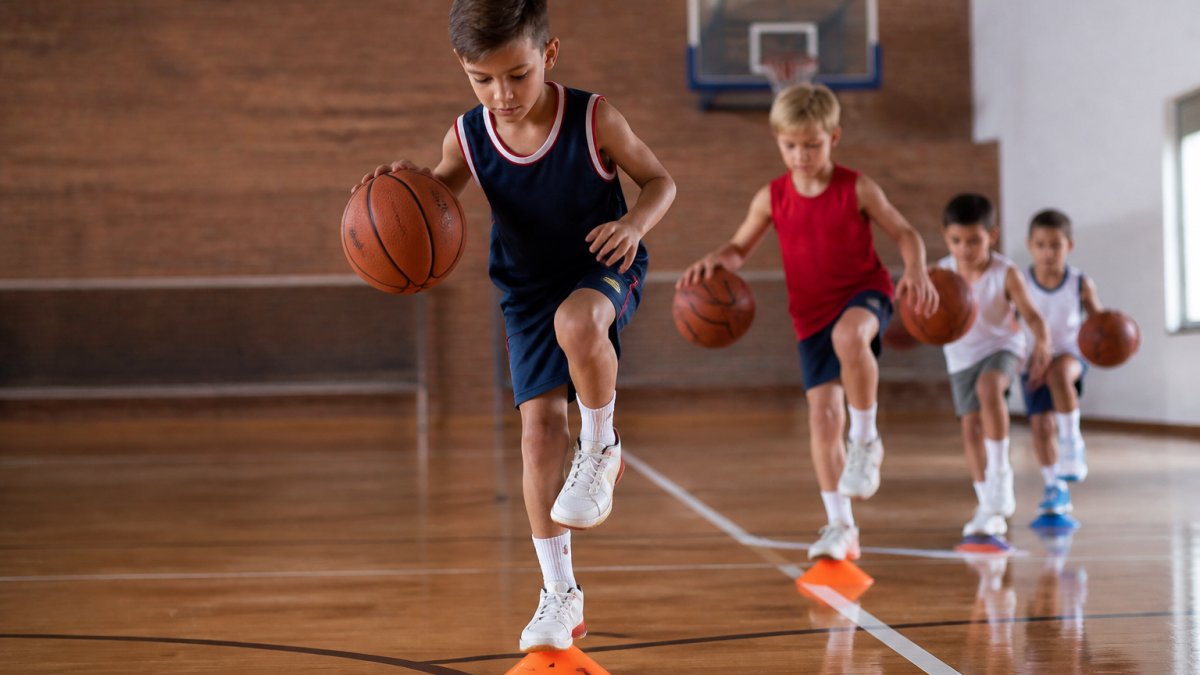
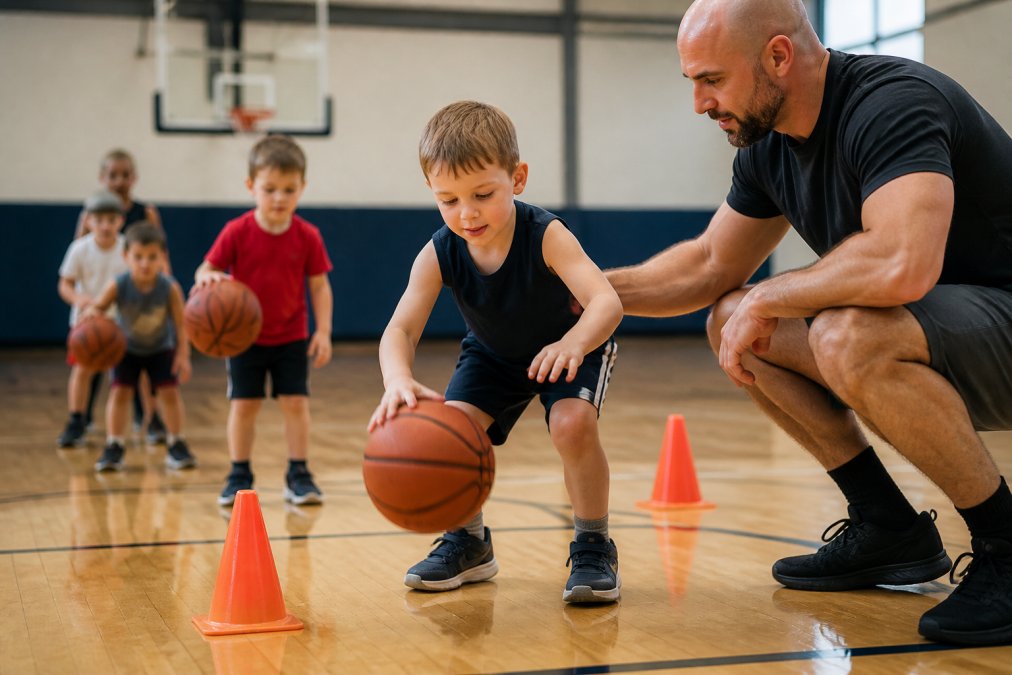
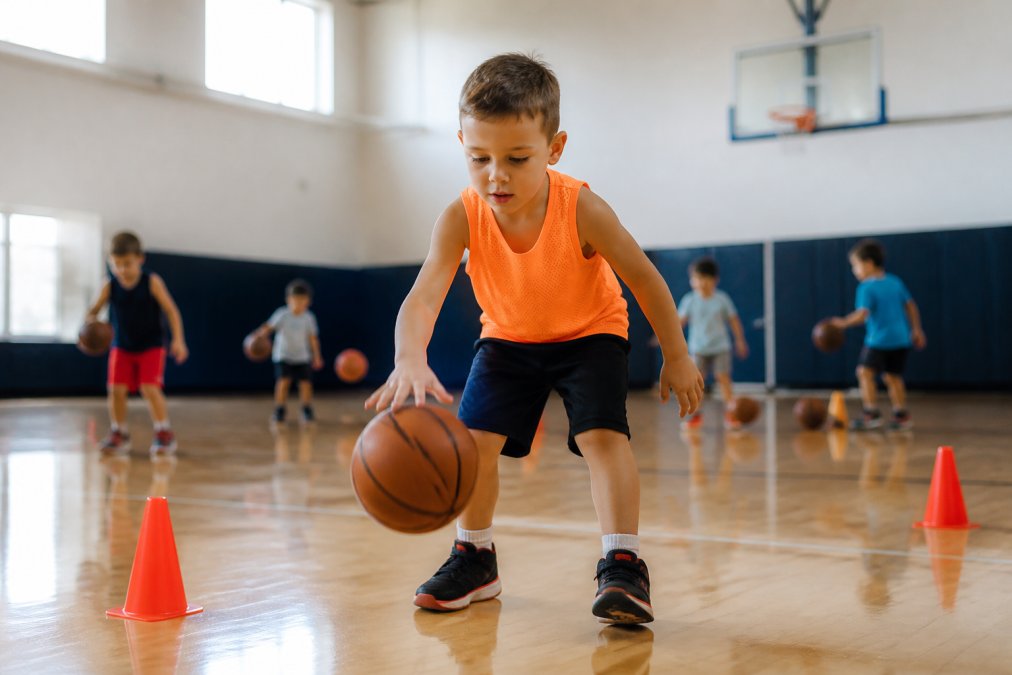
Dribbling is deceptively complex for young children. Their hand must push the ball with the right force, their eyes must track it, and their body must stay balanced. Start with stationary dribbling before adding movement.
Basic Dribbling Progression:
-
Stationary dribbling with both hands. Have the child stand in one spot and bounce the ball with both hands alternately, starting with just 5-10 bounces. Encourage fingertip control, not palm slapping.
-
Figure-eight dribbling. Once comfortable with stationary dribbling, have them dribble while walking in a slow figure-eight pattern. Keep the pattern large and slow.
-
Dribbling relay races. Set up a simple course and have children dribble from one point to another as a relay. This adds peer encouragement and natural waiting time.
A 5-year-old who can dribble 5 times without losing the ball has succeeded. Celebrate that. Consistency and distance improve naturally over weeks and months.
Passing and Catching Techniques
Catching is harder than dribbling for young children because it requires tracking a moving object and timing their hands correctly. Start with short distances and soft passes. A chest pass from about 1 to 1.2 meters away is ideal.
Passing and Catching Progression:
-
Two-handed chest pass. Demonstrate proper form: hands on either side of the ball at chest height, step forward, extend arms, release. Have children practice against a wall first, throwing and catching their own pass.
-
Partner passing with short distance. Once comfortable with wall passes, have them pass to a partner standing about 1 to 1.2 meters away. Emphasize soft passes.
-
Catching fundamentals. Teach them to "give" with their hands when catching, letting hands move backward slightly as the ball arrives. This cushions the catch.
-
One-handed catch progression. Introduce only after they're comfortable with two-handed catches, keeping distances short.
Young children often throw harder than intended. Consistently throwing soft passes takes practice. Use foam or smaller balls initially if hard passes cause frustration.
Shooting Fundamentals for Beginners
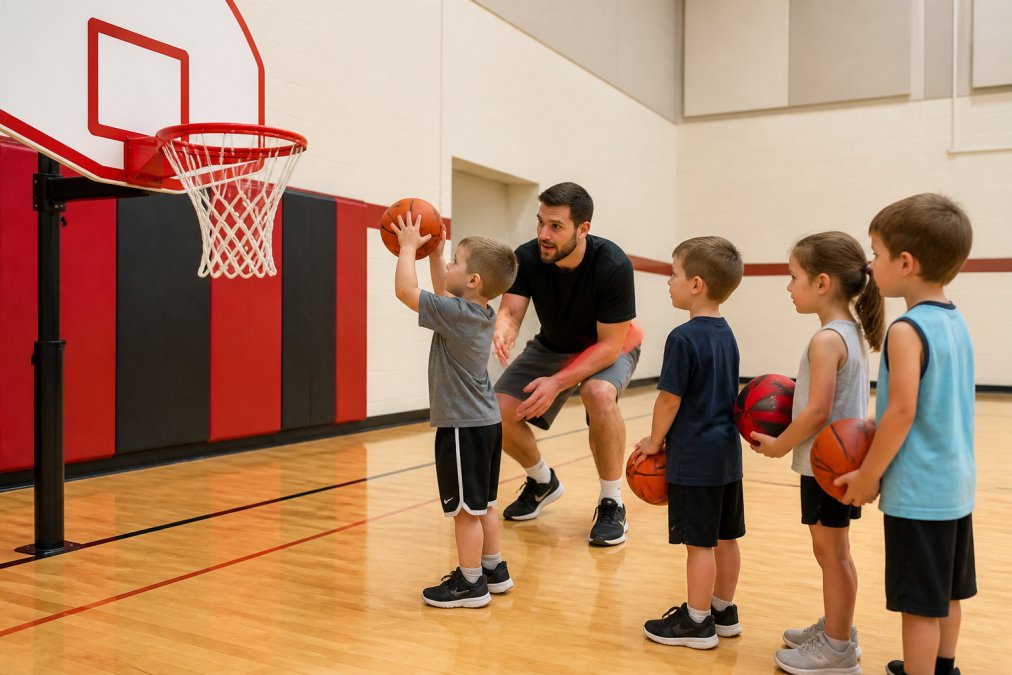
Shooting form matters less at age 5 than comfort with the motion. Lower the rim to 1.8 to 2.4 meters, or use a portable hoop adjusted to their height.
Basic Shooting Progression:
-
Two-handed push shot from close range. Start with the child standing about 0.6 to 0.9 meters from the hoop, pushing the ball toward the basket with both hands.
-
Footwork and balance. Add footwork once comfortable with the motion. Teach them to step toward the basket as they shoot.
-
One-handed shot introduction. After several weeks of two-handed shooting, introduce a one-handed shot from about 0.6 to 1.2 meters. Form is less important than attempting it.
-
Shooting from different spots. Gradually increase distance, keeping it within 1.5 to 1.8 meters initially.
Setup takes 5-10 minutes per session. Actual shooting practice should be 10-15 minutes of focused work. After that, attention naturally shifts, and forcing more shooting creates frustration.
How Long Should a Basketball Practice Be for 5 Year Olds
A basketball practice for 5-year-olds should last 30-45 minutes total. Anything longer pushes against their natural attention span and results in restlessness and reduced engagement. Anything shorter doesn't give enough time to practice skills meaningfully.
Not all 30-45 minutes should be intense skill work. Young children need variety, play, and frequent transitions. A practice that's 50% structured drills and 50% game-based play typically works best.
Sample Practice Structure
| Activity | Duration | Purpose |
|---|---|---|
| Arrival & warm-up (stretching, light movement) | 5 minutes | Get bodies moving, settle attention |
| Ball handling drill (stationary dribbling, figure-eight) | 8 minutes | Develop comfort with the ball |
| Passing and catching drill | 8 minutes | Work on hand-eye coordination |
| Shooting practice (two-handed, close range) | 8 minutes | Build confidence and form basics |
| Game or small-sided play | 10 minutes | Apply skills in a fun, competitive context |
| Cool-down & dismissal | 1 minute | End on a positive note |
This structure provides roughly 24 minutes of focused skill work and 10 minutes of applied play. You're running 3-4 short drills per session, each getting just enough time to be meaningful without becoming repetitive.
Coaching Youth Basketball Fundamentals: A Parent's Approach
Most parents feel unprepared to coach basketball. Coaching your own 5-year-old is actually one of the best things you can do for their development if you approach it correctly.
The coaching philosophy that works best at this age prioritizes fun and encouragement over correction. A 5-year-old who feels supported and capable will keep playing. Your job as a parent-coach is to create that experience.
Creating a Fun-Focused Environment
The foundation of coaching young children is making the activity inherently enjoyable. This doesn't mean avoiding all challenge or never correcting mistakes. It means framing everything through "Can we make this fun?"
Practical strategies for a fun-focused environment:
-
Use games and play, not just drills. Instead of 10 minutes of stationary dribbling, do 5 minutes of dribbling followed by a relay race or "dribble tag" game.
-
Celebrate effort and attempt, not just success. When your child misses a shot, respond with "Great try! You're getting closer," not silence or correction.
-
Keep practice sessions short and varied. Attention span at age 5 is roughly 5-10 minutes per activity. Switch between dribbling, passing, and shooting every 8-10 minutes.
-
Give specific, actionable feedback. Instead of "Good job," try "I liked how you stepped forward when you shot that, that's exactly right."
-
Play alongside them when possible. Shoot a few shots yourself. This shows you enjoy the activity and makes practice feel like shared play.
Young children watch how you respond to their mistakes more than they listen to technical advice. If you stay calm, encouraging, and focused on effort, they'll develop resilience and a growth mindset.
Building Motor Skills and Hand-Eye Coordination
Motor skill development at age 5 is rapid but uneven. The goal isn't identifying who's athletic but giving every child the opportunity to improve through deliberate practice.
Hand-eye coordination improves through repeated exposure to tracking and catching moving objects. A child practicing dribbling 3-4 times per week for 10 minutes will improve noticeably within 4-6 weeks.
Spatial awareness develops through small-sided games and play. A 3-on-3 or 2-on-2 game forces children to think about positioning and movement in ways isolated drills don't. Mixing structured drills with game-based play is essential.
Equipment Sizing and Safety Essentials
The right equipment makes a massive difference in how quickly a 5-year-old develops confidence and skill.
Basketball size for 5-year-olds: A size 4 or "mini" basketball (approximately 41 cm in circumference) is ideal. A regulation size 7 ball is far too large for small hands.
Hoop height: Adjust the rim to 1.8 to 2.4 meters, not the regulation 3 meters.
Footwear: Children need supportive shoes with good ankle stability. Athletic shoes designed for lateral movement are preferable to casual sneakers.
Court surface: A smooth, non-slippery surface is essential. Hardwood or rubber courts are ideal. Concrete is acceptable if smooth and well-maintained.
Safety considerations: Ensure the practice area is clear of obstacles with adequate space around the court. Teach basic awareness like looking up while dribbling. Collisions are rare in recreational youth basketball but happen more often when children are crowded together.
Common Mistakes to Avoid When Training Young Players
Mistake 1: Starting with a ball that's too large. A regulation basketball in a 5-year-old's hands is frustrating. Use a size 4 ball.
Mistake 2: Expecting perfect form before consistency. A 5-year-old who can dribble five times has achieved something real. Form refinement comes later.
Mistake 3: Running drills that are too long or repetitive. A 10-minute dribbling drill loses attention after 6-7 minutes. Shorter, varied drills keep engagement high.
Mistake 4: Comparing your child to other children. Every child develops at their own pace. Comparisons breed discouragement.
Mistake 5: Mixing skill instruction with game play without clear transitions. Young children need to know when they're practicing a skill and when they're playing a game.
Mistake 6: Pushing intensity before building foundation. A 5-year-old needs 8-12 weeks of consistent, foundational practice before competitive basketball. Rushing this creates poor habits and frustration.
Basketball training for 5-year-olds is about building confidence, developing fundamental motor skills, and creating a positive relationship with movement and play. When you focus on comfort with the ball, encouragement from adults, and frequent, varied practice, skill development follows naturally.
Tier 1 Sports understands this approach. Our programs for young children prioritize fun-focused skill development in a supportive environment, recognizing that the goal at age 5 isn't competitive excellence but a foundation of physical literacy and genuine enthusiasm for the game. Whether your child is just discovering basketball or ready to develop their skills further, our tailored programs are designed to meet them where they are and help them discover their full potential. Join us and give your child the foundation they need to thrive.
Frequently Asked Questions
What size basketball is best for a 5 year old?
A size 3 basketball (approximately 41 cm in diameter) is ideal for 5-year-olds. It's lightweight enough for small hands to control and allows children to develop proper ball handling skills without struggling with equipment. Size 1 and 2 balls are too small for meaningful skill development, while larger balls frustrate young players and discourage participation.
Can a 5 year old play basketball?
Yes, 5-year-olds can absolutely play basketball when programs are designed for their developmental stage. At this age, children benefit from age-appropriate drills that focus on fundamental movement, hand-eye coordination, and basic ball handling rather than complex plays or competitive scoring. Fun-focused activities keep young players engaged and build a foundation for lifelong participation.
How do you teach a 5 year old to dribble a basketball?
Start with stationary dribbling: have your child stand in one spot and bounce the ball using fingertips (not the palm) with bent knees. Progress to walking while dribbling in straight lines, then gentle curves. Use games like 'dribble tag' or 'follow the leader' to keep it fun. Practice sessions should be short (5-10 minutes) to match their attention span. Celebrate effort over perfection to build confidence.
What are the 5 basic rules of basketball for kids?
For 5-year-olds, focus on these simplified rules: (1) Dribble the ball when moving with it, (2) Don't run while holding the ball without bouncing, (3) Throw the ball to teammates, (4) Try to shoot the ball toward the basket, (5) Play safely and respect others. Formal rule instruction can wait; at this age, emphasize fun and basic movement patterns rather than strict rule enforcement.
This article was written using GrandRanker