 how-to
Effective Communication Strategies for Youth Basketball Coaches
Table of Contents
- Why Communication Skills Decide How Much Your Team Improves
- Coach-Player Communication Strategies That Build Trust First
- Positive Coaching Feedback Examples You Can Use This Week
- Basketball Coaching Cues That Players Actually Remember
- Basketball Practice Communication Drills for Every Age Group
- Communication Plans for Practices, Games, and Timeouts
- Difficult Conversations: Parents, Conflict, and Emotional Regulation
- How Youth Basketball Coaches Measure Whether Communication Is Working
- Frequently Asked Questions
Last Updated: October 18, 2026
Why Communication Skills Decide How Much Your Team Improves
Effective communication strategies for youth basketball coaches are the single biggest lever on how fast players develop. At Tier 1 Sports, two teams with identical drills and gym time improve at completely different rates, and the gap almost always comes down to how the coach talks to players.
Players do not learn from what you know. They learn from what they can hear, hold onto, and repeat. A brilliant drill explained badly produces confusion; a simple drill explained well produces confidence.
Youth basketball is loud, fast, and full of failure. A player who misses a layup and hears nothing learns nothing; one clear, calm correction teaches something they keep.
Coach-Player Communication Strategies That Build Trust First
Trust comes before instruction. A player who does not trust you hears feedback as criticism, no matter how kindly you phrase it. The first job is connection, not teaching.
Active Listening and Two-Way Dialogue
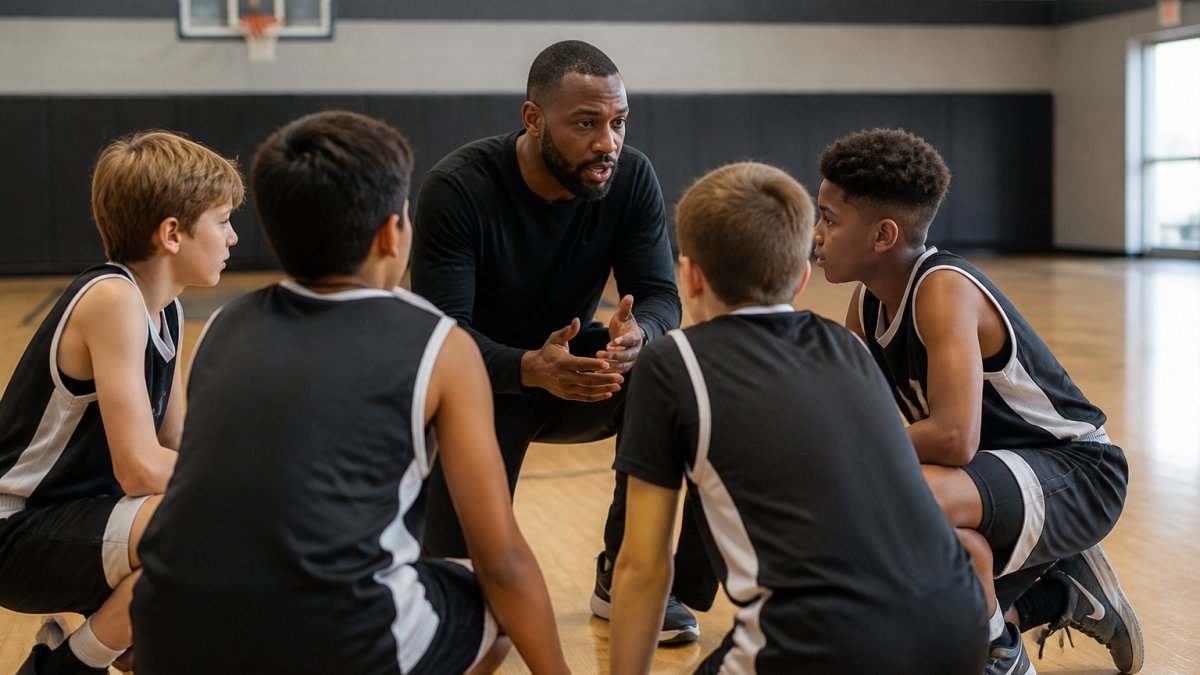
Active listening means fully focusing on a player, then confirming what you heard before you respond. It sounds basic; almost nobody does it under pressure.
Try this at your next practice:
- Kneel or squat to the player's eye level before they speak
- Let them finish without filling the silence
- Repeat back what you heard: "So you're saying the help defender keeps arriving late?"
That last step is the trick. When a player feels heard, they stop defending and start solving. Two-way dialogue also surfaces problems you would never spot from the sideline, like confusion about a team role or nerves about a matchup.
Body Language and Nonverbal Cues
Your face broadcasts before your mouth opens. Players read crossed arms, sighs, and eye rolls instantly, and read them as verdicts about themselves.
A few nonverbal habits worth building:
- Open posture: arms uncrossed, shoulders down, facing the player
- Eye contact at their level, especially after a mistake
- A quick nod or thumbs-up across the gym to confirm you saw a good cut
If you only make eye contact when something goes wrong, players learn your attention means trouble. Spread it around.
Positive Coaching Feedback Examples You Can Use This Week
Positive coaching feedback works when it is specific and immediate. "Good job" teaches nothing. "Good job squaring your feet before the shot" teaches exactly what to repeat.
Here are real scripts you can borrow:
- After a good pass: "That was the right read. You hit the cutter in stride. Do that again."
- After a mistake: "Your feet were set, the shot was good. It just missed. Keep shooting that."
- After a lazy closeout: "Get there a half-second earlier and hands up. You're quick enough to beat that pass."
Constructive Feedback Without the Sting
Our formula: name the behavior, name the fix, keep the player's value intact.
- Behavior: "You're reaching on defense."
- Fix: "Slide your feet and stay in front."
- Value: "You're fast enough to guard this kid. Trust your feet."
Notice what is missing: no "you always," no "you're not," no comparison to another player. Feedback describes an action, not a person, that is what makes it easy to hear and act on.
Basketball Coaching Cues That Players Actually Remember
Basketball coaching cues are short, repeatable phrases that trigger a skill without a full explanation.
Here are cues worth building into your program:
- "Hands up" on closeouts and contests
- "Feet first" when a defender starts reaching
- "Talk early" on screens and switches
The test of a good cue is whether a player uses it without you. If a nine-year-old yells "feet first" to a teammate during a scrimmage, the cue has done its job.
Keep your cue list short: five to seven per age group is plenty. Too many and players stop hearing any of them.
Basketball Practice Communication Drills for Every Age Group
Basketball practice communication drills build talking and listening into the session itself, so communication becomes a habit rather than a lecture. Each drill below has a setup, progression, coaching cue, and common failure. Run two per practice and rotate them across a month.
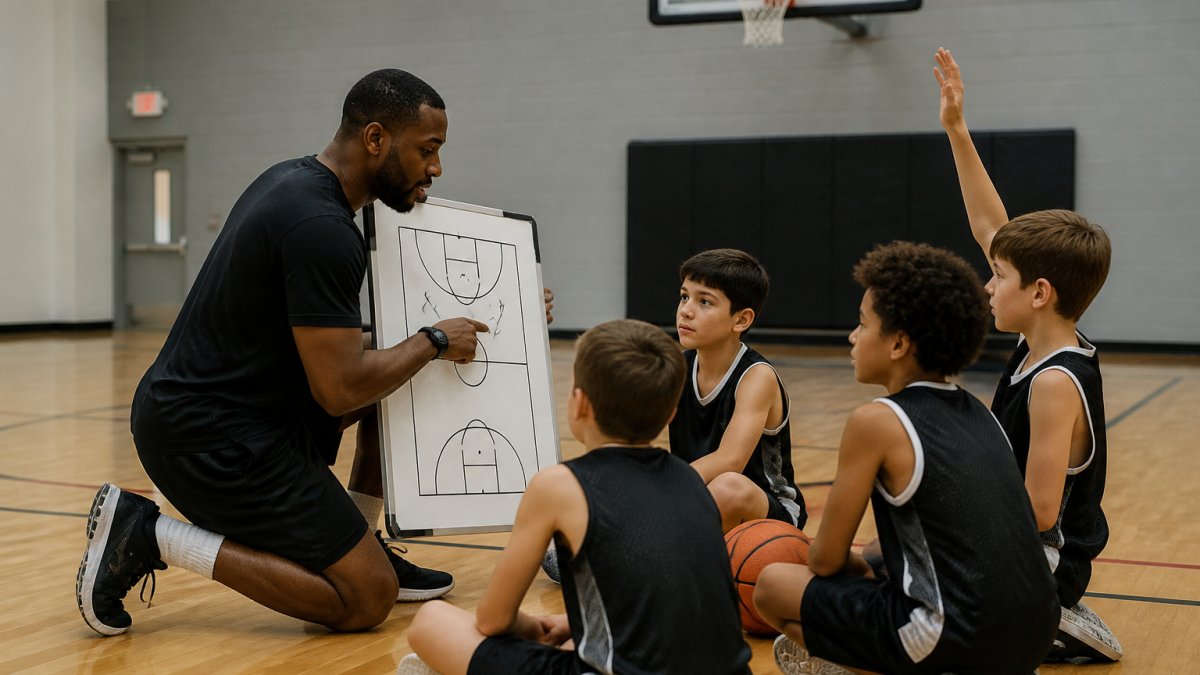
Drill 1: Name-and-Pass (5 minutes)
Progression: Start with one ball and a slow pace. Add a second ball once the group completes two clean laps.
Coaching cue: "Name before ball." If the ball arrives before the name, the rep does not count.
Common failure: Players whisper the name or say it after the pass. Stop the drill and reset, the point is that the call comes first, every time.
Drill 2: Shell Drill with Calls (10 minutes)
Setup: A standard four-on-four shell drill, but every defender must call "ball," "deny," or "help" before moving.
Progression: Begin with the coach directing the offense slowly. Speed up only when every defender is calling on every pass.
Coaching cue: "Call it, then move it." The call leads the feet, not the other way around.
Common failure: One loud player does all the talking.
Drill 3: Overload Drill with a Talker (10 minutes)
Setup: Run an overload drill, five attackers against four defenders, for example, with one player assigned as communicator.
Progression: Rotate the talker every two minutes so everyone practices leading.
Coaching cue: "One voice, clear job." The talker gives directions, not commentary.
Common failure: The talker narrates the play after it happens ("nice pass") instead of directing before it happens ("ball, you, help left").
Drill 4: Freeze-and-Explain (5 minutes)
Setup: Stop a scrimmage at random and ask a random player to explain what just happened and what comes next.
Progression: Start with simple questions ("Who has the ball?").
Coaching cue: "Say it in one sentence." Short answers build confidence and force clarity.
Common failure: The same two players answer every time. Call on players by name and give them a moment to think before answering.
Age-Specific Adjustments for Ages 4 to 16
The same drill looks different depending on who is in front of you. Here is the version we use at Tier 1 Sports when we plan a session.
- Ages 4 to 6: One instruction at a time. Show, don't tell. Use names constantly and keep the energy high. Two-minute attention spans are normal. Run Name-and-Pass only, with one ball, and stop the drill the moment attention drifts.
- Ages 7 to 10: Two-step instructions work well. Ask questions instead of giving answers: "Where should your hands be?" This is the window where fundamentals stick fastest, so keep cues simple and repeat them every session. Name-and-Pass and Freeze-and-Explain are the best fits.
- Ages 11 to 13: Players can handle a full sentence of feedback and a group discussion. Start letting them call out defensive assignments themselves. Shell Drill with Calls and Overload with a Talker become the core drills.
Track one thing per practice. If your focus this week is calling the screen, count how many times defenders call it during the scrimmage. A number you can see beats a feeling you can't.
Communication Plans for Practices, Games, and Timeouts
Before practice: Post or say the focus of the day in one sentence.
During practice: Use one-on-one check-ins at water breaks.
Before tip-off: Give each player one job in one sentence.
During timeouts: Follow the same order every time.
- One sentence on what went wrong
- One sentence on the fix
- One thing to keep doing
- Hands in, done
After the game: Ask two questions before you give any feedback.
Keep timeouts short. A long timeout with a raised voice rarely produces a better fourth quarter.
Difficult Conversations: Parents, Conflict, and Emotional Regulation
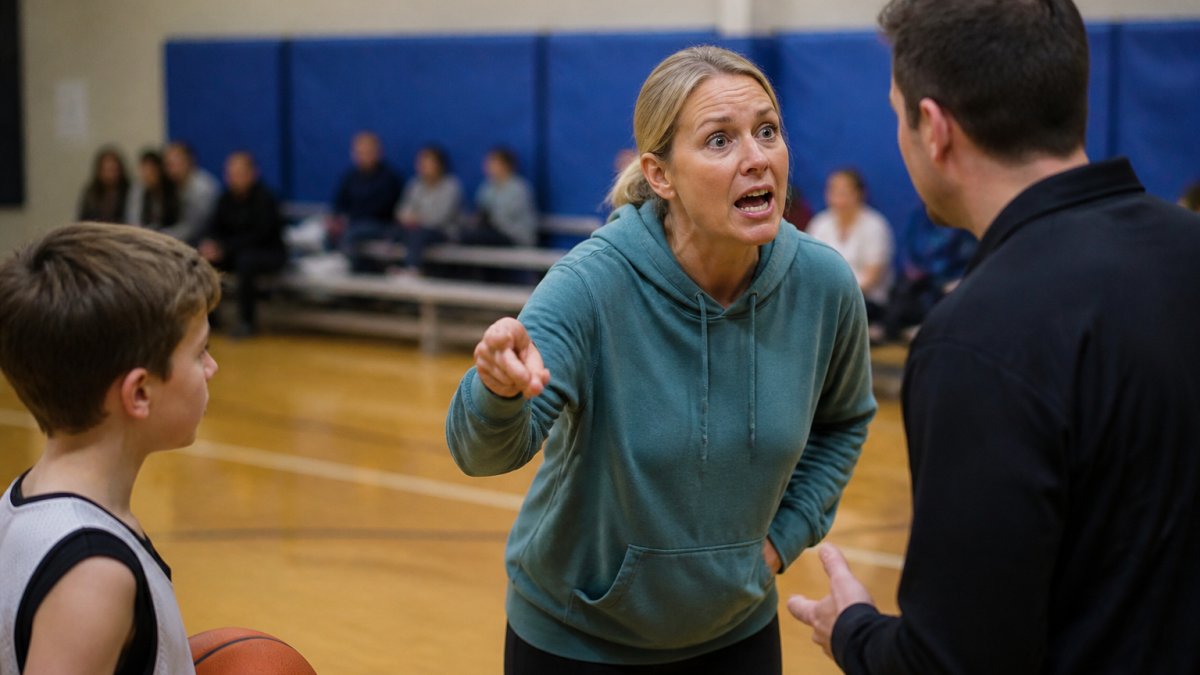
Hard conversations are part of the job, and handling them well protects team morale. "Stay calm and listen" is not enough when a parent is upset after a loss or two players refuse to pass to each other. Here is a repeatable structure and the actual words, the gap between coaches who handle conflict well and those who don't is usually preparation, not personality.
A Four-Step Structure for Any Hard Conversation
Use the same order every time. The structure does the work when your emotions are high.
- Open with the shared goal. Say out loud what you both want. "We both want your daughter to enjoy the season and improve." This lowers the temperature before the content arrives.
- Describe the specific behavior, not the person. "In the last two games, she has been late to two practices", not "she isn't committed."
- Ask one open question and then stop talking. "What is going on from your side?" Let the answer run. Most conflicts defuse at this step because the other person feels heard.
- Agree on one next step and a check-in date. "Let's try X for two weeks and talk again on the 15th." A specific follow-up turns a complaint into a plan.
Scripts for the Three Most Common Conversations
Between two players after a conflict. Separate the emotion from the problem.
"You two are not leaving this gym until you can each say the other's side back to me.
When a player is overwhelmed or in tears. Lower your voice and slow down.
"Take a breath. You're okay. When you're ready, I need one thing from you: get back on defense and talk.
Regulating Yourself in the Moment
Coaches need regulation too, and the most useful tool is a delay. If your temper rises, take one breath and delay the correction by one possession. The message lands better, and players remember how you handled it more than what you said.
A few habits that help:
- Name the feeling silently. "I'm angry about the turnover" is easier to manage than a wave of unnamed frustration.
- Move your feet before you speak. Walk to the sideline, then talk. Movement buys you two seconds.
- Set a personal rule. Many coaches use "no corrections in the first thirty seconds after a bad call." Pick one rule and keep it.
How Youth Basketball Coaches Measure Whether Communication Is Working
You can measure communication without a spreadsheet. Watch for these signals over a few weeks.
- Are players talking to each other during drills and scrimmages, without being told?
- Do players use your cues on their own during game situations?
- Can a player explain their team role back to you in one sentence?
If most of those are yes, your communication is working. If they are not, pick one area and fix it before adding more.
This is where a club environment helps. Our programs for ages 4 to 16 are built around age-appropriate coaching, clear cues, and a supportive tone, from introductory sessions through rep basketball.
Frequently Asked Questions
What are some examples of a good coaching philosophy for youth basketball?
A workable philosophy states what you value before you state what you want to win. For example: every player gets meaningful game minutes, mistakes are treated as information rather than failures, and effort is praised more often than results. Write it down, share it with parents at the start of the season, and use it to explain your decisions during games. When players and families know the philosophy up front, fewer sideline disputes happen later, and young athletes feel safer speaking up.
How can youth basketball coaches give feedback that builds player confidence?
Use specific, behavior-focused feedback rather than labels. Instead of 'nice shot,' say 'you set your feet before releasing, that is why it went in.' Pair one correction with two things the player did well, and deliver it within seconds of the action so it connects to what they just felt. Positive coaching feedback examples work best when they name the exact skill, such as 'great low stance on defense,' because the player knows what to repeat next possession.
What should a youth basketball coach say during a game or timeout?
Keep timeouts to one or two messages. Name the specific defensive or offensive adjustment, give a short basketball coaching cue players already know from practice, and finish with encouragement. Avoid re-teaching a skill in thirty seconds. For example: 'They are screening high, so call the switch early. Hands up, talk loud. You have earned this, go play.' Players retain the last thing they hear, so end on confidence rather than correction.
How should a coach communicate with parents and families?
Set the channel and the rhythm early. Share your coaching philosophy, expectations, and how you will handle playing time questions in a single preseason message, then keep updates consistent through one channel rather than several. When a parent raises a concern, listen fully before responding and follow up within a day. Basketball practice communication drills and game plans are easier to run when families understand the reasoning behind minutes and roles.
Communication is a skill, and like any skill it improves with reps. If you want your child in an environment where coaches talk with players, not at them, Tier 1 Sports is built for exactly that. Our age-specific programs, supportive coaching style, and recreational-to-rep pathway give every player a clear route to grow. Rep tryouts are open, and we would love to see your family in the gym. Get started with Tier 1 Sports and watch your player's confidence grow on and off the court.