 how-to
How to Manage Difficult Parents in Youth Basketball
Table of Contents
- Why Difficult Parents Show Up in Youth Basketball
- Setting Boundaries With Sports Parents Before the Season Starts
- How to Talk to Parents About Playing Time
- Coach Parent Communication Examples You Can Use Tonight
- Handling Sideline Behavior During Games
- When a Conversation Is Not Enough: Escalation and Documentation
- Age-Appropriate Approaches From U6 to U16
- Frequently Asked Questions
Last Updated: October 13, 2026
Why Difficult Parents Show Up in Youth Basketball
Most coaches meet their first difficult parent before the first practice ends. Learning how to manage difficult parents in youth basketball starts with understanding the behavior rarely comes from a bad place.
At Tier 1 Sports, we see this every season across our programs for kids aged 4 to 16. The parent who corners you after a loss is usually scared, not angry: their child's happiness feels on the line, and you're the obstacle.
That reframe matters. It changes how you respond.
What Is Often Driving the Behavior
Difficult parents in youth sports are usually reacting to one of a few pressures:
- Fear that their child is falling behind peers
- A belief that playing time equals love or worth
- Their own unfinished athletic story
- Simple confusion about roles and rules
None of that excuses shouting at a referee, but it explains why a calm conversation beats a defensive one.
The Cost of Ignoring It
Let it fester and the damage spreads: players tense up, families pull back, volunteers quit. A negative sideline poisons team culture, and the kids feel it first.
So the goal isn't to "win" against a parent. It's to protect the youth sports experience for every player on the floor.
Setting Boundaries With Sports Parents Before the Season Starts
The best time to handle a difficult parent is before they become one. Setting boundaries with sports parents works best in the first two weeks, not mid-season when emotions run hot.
Boundaries aren't walls. They're clear, kind lines that tell everyone what to expect.
Cover these basics early:
- How you communicate and when (one channel, set hours)
- Playing time philosophy, stated out loud
- Sideline behavior rules for every family
- A simple way to raise a concern
Put it in writing. Send it home. Then repeat it at the parent meeting.
The Youth Sports Parent Meeting Agenda That Prevents Most Problems
A strong youth sports parent meeting agenda does more than any conversation later in the year. Keep it to 30 minutes:
- Introduce yourself and your coaching style (2 minutes)
- State your player development philosophy (3 minutes)
- Explain playing time and roles (5 minutes)
- Set sideline and communication rules (5 minutes)
- Share the concern process (3 minutes)
- Open the floor for questions (10 minutes)
- Close with the season's goals (2 minutes)
How to Talk to Parents About Playing Time
Playing time is the top source of coach-parent conflict in youth basketball, and the easiest to defuse when you get ahead of it. Never debate it in the bleachers or right after a game, set a separate time.
When a parent asks about minutes, follow this shape:
- Listen first. Let them finish without interrupting.
- Ask what they've observed. Often the real worry is different from the stated one.
- Explain your role decisions. Tie minutes to effort, skill, and team needs.
- Name what their child can work on. Give them something concrete.
- Set a follow-up. Agree to check in again in a few weeks.
This turns a complaint into a plan. Most parents just want to feel heard and know their child has a path forward.
Coach Parent Communication Examples You Can Use Tonight
You don't need to be a great speaker to handle a hard conversation, just a few phrases tuned to basketball, not youth sports in general.
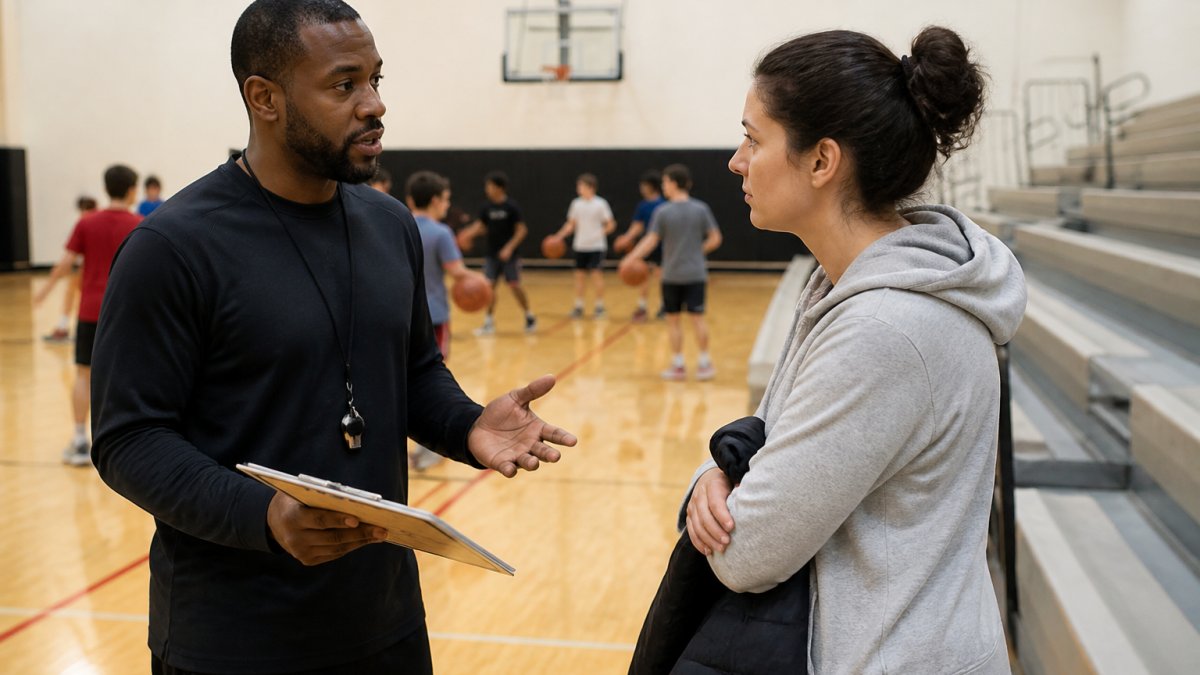
Here are coach parent communication examples you can borrow, organized by the situation you'll actually face.
Playing time and substitutions
When a parent demands more minutes: "I hear you.
When a parent tracks minutes on their phone and confronts you after a game: "I don't debate minutes in the gym.
When a parent asks why their child was pulled in the fourth quarter: "That was a matchup call.
When a parent compares their child to a teammate: "I won't talk about another player's minutes with you.
Positions and roles
When a parent insists their child is a point guard: "I see them as a combo right now.
When a parent wants their child moved up an age group or to a higher team: "Here's the gap between where they are and where that team is.
When a parent says their child is being 'wasted' in a role: "Every role on this team teaches something.
Practice effort and attitude
When a parent says their child isn't being challenged at practice: "I'll watch for that this week. If they're coasting, I'll address it directly with them.
When a parent excuses low effort with 'they're just tired': "I get it. I still need a baseline from them every session.
When a parent wants their child to skip practice for another activity: "That's your call.
Game-day conduct
When a parent yells from the sideline: "I need you to let the kids play. I'll handle the coaching.
When a parent argues with a referee: "That's not helping your child or this team.
When a parent coaches their child from the bleachers during live play: "Your child is hearing two voices out there.
When a parent is upset after a loss: "Tough one tonight.
Handling Sideline Behavior During Games
Sideline behavior is where good intentions go to die: a parent calm all week can turn into a referee-critic the moment the game starts. You need a plan before tip-off, not during it.
- State the rule at the parent meeting. No coaching from the stands.
- Use a neutral first warning. A quiet word, not a public callout.
- Escalate calmly if it continues. Ask them to step away from the court.
- Involve the organization if needed. You shouldn't carry this alone.
The goal is a positive environment for the players. If a parent can't respect that, removing them from the gym for a game is fair and reasonable.
When a Conversation Is Not Enough: Escalation and Documentation
Some situations move past a friendly talk. Difficult parents who ignore every boundary need a clear, documented process, the part most coaches handle badly by waiting too long, skipping steps, or leaving no record. A written trail turns a he-said-she-said dispute into a decision the club can stand behind.
The escalation ladder
Follow these steps in order. Don't skip rungs or jump to the top out of frustration.
- Private conversation. Restate the boundary and the consequence in plain language. One coach, one parent, no audience.
- Written summary. Same day or next day, send a short note: date, what was discussed, what was agreed, what happens if it repeats. Keep it factual and free of adjectives.
- Second meeting with a witness. Bring an organization leader or another coach. The witness is there to confirm what was said, not to gang up on the parent.
- Formal warning. Put it in writing through the club, on club letterhead or club email, signed by a director. State the specific behavior, the policy it violates, and the consequence of the next occurrence.
- Removal if it continues. Suspend attendance at games or practices for a defined period. Communicate the terms in writing to the parent and, where appropriate, to the team.
What to actually write down
A useful incident note is short and boring, answering six questions:
- When and where did it happen?
- Who was present?
- What was said or done, in direct quotes where possible?
- What policy or expectation does it relate to?
- What did you do in response?
- What did you agree would happen next?
Avoid editorializing. "Parent was aggressive and unreasonable" is not documentation. "Parent raised voice, said 'you're ruining my kid,' and stepped toward the bench during the third quarter" is.
Keep notes in one place, a shared club folder or dedicated email thread. Scattered texts and memory don't hold up when a director or board makes a call weeks later.
Timelines that keep it fair
A common pattern gives the parent a short window to respond before each step: conversation this week, written summary within 48 hours, follow-up meeting within seven days, formal warning within 14 days if nothing changes. The exact numbers matter less than consistency, parents who see a predictable process are less likely to claim they were ambushed.
Safety, harassment, and severe misconduct
Some behavior skips the warning stage entirely. Threats, harassment, physical aggression, discrimination, bullying, or any safety concern goes straight to organization leadership. Don't handle these alone or wait for a second incident.
Here the priority shifts from managing a parent to protecting children. Report it, document it, and let the club act, it may need to involve local authorities or child protection services.
Age-Appropriate Approaches From U6 to U16
The same parent needs a different conversation depending on their child's age. What works for a U6 family will annoy a U16 family, and vice versa.
| Age Group | Main Parent Concern | Best Approach |
|---|---|---|
| U6-U8 | Fun and belonging | Reassure, keep it light, focus on smiles |
| U9-U10 | Skill progress | Show small wins, explain the learning curve |
| U11-U13 | Playing time and roles | Be direct, set goals, check in often |
| U14-U16 | Exposure and next steps | Talk pathways, honesty, and realistic plans |
With younger kids, parents mostly want to know their child is happy and safe. With teens, questions get sharper and vague answers breed frustration.
Managing difficult parents in youth basketball is really about building a culture before problems start.
Frequently Asked Questions
How should a youth basketball coach handle an angry parent?
Do not match their volume. Step away from the court, keep your voice level, and let them finish before you respond. Repeat back what you heard so they know you were listening, then state what you can and cannot discuss in that moment. If they are still heated, set a time to talk within 48 hours. A calm, firm response usually lowers the temperature faster than defending your decisions on the spot.
What should a coach say to a parent who criticizes playing time?
Lead with the role you have assigned their child and the specific skills you are developing, then explain the rotation logic without comparing the player to teammates. For example: "Emma is working on her weak hand this month, and that is where her minutes are going right now." Avoid promising more minutes. Instead, offer one thing the player can work on and a date to check in again.
How can basketball coaches set boundaries with parents?
Put your boundaries in writing at the start of the season: no coaching from the sideline, no approaching players during games, and a 24-hour rule before discussing playing time. Repeat them at your parent meeting and in your team communication channel. When someone crosses a line, address it privately and refer back to the written rule rather than making it personal. Consistent enforcement matters more than how strict the rules are.
What should a coach do if a parent's behavior continues after a private conversation?
Move to a documented second conversation, then involve your club's leadership or board. Keep a written record of each incident with dates, what was said, and who was present. If the behavior involves threats, harassment, or any safety concern, report it to your organization immediately and follow their policy, including any obligation to contact local authorities. Most clubs have a conduct agreement that outlines the next step, up to removal from the program.