 Listicle
Best Basketball Drills for Court Vision: 9 Drills That Work
Quick Summary
Court vision is trained through repeated, structured drills where a player must look up, process information, and react. Wall passing for reaction time, two-ball dribbling, and 1v1 and 2v2 small-sided games build the habit of reading the floor while controlling the ball. Court vision is the ability to take in the whole floor while still controlling the ball.
- Use wall passing for five-minute sessions to build reaction time without moving your head.
- Dribble two balls at once to train split-attention awareness.
- Keep 1v1 and 2v2 games short, around three to four minutes each, for many decisions per session.
- Run peripheral vision drills two or three short times per week to build awareness at the edge of your sight line.
- Watch game footage with your player and pause to discuss the best option at each moment.
Table of Contents
- Why Court Vision Separates Good Players From Great Ones
- 1. Wall Passing Drills for Reaction Time
- 2. Two-Ball Dribbling to Build Multi-Tasking Awareness
- 3. Ball Handling Drills That Free Up Your Eyes
- 4. 1v1 and 2v2 Small-Sided Games for Live Decision Making
- 5. Peripheral Vision Training for Basketball Players
- 6. Solo Court Vision Drills You Can Do Anywhere
- How to Improve Basketball IQ Alongside Court Vision
- Frequently Asked Questions
Basketball players who keep their eyes on the court, not the ball, make better decisions. Court vision is the skill that lets a player see a teammate cutting to the basket, spot an open lane, and read a defender's next move before it happens. Young players can build these habits quickly with the right repetitions. The drills below are practical, easy to run, and suited to players from beginners through competitive rep athletes.
Coaches and parents often ask whether court vision can really be trained. The answer is yes. It improves through repeated, structured practice where a player must look up, process information, and react. The nine drills in this guide each target a different part of that process, from reaction time and peripheral awareness to decision-making under pressure. Use them in order for a complete progression, or pick the ones that match what your player needs most.
Why Court Vision Separates Good Players From Great Ones
Court vision is the ability to take in the whole floor while still controlling the ball. A player with strong vision spots open teammates early and anticipates where the defense will rotate.
Players with weaker vision tend to stare at the ball while dribbling, which slows their passing and invites turnovers. Developing the habit of looking up is often the first real gain a young player makes.
1. Wall Passing Drills for Reaction Time
Wall passing is one of the simplest ways to build reaction time. Stand two to three metres from a wall, pass a basketball off it, and catch the return without stopping your head from moving. Increase the pace as your hands improve.
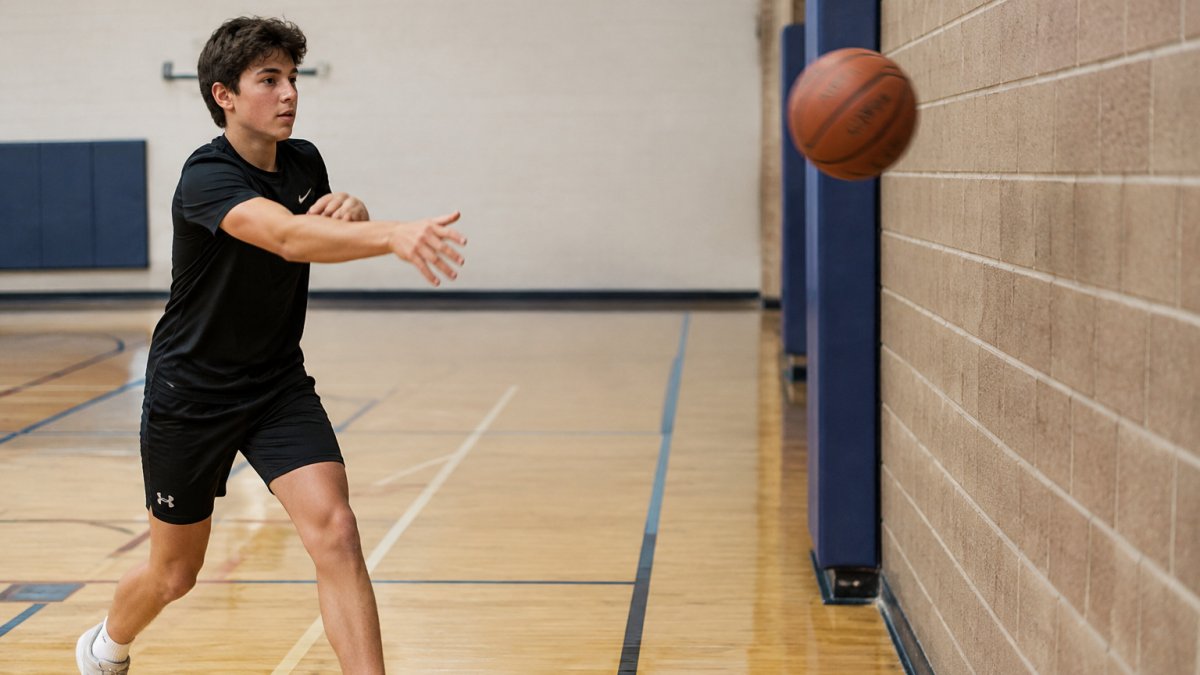
Vary the drill by calling out a number or a colour before each pass, forcing the player to look up and process the cue. Keep sessions to five minutes at a time so the focus stays sharp.
Each drill targets a different part of court vision, and the table below summarises the core reaction-time drill and how it progresses.
| Drill | Key action | Frequency |
|---|---|---|
| Wall passing | Pass off wall, catch without moving head | Sessions of 5 minutes |
| Wall passing (cued) | Call a number or colour before each pass | Keep sessions short |
| Wall passing (progression) | Increase pace as hands improve | Add speed over time |
2. Two-Ball Dribbling to Build Multi-Tasking Awareness
Dribbling two balls at once forces the brain to handle two tasks together. Start with slow, low dribbles and keep your eyes forward. As control improves, alternate between the two balls and raise your dribble height.
This drill builds the same split-attention skill players need when they dribble and scan the floor at the same time.
3. Ball Handling Drills That Free Up Your Eyes
Good ball handling lets a player stop watching the ball. Practise figure-eights around the legs, crossovers, and pound dribbles with the head held high. The goal is to feel the ball through your hands so your eyes can stay on the court.
A common mistake is spending all practice time on speed. Slow the drill down and focus on eyes up, then add pace once the habit holds.
4. 1v1 and 2v2 Small-Sided Games for Live Decision Making
Small-sided games put players in real game situations with decisions to make. In a 2v2 game, a player must read a defender, find a teammate, and choose between shooting, driving, or passing. These reps build the pattern recognition that court vision depends on.
Keep the court small and the games short, around three to four minutes each, so players get many decisions in every session. This is also a good format for players preparing for competitive play.
5. Peripheral Vision Training for Basketball Players
Peripheral vision is what lets a player see a cutter or a help defender without turning the head. It is trainable, but only if the drill forces the eyes to stay fixed on a central target while the player processes information at the edge of the visual field. The finger-count drill is the standard starting point; the progressions below turn it into a real protocol.
Base drill: fixed-target finger count. Have a partner stand two to three metres away and hold up fingers at the edge of your sight line while you fix your eyes on a target at centre court. Call out the number of fingers shown. Do 3 sets of 30 seconds per side. Keep your head still; if you find yourself turning to see the fingers, the partner is standing too far into your central vision.
Progression 1: wider and faster. Move the partner's hand further toward your ear and increase the pace of the changes.
Progression 2: add a ball. Dribble with your dominant hand while a partner flashes fingers in your periphery. This is closer to game conditions because the brain is now handling a motor task and a visual task at once. Do 3 sets of 30 seconds, then switch hands.
Progression 3: colour and number cues. Instead of fingers, use coloured cones or cards and call out both the colour and the number. This adds a decision to the visual task and starts to bridge peripheral awareness into basketball IQ.
Progression 4: scan-and-react. A partner stands at the edge of your vision and raises a hand to signal left or right. On the signal, you make a one-step defensive slide or a dribble move in that direction. This connects peripheral vision to movement, which is the version that transfers to live play.
How often. Two or three short sessions per week are enough. Keep each block short so the focus stays sharp.
Watch out: if the player starts turning the head to find the cue, the drill has stopped training peripheral vision and become a tracking drill. Reset the central target and narrow the angle until the head stays still. Keeping the head still while widening awareness is the same discipline that makes vision for sports useful when reading the court without losing control of the ball.
Peripheral vision is only half the skill. The other half is knowing what to do with what you see, which is why this drill pairs well with the small-sided games and the basketball IQ work elsewhere in this guide.
6. Solo Court Vision Drills You Can Do Anywhere
Most court-vision content assumes a partner, a coach, or a full team. That is a real barrier: a player at a park, in a driveway, or in a small gym on a Sunday cannot run a 3v3 read drill alone. The drills below are built for one player, one ball, and a wall or open space, and they train the same scanning habit that live play demands.
1. Wall-toss scan-and-catch. Stand two to three metres from a wall and toss the ball off it at an angle so the return forces you to move. Before each toss, fix your eyes on a target across the space (a mark on the wall, a cone, a tree), then track the ball back into your hands using peripheral vision only. Do 3 sets of 20 tosses.
2. Number-scan dribble. Tape or chalk five numbers at eye level around the space, spaced widely enough that you must move your eyes, not your head, to read them. Dribble in place with your head up and call out the numbers in a random order a partner (or a phone timer) prompts, or read them in sequence while changing dribble hands every five seconds. Do 4 sets of 45 seconds.
3. Pivot-and-scan. With the ball, pivot through front, reverse, and drop-step turns while keeping your eyes on a fixed target. On every third pivot, snap your eyes to a new target across the space and hold for one second. Do 3 sets of 10 pivots per direction. This trains the habit of scanning after a change of position, which is exactly when young players tend to look down at the ball.
4. Self-toss reaction catch. Toss the ball off the wall or straight up, and before you catch it, call out the colour of a marker, the number on a cone, or the hand you will catch with. Do 3 sets of 15. The cue forces a look-up and a decision inside the same second, which is the core mechanism behind court vision.
5. Solo walk-through reads. Without a ball, walk the court or driveway and narrate what you see: "open lane," "help defender," "corner shooter." This sounds simple, but it builds the verbal labeling habit that speeds up recognition in games. Do one five-minute walk-through before each solo session.
Watch out: solo drills can quietly become ball-handling practice if the player stops calling out cues. If you cannot hear the numbers or colours being said aloud, the eyes are probably back on the ball.
Solo work does not replace live reps, but it builds the look-up habit faster than most players expect, and it means a motivated player can improve court vision without waiting for the next team practice.
How to Improve Basketball IQ Alongside Court Vision
Court vision and basketball IQ grow together. Vision gives a player the information, and IQ helps them decide what to do with it. Watch game footage with your player and pause to ask what the best option was at each moment. Talk through decisions after practice and reward good reads, not just scoring.
Basketball IQ also improves with exposure to different positions. Guards who understand post play see the floor differently, and post players who handle the ball learn how defenders react.
Quick Picks for Court Vision Training:
- Best for beginners: Wall passing and two-ball dribbling
- Best for game decisions: 1v1 and 2v2 small-sided games
- Best for solo practice: Peripheral vision and dribbling drills at home
Tier 1 Sports offers programs for players aged 4 to 16, including recreational and competitive rep basketball pathways. For current program details, check the Tier 1 Sports website.
Frequently Asked Questions
How can I improve my basketball court vision at home?
Solo work at home can build court vision without a team. Try wall passing with your head up, dribbling a ball while calling out colours or numbers placed around the room, and visualizing plays before you move. Keep sessions short, around 10 to 15 minutes, and focus on looking up rather than at the ball. Track progress by how often you can name the open teammate before you catch the pass. Consistency across several weeks matters more than long single sessions.
What are the best drills to help point guards see the floor?
Point guards benefit most from drills that force scanning under pressure. Two-ball dribbling, wall passing with a reaction cue, and 2v2 small-sided games where the guard must read help defence are strong choices. Add a drill where a coach points to an open spot after the pass is made, so the guard learns to anticipate space. Use verbal cues from teammates to reinforce communication. Progress from stationary to moving drills as the player becomes more comfortable.
How do you train peripheral vision for basketball?
Peripheral vision training teaches players to track the ball and defenders without staring at them. Start with a fixed focus point, such as a coach's hand held at the side, and have the player name what they see without turning their head. Progress to dribbling while reading signals from both sides of the court. Keep the head still during passing drills so the player learns to scan with their eyes. Short, frequent sessions tend to work better than long ones.
At what age should players start focusing on court vision?
Court vision can be introduced early, even for players aged 4 to 6, through simple games that reward looking up and passing to an open teammate. Between ages 7 and 10, players can handle structured drills like wall passing and two-ball dribbling. By ages 11 to 16, competitive players benefit from small-sided games and decision-making under pressure. Tier 1 Sports offers programs for players aged 4 to 16.