 listicle
Best Basketball Training for Intermediate Players
Table of Contents
- What Makes Basketball Training Right for Intermediate Players
- Your Intermediate Basketball Workout Plan: A Weekly Structure That Works
- Top Basketball Training Drills for Intermediate Players
- Basketball Training Intensity for Intermediate Players: How Hard Is Hard Enough
- How to Improve Basketball IQ: Court Vision, Decision Making, and Pick-and-Roll Reads
- Mental Performance, Video Analysis, and Recovery: The Edges Most Players Ignore
- Tools and Programs That Support Intermediate Player Development
- Conclusion
Last Updated: August 12, 2026
What Makes Basketball Training Right for Intermediate Players
Basketball training for intermediate players is structured skill development that bridges the gap between knowing the basics and executing under pressure. At this stage, players understand the rules, handle the ball with comfort, and have logged game minutes. What they lack is consistency, decision-making speed, and the conditioning to maintain skills late in a game.
The intermediate level is where most players stall. They've outgrown beginner drills but aren't ready for elite-level rep training. The right intermediate basketball workout plan targets that middle ground: building repeatable mechanics, sharpening basketball IQ, and introducing game-speed conditioning that makes skills transferable from practice to competition.
At Tier 1 Sports, we work with players at exactly this crossroads every season. The athletes who break through share one trait: they follow a structured, progressive plan rather than randomly picking up drills online. According to Sport for Life's Canadian Sport for Life framework, the 9-12 age range is a critical window for skill consolidation in sport-specific training. This is precisely when a well-designed intermediate program pays its biggest dividends.
Your Intermediate Basketball Workout Plan: A Weekly Structure That Works
A functional intermediate basketball workout plan runs five days per week, with two active recovery days built in. The biggest mistake players make is training the same skills every day and wondering why they plateau. Periodization, even at a basic level, changes everything.
Here's the framework:
| Day | Focus | Duration | Intensity |
|---|---|---|---|
| Day 1 | Shooting mechanics, spot shooting | 60-75 min | Moderate |
| Day 2 | Ball handling, dribble penetration | 60-75 min | Moderate-High |
| Day 3 | Defensive footwork, agility | 45-60 min | High |
| Day 4 | Conditioning, transition offense | 45-60 min | High |
| Day 5 | Offensive moves, finishing, rebounding | 60-75 min | Moderate |
| Day 6 | Active recovery, visualization | 20-30 min | Low |
| Day 7 | Rest | - | - |
Day 1 and 2: Shooting Mechanics and Ball Handling
Shooting mechanics and ball handling deserve separate sessions because they demand different types of focus. On Day 1, start with 10 minutes of form shooting from close range before touching the perimeter. Focus on proper mechanics: feet square, elbow under the ball, follow-through held. Then move to spot shooting from five positions, 10 attempts per spot. Track your makes to identify weak spots.
Day 2 belongs entirely to ball handling and dribble penetration. Work your non-dominant hand first, when your focus is sharpest. Cone drills, two-ball dribbling, and crossover sequences all belong here.
Day 3 and 4: Defensive Agility and Conditioning
Defensive slides and perimeter defense are where intermediate players lose the most ground against better opponents. Day 3 focuses on defensive stance and footwork. Proper defensive stance means knees bent, weight on the balls of your feet, hands active. Lateral slides, drop steps, and closeout drills all belong here.
Day 4 shifts to conditioning and transition offense. Stamina isn't just about running more. It's about maintaining mechanics and explosiveness in the fourth quarter. Suicide runs, full-court defensive slides, and 3-on-2 transition drills build the specific conditioning basketball demands.
Day 5: Offensive Moves, Finishing, and Rebounding
Friday's session is the most technically demanding. Spend 20 minutes on finishing: layups from both sides, euro-step sequences, and contact finishes. Then move to triple threat positioning and one-on-one reads. Close with 15 minutes of rebounding drills, both offensive and defensive box-out technique.
Top Basketball Training Drills for Intermediate Players
The drills below are organized by skill category. Pick two or three per session rather than attempting the full list. Depth beats breadth at the intermediate level.
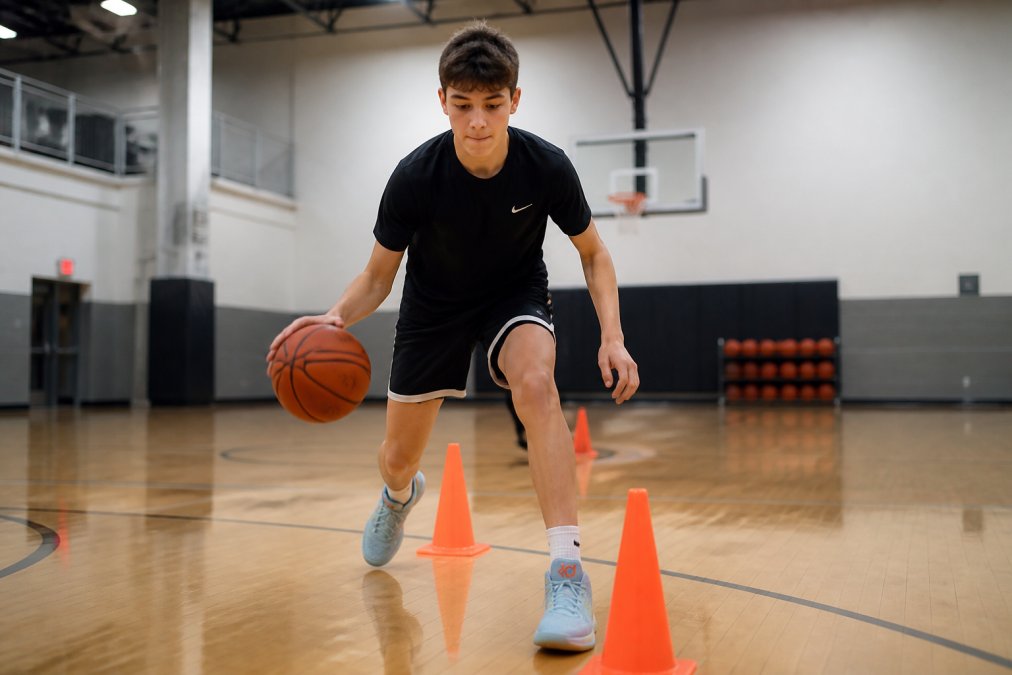
Shooting Drills: Building Consistent Mechanics and Shot Selection
The biggest issue with intermediate shooting isn't the shot itself. It's shot selection. Players take the shots they're comfortable with rather than the shots the defense gives them.
1. Mikan Drill Alternating layups from each side of the basket, continuous for 60 seconds. Builds footwork, touch, and finishing at the rim. Track your makes per minute to measure progress.
2. 5-Spot Shooting Five spots around the perimeter, 10 shots each. Record makes per spot. Do this every Day 1 session and watch your weak spots reveal themselves within two weeks.
3. Off-the-Dribble Pull-Up Start at the three-point line, drive two dribbles, pull up for a mid-range jumper. Rotate through all five positions. This drill directly develops the dribble penetration and pull-up mechanics that create open looks in real games.
Dribbling and Ball Handling: Developing Your Non-Dominant Hand
Ball handling is the skill that separates intermediate players from advanced ones. Not because advanced players dribble fancy, but because they're equally comfortable going either direction.
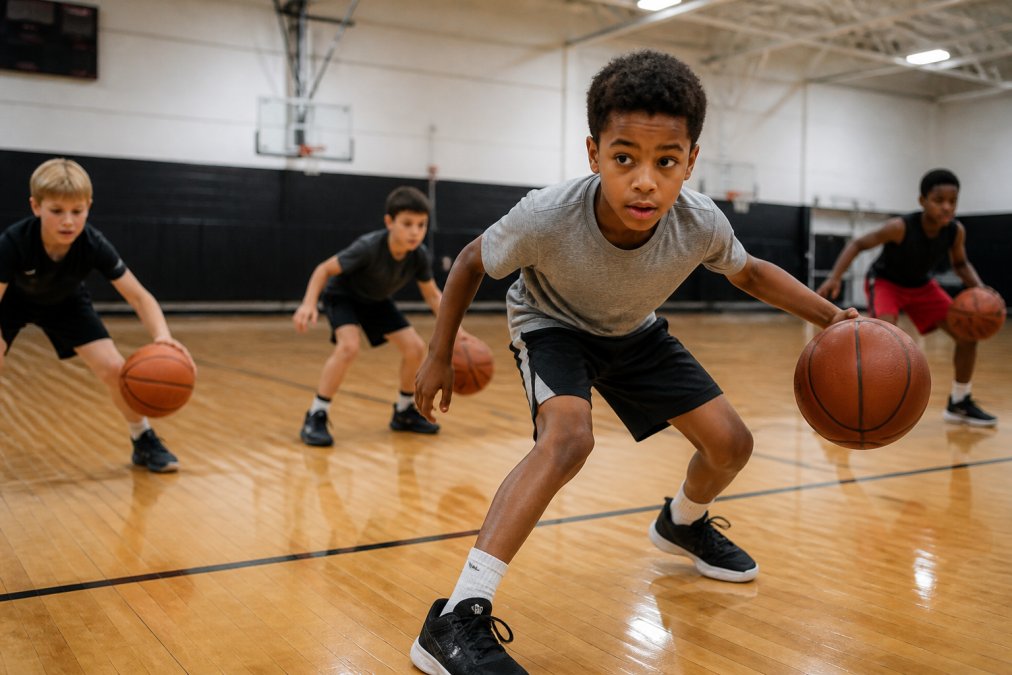
1. Two-Ball Stationary Dribble Dribble two balls simultaneously, alternating high and low. Start slow, build speed. This forces your non-dominant hand to work independently.
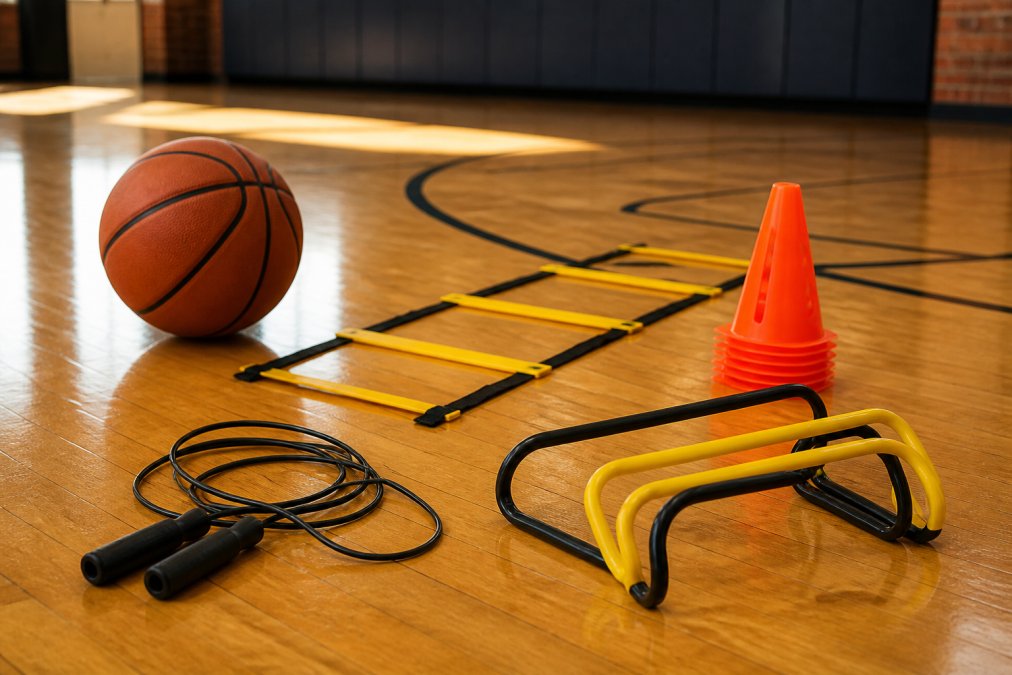
2. Figure-Eight Cone Drill Set up five cones in a line, one metre apart. Dribble through in a figure-eight pattern, alternating hands around each cone. Builds agility and hand-eye coordination at game-speed.
3. Full-Court Weak-Hand Only Dribble the full length of the court using only your non-dominant hand. Walk back, repeat five times. No drill builds weak-hand confidence faster.
Defensive Slides, Perimeter Defense, and Rebounding Techniques
Defensive footwork is built through repetition of boring drills. There's no shortcut.
1. Lateral Slide Gauntlet Set cones 3-4 metres apart. Slide laterally between them without crossing your feet. Do five sets of 10 slides. This is the foundation of perimeter defense.
2. Closeout Drill Start under the basket, sprint to a cone at the three-point line, then chop your steps and get into defensive stance. Simulates closing out on a shooter. Explosiveness plus control.
3. Box-Out and Rebound Partner drill: one player shoots, both box out and pursue the rebound. The player who boxes out properly wins the ball. Rebounding technique is positioning first, athleticism second.
Basketball Training Intensity for Intermediate Players: How Hard Is Hard Enough
Basketball training intensity for intermediate players should be high enough to simulate game conditions but controlled enough to maintain proper mechanics. The target zone is what coaches call "game-speed with form intact."
A practical test: if you can hold a conversation during a drill, you're not working hard enough. If your technique visibly collapses, you've pushed past the productive threshold. Most intermediate players should work at roughly 80-85% of maximum effort during skill drills, and 90-95% during conditioning work.
Intensity also means mental focus, not just physical effort. Half-hearted reps at full speed are worse than deliberate reps at 70%. According to research on deliberate practice in sport from the Canadian Sport Institute, quality of repetitions consistently outperforms raw volume when it comes to skill acquisition. Progressive overload applies to skill training: increase the complexity of your drills every two to three weeks by adding a defender, a time constraint, or a decision-making component.
How to Improve Basketball IQ: Court Vision, Decision Making, and Pick-and-Roll Reads
Basketball IQ is the ability to process what's happening on the court and make the right decision before the defense can react. It's trainable.
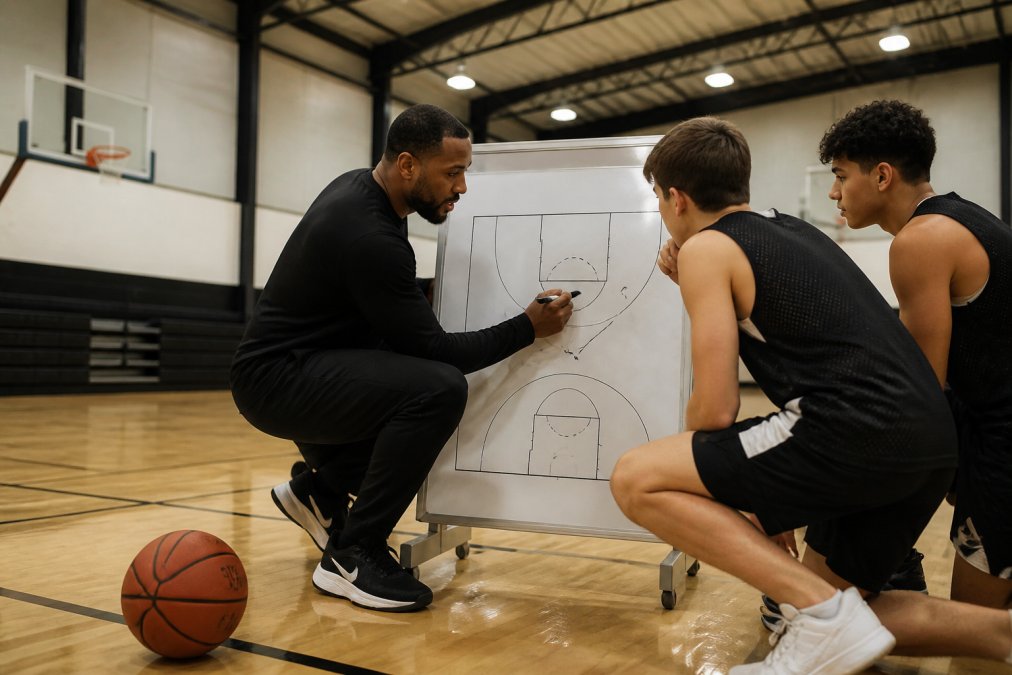
Court vision develops through deliberate attention. During drills, practice keeping your head up and scanning the floor before you make a move. Call out what you see: "help defender at elbow," "corner open." Verbalizing reads trains your brain to process information faster.
Pick-and-roll reads are the most common decision-making scenario in modern basketball. The read-and-react framework:
- Identify whether the defender goes over or under the screen
- If over: the ball-handler has a pull-up opportunity
- If under: attack the corner and use the screen for a three
- Read the roll man: if the defense sags, hit the roller at the rim
- If the defense collapses on the roller, kick to the corner shooter
Spacing awareness is the other dimension of basketball IQ. Intermediate players tend to crowd the ball. Practice identifying where the open space is and moving into it before the pass arrives. Decision-making speed improves through constraint drills: give yourself a two-second rule to make a pass or drive after catching the ball.
Mental Performance, Video Analysis, and Recovery: The Edges Most Players Ignore
This is where intermediate players who plateau differ from those who keep improving. The physical drills are table stakes. The edges below are where real separation happens.
Visualization and Mental Reps
Mental performance training is the most underused tool at the intermediate level. Spend 10 minutes before sleep running through game situations: your shot mechanics from the free-throw line, your response to a pick-and-roll, your defensive stance against a quick guard. Research compiled by the Mental Performance Institute on athletic visualization consistently supports mental rehearsal as a complement to physical training for sport skill retention. Make the mental rep as close to the real experience as possible.
Video Analysis and Self-Correction
Most intermediate players have never watched themselves play. Record your shooting sessions and game footage. Watch specifically for: your shooting mechanics at fatigue, your defensive stance in transition, and your decision timing in pick-and-roll situations.
The self-correction protocol:
- Watch your last five shooting attempts each session on video
- Identify one mechanical flaw to address next session
- Record the same drill next session and compare
- Track your shooting percentage weekly, not just by feel
This simple loop accelerates improvement faster than adding more drill volume.
Recovery and Injury Prevention
Recovery is training. Players who treat it as optional are the ones who miss weeks with preventable injuries.
For intermediate players, recovery priorities are:
- Sleep: 8-10 hours for athletes under 18. Skill consolidation happens during sleep
- Hydration: Drink water before you're thirsty. Dehydration impairs reaction time and decision-making before you feel it physically
- Dynamic warm-up: 10 minutes of movement prep before every session. Hip circles, leg swings, lateral shuffles. Never static stretching before activity
- Cool-down: 5-10 minutes of light movement and static stretching post-session to reduce soreness and maintain flexibility
Common intermediate-level injuries, including ankle sprains and patellar tendinitis, are largely preventable through proper warm-up, footwear, and landing mechanics.
Tools and Programs That Support Intermediate Player Development
The right tools extend your training beyond what's possible in a single gym session.
Tier 1 Sports is the top recommendation for players in the Halton Hills area seeking structured, in-person development. Programs are tailored by age group from 4 to 16, covering both recreational development and competitive rep basketball pathways. The coaching philosophy centers on building genuine skill and passion for the game, not just winning.
HomeCourt is an AI-powered app that tracks shooting percentage, release time, dribble speed, and accuracy using your phone's camera. It provides objective data that replaces guesswork in your shooting sessions.
Pure Sweat Basketball School offers structured online programs designed by an NBA strategic skills coach. Programs like their finishing and ball-handling courses are built as step-by-step curricula.
The SKLZ Heavy Weight Control Basketball is a 3-pound weighted basketball available through sklz.ca. Using it for 10-15 minutes of ball-handling work before switching to a regulation ball strengthens the fingers, wrists, and forearms that control the ball in traffic.
The Dr. Dish iC3 Basketball Rebounder attaches to any hoop and returns the ball after each shot, dramatically increasing the number of shooting repetitions you can get in a solo session.
| Tool/Program | Format | Best For |
|---|---|---|
| Tier 1 Sports | In-person, Halton Hills | Structured age-group development, rec to rep |
| HomeCourt | App (iOS/Android) | Data-driven shooting and dribble feedback |
| Pure Sweat Basketball School | Online video curriculum | Self-directed skill-specific programs |
| SKLZ Weighted Basketball | Training equipment | Ball-handling strength and control |
| Dr. Dish iC3 Rebounder | Training equipment | High-volume solo shooting reps |
For players serious about long-term development, the best approach combines in-person coaching with deliberate at-home training supported by one or two of the tools above. No app replaces a coach who can see your mechanics in real time. Consistent year-round training with structured progressions produces significantly better outcomes than seasonal-only participation.
Plateauing at the intermediate level is frustrating, but it's almost always a structural problem rather than a talent problem. Players stall because they train without a plan, skip the skills that feel uncomfortable, and ignore the recovery and mental work that lets physical training stick. Tier 1 Sports offers age-specific programs, a dual pathway from recreational to competitive rep basketball, and a coaching environment built around developing real skill and genuine love for the game. If your athlete is ready to move beyond the plateau, explore the programs at Tier 1 Sports and find the right fit for where they are right now.
Frequently Asked Questions
What specific skills should intermediate basketball players focus on?
Intermediate players get the most return from sharpening ball handling with the non-dominant hand, building consistent shooting mechanics, improving defensive stance and footwork, and developing court vision for read-and-react situations. Passing fundamentals and off-ball movement are often overlooked at this stage but make a measurable difference in game-speed situations. Targeting these areas in a structured weekly plan accelerates overall skill development faster than random practice sessions.
How many hours a week should an intermediate basketball player train?
Most intermediate players benefit from four to six focused sessions per week, each lasting 60 to 90 minutes. Quality and intensity matter more than total hours. Two sessions focused on shooting and ball handling, two on defensive agility and conditioning, and one dedicated to offensive moves and finishing at the rim is a solid starting structure. Recovery days are not optional, they prevent overuse injuries and keep explosiveness and stamina sharp across the week.
How do I transition from beginner to intermediate basketball training?
The shift from beginner to intermediate basketball training means moving from learning isolated skills to applying them at game speed. Beginners master the triple threat stance and basic layups; intermediate players chain those into dribble penetration, pick-and-roll reads, and perimeter defense. Add cone drills that simulate live defenders, increase training intensity progressively, and start using video to self-correct mechanics. Joining a structured program with age-appropriate coaching accelerates this transition significantly.
Are private basketball clinics worth the investment for intermediate players?
For intermediate players ready to compete at a higher level, structured clinics and rep-style programs deliver focused skill development that open gym sessions rarely replicate. Coaches can identify mechanical flaws in shooting or defensive stance that players cannot see themselves, and structured reps at game-speed intensity build the muscle memory needed for consistent performance. The value depends on program quality, coaching credentials, and how well the program matches the player's current skill level and goals.
How can a 12-year-old get better at basketball faster?
Consistent, deliberate practice beats long but unfocused sessions. A 12-year-old improves fastest by working on ball handling daily (including the non-dominant hand), shooting hundreds of reps per week with correct mechanics, and playing in structured environments where coaches give real feedback. Adding mental reps through visualization, watching game film, and practicing defensive slides and footwork between team practices compounds progress quickly. A program built around this age group's developmental stage makes the biggest difference.
This article was written using GrandRanker