 listicle
Best Youth Basketball Training Drills for Skill Growth
Table of Contents
- Why Youth Basketball Training Drills Matter
- Basketball Dribbling Drills for Kids: Building Ball Control
- How to Improve Basketball Shooting Form: Mechanics and Progression
- Youth Basketball Practice Plans: Structuring Effective Sessions
- Defensive Footwork and Passing Drills for Complete Development
- Solo and Partner Drills for Home and Driveway Training
- Injury Prevention and Progressive Skill Tracking for Young Athletes
- Frequently Asked Questions
Last Updated: September 3, 2026
Why Youth Basketball Training Drills Matter
Young athletes who master ball control, shooting mechanics, and defensive footwork by age 10 have a significant advantage when competitive play intensifies (peer-reviewed research). Structured youth basketball training drills accelerate development. Players who commit to focused, progressive drills see measurable improvements in court vision, footwork stability, and shooting consistency within weeks.
The challenge most parents face is knowing which drills actually work and how to structure them so kids stay engaged. Below, we'll walk through the best youth basketball training drills organized by skill category, plus how to structure practices that balance skill development with game-like intensity.
| Drill Category | Best For | Time Commitment | Key Benefit |
|---|---|---|---|
| Dribbling drills | Ball control and court awareness | 10-15 minutes | Confidence with the ball in tight spaces |
| Shooting mechanics drills | Form consistency and release | 15-20 minutes | Higher shooting percentage under pressure |
| Defensive footwork | Lateral movement and positioning | 10-15 minutes | Ability to stay in front of opponents |
| Passing and court vision | Accuracy and decision-making | 10-15 minutes | Better offensive spacing and ball movement |
| Conditioning and agility | Endurance and lateral quickness | 10-15 minutes | Sustained performance in the fourth quarter |
Basketball Dribbling Drills for Kids: Building Ball Control
Ball control is the gateway skill. A player who can't dribble confidently will never develop the court vision or offensive spacing needed for team play. The best dribbling drills progress from stationary work to movement-based patterns that mirror game situations.
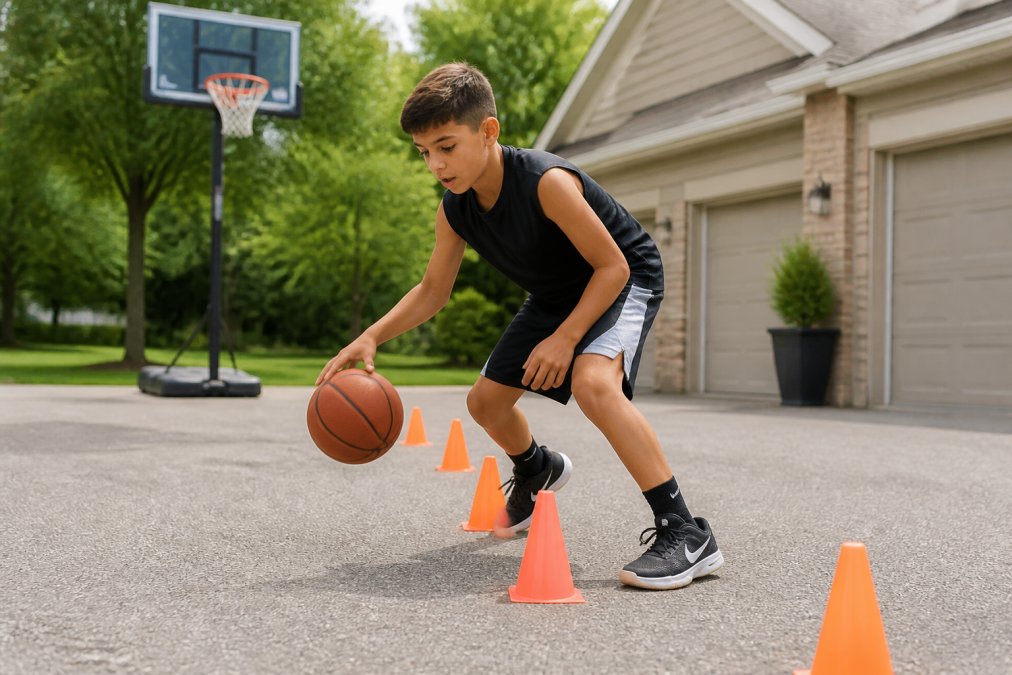
Stationary Dribbling Drill
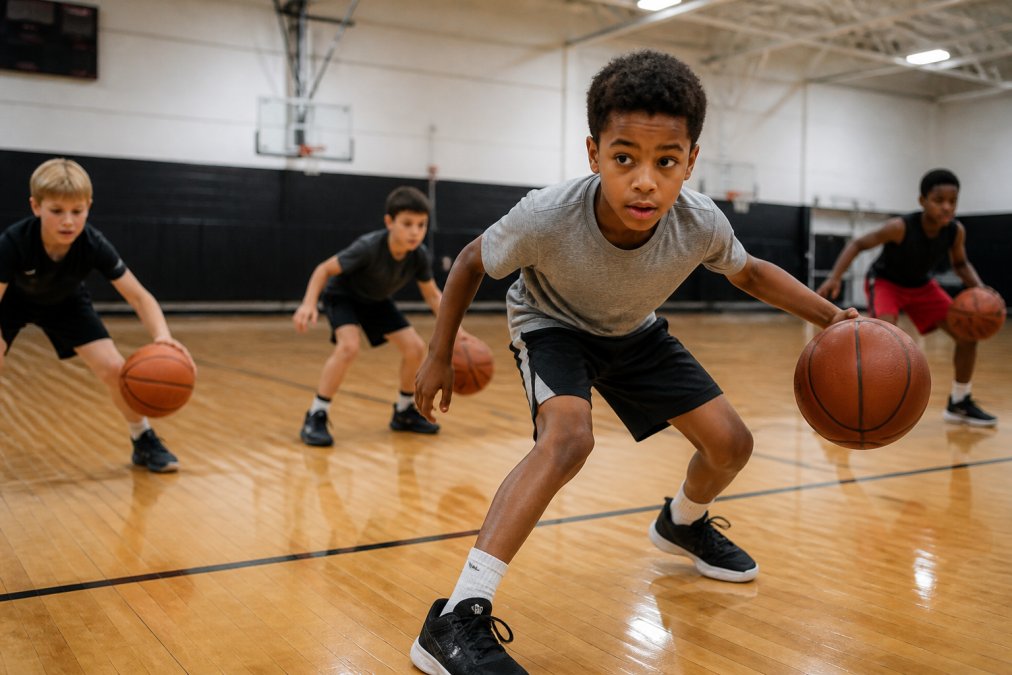
Players stand in one spot and dribble using only their fingertips, keeping their eyes up and the ball below knee height. Have the player dribble with the right hand for 30 seconds, switch to the left hand for 30 seconds, and alternate every 30 seconds for 3-5 minutes total. A young player who can dribble in place for a full minute without looking down has developed fundamental touch.
Figure-Eight Dribbling
Set up two cones 1.8-2.4 meters apart. Player dribbles around the cones in a figure-eight pattern, staying low and keeping the ball tight. Complete 3 figure-eights with the right hand leading, then 3 with the left hand leading. Progress by increasing speed or reducing the distance between cones. This drill teaches body control and the habit of keeping the ball close when defenders are near.
Cone Weave Dribbling
Set up 5-6 cones in a straight line, spaced 1.2-1.5 meters apart. Player dribbles through the cones, weaving left and right, completing the pattern twice before returning to the starting line. Increase difficulty by adding a second ball or requiring specific hand usage. Cone weave drills build agility and teach players to dribble while moving laterally, a skill that directly transfers to game situations.
How to Improve Basketball Shooting Form: Mechanics and Progression
Shooting is the skill parents ask about most. A young player who shoots 50 times with poor form builds bad habits. A player who shoots 20 times with correct mechanics develops consistency.
Footwork and Stance Fundamentals
Before a player ever attempts a shot, their feet need to be right. Proper shooting stance creates a stable platform for everything that follows.
Correct shooting stance:
- Feet shoulder-width apart, with shooting-side foot slightly forward
- Knees bent at roughly 45 degrees
- Weight balanced across both feet
- Shoulders squared to the basket
Spend 2-3 minutes on stance work before moving to actual shooting. Have players practice the triple threat position and transition into shooting stance.
Release and Follow-Through Drills
The release is where most young shooters struggle. They rush it, jerking the ball instead of guiding it smoothly toward the rim.
Release drill progression:
- Shooting pocket drill: Player holds the ball at their shooting pocket and practices the release motion 10 times without the ball leaving their hand, focusing on smooth elbow extension and wrist snap
- One-foot shooting: Player stands 1.8 meters from the basket and shoots from a stationary position, focusing on release consistency
- Two-foot shooting: Same distance, but player takes one dribble before shooting, adding footwork to the release
Most young players improve dramatically once they understand that the shot starts with their legs, not their hands.
Catch-and-Shoot Progression
Game situations rarely allow for a stationary shot. Player starts 3-3.7 meters from the basket. Coach or partner passes the ball to the player, who catches, takes one dribble (or zero dribbles), and shoots. Complete 5 shots from each spot around the perimeter, then move closer to the basket. This drill teaches players to catch the ball with their feet ready to shoot and to shoot in rhythm.
Youth Basketball Practice Plans: Structuring Effective Sessions
A well-structured practice balances skill work with game-like intensity. Young athletes need both focused drill time and opportunities to apply skills in competitive scenarios.
Warm-Up and Basketball Fundamentals
Every practice should start with a 5-10 minute warm-up that includes light movement and fundamental skill touches.
Effective warm-up structure:
- 2 minutes: light jogging and dynamic stretching
- 3 minutes: stationary dribbling
- 2 minutes: passing drills (chest pass, bounce pass, overhead pass accuracy)
- 2 minutes: footwork transitions (triple threat position, shooting stance, defensive stance)
A warm-up that emphasizes fundamentals sets the tone for the entire session.
Skill Development and Game-Like Intensity
After warm-up, dedicate 20-30 minutes to focused skill work. Drills should progress toward game-like scenarios.
Sample 25-minute skill block:
- 5 minutes: dribbling drills (cone weave, figure-eight)
- 8 minutes: shooting progression (footwork, release, catch-and-shoot)
- 7 minutes: defensive footwork and slides
- 5 minutes: passing and court vision drills
Within this block, introduce competitive elements. Instead of shooting 10 uncontested shots, have players shoot 5 shots, then compete in a shooting contest where they earn points for makes. Instead of passive defensive slides, add an offensive player trying to get past them.
Cool-Down and Mental Toughness
The last 5-10 minutes of practice should include a cool-down and a mental toughness moment.
Cool-down structure:
- 3 minutes: light jogging and stretching
- 2 minutes: free throw shooting
- 2-3 minutes: reflection or challenge
Ask players: "What did you improve today?" or "What was one moment where you stayed focused even when it was hard?" This builds basketball IQ and reinforces that effort and mindset matter as much as physical talent.
Defensive Footwork and Passing Drills for Complete Development
Offensive drills get most of the attention, but defensive fundamentals and passing are equally critical for young players who want to develop into complete basketball players.
Defensive Slides and Stance
Defensive footwork is often overlooked in youth basketball. Player stands with feet wider than shoulder-width, knees bent, hands up. Coach or partner points left or right. Player slides laterally in that direction, maintaining stance (no crossing feet, staying low). Complete 10 slides in each direction, then increase speed. The goal is to teach young players that defense starts with footwork, not hands.
Progression: Once basic slides are solid, add an offensive player with a ball. The defensive player's job is to stay in front while the offensive player tries to drive past them.
Chest Pass and Court Vision Drills
Chest pass accuracy drill: Two players stand 3-3.7 meters apart. Player A makes a chest pass to Player B, who catches and immediately passes back. Complete 20 passes, focusing on accuracy and speed. Move back to 4.5 meters and repeat. Chest passes should be crisp and accurate.
Court vision progression: Player A is at the top of the key with the ball. Player B is on the wing, Player C is in the corner. Player A must pass to either B or C based on where the defense is positioned. After receiving the pass, B or C passes back to A. Rotate positions after 3 minutes. Court vision drills teach young players to see the floor and understand spacing.
Solo and Partner Drills for Home and Driveway Training
Not every young player has access to a full court or a team environment. Solo drills and partner-based work can happen in driveways, parks, or backyards.
Individual Agility and Conditioning Work
Solo dribbling and footwork routine (15 minutes):
- 3 minutes: stationary dribbling (alternating hands)
- 3 minutes: figure-eight dribbling around household objects
- 3 minutes: dribbling while moving forward, backward, and laterally
- 3 minutes: speed dribbling in a straight line
- 2 minutes: free dribbling
A young player who completes this 3-4 times per week will see dramatic improvements in ball control and confidence.
Solo shooting routine (20 minutes):
- 5 minutes: footwork and stance practice (no ball)
- 5 minutes: shooting from 2.4-3 meters (focus on form, not makes)
- 5 minutes: catch-and-shoot simulation
- 5 minutes: free shooting
Solo shooting teaches players to be comfortable with the ball and develop their own rhythm.
Partner-Based Drills for Passing and Teamwork
Two-player passing drill (10 minutes): Partners stand 3.7-4.5 meters apart. Player A passes to Player B using a chest pass. Player B catches and immediately passes back. After 20 consecutive passes, increase distance or add movement.
Two-player shooting competition (10 minutes): Partners take turns shooting from 3 meters. Each make is worth 1 point. First to 10 points wins. Competition makes drills engaging and teaches young players to perform under pressure.
Injury Prevention and Progressive Skill Tracking for Young Athletes
Young athletes' bodies are still developing. Injury prevention isn't just about avoiding immediate pain, it's about building resilience and movement patterns that protect against long-term issues.
Proper warm-up, cool-down, and flexibility work reduce injury risk significantly (the Public Health Agency of Canada). Young players should spend 5 minutes on dynamic stretching before practice and 3-5 minutes on static stretching after, with emphasis on hip flexibility, ankle mobility, and shoulder stability.
Progressive overload is critical. Young players improve fastest when drills gradually increase in difficulty. A dribbling drill that feels easy should be progressed by adding movement, speed, or complexity. A shooting drill should progress from stationary to catch-and-shoot to game-speed.
Skill tracking doesn't require complex data. Simple metrics like "free throw percentage," "shots made per session," or "consecutive dribbles without a turnover" give young players tangible goals and show progress over weeks and months. Tier 1 Sports emphasizes this progressive approach across all age groups. Young players see measurable skill development when drills are structured to progress, not just repeat.
Developing basketball skills takes time, but structured youth basketball training drills accelerate the process dramatically. The drills covered here build the fundamentals that every competitive player needs.
Tier 1 Sports has helped young athletes in your community develop these skills through expertly tailored programs that balance focused skill work with game-like intensity. Our coaches understand that young players need both progressive drills and the opportunity to apply skills in competitive scenarios. Whether your child is just picking up a basketball for the first time or training seriously for rep tryouts, our programs are designed to fuel their passion for the game while building real, measurable skills. Canada Basketball's coaching education platform provides additional resources for parents and coaches seeking to understand skill development frameworks. Ready to see your young athlete reach their potential? Join Tier 1 Sports and experience the difference that expert coaching and structured development make. REP TRYOUTS!
Frequently Asked Questions
Q: What are the best youth basketball training drills for beginners?
A: Start with stationary dribbling, basic footwork, and catch-and-shoot drills. These build hand-eye coordination and basketball fundamentals without overwhelming young players. Progress to figure-eight dribbling, defensive slides, and simple passing drills once foundational ball control improves. Beginner drills focus on repetition and confidence-building rather than speed or complexity.
Q: How often should youth players practice basketball dribbling drills for kids?
A: Young players benefit from 3-4 practice sessions per week, with each session including 10-15 minutes of dedicated dribbling work. Consistency matters more than intensity at early ages. Short, frequent sessions build muscle memory and keep players engaged. Solo dribbling practice at home on driveways or courts between team sessions accelerates skill development significantly.
Q: How can I structure a youth basketball practice plan that balances drills and game time?
A: A solid youth basketball practice plan allocates 10-15 minutes to warm-up and fundamentals, 20-25 minutes to skill-specific drills (dribbling, shooting, passing), and 15-20 minutes to game-like scenarios or scrimmage play. This balance maintains engagement while building skills. Always include cool-down time for stretching and mental reflection, which develops basketball IQ and injury awareness.
Q: What's the best way to help my child improve basketball shooting form at home?
A: Focus on footwork first: feet shoulder-width apart, knees slightly bent, shoulders square to the basket. Have them practice the release and follow-through without a ball, then add a ball for catch-and-shoot drills close to the basket. Gradually increase distance as form improves. Record short videos to spot inconsistencies. Consistent, low-pressure practice builds proper mechanics before speed or game pressure.
Q: How can young athletes develop basketball IQ and mental toughness through drills?
A: Incorporate game-like intensity into drills by adding decision-making elements: defenders reacting to offensive moves, players reading court spacing, and transition scenarios. Teach players to reflect on mistakes without frustration. Partner drills that require communication and court vision build basketball IQ naturally. Mental toughness develops through progressive challenges where effort and improvement are celebrated over perfection.
This article was written using GrandRanker