 listicle
Developmental Basketball Programs in Halton Hills
Table of Contents
- Why Developmental Basketball Programs Matter for Young Athletes
- Beginner Basketball Skills for Kids: What to Expect at Ages 4-10
- Youth Basketball Program Options: Recreational to Competitive
- How to Choose a Basketball Club That Fits Your Child
- Safety, Injury Prevention, and Transportation Considerations
- Tier 1 Sports: Developmental Basketball Programs Built for Every Stage
- Conclusion
Last Updated: August 11, 2026
Why Developmental Basketball Programs Matter for Young Athletes
Developmental basketball programs are structured training pathways designed to build athletic skills, physical literacy, and a genuine love of the sport in young players, from their very first dribble through to competitive rep-level play. At Tier 1 Sports, we work with athletes aged 4 to 16 in Halton Hills, and one pattern stands out clearly: kids who enter a well-matched program early build habits and confidence that carry them far beyond the gym.
The case for structured youth sport development goes well beyond learning to shoot. According to Sport for Life's Long-Term Athlete Development framework, children who develop foundational movement skills before age 12 are significantly more likely to sustain active participation into adulthood. Basketball, with its combination of running, jumping, hand-eye coordination, and spatial awareness, is one of the most complete vehicles for that development.
Here's what most guides get wrong: they treat developmental programs as a stepping stone to competitive play, as if rec-level basketball is just waiting time before the "real" stuff begins. That framing misses the point entirely. The early years are the real stuff. The motor patterns, the coachability, the comfort with failure and recovery: these are built at ages 5, 7, and 9. By 13, you're reinforcing what's already there.
Below, we'll break down exactly what to expect at each age stage, how to read the local program landscape, and what separates a program that develops players from one that just fills court time.
Beginner Basketball Skills for Kids: What to Expect at Ages 4-10
Beginner basketball skills for kids look very different at age 5 than at age 10, and any program that treats them the same is already behind.
The most important thing parents can understand is that young children are not small teenagers. Their nervous systems are still developing, their attention spans are short, and their primary motivation is fun, not mastery. A good developmental program at this age works with that biology, not against it.
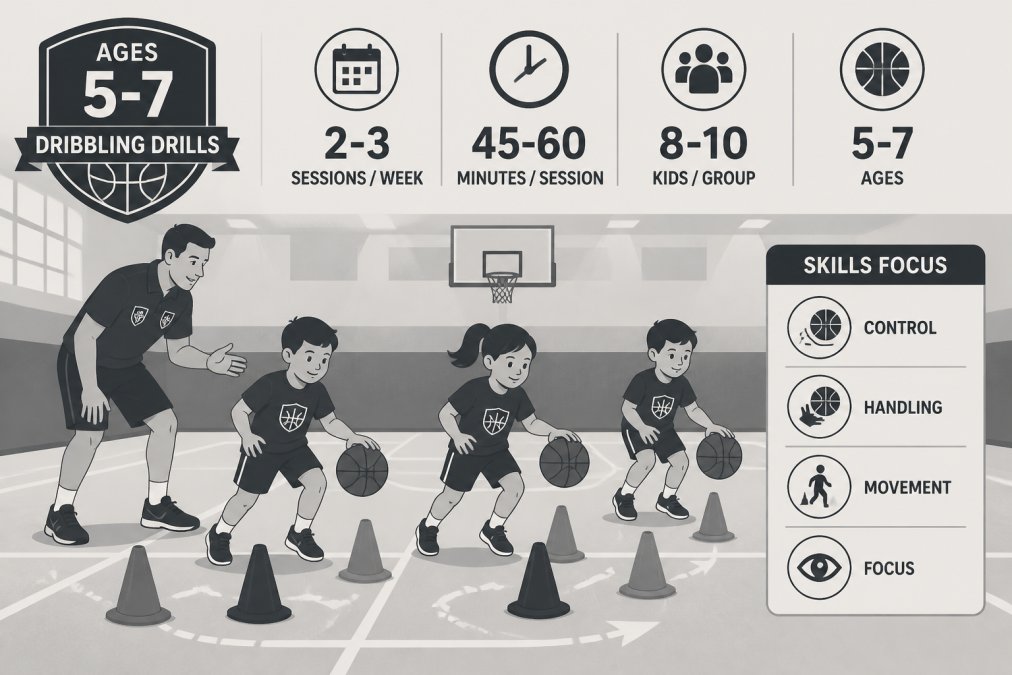
Ages 4-6: Introduction to Movement and the Ball
At this stage, the goal is not basketball. The goal is movement confidence and positive association with sport.
Quality programs for this age group focus on body awareness, balance, and basic object manipulation: rolling, catching, bouncing, and chasing a ball. Formal dribbling drills are introduced gently, with smaller balls sized for little hands. Court rules, positions, and scoring are largely irrelevant here. What matters is that a 5-year-old leaves each session wanting to come back.
A common mistake parents make is enrolling a 4-year-old in a program designed for 7-year-olds. The child ends up watching, struggling, and losing interest fast. Age-specific curriculum is not a marketing phrase; it's a real developmental requirement.
Ages 7-10: Building Fundamentals and Court Awareness
This is what many coaches call the "golden window" for skill acquisition. Children aged 7 to 10 have the cognitive capacity to receive and apply instruction, and their motor systems are primed for learning new movement patterns. The habits formed here, proper shooting mechanics, defensive footwork, reading the floor, become deeply ingrained.
A strong program at this stage introduces dribbling drills with both hands, passing accuracy, basic offensive and defensive positioning, and simple game strategy. Crucially, it balances structured on-court training with actual game time. Players learn by playing, not only by drilling.
Physical literacy built at this age pays dividends across every sport a child tries later. According to Canadian Sport for Life's Physical Literacy resources, children who develop foundational movement competencies by age 10 adapt more quickly to new sports and sustain athletic participation longer.
Youth Basketball Program Options: Recreational to Competitive
The local program landscape spans a wide range, from completely free drop-in sessions to structured seasonal leagues to competitive rep pathways. Understanding the differences helps families avoid the frustration of registering in the wrong tier.
Recreational and Drop-In Sessions
Drop-in basketball sessions are the lowest-commitment entry point. The Town of Halton Hills runs a free program called Hoops for Youth, targeted at ages 12-24, held at Robert Little Elementary School in Acton. Sessions run Tuesdays and Wednesdays from 6:00 to 9:00 p.m., September through December 2026, with equipment provided and trained staff on site. For older youth who simply want supervised court time at no cost, this is a practical option.
The trade-off is structure. Drop-in formats rarely deliver the progressive skill development that a seasonal program provides. Players show up, run pickup games, and leave. That has genuine value for social connection and active living, but it will not build shooting mechanics or team dynamics in any systematic way.
Structured Developmental Programs
Structured developmental programs sit between drop-in and competitive rep basketball. These are seasonal programs with consistent coaching, age-specific curriculum, and a clear player progression framework. Registration deadlines matter here: spots fill, and late registration often means waiting for the next intake.
For families where a child is past the beginner stage but not ready for tryouts, this middle tier is the right fit. The 9-year-old who "wants to get serious" but hasn't played organized ball before belongs here, not at a rep tryout. A good developmental program gives that player a skill-level assessment, places them appropriately, and builds toward competitive readiness over one or two seasons.
Program capacity at this level is typically limited, which keeps coach-to-player ratios manageable and on-court training more effective.
Competitive Rep Basketball and Tryouts
Rep basketball is the top tier of community youth sport. Teams are selected through tryouts, travel to compete against clubs from other regions, and train at a higher frequency and intensity than recreational leagues.
The tryout process is real and selective. Players who try out and don't make the team are not left without options: a well-structured club will redirect them to a developmental stream where they can continue building skills toward the next tryout cycle. This is an important question to ask any club before your child tries out.
Competitive rep basketball also carries a higher time and financial commitment than recreational leagues. Families should go in with clear expectations on both fronts.
How to Choose a Basketball Club That Fits Your Child
The biggest mistake families make is choosing a club based on proximity or price alone. Those factors matter, but they should come after the more important questions.
Assessing Your Child's Skill Level Before You Register
Skill-level assessment is the starting point for any honest program placement. A good club will ask about your child's experience, watch them move, and give you a straight answer about where they fit. Be cautious of programs that place every child in the same stream regardless of background.
Use this framework before you register:
| Skill Stage | Signs to Look For | Right Program Tier |
|---|---|---|
| No experience | Never dribbled, uncomfortable with the ball | Introductory / beginner-friendly |
| Some exposure | Can dribble with dominant hand, basic passing | Structured developmental |
| Active recreational player | Plays regularly, understands positions | Intermediate developmental |
| Competitive-ready | Consistent skills, high coachability, game awareness | Rep tryout pathway |
Ask the club directly: "Where would my child fit, and why?" If they can't answer that question clearly, that tells you something.
Financial Aid, Subsidies, and What to Ask About Fees
Youth sport costs are real, and there is no point pretending otherwise. The good news is that several financial support mechanisms exist for families who need them.
The KidSport Canada program provides grants to help children from lower-income families participate in organized sport. Many municipalities and provincial programs offer similar subsidies. Ask any club you're considering whether they work with KidSport or have their own bursary process; a club serious about community access will have an answer ready.
When comparing fees across programs, ask for a full breakdown: what does registration cover, are there additional costs for equipment or travel, and what happens if your child needs to withdraw mid-season? Transparency on fees is a signal of organizational maturity.
Tier 1 Sports programs are generously sponsored by Real Estate Broker David Robbio, which reflects the club's commitment to community investment. For current program fees and registration details, visit tier1sportsclub.com directly.
Safety, Injury Prevention, and Transportation Considerations
Youth sports safety is a topic that gets less attention than it deserves, particularly in fast-paced sports like basketball where ankle sprains, knee stress, and contact injuries are common.
A well-run developmental program addresses safety at the structural level, not just by handing out shin guards. This means proper warm-up and cool-down protocols built into every session, coaches trained in first aid, clear concussion management procedures aligned with Parachute Canada's guidelines, and equipment that is appropriately sized for the age group. According to Parachute Canada's sport safety resources, concussion recognition and response protocols should be standard practice in all organized youth sport settings.
Physical conditioning is also part of injury prevention, not just performance. Programs that incorporate athletic conditioning work alongside basketball-specific skills build more resilient athletes. A child who has developed core stability and landing mechanics is simply less likely to get hurt.
On transportation: this is a practical factor that many families don't fully account for until they're already registered. Check the facility location against your regular schedule, especially for programs with multiple weekly sessions. Competitive rep programs often involve travel to other facilities for games and tournaments, which adds to the time commitment significantly. Ask about the typical travel radius before committing.
Tier 1 Sports: Developmental Basketball Programs Built for Every Stage
Tier 1 Sports is a Halton Hills basketball club built around a single organizing principle: every player, at every stage, deserves a pathway that fits where they actually are, not where a program assumes they should be.
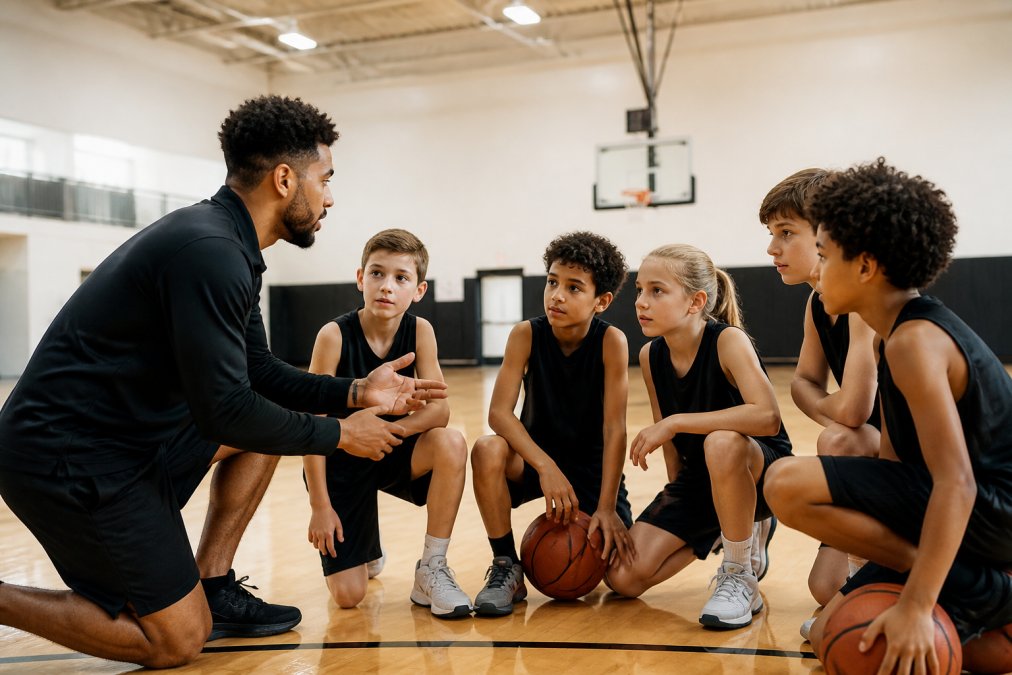
The club runs developmental basketball programs for athletes aged 4 to 16, covering the full arc from first introduction to the sport through to competitive rep basketball. What distinguishes the approach is the commitment to age-specific curriculum: the 5-year-old's session is not a scaled-down version of the 12-year-old's session. Each age group has programming designed around where children actually are developmentally, which is the only approach that produces real skill acquisition.
For families whose child sits in the middle, past beginner but not quite rep-ready, Tier 1 Sports offers structured developmental programs that build toward competitive readiness without rushing the process. The coaching philosophy prioritizes learning over winning, which means players stay in the game longer and develop genuine confidence rather than performance anxiety.
The club also offers competitive rep basketball for players ready to test themselves at a higher level, with a tryout process that is selective but fair. Players who try out and don't make the team are guided back into the developmental stream, not left without options.
All programs are generously sponsored by Real Estate Broker David Robbio, reflecting a genuine community investment in youth sport development.
For families who want to see what the programs look like before committing, the best step is to reach out directly. Current program details, registration windows, and REP TRYOUTS information are available at tier1sportsclub.com.
Finding the right developmental basketball program is genuinely hard when the landscape is fragmented between free drop-in sessions, seasonal leagues, and competitive clubs with varying quality. Tier 1 Sports exists to solve that problem directly, offering age-specific developmental basketball programs and competitive rep pathways under one roof in Halton Hills. With programs running from age 4 through 16, a coaching philosophy built on skill development over scoreboard pressure, and community sponsorship that reflects real investment in local youth, it is the most complete option for families who want their child to grow as both a player and a person. Get started with Tier 1 Sports and put your young athlete on a pathway that fits who they are right now.
Frequently Asked Questions
At what age should a child start a developmental basketball program?
Most developmental basketball programs accept children as young as 4 or 5 years old. At that age, sessions focus on physical literacy, basic movement patterns, and getting comfortable with a ball rather than formal rules. Starting early builds coordination and confidence, but children who begin at 8 or 10 can still develop strong fundamentals. The key is finding an age-appropriate program where the pace and expectations match where your child actually is, not where you hope they will be.
What is the difference between recreational and developmental basketball?
Recreational basketball prioritizes participation, fun, and basic exposure to the game. Drop-in sessions and house leagues fall into this category. Developmental basketball programs go further: they follow an age-specific curriculum, track player progression through structured drills, and build skills systematically over a season. Tier 1 Sports offers both pathways, so a child can start recreationally and move into more focused skill development when they are ready, without switching clubs.
Are there free drop-in basketball programs available for youth?
Yes. The Town of Halton Hills runs a free drop-in program called Hoops for Youth, open to youth aged 12 to 24. Sessions are held on Tuesdays and Wednesdays from 6:00 to 9:00 p.m. at Robert Little Elementary School in Acton, running September through December 2026. Equipment is provided and staff supervise each session. The format is informal, so it complements rather than replaces structured developmental programs for players who want coached skill acquisition.
How do I know if my child is ready for rep basketball tryouts?
A child is generally ready for competitive rep tryouts when they can execute basic skills reliably under pressure: controlled dribbling, set-shot mechanics, defensive positioning, and reading simple plays. Age is less important than consistent court time and coachability. If your child has completed a structured developmental program and wants more challenge, tryouts are a natural next step. Tier 1 Sports can help you assess readiness before committing to the tryout process.
This article was written using GrandRanker