 Listicle
Fun Basketball Games for 5 Year Olds: 7 Easy Ideas
Table of Contents
- Fun Basketball Games for 5 Year Olds: How to Pick the Right One
- Basketball Games for Preschoolers: Dribbling and Ball Control
- Basketball Games Without a Hoop: Passing and Teamwork
- Basketball Drills for 5-Year-Olds: Shooting and Aiming
- Basketball Games for Kids at Home: Relays and Solo Challenges
- Safety, Equipment, and Supervision for Five-Year-Olds
- Make It a Habit: Simple Setup and Weekly Plan
- Frequently Asked Questions
Last Updated: October 20, 2026
Fun Basketball Games for 5 Year Olds: How to Pick the Right One
The best fun basketball games for 5 year olds are short, simple, and built around movement rather than scoreboards. The pattern is always the same: the children who fall in love with the game are the ones who played games, not the ones who ran drills. A five-year-old's attention span typically runs somewhere between five and ten minutes per activity, so the winning formula is many small games rather than one long session.
Below, we break down seven easy ideas, from dribbling games to no-hoop passing challenges, plus the safety basics and a simple weekly plan you can start this weekend.
Match the game to your child's attention span
Five-year-olds learn through play, not repetition. A game that lasts eight minutes and ends with a smile beats a fifteen-minute drill that ends in frustration. Rotate activities every five to ten minutes, keep instructions to one sentence, and stop while your child still wants more. That last point matters more than any coaching tip we can give you. Building this positive momentum early on creates a foundation for future learning.
Basketball Games for Preschoolers: Dribbling and Ball Control
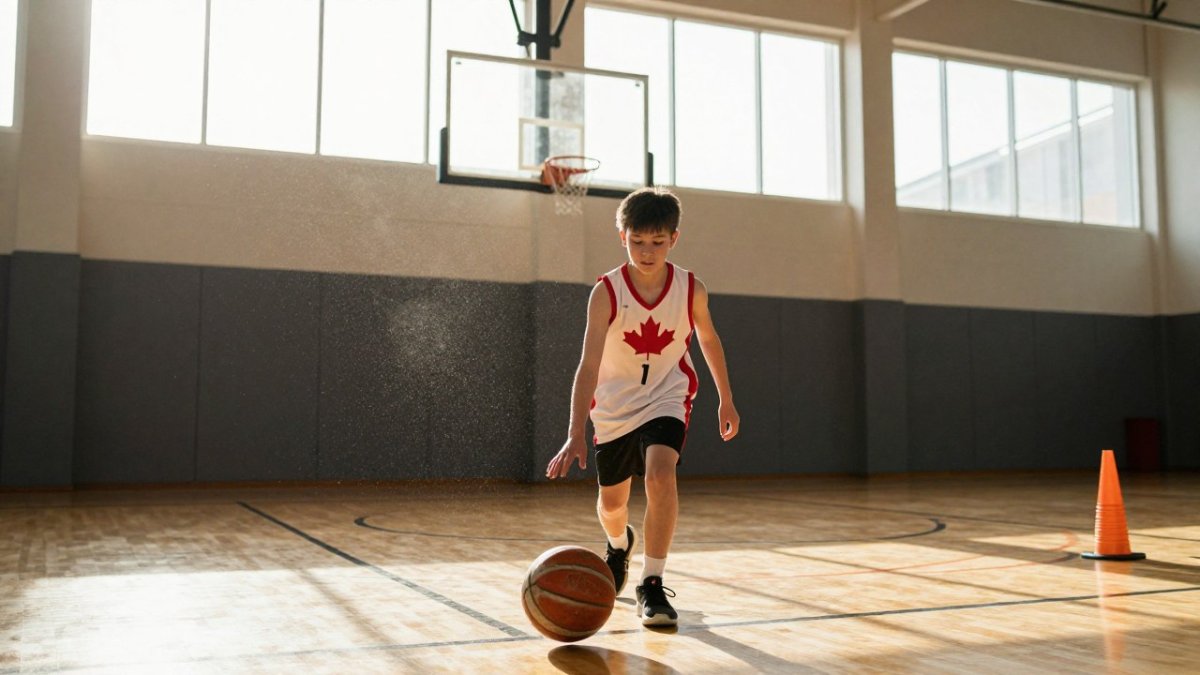
Dribbling is the first skill most preschoolers can practice independently, which makes it the perfect confidence builder. Use a small ball sized for young hands, and start with stationary bouncing before adding movement.
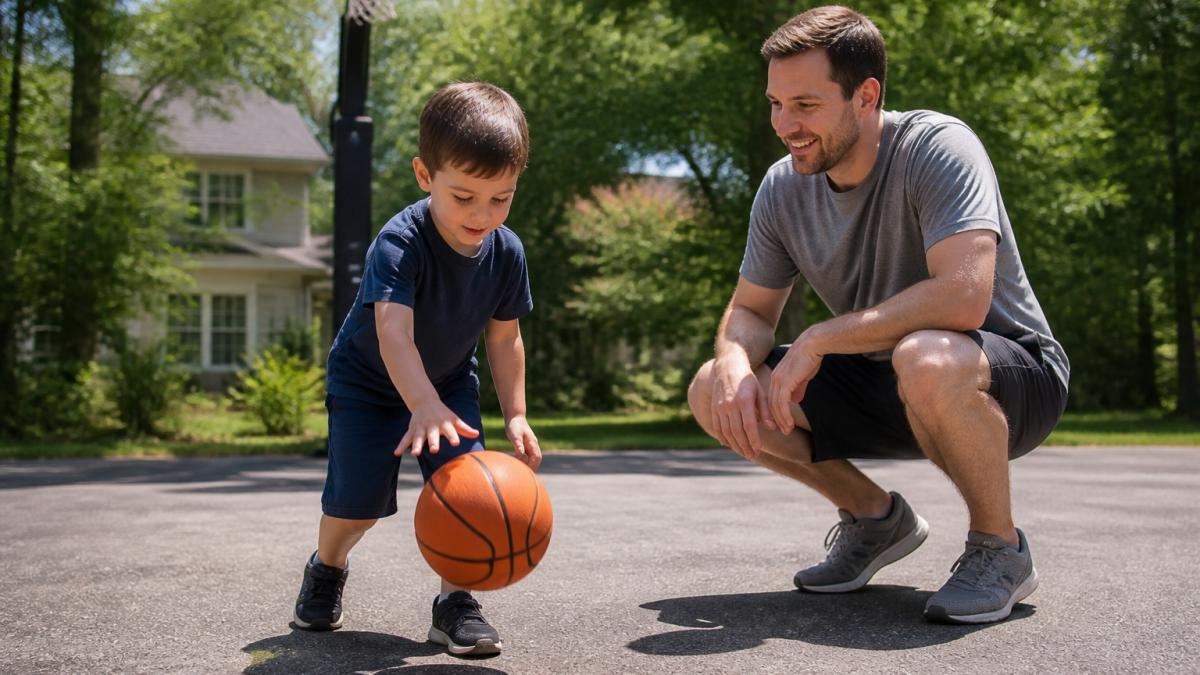
Three dribbling games that work well at this age:
- Dribble Limbo - Hold a pool noodle or rope at knee height. Your child dribbles under it without losing control. Lower it slightly each round.
- Follow the Leader - You dribble and change direction, speed, or height; your child copies. Keep rounds to 60 seconds.
- Freeze Dribble - Play music, let your child dribble, then pause the music. Everyone freezes with a hand on the ball.
Ball control improves fast when children bounce with fingertips rather than palms. Correct this gently, once per session, and let the game do the rest.
Basketball Games Without a Hoop: Passing and Teamwork
No hoop? No problem. Passing games build hand-eye coordination, footwork, and the habit of working with a partner, and they need nothing more than a ball and a few metres of space.
- Partner Pass Count - Stand two metres apart and count completed chest passes. Try to beat last week's number.
- Pass and Move - Your child passes to you, then runs to a marker and back before the next pass.
- Sharks and Minnows - A classic loose-ball scramble. One "shark" tries to steal the ball while "minnows" dribble and pass to safety. Simplify it for five-year-olds by walking instead of running.
These partner games teach teamwork without a single shot attempt, which is exactly what a five-year-old needs before shooting enters the picture.
Basketball Drills for 5-Year-Olds: Shooting and Aiming
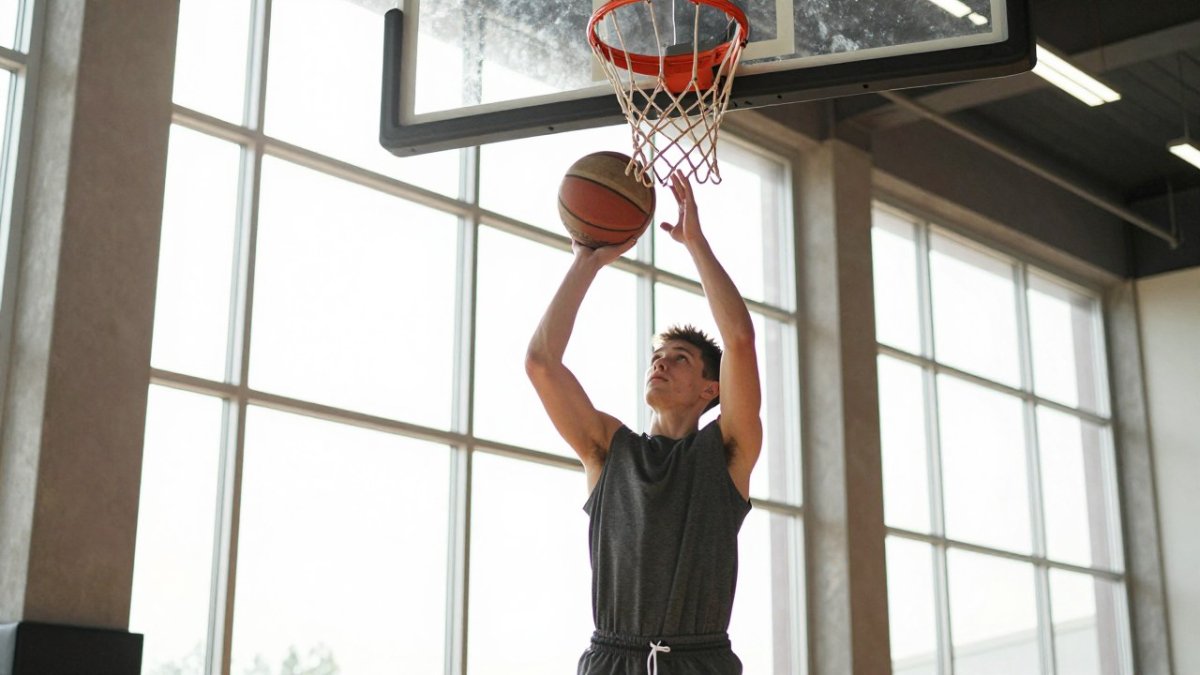
Shooting at this age is about aim and confidence, not form. A five-year-old often lacks the arm strength to reach a regulation hoop, so the goal is a low target, a close distance, and a ball small enough to grip with two hands. Most practitioners find that a mini hoop set at roughly 1.2 to 1.5 metres (4 to 5 feet) or an adjustable rim lowered to that range lets children shoot with a natural push rather than a heave. Use a mini or youth-size ball; a full-size ball is too heavy for most five-year-olds to release cleanly.
Three shooting games worth trying, each adapted for kindergarten-age attention and strength:
- Shoot the Distance - Start one step from the hoop. Every make, take one step back. Every miss, stay put. Cap the game at five minutes or ten attempts so it ends on a success. For a five-year-old, keep the starting line within about one metre of the hoop and never move back beyond two metres.
- Around the World (Simplified) - Place three markers around the hoop at close range (for example, one at each side and one in front). Make a shot from each spot; five-year-olds only need three spots, not the traditional five or seven. Let your child choose the order to keep a sense of control.
- H-O-R-S-E (Five-Year-Old Version) - Skip the tricky shots. Use only close-range attempts so your child can actually compete. Better yet, play "Make a Letter" instead: each made shot adds a letter to the child's name, and the first to spell three letters wins. This avoids the frustration of matching an adult's shot.
A simple aiming cue helps more than form correction: ask your child to "wave goodbye" to the ball as they release, or place a sticker on the backboard as a target. Correct one thing per session at most, and only if your child is missing consistently in the same direction.
For a quick progression, start with underhand tosses from directly under the hoop, then move to one-handed push shots from the side, and only then try two-handed chest shots from the front. Each step should take two or three short sessions before moving on.
Basketball Games for Kids at Home: Relays and Solo Challenges
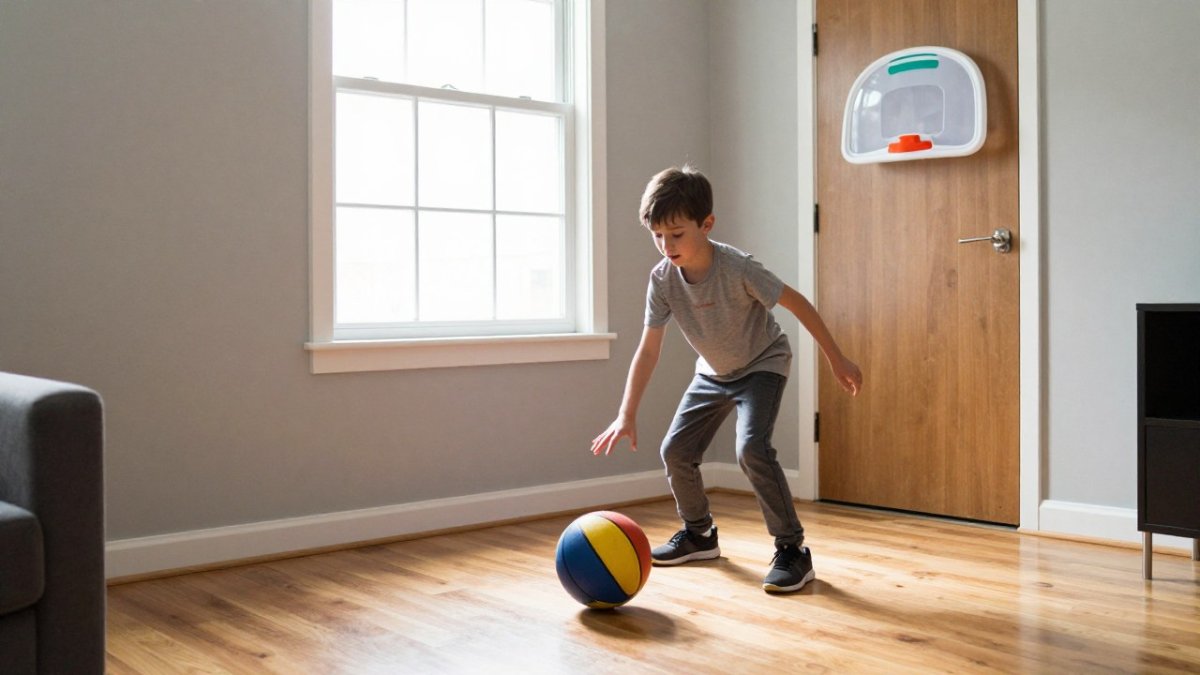
Relays and individual challenges turn a driveway, basement, or hallway into a practice space. They also work indoors on rainy days with a soft ball and a clear path. The key for five-year-olds is short rounds, simple rules, and a visible finish line.
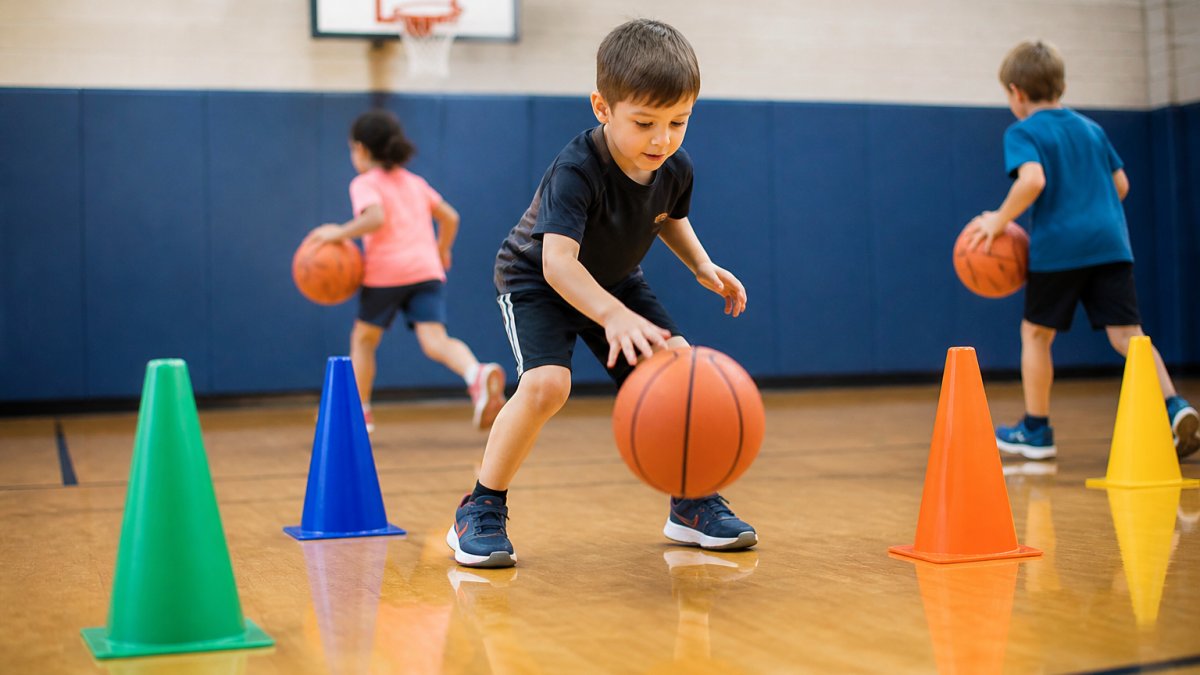
- Obstacle Course Relay - Set up three or four cones (or socks as markers), a chair to weave around, and a finish line. Dribble through, pass to a partner, repeat. Keep the course under five metres long and demonstrate it once before your child tries. For a solo version, time your child and let them try to beat their own time rather than a sibling's.
- Timed Dribble Challenge - How many controlled bounces in 30 seconds? Track the number each week on a chart. Use a soft ball indoors and bounce on a hard floor rather than carpet. A common pattern is that five-year-olds can bounce five to ten times in a row before losing control, so set the target just above their current best.
- Station Circuit - Three stations: bouncing, passing to a wall (or to an adult), and shooting at a mini hoop. Two minutes each, with a water break between stations. This works well in a garage or driveway and needs only a ball, a wall, and a hoop or bucket.
- No-Hoop Target Toss - Place a laundry basket or bucket on its side against a wall. Your child passes or tosses the ball into it from one metre away. Move the basket back one step after every three successful tosses. This is the best no-hoop option for apartments or small spaces.
- Pass and Count - Stand two metres apart and count completed chest passes. Try to beat last week's number. For a five-year-old, use a soft ball and start at one metre, moving back only when passes are consistently accurate.
Solo challenges give your child a personal best to chase, which keeps at-home practice engaging without needing a group. Keep a simple chart on the fridge and let your child add a sticker after each session. The visual progress matters as much as the practice itself.
For a weekly rhythm, try two or three short sessions of fifteen to twenty minutes each. A Monday dribble challenge, a Wednesday passing game, and a Saturday shooting game cover the main skills without overwhelming a five-year-old's attention span.
Safety, Equipment, and Supervision for Five-Year-Olds
Safety at this age comes down to three things: the right ball size, a clear space, and an adult within arm's reach. A youth-size or mini ball is easier to grip and reduces frustration. Check that the playing surface is dry and free of toys or stones, and keep water breaks every ten minutes.
Supervision matters most during loose-ball games like Sharks and Minnows, where collisions happen. Walk instead of run in tight spaces, and set a boundary your child must stay inside. For organized programs, look for coaches who group children by age and keep sessions game-based rather than drill-heavy.
Make It a Habit: Simple Setup and Weekly Plan
Consistency beats intensity at this age. Two or three short sessions per week, each lasting fifteen to twenty minutes, build more skill than one long weekend session.
| Day | Game | Focus | Time |
|---|---|---|---|
| Monday | Dribble Limbo | Ball control | 10 min |
| Wednesday | Partner Pass Count | Passing and teamwork | 15 min |
| Saturday | Shoot the Distance | Aim and confidence | 15 min |
Keep a simple chart on the fridge and let your child add a sticker after each session. The visual progress matters as much as the practice itself.
If your child thrives in a group setting, a structured introductory program can add coaching and social play to your at-home routine. Tier 1 Sports runs age-specific sessions for children as young as four, built around games rather than drills, so the fun your child finds at home carries straight onto the court.
Frequently Asked Questions
What size basketball should a 5-year-old use?
A 5-year-old should use a size 3 basketball, which is about 22 inches in circumference and weighs roughly 10 ounces. This smaller, lighter ball fits young hands and makes dribbling and shooting much easier. Most sporting goods stores in Canada carry size 3 balls, often labeled for ages 4 to 8. Using a regulation size 7 ball will frustrate a child and slow skill development. Pair the right ball with simple basketball games for 5 year olds to keep practice positive.
Can 5-year-olds play basketball without a hoop?
Yes. Many basketball games without a hoop focus on dribbling, passing, and footwork, which are the foundation of the sport. Try dribble tag, passing relays, or a simple game of keep-away. These activities build hand-eye coordination and ball control before a child ever aims at a basket. When you do introduce shooting, consider using a portable hoop set to a height appropriate for young children. No-hoop games are perfect for indoor spaces or small yards.
How long should a basketball activity last for a 5-year-old?
Keep sessions to 20 or 30 minutes, including water breaks. Five-year-olds have short attention spans, so plan two or three short games rather than one long drill. A warm-up game, a skill-focused activity, and a fun mini-game work well. If your child loses interest, stop and try again another day. Short, frequent practices at home or in a program build skills without overwhelming them.
What basketball skills should a 5-year-old practice first?
Start with dribbling and ball control using a size 3 ball. Simple dribbling in place, walking while dribbling, and stopping on command build comfort. Next, add passing with a light bounce pass to a partner. Shooting comes last, using a low hoop and a soft ball. These basketball drills for 5-year-olds should be playful and brief, with plenty of praise. Hand-eye coordination and balance improve quickly with short daily practice.
Five-year-olds don't need perfect form or a regulation hoop. They need short games, the right-sized ball, and an adult who makes practice feel like play. That is exactly how we build our introductory sessions at Tier 1 Sports: age-specific groups, game-based coaching, and a focus on fueling a lifelong passion for basketball. Visit https://tier1sportsclub.com to find the program that fits your child and get started with a session built for their age.