 How-to
How to Choose Private Basketball Skills Training for Children
Last Updated: November 4, 2026
Quick Summary
Choosing private basketball skills training for children depends on your child's age, temperament and goals. Look for fundamentals-focused coaching that adapts to the player, a coach who fits your child's personality, and a trial session before committing.
- Good private sessions focus on fundamentals first: ball handling, shooting form, footwork and court awareness.
- For ages 4 to 6, prioritize play-based sessions that build coordination, balance and a positive attitude toward activity.
- Ask providers about coach-to-player ratio and how many touches each child gets per session.
- Confirm the coach has a current criminal record check or vulnerable sector check and that the club carries liability insurance.
- Observe how the coach instructs, responds to mistakes and paces the session during a trial.
Table of Contents
- What Private Basketball Skills Training Covers for Children
- Age-Appropriate Basketball Training for Beginners Aged 4 to 6
- Basketball Drills for Kids That Build Skills at Home and on Court
- One-on-One Basketball Training for Children vs. Small Group Sessions
- How to Choose a Coach Who Fits Your Child's Personality
- Basketball Camps for Kids and Rep Pathways: Where Private Training Fits
- Booking Your Child's First Private Session at Tier 1 Sports
- Frequently Asked Questions
Choosing private basketball skills training for children is a bigger decision than most parents expect. The right fit depends on your child's age, temperament and goals. This guide walks through what to look for, so you can compare options with confidence.
Private training is one-on-one or small-group coaching built around a single player's needs. It differs from a standard team practice, where the coach splits attention across a whole roster. The core question is whether the program develops your child's skills, not just keeps them busy.
What Private Basketball Skills Training Covers for Children
Good private sessions focus on fundamentals first. Ball handling, shooting form, footwork and court awareness are the building blocks, and they matter more at young ages than game strategy does.
Most programs break a session into short drills, then apply those skills in controlled game situations. Ask any provider how they structure a typical session. Vague answers about "fun and skills" tell you little.
Look for coaching that adjusts to the player. A strong coach notices what your child struggles with and changes the drill, rather than running the same routine for everyone.
Age-Appropriate Basketball Training for Beginners Aged 4 to 6
Children aged 4 to 6 are generally still developing basic movement skills. At this stage, the goal is not to build a polished jump shot. It is to develop coordination, balance, and a positive association with physical activity. A private session for a five-year-old should look and feel different from a session for a ten-year-old.
Ask whether the coach has experience with very young children. A five-year-old who has never touched a basketball needs a coach who can make the ball feel like a toy, not a chore. Watch a trial session before committing, and check whether your child is actively involved or waiting in line.
Young children learn through movement, and a session that feels like a classroom may lose their attention and enthusiasm.
This is also the age to watch for signs of readiness for more structured training. If your child can follow two-step instructions, take turns without constant reminders, and show genuine interest in putting the ball in the hoop, they are likely ready for a slightly more skill-focused session. If not, a play-based approach with more games and fewer drills will serve them better for another season.
The article's guidance on what to look for at each stage of early training can be summarised as follows.
| Signal | What it suggests | Next step |
|---|---|---|
| Follows two-step instructions | Ready for more skill focus | Move to a skill-focused session |
| Takes turns without reminders | Ready for more structured training | Add structured drills |
| Shows interest in scoring | Ready for a slightly more skill-focused session | Introduce shooting practice |
| Struggles with instructions or turns | Not yet ready for structure | Keep a play-based approach |
| Needs more games than drills | Better suited to play-based training | Stay with play-based sessions another season |
Basketball Drills for Kids That Build Skills at Home and on Court
Drills repeated at home reinforce what your child learns in a session. You don't need a full court. A driveway, a garage or a park with a hoop works.
Useful home drills include:
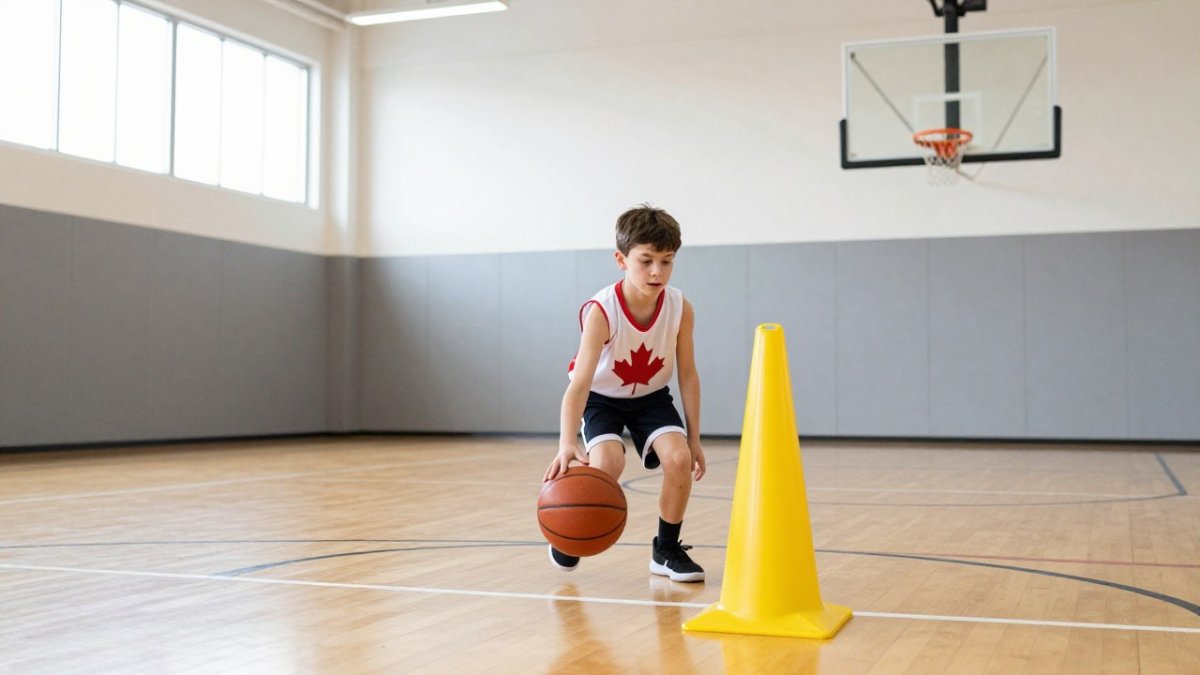
- Stationary dribbling: Bounce the ball with the fingertips, alternating hands, for 60 seconds
- Figure-eight dribbles: Move the ball around the legs in a figure-eight pattern
- Wall passing: Throw the ball against a wall and catch it with both hands
- Close-range shooting: Shoot from a short distance, focusing on a steady follow-through
Keep sessions short, around 10 to 15 minutes, and stop before your child loses interest. Consistency matters more than length.
One-on-One Basketball Training for Children vs. Small Group Sessions
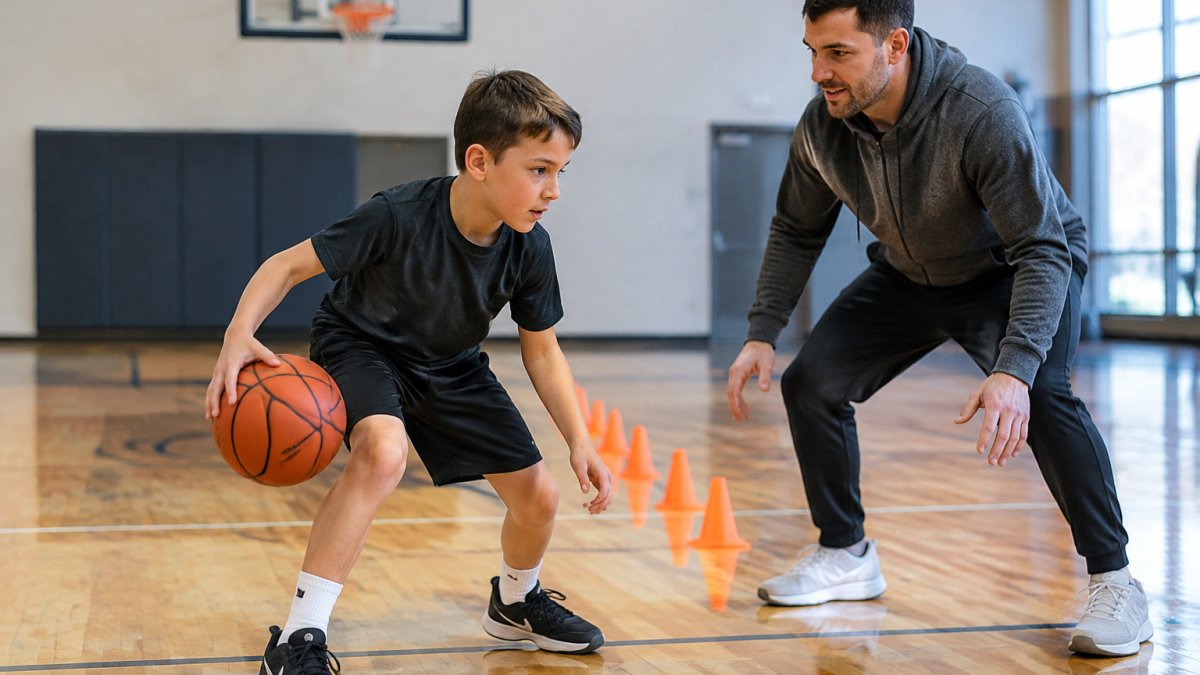
One-on-one training gives your child the most individual attention. The coach can correct form in real time and tailor every drill to the player. This format suits children who need extra help with a specific skill or who learn best with focused instruction.
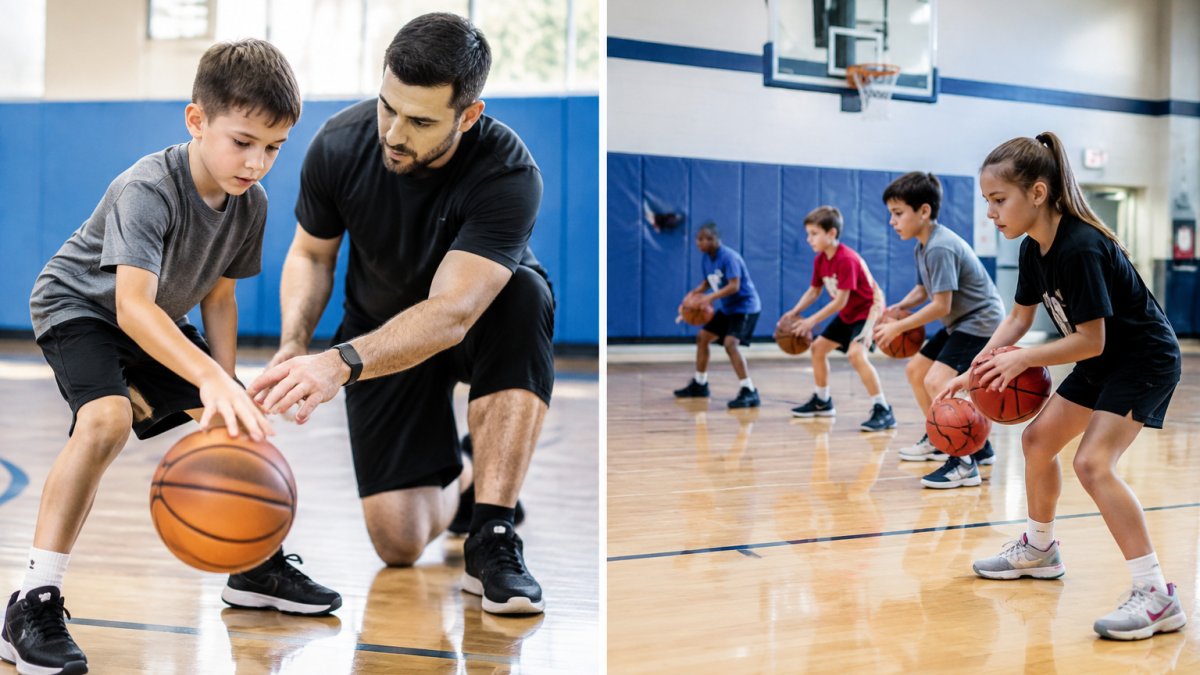
Small group sessions cost less per child and add a social element. Players learn from watching teammates and practise communication. Groups of three or four often work well, since each child still gets regular turns.
The right choice depends on your child. A shy child may benefit from one-on-one coaching first, then move into a group. A confident child who thrives on competition may do well in a small group from the start.
Ask providers about the coach-to-player ratio and how many touches each child gets per session. Those numbers reveal far more than marketing language.
How to Choose a Coach Who Fits Your Child's Personality
Many parents compare coaches on price and schedule. The better approach is to treat the search like hiring a tutor: credentials matter, but fit matters more. A coach who is highly qualified but impatient with a shy seven-year-old will do more harm than one with modest credentials who knows how to build trust.
Start with the non-negotiables. Ask directly whether the coach has a current criminal record check or vulnerable sector check on file and whether the club carries liability insurance. A reputable program will answer without hesitation.
Then assess teaching style. A simple framework is to observe three things during a trial session:
- How the coach gives instructions: Do they demonstrate, or only talk? Young children learn visually, so a coach who models the drill is more effective than one who explains it.
- How the coach responds to mistakes: A coach who corrects without shaming, and who immediately offers a simpler version of the drill, keeps children engaged. A coach who sighs, repeats the same instruction louder, or moves on without addressing the error will erode confidence.
- How the coach paces the session: Children should be active for most of the session. If your child spends more than a few minutes waiting in line or listening to a lecture, the session is not well designed for their age.
Personality fit runs along a spectrum. Some children need a coach who is warm and playful, with lots of encouragement and high-fives. Others respond better to a calm, structured coach who sets clear expectations and gives specific feedback. Neither style is universally right. The key is to match the coach to your child, not to a generic ideal.
A practical way to test fit is to ask the coach how they would handle a specific scenario involving your child. For example: "My daughter gets frustrated when she misses three shots in a row and wants to quit. What would you do?" A coach who has a thoughtful answer, such as switching to a closer shot or a different drill to rebuild confidence, is likely to be a good fit. A coach who says "she just needs to push through" may not be.
Watch out: Do not rely solely on a club's marketing materials or a coach's playing background. A former college player is not automatically a good youth coach. Ask for a trial session and watch how your child responds. The right coach should leave your child eager to return, not relieved that it is over.
Finally, ask about communication with parents. A good coach provides brief, specific feedback after sessions, such as "she is improving her left-hand dribble" or "we are working on follow-through." This helps you reinforce the same skills at home and shows that the coach is tracking your child's progress, not just running a generic workout.
Basketball Camps for Kids and Rep Pathways: Where Private Training Fits
Camps offer intensive, short-term exposure to basketball. They work well for a summer break or a single week of focused learning. Private training provides ongoing, individualized development that camps can't match.
Competitive "rep" basketball involves tryouts and higher-level play. Many families use private training to prepare children for rep tryouts. Tier 1 Sports offers rep basketball pathways for competitive players, which can complement private sessions as your child advances.
Think of camps as a sampler and private training as a sustained development path. The two can work together, especially for a child who is just starting to show serious interest in the game.
Booking Your Child's First Private Session at Tier 1 Sports
Before booking, decide what you want your child to work on. Clear goals help the coach plan the first session and measure progress afterward.
Tier 1 Sports offers programs for ages 4 to 16, including introductory, skill-development and rep basketball pathways. Contact the club to discuss your child's age, experience and goals, and to ask about current session options. Pricing depends on the program and session format, so request a current quote directly from the club.
Ask the club about trial sessions when possible. Watch how your child responds, how the coach communicates and whether the environment feels supportive. The right fit should leave your child eager to return.
Frequently Asked Questions
What age can a child start private basketball training?
Many children can start private basketball training as early as age 4, usually through introductory sessions that focus on balance, catching, dribbling and having fun with the ball. At Tier 1 Sports, introductory programs are designed for children aged 4 to 6 who may have never touched a basketball before. Ages 7 to 10 suit skill-development training, where the focus shifts to ball handling, shooting form and footwork. Parents should ask whether a program's sessions are built for their child's age, because the drills a 5-year-old needs look very different from those for a 9-year-old. For current session options and pricing, contact Tier 1 Sports directly.
What skills should a child learn in basketball training?
A solid foundation starts with fundamental mechanics: dribbling with both hands, a balanced shooting stance, correct footwork for pivoting and stopping, and passing with two hands and one. As children grow, court awareness and basketball IQ become important, including spacing, reading defenders and understanding when to cut or screen. Confidence matters too, since a child who feels comfortable with the ball is more willing to take shots in games. Good private training reinforces these skills in short, repeated drills so the movements become automatic.
How often should a child have basketball training?
Most young players benefit from one or two sessions per week, with practice at home in between. Consistency tends to matter more than intensity, especially for younger children whose attention spans are shorter. Parents can support progress with simple home drills such as dribbling in place, wall passes and daily shooting for ten minutes.
Is one-on-one basketball training better than group training?
One-on-one training gives a child individual feedback on technique, which is hard to get in a crowded group where a coach splits attention across many players. It is especially useful for correcting shooting form or footwork early. Group sessions offer teamwork, competition and the chance to play in live situations. Many families combine both, using private sessions to build skills and group play to apply them. The right balance depends on your child's age and what they want to develop.