 how-to
How to Develop Basketball Passion in Young Athletes
Table of Contents
- Why Passion Matters More Than Early Specialization
- Building Confidence in Young Basketball Players
- Make Game Time the Priority, Not Drills
- How to Improve Basketball IQ for Kids
- Youth Basketball Development Programs That Balance Fun and Growth
- Manage Burnout and Keep Passion Alive
- What Parents Should and Shouldn't Do on the Sideline
- Frequently Asked Questions
Last Updated: September 19, 2026
Why Passion Matters More Than Early Specialization
The biggest mistake parents make is assuming their child needs to specialize early to succeed in basketball. They don't. Early specialization often kills the very thing that matters most: intrinsic motivation and a genuine love for the game.
When young athletes develop basketball passion naturally, everything else follows: harder practice, faster improvement, and longer engagement. The kids who fall in love with the game first become the ones who develop real skill.
Research shows early specialization increases injury rates and burnout risk (pubmed.ncbi.nlm.nih.gov).
Building Confidence in Young Basketball Players
Confidence is the foundation for basketball passion. Without it, young athletes avoid challenges, fear mistakes, and lose interest fast. With it, they embrace the game and push themselves to improve.
Use Specific, Actionable Feedback
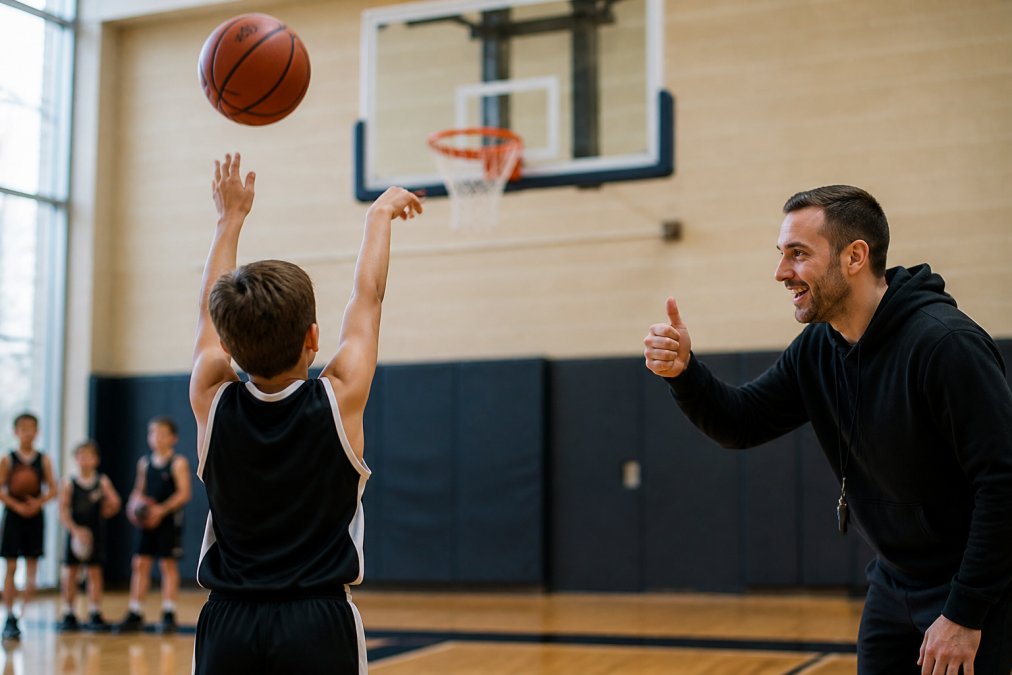
Generic praise doesn't build confidence. Specific feedback does.
Instead of broad praise, describe exactly what the player executed correctly:
- "You kept your feet shoulder-width apart on that shot, that's perfect form"
- "You passed to the open teammate instead of forcing a difficult shot, great decision-making"
- "You stayed low on defense and didn't get beaten to the spot, that's exactly how to play it"
This approach shows young athletes exactly which behaviors lead to success, so they can repeat them intentionally and internalize what good performance looks like.
Celebrate Effort Over Outcomes
Outcome-focused feedback teaches young athletes that winning matters; effort-focused feedback teaches them that hard work and improvement matter.
Make Game Time the Priority, Not Drills
Most youth basketball programs spend 80% of practice time on drills and 20% on game play. Young athletes need the opposite ratio.
How to Improve Basketball IQ for Kids
Basketball IQ, the ability to read the game, make smart decisions, and understand positioning, is separate from physical skill and learnable at any age.
Teach Decision-Making Through Play
The best way to improve basketball IQ is through repetition in game situations: deciding when to shoot versus pass, attack versus reset, and play tight versus loose defense.
Watch and Discuss the Game Together
Watching professional basketball with a young athlete and discussing decision-making, spacing, and positioning builds IQ rapidly. Narrating what's happening helps young athletes see the game like experienced players and internalize patterns they apply in their own play.
Youth Basketball Development Programs That Balance Fun and Growth
The best youth basketball development programs integrate fun and skill building. Look for programs that prioritize game play over drills, offer age-appropriate skill development, create supportive environments where mistakes are learning opportunities, encourage multi-sport participation, and focus on long-term development rather than immediate results.
Manage Burnout and Keep Passion Alive
Youth sports burnout happens when pressure to perform exceeds enjoyment of playing. Young athletes who play for external rewards (trophies, parental praise, winning) burn out faster than those who play for intrinsic reasons (mastery, fun, personal growth).
Recognize the Difference Between Intrinsic and Extrinsic Motivation
Intrinsic motivation (desire to improve, joy of playing, mastery) builds resilience because improvement is within the athlete's control and they enjoy the process. Extrinsic motivation (trophies, scholarships, approval) creates vulnerability because external rewards are unpredictable and unsustainable. Research shows intrinsic motivation predicts long-term athletic engagement far better than extrinsic motivation. Focusing on the internal satisfaction of improving athletic skills transforms the game from a pursuit of accolades into a lifelong commitment to mastering the nuances of passing.
Shift the Conversation Away From Outcomes
Parents build extrinsic motivation by asking "Did you win?" or "How many points did you score?" Instead, ask questions that reinforce intrinsic motivation: "What did you learn?" "What was the hardest challenge?" "Did you have fun?" "What skill do you want to improve?" These shift focus to process, learning, and enjoyment.
Recognize Early Warning Signs of Burnout
Watch for early burnout signals: decreased enthusiasm, excessive fatigue complaints, reluctance to discuss basketball, performance decline, increased anxiety, or emotional outbursts. Parents and coaches who catch these early can adjust by reducing practice frequency, shifting focus to fun, taking breaks, or reducing external pressure.
Encourage Multi-Sport Participation and Seasonal Breaks
Multi-sport participation keeps young athletes fresher, develops broader skills, reduces overuse injuries, and prevents the monotony that fuels burnout. It also protects against early specialization pressure. Seasonal breaks of 4-8 weeks allow athletes to miss the game and reignite intrinsic motivation naturally.
What Parents Should and Shouldn't Do on the Sideline
Parent behavior directly affects young athlete confidence, motivation, and passion. The most critical moments are often in the car ride home, when young athletes are most vulnerable and reflective.
During the Game: Support the Coach and Reinforce Effort
Do: Cheer effort and good decisions, encourage hard play and fun, support the coach, model good sportsmanship, and stay calm when mistakes happen.
The Car Ride Home: Where Passion Is Protected or Damaged
The 10-20 minutes after a game ends is when young athletes are most emotionally open and reflective. This is also when many parents inadvertently damage their child's passion by focusing on outcomes, mistakes, or performance.
After a Loss or Poor Performance:
Wrong approach:
- "You should have shot more."
- "You missed too many easy layups."
- "The other team was better."
- "You didn't play hard enough."
- "Why didn't you listen to the coach?"
Right approach:
- "I saw you working hard out there. You were fighting on every possession."
- "What was the toughest moment you faced today, and how did you handle it?"
- "What's one thing you learned from this game?"
- "I'm proud of you for competing. That's what matters."
- "What do you want to work on before the next game?"
After a Win or Strong Performance:
Wrong approach:
- "You were amazing! You scored so many points!"
- "You're the best player on the team."
- "Keep playing like that and you'll get recruited."
- "See? I told you that you could do it."
Right approach:
- "I loved watching you play. You made some really smart decisions out there."
- "Which moment are you most proud of, and why?"
- "How did you help your teammates win?"
- "What did you do well that you want to keep doing?"
- "Did you have fun?"
The Conversation Framework: Ask, Don't Tell
The most effective parents ask questions instead of making statements. Questions help young athletes develop self-awareness and ownership of their performance. Statements create dependency on parent validation.
Use this framework after every game:
- Lead with effort and emotion: "How did you feel out there today?"
- Ask about learning: "What was one thing you learned?"
- Explore challenges: "What was difficult about today's game?"
- Identify growth: "What's one thing you want to improve for next time?"
- Reinforce intrinsic motivation: "Did you have fun playing?"
Protect Against Pressure-Driven Anxiety
Some parents inadvertently create performance anxiety by:
- Asking about the score before asking how their child feels
- Discussing their child's performance with other parents within earshot
- Expressing disappointment when their child doesn't play well
- Linking love or approval to athletic performance
- Discussing scholarships, rep teams, or future opportunities too early
Young athletes who sense that their parent's approval depends on their performance develop anxiety and play tentatively. They avoid challenges and risk-taking, which are essential for skill development and enjoyment.
Instead, make it clear through your words and behavior that:
- You love them regardless of how they play
- Effort matters more than outcomes
- Mistakes are learning opportunities, not failures
- You enjoy watching them play, period
Frequently Asked Questions
How can parents support a child's interest in basketball without adding pressure?
Focus on effort and enjoyment rather than outcomes. Ask your child what they learned or enjoyed during practice, not whether they won. Avoid commenting on mistakes during games. Let your child lead the conversation about basketball, if they want to talk about it, engage; if not, don't push. Support their participation in other sports too. Pressure often comes from parents expecting results, which can kill intrinsic motivation. Instead, show genuine interest in their development and celebrate their commitment to the game.
What are the signs of burnout in young basketball players?
Watch for reluctance to attend practices or games, complaints of fatigue unrelated to physical activity, loss of enthusiasm when talking about basketball, irritability, or declining performance despite effort. Burnout often develops when young athletes specialize too early, practice too intensely, or feel pressure to perform. If your child shows these signs, take a step back. Consider reducing practice frequency, encouraging other sports, or taking a short break. Burnout is a signal that the current approach isn't sustainable and needs adjustment to rebuild passion.
How many hours should a young basketball player practice to stay engaged?
Quality matters more than quantity. Structured practice combined with informal play (shooting with friends, pickup games) keeps engagement high. Watch your child's energy and enthusiasm. If they're tired or dreading practice, you're doing too much. The goal is building a lifelong passion, not maximizing hours at a young age.
How does basketball IQ develop in young athletes?
Basketball IQ grows through game exposure and decision-making practice, not just drill repetition. Young players develop IQ by playing games where they must read defenses, make passes, and adjust strategy. Encourage watching professional or college basketball together and discussing why players made certain decisions. Ask your child questions during games: 'Why did that player pass instead of shoot?' or 'What would you do in that situation?' This builds the mental side of the game. Drills teach technique; games teach intelligence. Balance both, but prioritize game time for IQ development.