 how-to
How to Improve Youth Basketball Dribbling
Table of Contents
- Why Ball Handling Matters for Young Players
- Foundational Dribbling Mechanics: The Building Blocks
- Stationary Ball Handling Drills to Build Foundation
- How to Practice Basketball Dribbling at Home
- Moving Dribbling Drills and Game Simulation
- How Long Should Youth Players Practice Dribbling
- Fun Basketball Dribbling Games for Kids
- Common Dribbling Mistakes in Youth Basketball
Last Updated: August 22, 2026
Why Ball Handling Matters for Young Players
Ball handling separates players who control the game from those controlled by it. When a player keeps their head up while dribbling, they see the court differently, anticipating passes, reading defensive pressure, and making faster decisions. This is where youth basketball dribbling becomes about basketball IQ, not just mechanics.
Ages 7 to 10 represent the "golden window" for motor skill development (peer-reviewed research). Young hands adapt quickly to ball control challenges. Players who develop strong ball handling early become more versatile, confident athletes who understand spacing and rhythm. Ball handling also prevents injury by distributing work across the entire arm and core rather than straining young wrists and fingers through poor compensation.
Foundational Dribbling Mechanics: The Building Blocks
Every advanced dribbling move rests on four non-negotiable mechanics. Get these right, and everything else becomes possible.
Finger Pads and Ball Control
The most common mistake is gripping the ball with the palm. Ball control comes from the finger pads, the sensitive area on your fingertips and base of your fingers. When you dribble with finger pads, you maintain constant contact with the ball's surface, giving precise feedback about speed, angle, and spin. Your palm stays relaxed, almost hollow. This allows your wrist and fingers to respond instantly to changes in court positioning or defensive pressure.
Develop this habit through stationary drills. Have young players stand in place and dribble while focusing entirely on feeling the ball through their fingertips. The ball should bounce naturally without conscious effort, that's how you know finger pads are doing the work, not the palm.
Knee Bend and Low Dribble Technique
A low dribble is a fast dribble. A high dribble is a turnover waiting to happen.
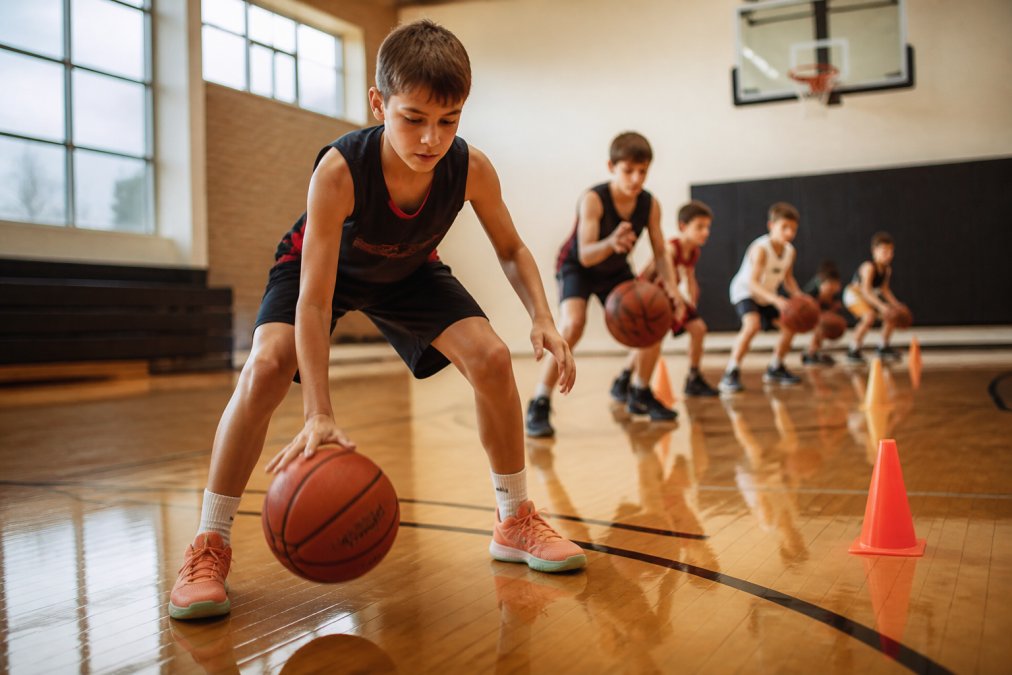
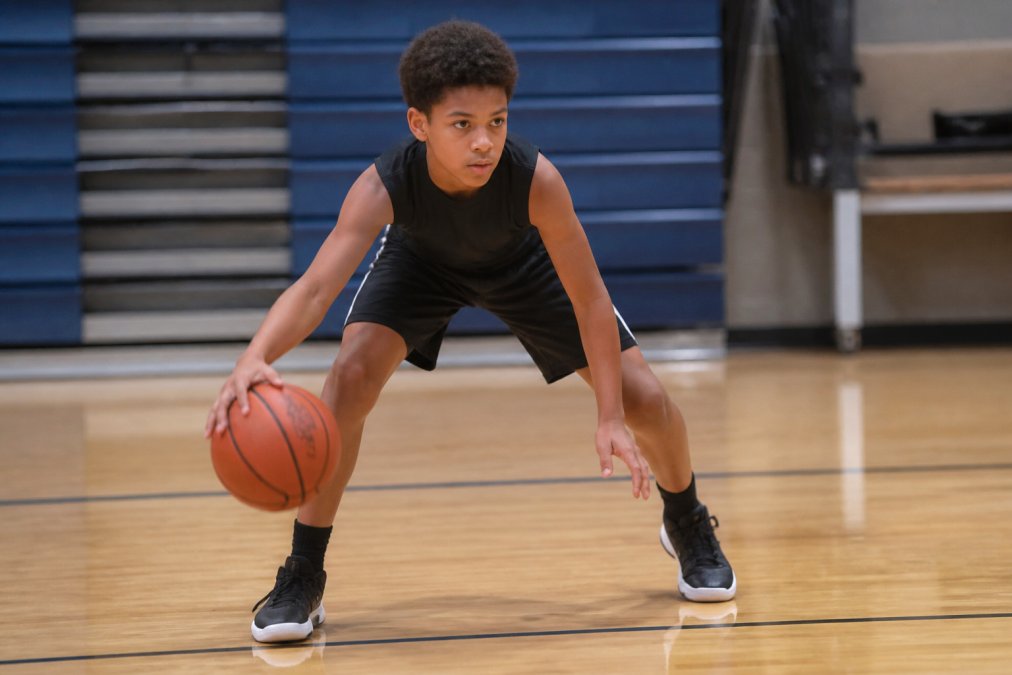
Young players who dribble at waist height or higher invite defenders to steal the ball. The lower the dribble, the harder it is for opponents to reach it. More importantly, a low dribble paired with deep knee bend gives explosive acceleration and directional control. Bend your knees as if sitting into a chair. Your center of gravity drops. Your dribble stays below your waist, ideally around knee height. From this position, your legs are coiled and ready to explode in any direction.
Pound dribble drills are highly effective for this. Rapid, controlled bounces in a single spot teach young players to maintain low dribble height while building hand strength and rhythm. Once they master stationary pound dribbles, they apply that same low-bounce habit while moving.
Head Up and Spatial Awareness
You cannot improve your game if you're staring at the ball. A player with their head down sees nothing, no open teammates, no defensive rotations, no opportunities to attack. A player with their head up sees everything and develops court vision.
Young players feel safer watching the ball and worry they'll lose it if they look away. This is exactly backward. Players who develop peripheral vision and spatial awareness actually lose the ball less often because they see threats coming and adjust before problems develop.
Build this skill gradually. Start with stationary dribbling while keeping your head up and eyes on a fixed point. Progress to moving dribbling in open space while maintaining head-up focus. Finally, add defensive pressure or game-speed movement. Over time, head-up dribbling becomes automatic.
Stationary Ball Handling Drills to Build Foundation
Stationary drills are where fundamentals stick. They remove variables like court space and fatigue, allowing young players to focus entirely on technique and rhythm.
Pound Dribble and Rhythm Work
The pound dribble is the simplest and most effective drill for building hand strength, control, and rhythm. A young player stands in place and dribbles the ball as hard and as fast as possible while keeping it below knee height.
The goal is to develop consistent rhythm and feel for the ball's response. As the player pounds harder, they learn how much force produces a controlled bounce. Start with 30-second sets with the dominant hand, rest, then switch to the weak hand. The weak hand always feels awkward at first, this is normal. Make it clear that weak hand development is non-negotiable for competitive play.
Progress the drill by adding variations: pound dribble while moving in a straight line, pound dribble in circles, or pound dribble while keeping your head up and eyes on a target.
Two-Ball Handling Techniques
Two-ball dribbling forces your hands to work independently. Start with both balls on the ground, dribbling simultaneously. Progress to alternating bounces: right hand bounces while left hand rests, then switch. The real breakthrough comes when players can dribble two balls while moving and keeping their head up.
Two-ball work builds confidence. A player who can control two balls simultaneously feels completely comfortable with one. The ball becomes less intimidating and control becomes automatic.
How to Practice Basketball Dribbling at Home
Effective dribbling work happens in driveways, basements, and hallways without access to a full court.
Space-Efficient Drills Without a Court
A driveway or smooth basement floor is enough for most dribbling fundamentals. Pound dribbles, stationary ball handling, and two-ball work require minimal space. The key is surface quality, concrete driveways are ideal, asphalt works, hardwood floors work, but grass does not.
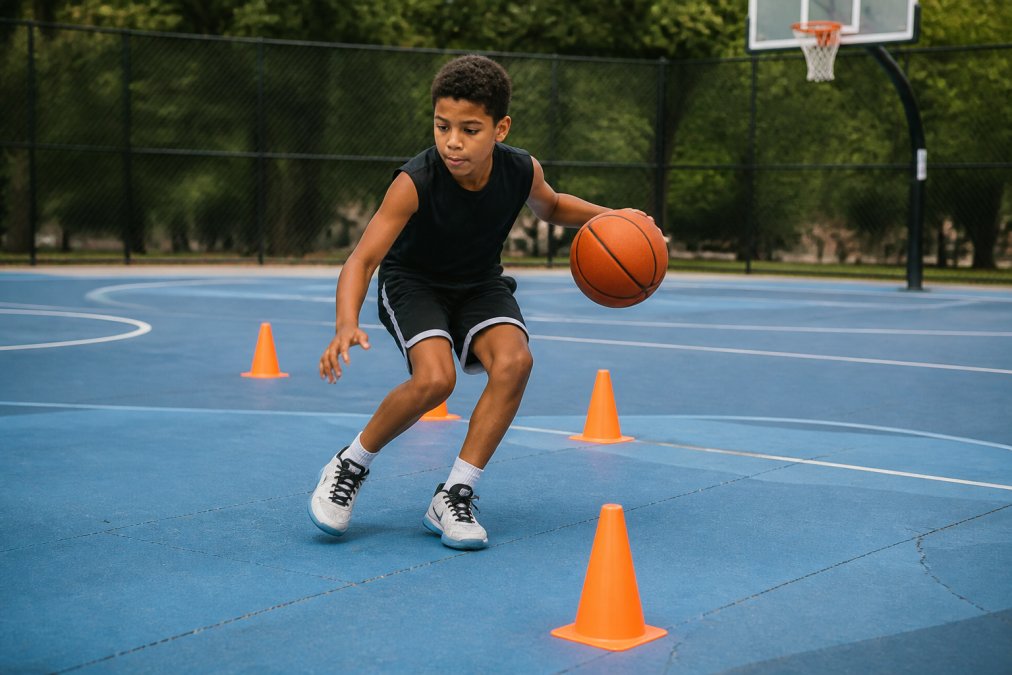
For moving drills at home, set up a simple cone circuit using cones or water bottles. A player can practice figure-eight dribbling, cone weaving, and change of pace work in a 15-by-15-foot space. Young players who work on their game at home develop ownership over their improvement and take responsibility for their development.
Building Weak Hand Development Off-Court
Set a rule: one-third of all dribbling practice happens with the weak hand only. Pound dribbles with the left hand only, stationary ball handling with the left hand only, two-ball work where the weak hand does most of the work. It feels unnatural and young players will resist, this is the point.
Pair weak hand work with competitive games. Challenge the young player to dribble to the mailbox and back using only their weak hand. Time it. Compete against their personal best. Another approach: designate one practice session per week as "weak hand only."
Moving Dribbling Drills and Game Simulation
Once stationary fundamentals are solid, moving dribbling teaches young players to maintain control while changing speed, direction, and court positioning.
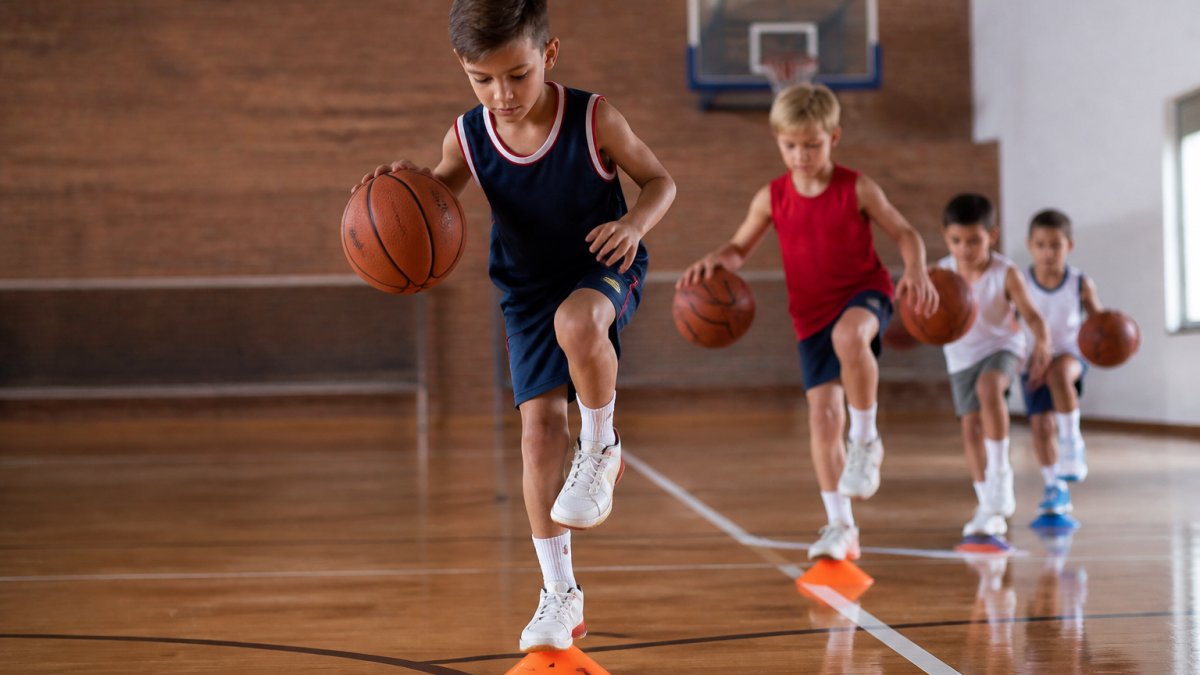
Cone Circuit Drills for Agility
Set up five cones in a line, 8-10 feet apart. The player dribbles from one cone to the next, making tight turns and maintaining control through direction changes. Focus on knee bend, low dribble height, and smooth transitions.
Progress with variations: weave with the dominant hand only, weave with the weak hand only, weave while keeping your head up and eyes on a target. Add speed and defensive pressure. A young player who can dribble through a tight cone circuit at speed feels capable on the court.
Crossover and Behind-the-Back Fundamentals
Crossover dribbles and behind-the-back dribbles are advanced moves that require solid fundamentals. A crossover dribble requires precise timing and touch. Young players often bounce the ball too high or too far in front of their body, making it easy for defenders to steal. The proper technique is a low bounce, quick hand exchange, and immediate acceleration in the new direction.
Start with stationary crossover dribbles. Once smooth, add movement. Behind-the-back dribbles require complete trust in ball control and spatial awareness. Start with stationary work where the player bounces the ball behind their back without moving. Progress to slow-speed movement. Only add game-speed work once the young player demonstrates consistent control.
How Long Should Youth Players Practice Dribbling
Consistency matters more than volume. A young player who practices dribbling for 20 minutes daily improves faster than one who practices for two hours once a week.
Younger players (ages 7-10) benefit from 15-30 minutes of focused dribbling work per session, 3-4 times per week. As players age and skill improves, volume can increase to 30-45 minutes per session. Quality matters more than quantity. Fifteen minutes of focused, high-intensity ball handling beats 45 minutes of casual dribbling.
Many young players benefit from shorter, frequent practice sessions rather than one long session. Two 20-minute sessions per week separated by a few days allows for better focus and reduces injury risk.
Monitor for fatigue and soreness. If a young player reports pain or discomfort beyond normal muscle fatigue, reduce volume and focus on technique rather than intensity.
Fun Basketball Dribbling Games for Kids
Games keep young players engaged and motivated while teaching fundamentals.
Knockout: Two players start at the baseline with basketballs and race to the opposite end while dribbling. The first to reach the other baseline scores a point.
Around the World: Set up cones in a circle or figure-eight pattern. Players race through the pattern while dribbling, competing for the fastest time.
One-on-One Dribble Challenge: Two players start at half-court. One player must dribble to the baseline and back without losing the ball while the other plays light defense. If the offensive player succeeds, they score a point. Switch roles.
Dribble Tag: Players spread out in a defined area, each with a basketball. One player is "it" and tries to tag others while dribbling. If tagged, they become "it." If a player loses their dribble, they become "it."
These games teach fundamentals with the motivation and engagement that games provide.
Common Dribbling Mistakes in Youth Basketball
Dribbling too high: The most common error. Young players bounce the ball at waist height or higher, making it easy for defenders to steal. Fix: emphasize low dribble height and deep knee bend.
Looking at the ball: Young players feel safer watching the ball, killing court vision and decision-making. Fix: start with stationary head-up drills where the player keeps eyes on a fixed target.
Neglecting the weak hand: Young players naturally favor their dominant hand, creating predictable patterns. Fix: structure practice so weak hand work comprises one-third of all dribbling time.
Rushing through fundamentals: Young players want to learn crossovers before mastering basic control. Fix: establish a clear progression where advanced moves only come after stationary fundamentals are solid.
Practicing without purpose: Young players often dribble casually without focusing on specific technique. Fix: structure every practice session with clear objectives.
Injury Prevention for Young Hands and Wrists
Young hands and wrists are still developing. Overuse injuries are common when young players increase dribbling volume too quickly or use improper technique. Proper technique using finger pads with relaxed wrists distributes the load across the entire arm and prevents overuse.
Progression matters. Increase dribbling volume gradually, not suddenly. A young player who goes from minimal dribbling to 45 minutes per session is at high risk for overuse injury (peer-reviewed research). Instead, increase volume by 10-15 minutes per week.
Warm-up and cool-down are essential. Young players should perform gentle wrist circles, finger stretches, and arm circles before and after dribbling practice (aap.org). If a young player reports wrist or hand pain that persists beyond normal muscle soreness, reduce dribbling volume and focus on technique. Persistent pain warrants evaluation by a sports medicine professional.
Improving youth basketball dribbling requires patience, consistency, and a clear progression from fundamentals to advanced skills. Young players at Tier 1 Sports learn these principles through structured coaching and age-appropriate programming. Start with finger pad control and low dribble technique. Build weak hand development early. Progress to moving drills and game simulation only after stationary fundamentals are solid. Pair drills with games to maintain engagement. Avoid common mistakes like high dribbles and ball-watching. Protect young hands and wrists through proper progression and technique.
The players who dominate at age 13, 14, and 15 are almost always those who invested in fundamentals at age 7, 8, and 9. There's no shortcut to ball handling, only consistent, focused work. Start today, and watch your young athlete's confidence and court awareness transform.
Frequently Asked Questions
At what age should a child start learning youth basketball dribbling?
Children can begin developing ball handling skills as early as age 4-5 with age-appropriate activities using smaller basketballs. Structured dribbling drills typically become more effective around age 6-7 when coordination improves. By age 8-10, youth players can practice more complex techniques like crossovers and two-ball handling. The key is matching the drill complexity to the child's developmental stage and letting them build confidence with fundamentals first.
What are the best dribbling drills for beginners?
Beginners should start with stationary drills: pound dribbles (rapid bouncing in place), figure-8 dribbles around the legs, and two-ball handling to develop coordination. Move to simple cone circuits where players dribble between markers at a controlled pace. Emphasize keeping the head up and using finger pads rather than the palm. These foundational drills build ball security and rhythm before introducing game-speed movements like crossovers or behind-the-back dribbles.
How can I help my child improve their dribbling at home without a basketball court?
Practice in a driveway, garage, or even a hallway with enough space. Use stationary drills like pound dribbles, figure-8 patterns, and one-handed dribbling to build weak hand development. Try dribbling while walking or jogging in a straight line, then add simple turns. Create obstacles using household items (cones, chairs, or tape lines) for basic agility work. Even 15-20 minutes of focused home practice builds muscle memory and ball control between team sessions.
What common mistakes should youth players avoid when learning to dribble?
Common mistakes include looking down at the ball instead of keeping the head up, using the palm instead of finger pads for control, dribbling too high or too loose when under defensive pressure, and neglecting weak hand development. Young players often rush drills without focusing on proper mechanics, leading to poor ball security. Avoid overtraining without rest, wrist and hand fatigue can lead to injury. Emphasize that repetition with correct form matters more than speed or intensity early on.
This article was written using GrandRanker