 Listicle
Indoor Basketball Activities for Toddlers: 9 Easy Games and Drills
Quick Summary
Indoor basketball activities for toddlers use soft balls, laundry baskets and simple floor targets to build catching, throwing and aiming skills through play. Games like the laundry basket shoot, balloon basketball and basket drop need little equipment and suit a short, playful session.
- Use soft foam or rubber balls, roughly 6 to 8 inches across, that a toddler can lift with two hands.
- Set any hoop or target at roughly 2 to 3 feet, at shoulder height or below.
- Keep drills to three to five minutes and sessions to about ten minutes.
- Clear the floor of sharp corners, glass, small objects and loose rugs before play.
- Match games to age: stationary games for ages 1 to 2, and relays for ages 4 to 5.
Table of Contents
- Why Basketball Works for Toddlers Indoors
- Basketball Games for Toddlers at Home With Household Items
- Basketball Games Without a Hoop You Can Set Up in Minutes
- Toddler Basketball Drills for Dribbling, Passing and Shooting
- Indoor Basketball Games for Kids in Relay and Team Formats
- Equipment Checklist and Toddler Safety Basics
- Developmental Benefits by Age: 1-3 vs 4-5
- Booking Your Child's First Session at Tier 1 Sports
- Frequently Asked Questions
Why Basketball Works for Toddlers Indoors
Last Updated: November 3, 2026
Indoor basketball activities for toddlers are one of the easiest ways to build movement skills on a rainy Canadian afternoon. A ball, a basket and a few square metres of floor are enough. Young children learn to catch, throw, bounce and aim, and they do it while laughing. A simple ball game can hold a small child's attention for a surprisingly long time. These playful moments can make movement part of a cosy winter routine, with more indoor activities to keep little ones happily active when the weather keeps them inside.
The core idea is simple: toddlers learn through play, not instruction. A game with a clear goal, like getting a ball into a basket, gives a child a reason to practise. Dribbling, shooting and passing come later. First comes reaching, grasping and letting go.
Dribbling and shooting also draw on hand-eye coordination, balance and spatial awareness. Those skills carry into every sport a child tries later. For the youngest players, the goal is comfort with a ball, not technique.
Basketball Games for Toddlers at Home With Household Items
You do not need equipment to start. A laundry basket, a sofa and a soft ball will do.
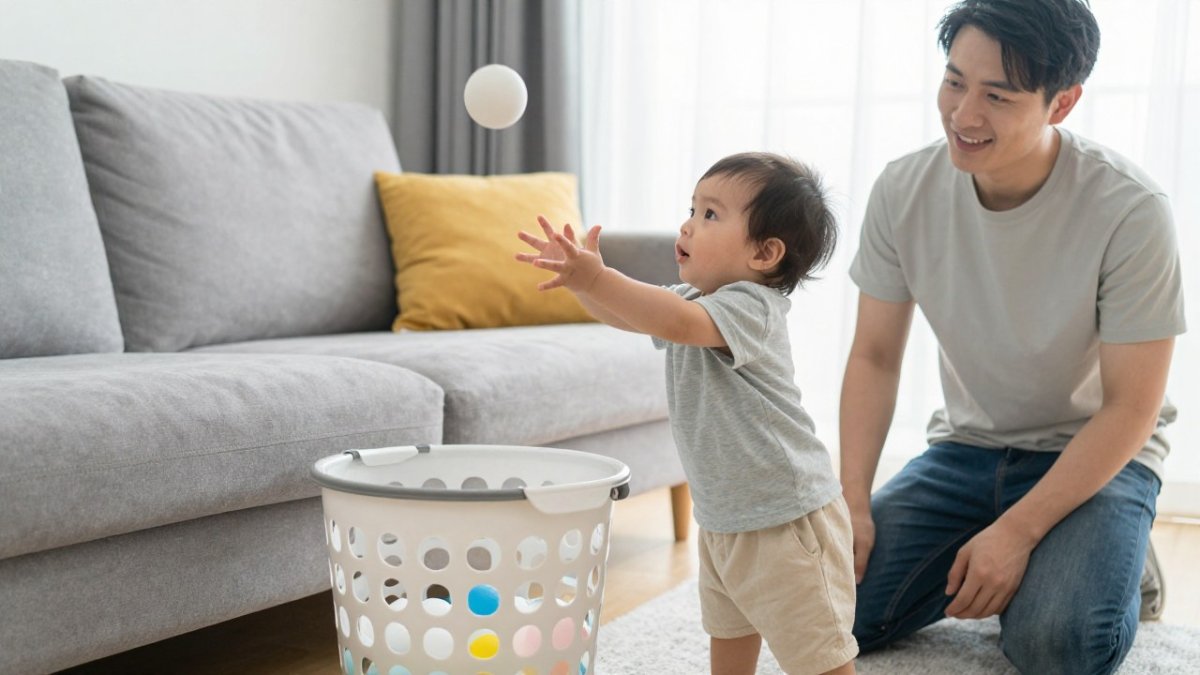
Laundry basket shoot: Prop a laundry basket against a sofa or wall at knee height. Give your child three soft balls and have them toss each one in from a short distance. Move the basket further away as they improve.
Color-sort baskets: Place two baskets of different colours and give your child coloured balls. They shoot each ball into the matching basket. This adds a thinking step to the throw.
Balloon basketball: Blow up a balloon and have your child tap it toward a basket or over a low string. Balloons move slowly, so toddlers can track them easily.
Keep the space clear of furniture corners and breakable items before you start. Soft balls matter here, because hard balls can hurt small faces and fingers.
Basketball Games Without a Hoop You Can Set Up in Minutes
Not every household has a hoop, and most toddlers do not need one yet. These games work on any floor.
Ball roll target: Put a few cushions or cardboard boxes on the floor as targets. Your child rolls a ball and tries to hit one. This builds aim and control without any lifting.
Basket drop: Hold a basket or bucket at waist height and have your child drop balls into it from a short distance. It is a simple way to practise releasing an object at the right time.
Freeze dribble: Have your child bounce a ball while you call "freeze." They must stop and hold the ball. This sharpens listening and control.
Many families find that these no-hoop games keep toddlers engaged for longer than a full-size hoop would. Short bursts of ten minutes work well.
Toddler Basketball Drills for Dribbling, Passing and Shooting
Drills work best when they stay short and playful. Aim for three to five minutes per drill, then switch.
Dribbling: Have your child bounce the ball with both hands while walking slowly across the room. Count the bounces out loud. Once that feels easy, try bouncing while standing still.
Passing: Sit facing your child, roll a ball back and forth, and gradually increase the distance. Two-handed chest passes are the easiest starting point for toddlers.
Shooting: Use a low hoop or basket. Your child lifts the ball with both hands and pushes it forward. Celebrate the attempt, not only the make.
A common mistake is correcting every movement. Toddlers learn best when they feel successful. Pick one thing to notice, such as "your eyes are on the basket," and leave the rest alone.
Indoor Basketball Games for Kids in Relay and Team Formats
As children grow, relay races and simple team games add energy and social learning.
Ball carry relay: Split the group into two teams. Each child carries a ball to a basket, drops it in, and runs back to tag the next player. Keep the course short.
Pass-and-go: Children stand in a line. The first player passes to the second, then runs to the back. The ball keeps moving down the line.
Freeze tag with balls: Each child dribbles a ball. When a helper calls "switch," everyone must pick up a new ball. It works well for listening and quick reactions.
Relay games build turn-taking and sportsmanship. Praise teamwork as often as individual effort.
Equipment Checklist and Toddler Safety Basics
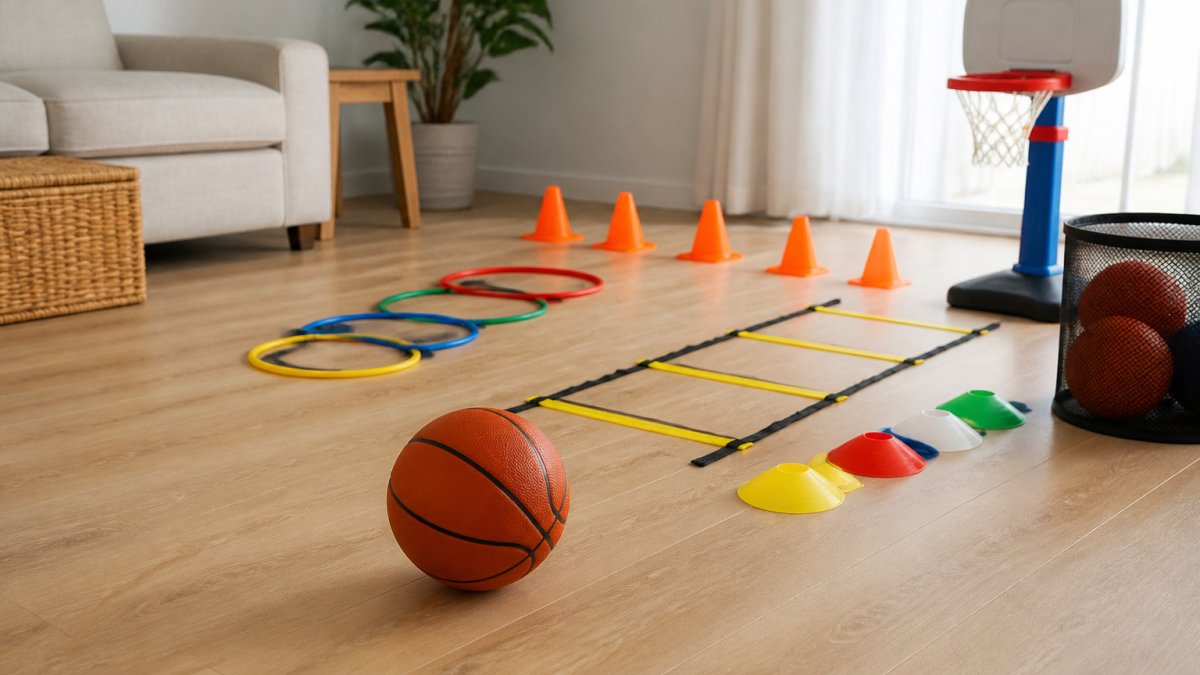
Toddler basketball equipment should be soft, light and sized to small hands. Many toddlers do better with a foam or rubber ball closer to 6 to 8 inches across. The ball should be light enough that a child can lift it overhead with two hands and soft enough that a missed catch does not sting.
Core equipment checklist:
- Two or three soft foam or rubber balls, 6 to 8 inches across, light enough to lift overhead
- A laundry basket, low bucket or cardboard box as a target
- A low hoop or over-the-door target set at or below toddler shoulder height (roughly 2 to 3 feet)
- A few balloons for slow-moving tracking games
- Cushions, boxes or painter's tape for floor targets
- Non-slip socks or bare feet on a clean, dry floor
Safety and injury prevention:
- Clear the floor of sharp corners, glass, small objects a child could swallow, and loose rugs that can slide.
- Use soft balls only. Hard plastic or full-size basketballs can bruise fingers and strike faces during close play.
- Set the hoop low. A target above a toddler's reach encourages jumping and falling backward; keep it at shoulder height or below.
- Supervise every session, especially near stairs, furniture edges and hard flooring.
- Stop play when a child is overtired or frustrated. Most toddler injuries happen in the last few minutes of a session when attention drops.
- Check balloons for tears before play and remove broken pieces immediately, since latex fragments are a choking hazard.
DIY equipment you can make at home:
A safe indoor hoop takes about ten minutes. Cut the bottom out of a sturdy cardboard box, tape the edges with painter's tape so no raw cardboard shows, and hang it over a door handle or tape it to a wall at shoulder height. A laundry basket works the same way and is more forgiving on missed shots.
For a soft ball, stuff a clean sock with crumpled paper or fabric scraps and tie the open end. It is light, slow-moving and safe for indoor throwing. A balloon also works as a slow ball for tapping games.
Watch out: a hoop set too high teaches toddlers to give up. Lower the target before you change the drill, and check that any taped or hung target cannot fall on a child.
Here is a quick reference for the equipment sizes and target heights the article recommends.
| Item | Value | Note |
|---|---|---|
| Soft ball size | 6 to 8 inches across | Light enough to lift overhead with two hands |
| Hoop or target height | Roughly 2 to 3 feet | Keep at shoulder height or below |
| Session length | About ten minutes | Switch games before attention fades |
| Drill duration | Three to five minutes | Keep drills short and playful |
| Balloon check | Before every play | Remove broken latex pieces immediately |
Developmental Benefits by Age: 1-3 vs 4-5
Most basketball content lumps toddlers and older kids together. Splitting by age gives a clearer picture of what a child can actually do and which games fit.
Ages 1 to 2: Children at this stage are building gross motor control and hand-eye coordination. They can roll a ball, push it along the floor, pick it up with two hands and drop it into a low basket.
Ages 2 to 3: Toddlers can walk while carrying a ball, toss overhand with some accuracy, and follow one-step instructions. They can bounce a ball once or twice with two hands, though control is inconsistent.
Ages 4 to 5: Children can follow two-step instructions, bounce a ball several times in a row, aim with more accuracy and take turns in a small group. Two-handed chest passes, simple relays and pass-and-go games start to make sense.
Social-emotional benefits: Group play teaches turn-taking, waiting, cheering for others and handling a missed shot without frustration. These soft skills matter as much as the physical ones and are easiest to practise in short, low-pressure group games.
How to adjust a game by age: Lower the target and shorten the distance for ages 1 to 2. Add a thinking step, like color matching, for ages 2 to 3.
Watch out: pushing a toddler into drills above their stage, like full dribbling or a regulation-height hoop, tends to build frustration rather than skill. Match the game to what the child can already do, then add one small challenge.
Booking Your Child's First Session at Tier 1 Sports
If your child is ready for structured play, Tier 1 Sports offers basketball programs for ages 4 to 16 in Halton Hills. Our skills and drills program focuses on fundamentals in a fun, low-pressure setting for children aged 7 to 12. To find the right fit for your child, compare our available programs for ages 4 to 17. When you are ready to get started, you can reserve your spot online.
Pricing depends on the program, session dates and registration details, so please check the website or contact us for current fees.
Frequently Asked Questions
What are some easy indoor basketball activities for toddlers?
Start with activities that need almost no equipment. Balloon basketball, where toddlers bat a balloon toward a laundry basket, builds tracking and reaching skills without the risk of hard impacts. Soft foam balls tossed into a low bin teach a basic shooting motion. Walking dribbles with a large, lightweight ball work well for short sessions. Keep each activity to five to ten minutes, switch often, and praise effort rather than accuracy so children stay engaged.
How can toddlers play basketball indoors without a hoop?
Basketball games without a hoop still build ball-handling and spatial awareness. Try target tossing into a laundry basket on the floor, rolling a ball between cones to practice control, or a passing game where a child rolls a ball to a parent and receives it back. Use painter's tape or a tea towel as a boundary line. These setups need only a ball and a bin, which makes them easy to repeat during short indoor breaks.
What can I use as a toddler-safe basketball hoop at home?
A low laundry basket, a sturdy bin or a small mini hoop set below shoulder height is usually enough for toddlers. Choose a hoop that is adjustable or can be placed on the floor, and make sure it cannot tip over. Avoid anything with sharp edges, loose parts or a backboard that could fall. Place the target away from furniture and walls so a missed shot does not cause a collision or a broken item.
What size basketball is best for a toddler?
Most toddlers do best with a soft, lightweight ball around 12 to 15 cm in diameter, often sold as a foam or mini ball. A standard size 7 ball is too large and heavy for small hands to control. Check that the ball is not small enough to be a choking hazard for children under three. Soft balls are also gentler indoors and reduce the risk of bumps against furniture or other children.
How do you teach a toddler to dribble a basketball?
Begin with a two-handed push, then move to one hand once the child can keep the ball bouncing. Have the child bend slightly at the knees and keep their fingers spread, not their palm. Use a large, lightweight ball that bounces low. Practice in short bursts of two to three minutes, and count bounces out loud. Progress slowly, since most toddlers need many short repetitions before a steady rhythm develops.