 ultimate-guide
Long-Term Athletic Development in Youth Basketball
Table of Contents
- What Is Long-Term Athletic Development in Basketball?
- Youth Basketball Training Stages: A Pathway From Beginner to Competitor
- Physical Literacy for Youth Basketball: Building Motor Foundations
- Benefits of Multi-Sport Participation for Basketball Players
- Age-Appropriate Training Principles and Recovery
- Managing Mental Health and Burnout in Youth Basketball
- How Parents Support Long-Term Athletic Development
- Conclusion
- Frequently Asked Questions
Last Updated: September 23, 2026
What Is Long-Term Athletic Development in Basketball?
Long-term athletic development in youth basketball is a structured, age-appropriate framework that builds athletic potential across childhood and adolescence rather than chasing short-term wins. It prioritizes foundational movement skills, gradual sport-specific training, and psychological growth over early specialization or competitive pressure.
Long term athletic development in youth basketball recognizes that young athletes develop at different rates. Peak height velocity, training load tolerance, and cognitive readiness all shift dramatically between ages 4 and 16. A program that works for a 12-year-old will either bore or injure a 7-year-old. At Tier 1 Sports, we structure our programs around these developmental windows, ensuring each age group gets exactly what they need to progress without burnout.
The real difference between programs that develop lifelong players and those that burn them out comes down to understanding long term athletic development in youth basketball: excellence at 18 is built on a foundation laid at 6. Most recreational programs miss this entirely. They treat every age group the same way, just with smaller basketballs.
Youth Basketball Training Stages: A Pathway From Beginner to Competitor
Athletic development isn't a single path, it's a progression through distinct stages, each with different priorities. Understanding these stages helps parents and coaches support young players at the right level, with the right expectations.
Active Start (Ages 4-6)
The foundation for all future athletic success is built here. Active start focuses on movement exploration, play-based learning, and building a love for physical activity. Children this age aren't ready for structured basketball drills, they're ready to move, chase, jump, and discover their bodies.
At this stage, the goal is simple: help young children develop basic coordination and comfort with movement. Basketball is the vehicle, not the destination. Unstructured play with a ball teaches hand-eye coordination naturally. Chasing games build speed and agility. Jumping for a low hoop develops lower-body power without feeling like work.
Common mistake: pushing technical skills too early. A 5-year-old who can't consistently catch a ball isn't ready for dribbling drills. They need permission to fail, play, and move without pressure. Programs that emphasize "correct form" at this age typically lose kids to frustration.
Fundamental Stage (Ages 7-9)
This is the golden window for physical literacy for youth basketball. Motor development peaks during these years, and children's brains are primed to absorb fundamental movement skills. Walking, running, jumping, throwing, catching, and balance, these foundational movements are the building blocks for every sport.
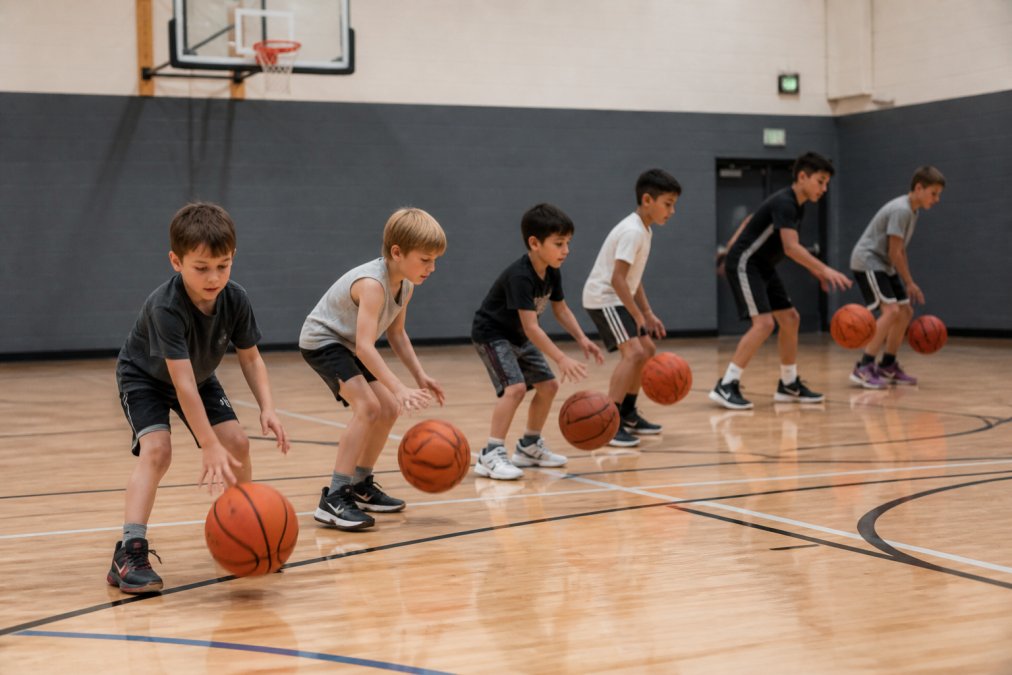
In basketball specifically, this stage introduces basic ball handling, footwork, and court awareness. Kids learn to dribble with both hands, pass accurately, and understand simple positioning. The emphasis remains on variety and enjoyment. Children who play multiple sports during this phase develop better overall coordination and lower injury rates later.
The mistake many programs make is specialization. A 9-year-old who only plays basketball misses the lateral movement patterns from soccer, the rotational power from baseball, and the hand-eye coordination from tennis. Multi-sport athletes at this stage have broader movement vocabularies, which translates to better basketball later.
Training to Train (Ages 10-12)
The shift here is toward sport-specific skill development while maintaining the multi-sport approach. Young athletes begin structured training in earnest. Footwork becomes precise. Ball-handling drills get more complex. Court positioning and basic tactics enter the picture.
This is also when psychological and social development accelerates. Peer relationships matter more. Competitive drive emerges. Team dynamics become real. Programs that ignore the social element at this stage miss a critical window for building confidence and resilience.
Training load, the total volume and intensity of practice, becomes important to monitor. A 10-year-old's body is still developing. Too much volume too fast leads to overuse injuries. Too little volume and skill development stalls. The balance is individual and depends on the child's maturity, other sports involvement, and recovery capacity.
Training to Compete (Ages 13-15)
By mid-adolescence, young athletes are ready to focus more heavily on basketball while still maintaining other activities if they choose. This is when specialization makes sense, but only after a solid foundation has been built. Sport-specific skills, tactical understanding, and competitive intensity all increase.
Peak height velocity happens during this stage for most athletes, usually between ages 12-14 for girls and 13-15 for boys. Growth spurts create temporary coordination challenges. Young athletes who understand this, who know the awkwardness is normal and temporary, navigate it better psychologically.
Mental resilience becomes as important as physical skill. Setbacks sting more. The difference between making a rep team and not makes a real impact on self-image. Programs that support psychological development alongside skill development see higher retention and better long-term success.
Physical Literacy for Youth Basketball: Building Motor Foundations
Physical literacy for youth basketball is the ability to move with confidence and control across a range of activities. It's the foundation that allows a young player to transition from general athletics to basketball-specific demands without injury or frustration.
Children with strong physical literacy can adapt. They can shift from soccer to basketball without confusion. They can learn new movement patterns quickly. They recover from mistakes without self-doubt. This adaptability is what separates players who thrive in competitive environments from those who struggle.
The components of physical literacy include balance, coordination, spatial awareness, and body control. These aren't taught in isolation, they develop through varied movement experiences. A child who climbs trees, plays tag, swims, and shoots hoops develops better overall literacy than one who only practices basketball drills. Assessing these foundational movement patterns through advanced movement screening helps coaches identify specific physical gaps before they become ingrained habits that limit a young player's long-term potential.
Benefits of Multi-Sport Participation for Basketball Players
The benefits of multi-sport participation for basketball players are substantial and well-documented in athletic development research. Young athletes who play multiple sports develop broader movement patterns, reduce injury risk, and maintain higher levels of motivation.
Basketball demands lateral movement, explosive jumping, and rotational power. Soccer builds lateral agility and endurance. Baseball develops rotational power and hand-eye coordination.
Age-Appropriate Training Principles and Recovery
Training load must match developmental stage. A 10-year-old's body cannot tolerate the training volume of a 15-year-old. Bones are still ossifying. Connective tissues are still developing. The nervous system is still maturing. Pushing adult-level intensity at young ages creates injury, not excellence.
Age-appropriate training principles include:
- Ages 4-6: Movement variety, play-based learning, minimal structure
- Ages 7-9: Fundamental skill development, multi-sport participation, 2-3 structured sessions per week
- Ages 10-12: Sport-specific skills, increased volume, 3-4 sessions per week, 1-2 rest days minimum
- Ages 13-15: Competitive intensity, specialization, 4-5 sessions per week, recovery protocols essential
Managing Mental Health and Burnout in Youth Basketball
Burnout in youth sports is real and increasingly common. It emerges when training intensity, parental pressure, or competitive stakes exceed the young athlete's psychological capacity. Early warning signs include loss of enjoyment, persistent fatigue, and reluctance to attend practice.
How Parents Support Long-Term Athletic Development
Parents are the single most influential factor in whether a young athlete stays engaged or burns out. Their role isn't to coach, it's to create conditions where the child can develop.
Conclusion
Long-term athletic development in youth basketball is about building a foundation that lasts decades, not winning tournaments at age 10. It requires patience, variety, and psychological safety. It means understanding that a 6-year-old needs play, a 9-year-old needs fundamental skills across multiple sports, and a 13-year-old is ready to specialize only after that foundation is solid.
| Development Stage | Age Range | Primary Focus | Training Frequency | Key Outcome |
|---|---|---|---|---|
| Active Start | 4-6 | Movement exploration, play-based learning | 1-2 sessions/week | Love for physical activity |
| Fundamental | 7-9 | Physical literacy, multi-sport participation | 2-3 sessions/week | Broad movement skills |
| Training to Train | 10-12 | Sport-specific skills, team dynamics | 3-4 sessions/week | Basketball competency |
| Training to Compete | 13-15 | Specialization, competitive intensity | 4-5 sessions/week | Competitive readiness |
Frequently Asked Questions
What is long-term athletic development and why does it matter for youth basketball?
Long-term athletic development (LTAD) is a framework that guides how young players progress through basketball from introductory play through competitive excellence. It emphasizes age-appropriate training, multisport participation, and skill-building over early specialization. This approach reduces injury risk, increases athlete retention, and builds a stronger foundation for those who pursue the sport seriously.
What are the main youth basketball training stages?
The stages typically include Active Start (ages 4-6), where children develop basic movement; the Fundamental Stage (ages 7-9), focusing on core basketball skills; Training to Train (ages 10-12), building sport-specific fitness; and Training to Compete (ages 13-15), preparing for competitive play. Each stage has specific physical, cognitive, and social objectives that guide training design.
How does physical literacy for youth basketball support long-term development?
Physical literacy means a child can move confidently and competently across different sports and environments. In basketball, this includes balance, coordination, spatial awareness, and fundamental movement patterns. Strong physical literacy prevents injury, accelerates skill acquisition, and helps young players adapt quickly when learning basketball-specific techniques.
Why is multi-sport participation recommended during youth basketball development?
Multi-sport participation develops diverse motor skills, prevents overuse injuries from specializing too early, maintains engagement and enjoyment, and reduces burnout. Young athletes who play multiple sports often transfer skills between them, agility from soccer, body control from gymnastics, or footwork from dance, making them more well-rounded basketball players when they eventually focus on the sport.