 How-to
How to Build Mental Toughness for Basketball Players
Last Updated: November 6, 2026
Quick Summary
Mental toughness in basketball is the ability to stay focused, composed, and committed when a game gets hard. It is a skill you can train through short, progressive practice, not a fixed trait. Training works best with breathing, visualization, pressure drills, and a fast reset routine after mistakes.
- Build the skill with a four-stage plan that moves from learning to game transfer over about nine weeks.
- Use box breathing for four counts in, hold, out, and hold during free throws and timeouts.
- Practise visualizing the reset after a miss, not only the successful shot.
- Keep a pregame routine of about 10 minutes that stays the same every time.
- Use a three-second reset after errors, with one breath, a physical anchor, and a short cue.
Table of Contents
- What Mental Toughness Means in Basketball
- Step 1: Set Up a Progressive Mental Training Plan
- Step 2: Build a Basketball Pregame Mental Routine
- Step 3: Practise Basketball Visualization Exercises
- Step 4: Use Basketball Breathing Exercises Under Pressure
- Step 5: Reset Quickly After Missed Shots and Turnovers
- Tracking Progress and Knowing the Limits of Mental Training
- Booking Your Next Practice at Tier 1 Sports
- Frequently Asked Questions
What Mental Toughness Means in Basketball
Mental toughness is the ability to stay focused, composed, and committed when a game gets hard (The Road to Mental Readiness).
Many coaches describe mental toughness as a mix of focus, composure, confidence, and effort. Players who develop these qualities tend to make better decisions under pressure.
A common mistake is treating mental toughness as playing through pain or pushing harder at all times.
Step 1: Set Up a Progressive Mental Training Plan
Mental skills improve the same way physical skills do: through practice that starts easy and gets harder over time. A sequenced plan often works better than a list of tips because it tells a player what to do this week, how long to do it, and when to add difficulty. The plan below can run alongside normal practice, not instead of it.
The four-stage progression
Each stage lasts two to four weeks. Move to the next stage only when the player can complete the current exercises without reminders from a coach.
- Stage 1, Learn (weeks 1-2): One breathing exercise and one focus cue. Five minutes at the end of each practice, three times per week. The player practices box breathing (described below) and repeats a single cue such as "next play" or "calm and quick" while shooting free throws.
- Stage 2, Add visualization (weeks 3-4): Three minutes of guided visualization before practice, three times per week. The player pictures one offensive play and one defensive possession in detail, including the reset after a mistake.
- Stage 3, Add pressure (weeks 5-8): Free-throw sets with a teammate talking, clapping, or waving a towel. Two sets of 10 free throws, twice per week. Track makes and note whether the player's routine stayed the same under noise.
Session structure
A mental-skills session should take 10 to 15 minutes and follow the same order each time: breathe, visualize, rehearse the cue, then apply it in a drill. Keep sessions short enough that they fit at the end of practice. A common pattern is three short sessions per week rather than one long session, because repetition under mild pressure builds the habit faster. Consistent execution of these routines prepares athletes to maintain mental clarity during the high-stakes environment of a tournament.
Progression criteria
Do not advance a player just because the calendar says so. Advance when the player can do three things: perform the exercise without a prompt, keep the routine consistent when a coach adds noise, and describe in one sentence what the exercise is for. If a player cannot explain why they are doing the drill, they are copying a routine rather than building a skill.
Choosing exercises by position, age and level
Not every exercise suits every player. A young point guard may need work on calm decision-making, while a post player may need to stay focused after a physical battle under the basket. Match the exercise to the player's role and level:
- Guards: Reset routines after turnovers and a pre-free-throw cue for staying calm while leading the offence.
- Forwards and centres: Blocking out distractions during physical play and re-engaging after a foul or a hard box-out.
- Younger players (ages 7-10): Keep exercises to three to five minutes and make them playful, such as a "reset" clap after each missed shot.
- Competitive players (ages 11-16): Add pressure drills, visualization before tryouts, and game-situation scrimmages with a clock.
Tracking progress
Keep a simple log after each session. Rate focus, composure after mistakes, and routine consistency on a 1-to-5 scale, and write one sentence about what went well and one about what to work on.
Watch out: a plan that adds pressure before the basic routine is automatic tends to backfire, because the player has no stable habit to fall back on when the noise starts.
The four-stage plan below summarises how to progress each mental training stage over the weeks.
| Stage | Timing | What the player does |
|---|---|---|
| Stage 1, Learn | Weeks 1-2 | Box breathing and one focus cue, 5 minutes, 3 times per week |
| Stage 2, Add visualization | Weeks 3-4 | Guided visualization of plays and resets, 3 minutes, 3 times per week |
| Stage 3, Add pressure | Weeks 5-8 | Free-throw sets with noise, 2 sets of 10, twice per week |
| Stage 4, Transfer to games | Weeks 9 and beyond | Scrimmage situations with a score and clock |
Step 2: Build a Basketball Pregame Mental Routine
A pregame routine helps the body and mind shift into game mode.
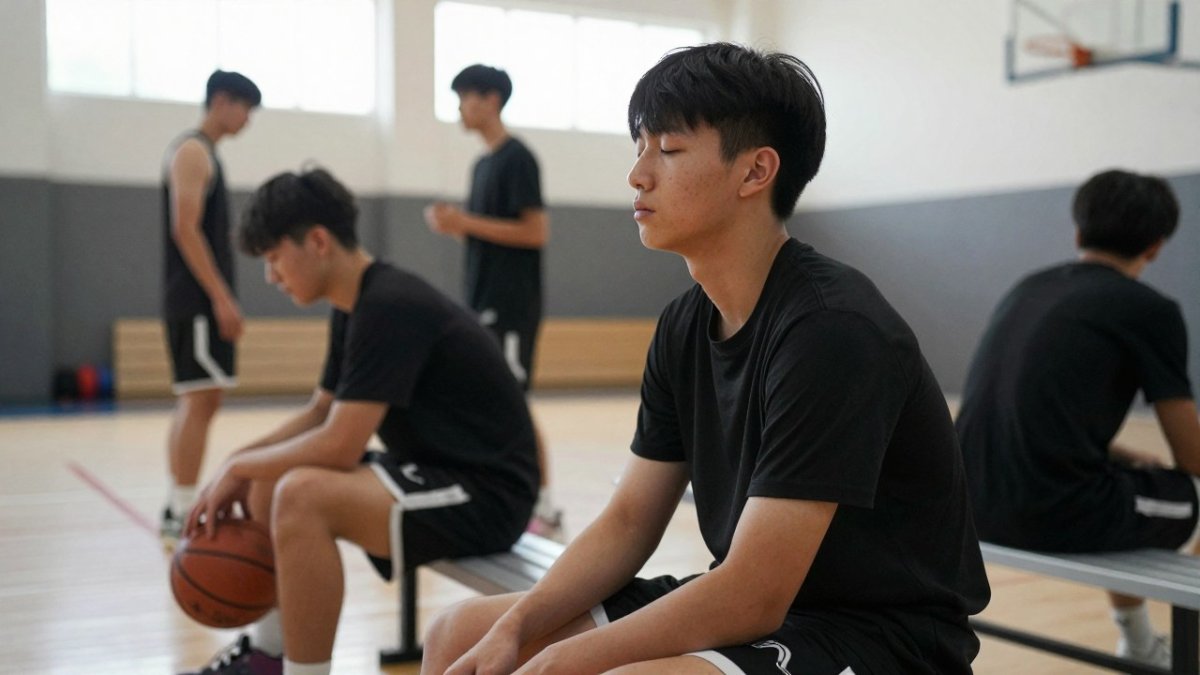
A simple routine takes about 10 minutes:
- Sit quietly for 1 minute and take slow breaths.
- Visualize one successful play from start to finish.
- Repeat one short cue, such as "calm and quick."
- Warm up with the same shooting sequence each time.
Many players find that a fixed routine lowers pre-game anxiety. The goal is not to feel perfect. The goal is to feel ready.
Watch out: if the routine gets too long or complicated, players skip it under pressure. Keep it short enough to do on a crowded bench.
Step 3: Practise Basketball Visualization Exercises
Visualization means picturing a play in detail before it happens. It works best when the player imagines the sights, sounds, and feelings of the game, not just the result.
Try this exercise:
- Close your eyes and picture the gym, the ball, and the hoop.
- See yourself receiving a pass and taking a shot.
- Feel the ball leave your hand and hear the net.
- Picture yourself missing, then resetting calmly for the next play.
Practise the reset part as much as the success part. Players often freeze after a mistake because they never imagined what to do next.
Step 4: Use Basketball Breathing Exercises Under Pressure
Breathing is one of the fastest ways to lower stress during a game. Slow, controlled breaths help slow the heart rate and clear the mind.
Try a simple pattern called box breathing:
- Breathe in for 4 counts.
- Hold for 4 counts.
- Breathe out for 4 counts.
- Hold for 4 counts.
Use this during free throws, timeouts, or after a foul. Practise it during drills first so it feels natural in a real game.
Step 5: Reset Quickly After Missed Shots and Turnovers
Every player misses shots and makes mistakes. What separates strong players is how fast they move on. A reset routine gives the player a clear action to take right after an error, and it works best when it is tied to the specific mistake rather than used as a one-size-fits-all phrase.
The 3-second reset
The core routine takes about three seconds and can be done while play continues:
- Take one slow breath out.
- Make a small physical anchor, such as tapping the chest or touching the floor.
- Say a short cue, such as "next play" or "one more."
- Lock eyes on the next task, such as the ball, the rim, or the player you are guarding.
Practise the reset in scrimmages first. Coaches can stop play after a mistake and ask the player to run through the reset before continuing, which makes the routine automatic before the pressure is real.
Resets for specific game situations
Different mistakes need slightly different resets, because the next task is different:
- Missed free throw: Step out of the lane, take one breath, repeat the pre-shot cue, and re-enter with the same routine. The goal is to keep the routine identical so the miss does not change the process.
- Turnover: Sprint back on defence immediately. The physical effort of getting back is itself the reset, and it gives the player a task instead of a moment to replay the error.
- Foul: Walk to the sideline, take one breath, and check the assignment for the next possession. A foul often comes with frustration, so the reset should include a slow exhale before re-entering play.
- Being benched: Use the bench as a reset station. Watch the next two possessions, identify one thing to do better, and say the cue before checking back in. This turns bench time into preparation rather than punishment.
Coaching script
A short script keeps the reset consistent across coaches. After a mistake, the coach says one sentence: "Reset, then next task." The player runs the three-second routine, and play resumes. Avoid long corrections during the reset, because the point is to move on, not to relitigate the error.
Measuring whether the reset works
Track two things in games and scrimmages: how many possessions it takes the player to return to their normal effort level after a mistake, and whether the next decision is a good one. A simple log with a 1-to-5 rating for composure after errors, recorded by a coach or the player, shows whether the routine is transferring from practice to games. Improvement usually shows up first in body language and then in decision quality.
Watch out: if the reset becomes a long ritual, players skip it under pressure. Keep it to three seconds and one cue so it survives a loud gym and a running clock.
Tracking Progress and Knowing the Limits of Mental Training
Mental skills are harder to measure than shooting percentages, but you can still track them. Use a simple scale from 1 to 5 each week to rate focus, composure after mistakes, and confidence.
Mental training also has limits. It supports good play but does not replace rest, proper nutrition, or skill practice. If a player seems constantly anxious, exhausted, or unwilling to play, talk with a parent, coach, or doctor.
Booking Your Next Practice at Tier 1 Sports
Ready to build these skills? You can prepare for REP tryouts or explore our programs by age and level to find the right fit.
Not sure which option suits your player? Contact our team and we will help you choose a starting point.
Ready to build stronger mental habits this season? Start with a clear plan and a consistent routine.
Frequently Asked Questions
How can basketball players build mental toughness?
Mental toughness is built through repeated, deliberate practice rather than talk alone. Start with one or two exercises, such as a pregame routine and a reset after mistakes, and practise them in every training session. Use game-like pressure during drills, like making free throws when tired, so skills hold up under stress. Keep sessions short and consistent, and increase difficulty only when the player can perform the exercise reliably. Coaches can reinforce the habit by praising effort and recovery, not only outcomes, which keeps players willing to take on challenges.
How do you stay calm under pressure in basketball?
Staying calm starts with controlling what you can control: effort, attitude and your next action. Slow, deliberate breathing helps lower heart rate during a stoppage or a free throw. A short self-talk phrase, such as 'next play', gives the mind a clear task instead of a worry. Practise these responses in scrimmages where the score is close, so the routine feels familiar when the stakes rise in a real game.
How can basketball players recover mentally after making a mistake?
Use a consistent reset routine immediately after an error. Take one breath, look at a specific target such as the rim or a teammate, and say a short cue that refocuses attention on the next defensive or offensive assignment. Avoid replaying the mistake during play, since dwelling on it draws attention away from the current possession. Review the error briefly at the next stoppage or after the game, then let it go. Practising this reset in drills, such as after a deliberately missed shot, builds the habit before it is needed.
How long should basketball players practise mental skills?
Short, frequent sessions work better than long ones. Five to ten minutes of visualization, breathing or reset practice, added to regular training, is usually enough to build the habit without fatigue. Players can add a few minutes before games for their pregame routine. Consistency over several weeks matters more than total minutes, and coaches should adjust the length based on the age and attention span of the players involved.