 ultimate-guide
Basketball Motor Skill Development: Why It Matters
Table of Contents
- Why Basketball Motor Skill Development Matters
- Understanding Motor Skills: Gross vs. Fine Motor Development
- Fundamental Movement Skills for Basketball
- Hand-Eye Coordination and Ball Handling in Early Development
- Basketball Coordination Drills for Kids: Building Neuromuscular Control
- Long-Term Athlete Development Basketball: The Golden Window
- Cognitive and Physical Benefits Beyond the Court
- Starting Your Child's Basketball Journey
Last Updated: August 23, 2026
Why Basketball Motor Skill Development Matters
Basketball builds the neurological pathways and physical capabilities that shape how young athletes move, respond, and coordinate for life. Hand-eye coordination, balance, and spatial awareness aren't incidental, they're foundational competencies that influence academic performance and injury prevention. Research shows children who engage in basketball during critical developmental windows develop superior neuromuscular control compared to sedentary peers (peer-reviewed research).
At Tier 1 Sports, we are dedicated to fueling a lifelong passion for the game, offering everything from engaging introductory sessions for beginners to competitive rep basketball, all designed to develop essential skills in a supportive environment. Below, we'll walk you through the science of motor skill development, the specific drills that build neuromuscular control, and the critical windows of opportunity that determine long-term athletic potential.
Understanding Motor Skills: Gross vs. Fine Motor Development
Motor skill development in basketball requires understanding two distinct but interconnected systems: gross motor skills and fine motor skills.
Gross motor skills involve large muscle groups and whole-body movements like jumping, running, changing direction, and maintaining balance. These emerge first in childhood and form the foundation for every athletic movement.
Fine motor skills involve smaller muscle groups and precise hand movements like dribbling control, shooting release, and passing accuracy. Fine motor skills develop later than gross motor skills, typically becoming more refined between ages 6 and 10 (the NIH). This is why a 5-year-old might run around a basketball court but can't consistently dribble without losing the ball.
The developmental age of your child matters more than their chronological age. Basketball training that ignores this reality wastes time and frustrates young athletes.
What makes basketball unique is that it demands both systems working together in real time. You can't practice gross motor movements in isolation. The game requires constant integration: your legs balance while your hands dribble while your eyes track teammates and defenders.
| Motor Skill Type | Primary Age Range | Key Basketball Application | Development Focus |
|---|---|---|---|
| Gross motor | 3-8 years | Running, jumping, balance, direction changes | Large muscle coordination |
| Fine motor | 5-10 years | Dribbling, shooting, passing | Hand control and precision |
| Integrated motor | 8+ years | Game play, tactical movement | Combined gross and fine systems |
Fundamental Movement Skills for Basketball
Before a child can play basketball effectively, they need to master fundamental movement skills: locomotion (running, jumping, sliding), stability (balance, landing, stopping), and object control (catching, throwing, kicking).
Physical literacy, the ability to move competently and confidently across a range of physical activities, is the foundation. Children with high physical literacy adapt quickly to new sports. Those without it struggle with each new skill.
Many parents skip this step and sign their child up for competitive training, then wonder why the child struggles with basic coordination. The real issue is that foundational skills weren't established first.
Basketball training that respects developmental progression starts with movement fundamentals, not basketball-specific skills. You're teaching the body how to move, balance, and respond to changing demands. Once those foundations are solid, basketball-specific skills develop rapidly.
Hand-Eye Coordination and Ball Handling in Early Development
Hand-eye coordination develops through repeated practice where the eyes track a moving object while the hands respond with precision. Basketball provides constant, real-world demand for this skill.
Between ages 4 and 6, children develop the basic ability to track a moving object while their hands move independently. A 5-year-old can watch a ball bounce and reach for it, but timing is often off.
By ages 7 to 9, hand-eye coordination improves dramatically. Children can dribble while moving, track teammates during play, and adjust hand position based on visual feedback. Age 7 is often called the "golden window" for introducing ball-handling skills.
Ball handling drills accelerate this development, but only if age-appropriate. A drill that's too advanced frustrates young athletes and teaches inefficient movement. A drill that's too simple doesn't create enough challenge to drive adaptation.
Basketball Coordination Drills for Kids: Building Neuromuscular Control
Neuromuscular control is the ability of the nervous system to coordinate muscle activation in response to movement demands. It's the foundation of skilled movement.
The most effective coordination drills follow a specific principle: they should be challenging enough to require focus, but achievable with effort. Too easy and the nervous system doesn't adapt. Too hard and the child practices failure instead of success.
Here are the most effective drills for building neuromuscular control:
-
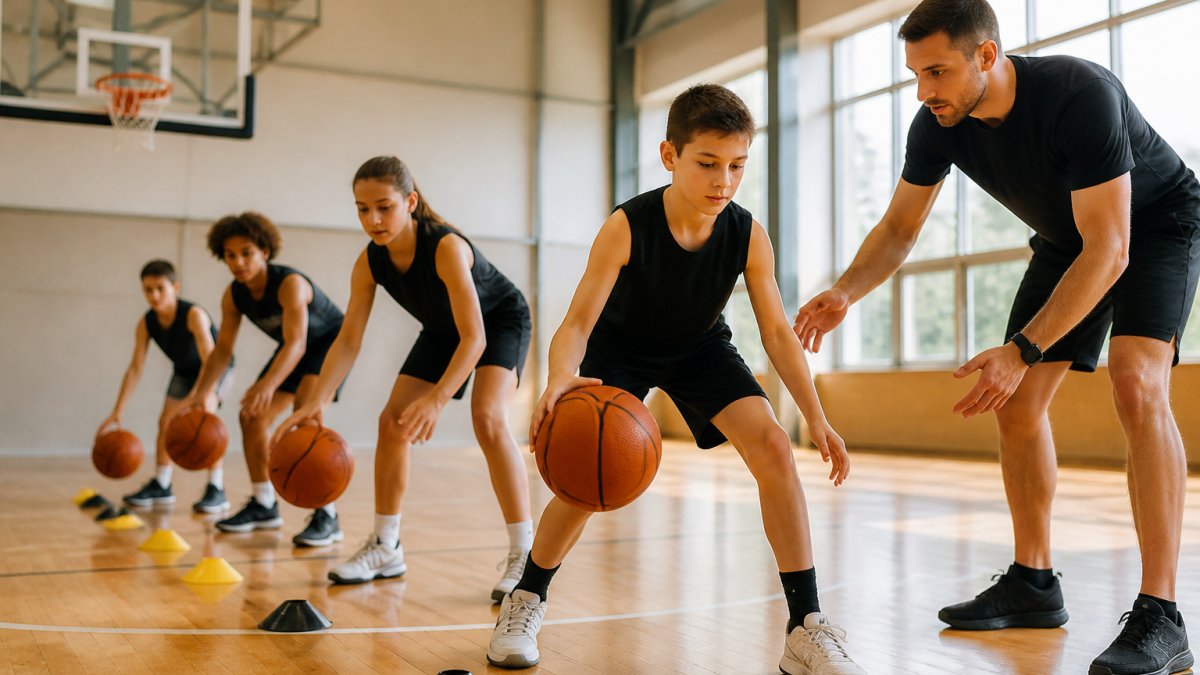
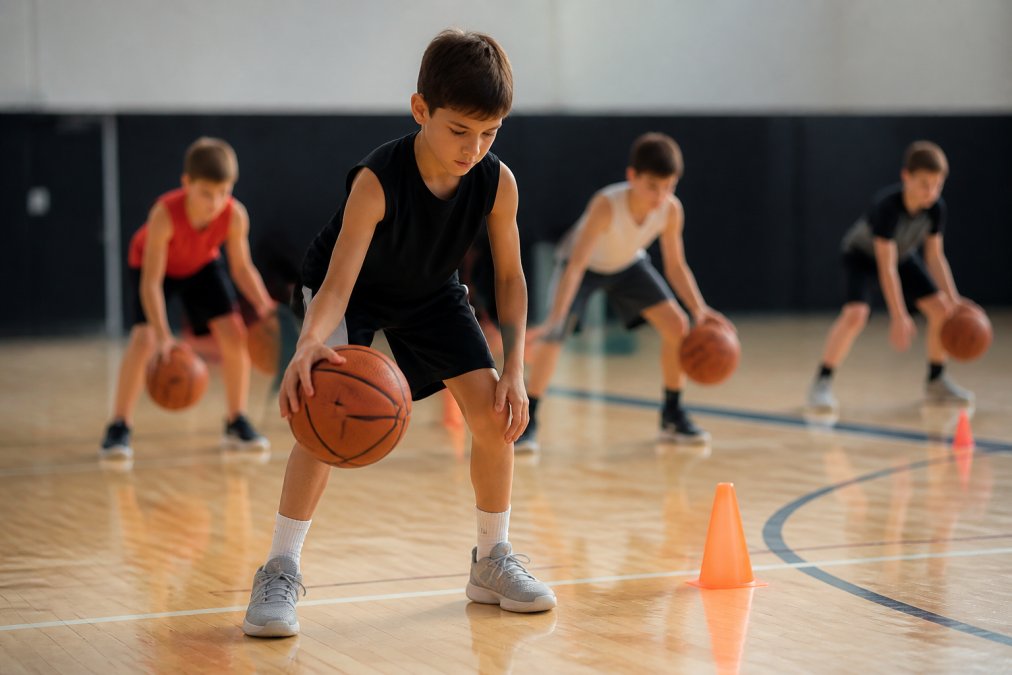
Stationary dribbling (single hand): Child stands in place and dribbles with one hand while keeping eyes forward. Duration: 30-60 seconds per hand.
-
Figure-8 dribbling: Child dribbles in a figure-8 pattern around two cones, alternating hands.
-
Cone weaving: Child dribbles through a line of cones, changing direction at each cone.
-
Two-hand catch and pass: Child catches a ball thrown by a coach and immediately passes it back.
-
Balance beam walking with ball: Child walks along a line while dribbling or holding a ball.
-
Mirror drills: Child mirrors the coach's movements while dribbling.
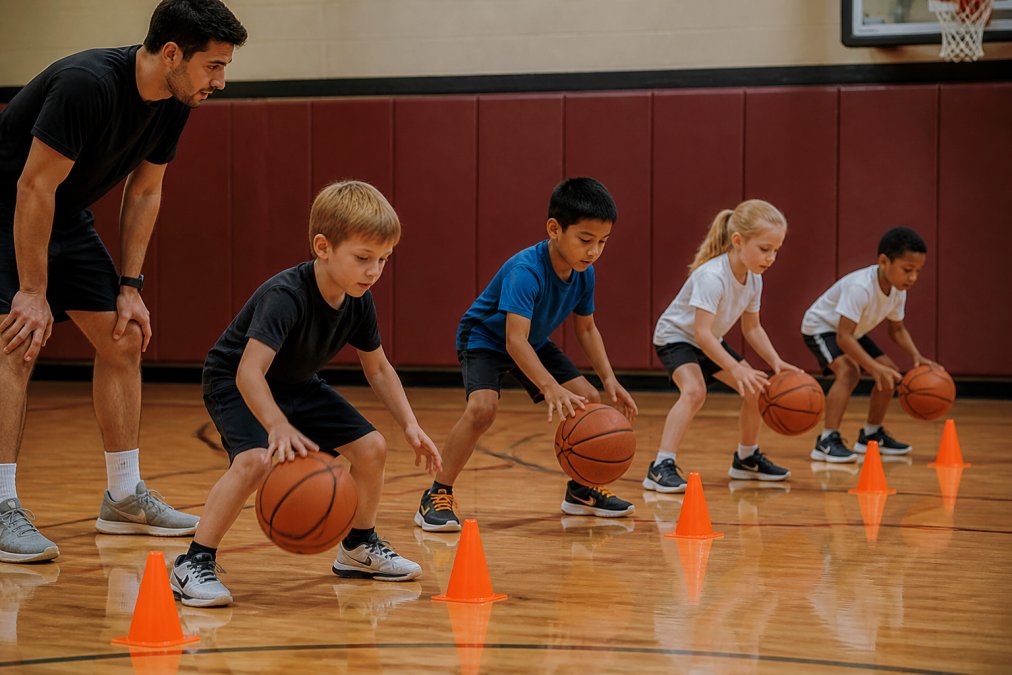
The progression matters more than the drill itself. Start with simple, stationary movements. Once the child masters those, add movement. Once movement is solid, add complexity like direction changes or obstacles.
Long-Term Athlete Development Basketball: The Golden Window
Long-term athlete development (LTAD) recognizes that athletic potential develops through predictable stages. A "golden window" refers to specific developmental periods when the nervous system is most responsive to motor skill training.
For basketball, the primary golden window occurs between ages 6 and 10 (peer-reviewed research). During this period, the nervous system is highly responsive to motor skill training. A child who receives quality basketball training during this window develops superior ball-handling, coordination, and spatial awareness compared to a child who starts later.
A child who starts at age 12 can still become skilled, but they'll require more intensive training because they've missed the window when the nervous system was most receptive.
The LTAD framework suggests specific training focuses for each developmental stage:
- Ages 4-6 (Fundamental Movement): Focus on basic motor skills, balance, and coordination.
- Ages 7-10 (Skill Development): Focus on basketball-specific skills, hand-eye coordination, and tactical awareness.
- Ages 11-14 (Sport-Specific Training): Focus on advanced techniques, game understanding, and competitive play.
- Ages 15+ (Advanced Development): Focus on position-specific skills, strength and conditioning, and competitive excellence.
Cognitive and Physical Benefits Beyond the Court
Basketball motor skill development generates benefits that extend far beyond athletic performance. The cognitive and physical adaptations influence academic performance, injury prevention, and lifelong movement quality.
Basketball requires constant decision-making: where are my teammates? Where is the defender? Should I pass or shoot? This real-time decision-making trains executive function, the brain's ability to plan, prioritize, and execute complex actions.
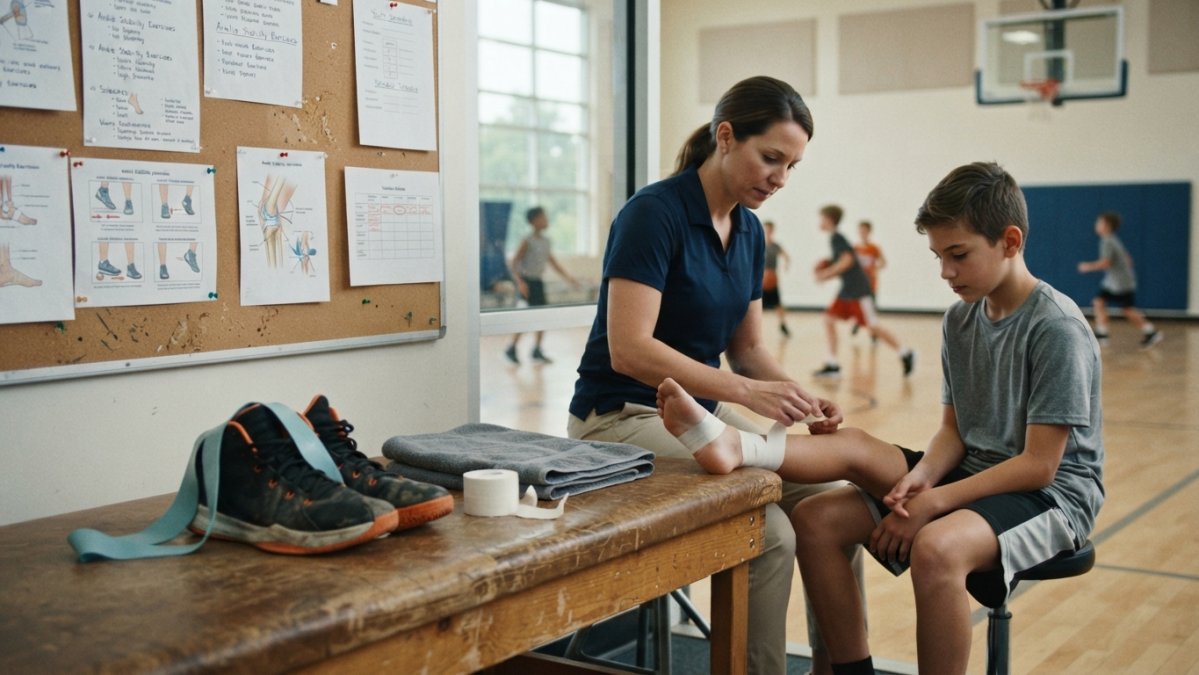
Research shows children who engage in basketball demonstrate improved focus, better problem-solving abilities, and stronger impulse control. The physical benefits include improved proprioception, better balance and stability, and reduced injury risk. Children who develop strong motor control are less likely to suffer sprains and movement-related injuries throughout their lives.
Basketball also builds confidence through immediate feedback. You either make the shot or you don't. This immediate feedback, combined with the social nature of the sport, creates powerful motivation for improvement.
The balance, coordination, and spatial awareness developed through basketball transfer directly to everyday activities: climbing stairs, riding bikes, navigating crowded spaces.
Starting Your Child's Basketball Journey
When evaluating a basketball program, ask these questions:
-
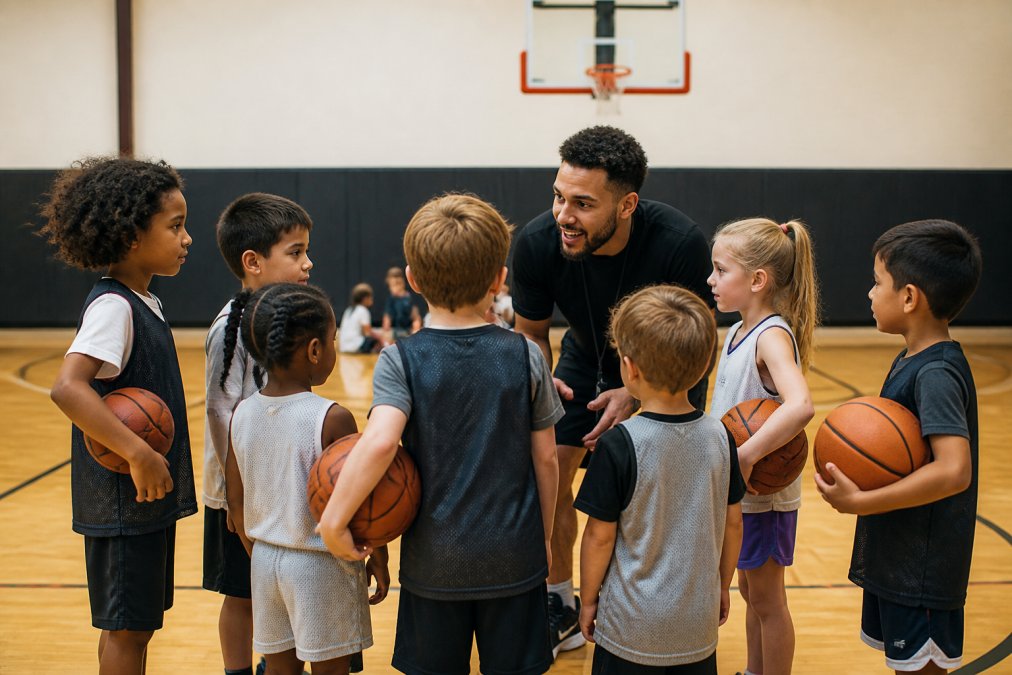
What's the coaching philosophy? Does the coach prioritize skill development or winning? For children under 12, skill development should come first.
-
How are players grouped? Are they grouped by age or by skill level? Skill-level grouping is more effective.
-
What's the practice structure? For younger children, 60-70% fundamentals and 30-40% game play is appropriate.
-
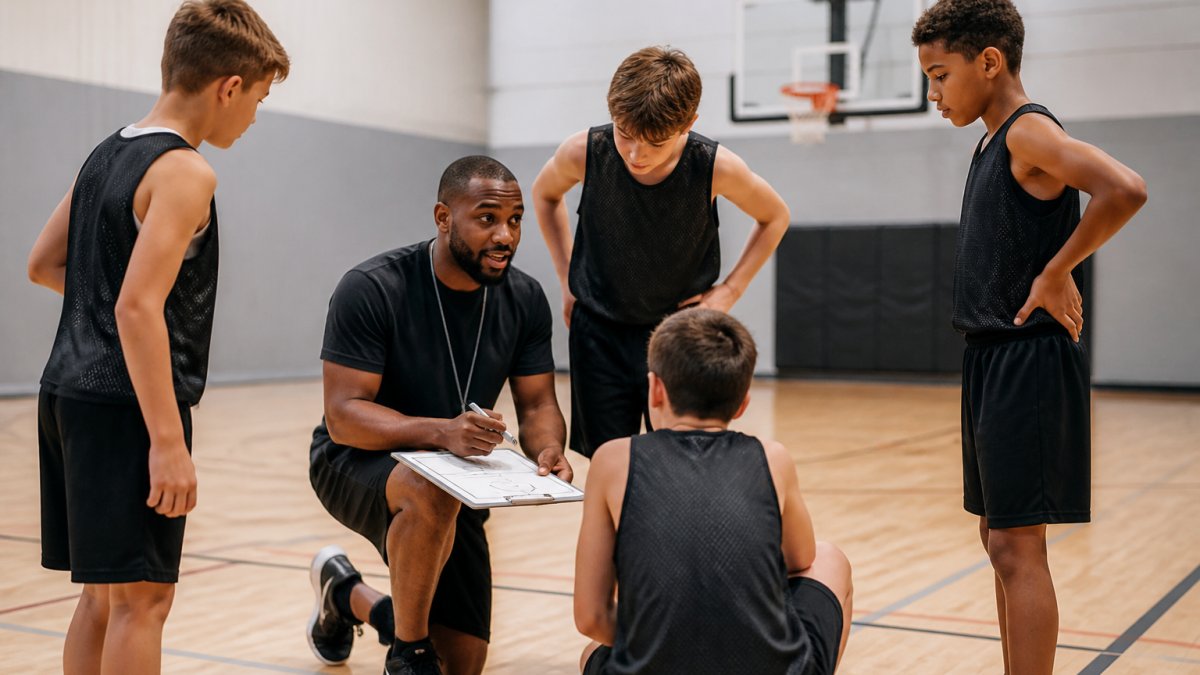
How does the coach handle mistakes? Does the coach treat mistakes as learning opportunities? A coach who creates psychological safety accelerates learning.
-
What's the communication with parents? Does the coach explain what skills are being developed and why?
Tier 1 Sports offers programs specifically designed around these principles. Our introductory programs for ages 4-6 focus on fundamental movement skills and building confidence. Our skill-development programs for ages 7-10 emphasize basketball-specific techniques within a supportive environment. Our competitive rep programs for ages 11-16 provide serious athletes with the training needed to develop advanced skills.
The key is matching your child's developmental stage and interest level to the right program. Starting early provides advantages, but starting at any age is better than not starting at all. The motor skill development, coordination, confidence, and cognitive benefits basketball provides matter at every age.
Your child's athletic journey begins with understanding why motor skill development matters. The coordination, confidence, and capabilities developed through basketball extend into every area of their life. At Tier 1 Sports, we've designed programs for every age and skill level, from introductory sessions for 4-year-olds experiencing basketball for the first time to competitive rep basketball for serious young athletes. Our coaching focuses on developing fundamental movement skills, building neuromuscular control, and creating a supportive community where every player discovers their potential. Explore our programs and find the right fit for your child's developmental stage and basketball aspirations.
Frequently Asked Questions
At what age should children begin focusing on basketball motor skill development?
Children can start developing foundational motor skills through basketball as early as age 4-5 with age-appropriate introductory programs. Around ages 6-8, the brain enters a critical window for motor learning, making this an ideal time to introduce structured basketball training. By ages 9-10, children benefit from more intentional skill development that builds on earlier movement patterns. Starting early allows children to develop spatial awareness, proprioception, and fundamental movement skills that support long-term athletic success.
What is the difference between gross and fine motor skills in basketball?
Gross motor skills involve large muscle groups and whole-body movements, such as running, jumping, and shooting. Fine motor skills use smaller muscles and precise hand-eye coordination, like dribbling, passing accuracy, and ball control. Basketball develops both: gross motor skills build athletic foundation and power, while fine motor skills enable technical precision. Young players need balanced development of both to become well-rounded athletes and improve their overall physical literacy in the sport.
How does basketball training influence physical literacy in children?
Basketball training develops physical literacy by building fundamental movement skills, spatial awareness, and kinesthetic awareness. Children learn to understand their body's position in space, control their movements, and adapt to changing game situations. This broader physical literacy extends beyond basketball to everyday activities like balance, coordination, and reaction time. Programs that emphasize task-oriented training and age-appropriate progression help children develop confidence in their movement abilities and lay the foundation for lifelong physical activity.
Why are fine motor skills so important for young basketball players?
Fine motor skills directly impact ball handling, shooting accuracy, and passing precision. Developing hand-eye coordination and neuromuscular control allows young players to manipulate the basketball with confidence and execute technical skills effectively. Strong fine motor development also improves reaction time and motor planning, enabling players to make quick decisions during gameplay. Early focus on fine motor skill development through structured drills creates a solid foundation for competitive play and long-term athletic development in basketball.
This article was written using GrandRanker