 how-to
How to Register for Youth Basketball Training in 2026
Table of Contents
- Youth Basketball Program Age Groups: Finding the Right Fit
- What to Expect at Basketball Training: Your First Session
- How to Register for Youth Basketball Training: Step-by-Step
- Recreational vs. Rep Basketball: Which Path Suits Your Child?
- Youth Basketball Skill Development: What Your Child Will Learn
- Evaluating Readiness and Long-Term Athletic Growth
- Final Steps to Secure Your Spot
- Frequently Asked Questions
Last Updated: September 4, 2026
Parents across Halton Hills are asking how to register for youth basketball training that actually fits their child. This guide from Tier 1 Sports walks you through registration, what to expect at your first session, and how to choose between recreational and rep pathways.
Youth Basketball Program Age Groups: Finding the Right Fit
Youth basketball program age groups typically break into three developmental bands: introductory (ages 4-6), skill-building (ages 7-10), and competitive preparation (ages 11-16). A 5-year-old and a 13-year-old have vastly different motor skills, attention spans, and social needs, so placing a child in the wrong band leads to frustration, boredom, or both.
For the youngest players, emphasis should be on fun, body control, and basic ball handling, with sessions running 45-60 minutes and games that disguise drills. For ages 7-10, the focus shifts to proper shooting form, passing mechanics, and defensive footwork. Players aged 11-16 who want a competitive path begin preparing for tryouts, which typically happen a few weeks before the season starts.
A common mistake is pushing a child up an age group because they are tall or skilled. Height does not equal readiness; the right fit balances physical development, emotional maturity, and genuine interest.
What to Expect at Basketball Training: Your First Session
Your child's first session should feel welcoming, structured, and slightly challenging. Expect a check-in, an introduction to the coaching staff, and a warm-up. The first session is usually assessment disguised as fun: coaches observe coordination, attention, and comfort with the ball to place each child appropriately.
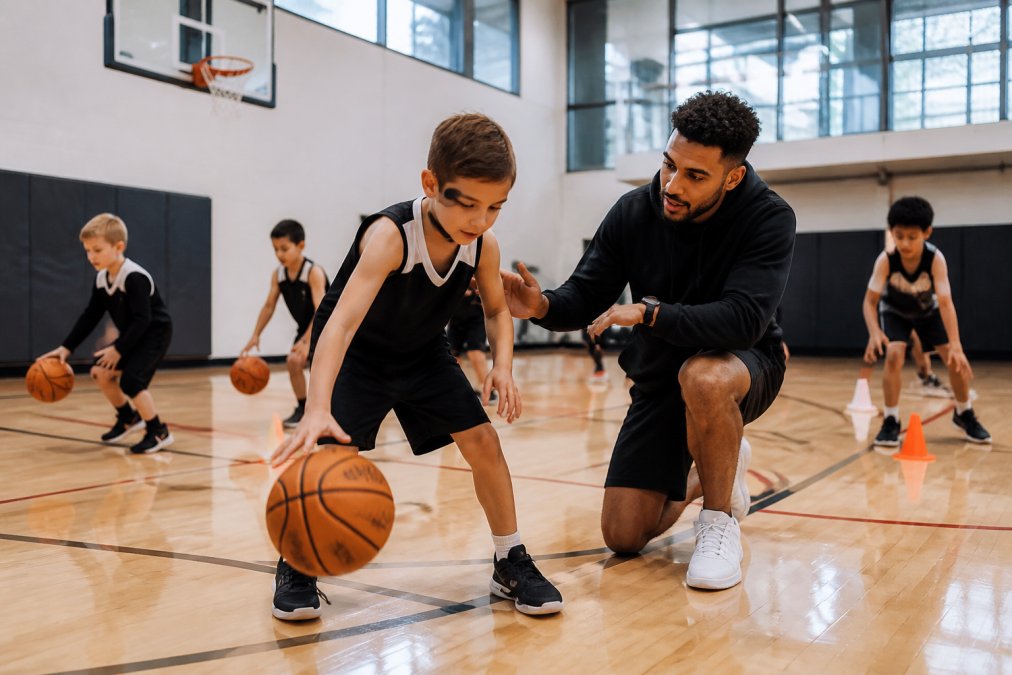
You should not see a child sitting on the sideline waiting for a turn. Quality programs keep every player engaged with age-appropriate drills that maximize court time.
Parents usually watch from a designated area. Observe whether coaches are patient and correct mistakes with constructive feedback or criticism, the answers tell you whether the program matches your family's values.
How to Register for Youth Basketball Training: Step-by-Step
Registering for youth basketball training follows a straightforward process, but timing and preparation matter more than most parents expect. Clubs in Canada typically run registration in two cycles: a primary cycle for fall/winter (opening in May or June) and a secondary cycle for spring/summer (opening in January or February) (canada.ca). Missing these windows often means joining a waitlist.
Here is the process most Canadian clubs follow:
-
Create a family account on the club's registration platform. Most clubs use platforms like RAMP Interactive, TeamSnap, or Uplifter. Creating an account before registration day saves critical minutes when slots are released. Have your child's birth date, health card number, and emergency contact information ready.
-
Review the program's age matrix, not just the age range. Clubs define age groups by birth year, not school grade. A "U10" program typically includes players born in a specific two-year window. Confirm your child's birth year falls within the stated range before proceeding.
-
Select your stream and session preference. Decide between recreational and competitive pathways before you begin. Competitive streams often involve two steps: registering for a tryout evaluation (usually $25 to $50) and accepting a roster spot if offered. Recreational streams typically allow direct registration.
-
Complete the player information form thoroughly. Beyond basic contact details, expect to provide emergency contacts (two recommended), medical conditions, allergies or medications, jersey size for competitive programs, and possibly a recent photo for gym access.
-
Review the fee breakdown before payment. Registration fees often exclude mandatory extras, including a non-refundable provincial membership fee (e.g., Ontario Basketball or Basketball BC, typically $15 to $30), uniform fees for rep teams ($100 to $200), tournament fees, and insurance surcharges.
-
Submit payment and confirm your spot. Most clubs accept credit cards or e-transfers through their portal. After payment, you should receive an immediate confirmation email; if not, contact the club within 24 hours.
-
Complete any post-registration paperwork. Many clubs require parents to sign a code of conduct, review the concussion protocol, and complete a volunteer commitment form within a week. Missing these deadlines can place your child on hold.
Set a calendar reminder for the registration opening date; popular time slots for ages 7-10 fill within 48 hours. If you miss the primary window, ask about mid-season intake or waitlist movement.
Recreational vs. Rep Basketball: Which Path Suits Your Child?
Recreational basketball, or house league, prioritizes participation, fundamentals, and equal playing time. Rep basketball involves tryouts, higher commitment, and a focus on competitive success. Neither is inherently better; the right choice depends on your child's goals and temperament.
Recreational programs suit children who want to play, learn skills, and have fun with friends. Practices are typically once or twice weekly, and games emphasize participation over winning. This path is ideal for beginners and families who cannot commit to travel schedules.
Rep basketball demands more: multiple practices per week, weekend tournaments, and a higher financial investment for travel and uniforms. Players who make rep teams are usually highly motivated with solid fundamentals. The coaching philosophy matters: does the program prioritize player development or winning at all costs? A healthy rep environment balances both.
Many clubs offer a middle ground: an advanced recreational group or a development program that prepares players for future rep tryouts without the full commitment.
Youth Basketball Skill Development: What Your Child Will Learn
The specific skills taught should match your child's age and ability. A curriculum that works for a 6-year-old will not serve a 14-year-old preparing for rep tryouts.
For ages 4-6, skill development focuses on gross motor control: running, stopping, changing direction, and basic ball handling. Children learn to dribble with their heads up, catch a pass, and shoot at a lowered hoop, building confidence and a love for movement.
For ages 7-10, the curriculum expands to proper shooting mechanics, pivot footwork, passing with both hands, and introductory defensive stance, plus basic spacing and offensive concepts. This is the "Golden Window" of motor skill development, when coordination and learning speed peak.
For ages 11-16, development shifts toward advanced skills: reading defenses, ball screens, transition play, and position-specific training. Rep players should also develop basketball IQ through film study and game analysis.
A quality program balances skill work with actual game play. Drills build mechanics, but scrimmages teach decision-making. If a program runs 45 minutes of drills with only 5 minutes of game time, your child will struggle to apply those skills in real situations.
Evaluating Readiness and Long-Term Athletic Growth
Most program websites will happily take your registration fee without asking whether your child is ready. Before you register, work through a practical readiness assessment covering physical, mental, and logistical readiness.
Physical Readiness Checklist
Answer yes or no to each statement:
- My child can run continuously for 10 minutes without needing to stop and rest.
- My child can catch a soft ball thrown from 3 meters away, at least 7 out of 10 times.
- My child can balance on one foot for 10 seconds without wobbling.
- My child can follow a three-step instruction (for example, "dribble to the line, stop, and pass the ball").
- My child can dress and undress independently, including tying shoes or managing velcro straps.
If you answered no to two or more statements, your child may benefit from a general physical literacy program before committing to basketball-specific training.
Mental Readiness Checklist
- My child can handle losing a game without a meltdown that lasts more than 10 minutes.
- My child can sit and listen to instructions for 5 minutes without constant redirection.
- My child asks to play basketball or practice skills on their own, without parental prompting.
- My child can cope with constructive correction from a coach without taking it personally.
If your child is not yet mentally ready, a recreational program with a strong emphasis on fun and low competition is a better starting point than a rep program.
The Long-Term Athlete Development (LTAD) Roadmap
Understanding where your child sits on the Long-Term Athlete Development framework helps you make registration decisions that align with their stage. The Canadian Sport for Life model outlines seven stages, but three are relevant for youth basketball registration:
-
Active Start (ages 0-6): The goal is daily active play and developing fundamental movement skills like running, jumping, and throwing. Basketball at this stage should look like games, not drills.
-
FUNdamentals (girls ages 6-8, boys ages 6-9): This stage focuses on developing ABCs, Agility, Balance, Coordination, and Speed. Basketball training should emphasize overall athleticism, not position-specific skills. Children benefit from multiple sports; specializing in basketball alone at age 7 slows long-term development.
-
Learn to Train (girls ages 8-11, boys ages 9-12): This is the "Golden Window" of motor skill development, where children learn skills fastest. Basketball training should now include proper shooting mechanics, passing technique, and defensive footwork. This is the earliest stage where structured, basketball-specific training makes sense.
-
Train to Train (girls ages 11-15, boys ages 12-16): This stage introduces advanced tactics, position-specific training, and competitive structure. Rep tryouts typically happen at the beginning of this stage. Players should have solid fundamentals before entering this phase.
How This Affects Your Registration Decision
A 6-year-old who is not ready for structured training needs an Active Start program with games and minimal instruction. A 10-year-old in the Learn to Train stage who has played multiple sports and shows genuine interest is ready for a structured program with qualified coaching.
When you contact a club, ask: "Where does your program fit on the LTAD framework, and what stage is your curriculum designed for?" A quality program will answer clearly.
If your child is between stages, err on the side of the lower stage. A slightly under-challenged child will still enjoy the game. An over-challenged child will lose confidence, which is harder to rebuild than skills.
Final Steps to Secure Your Spot
Once you have chosen a program, complete registration promptly. Confirm your session time, mark the first practice on your calendar, and ensure your child has proper footwear and clothing.
Connect with the club's community before the season starts. Ask about parent communication channels, volunteer expectations, and how the club handles questions.
If you are still weighing options, reach out directly to the program coordinators with your specific questions. Reputable clubs welcome inquiries about coaching qualifications, session structure, and their approach to player development. The Canadian Sport for Life long-term athlete development model provides a useful framework for understanding how your child's basketball training fits into their overall athletic growth.
Youth basketball training should be a positive, formative experience that builds skills and character. The right program challenges your child appropriately, celebrates effort, and fuels a genuine passion for the game. Programs that focus on both skill development and passion tend to produce players who stick with the sport for years, not just one season. For guidance on age-appropriate physical activity for children, the Public Health Agency of Canada's physical activity guidelines offers useful context on how much active play young athletes need alongside organized sports.
When you find the right fit, registration is just the beginning. The real reward comes weeks later when you watch your child dribble confidently down the court, make a smart pass, or sink their first basket.
Choosing the right program requires matching your child's developmental stage with a program's philosophy, coaching quality, and competitive structure. At Tier 1 Sports, we designed our programs to fuel a lifelong passion for the game through expertly tailored training for athletes aged 4 to 16, whether they are picking up a ball for the first time or preparing for rep tryouts. Our approach balances skill development with genuine game play, and our coaching staff prioritizes learning over winning at every age level. Get started with Tier 1 Sports and give your child the chance to realize their potential on the court.
Frequently Asked Questions
What age should a child start basketball training?
Many programs welcome children as young as 4 or 5. At this age, the focus is on fun, basic motor skills, and learning to follow instructions in a group. For older kids, programs are grouped by age and skill so they can start at any point. The key is matching your child to a group that matches their development, not just their age.
What is the difference between recreational and rep basketball?
Recreational basketball focuses on fun, fundamentals, and equal playing time. Rep basketball involves tryouts, a bigger time commitment with frequent practices and tournaments, and a focus on competitive game play. Rep also costs more due to travel and coaching. If your child is new to the sport, starting in a recreational house league is often the best first step.
What equipment does my child need for their first basketball session?
You only need a few basics: a properly sized basketball (size 5 for ages 5-8, size 6 for ages 9-11, size 7 for ages 12 and up), running shoes with good grip, and a water bottle. Most programs provide pinnies for scrimmages. Avoid bringing your own ball unless you check with the program first, as some provide equipment for all players.
How do I know if my child is ready for competitive rep tryouts?
Readiness for rep tryouts is about more than just skill. Your child should handle being coached hard without getting discouraged, work well in a team setting, and be committed to a demanding practice schedule. If they love the game and want to improve, coaches often value that attitude as much as current ability. Speak with their current coach for an honest assessment before registering for tryouts.
This article was written using GrandRanker