 how-to
How to Teach Basketball Fundamentals to Young Children
Table of Contents
- What You'll Need Before You Start
- Basketball Skill Development for Ages 4-7: What's Age-Appropriate
- Step 1: Teach Ball Handling and Dribbling Basics
- Step 2: Build Shooting Form and Passing Techniques
- Step 3: Footwork, Defensive Stance, and Movement Skills
- Fun Basketball Drills for Kids at Home (No Hoop Required)
- Youth Basketball Practice Plans for Beginners
- Common Mistakes to Avoid When Teaching Basketball Fundamentals
- Frequently Asked Questions
Last Updated: September 16, 2026
What You'll Need Before You Start
You don't need a gym membership or a full-size hoop to teach basketball fundamentals to a young child. What you do need is gear that matches the child's body, because mismatched equipment is the fastest way to turn a fun session into a frustrating one. Here's the honest list, organized by age.
Ball Size by Age
Youth basketball uses numbered ball sizes, and the number tracks the circumference. Getting this right matters more than any drill you'll run in the first year.
| Size | Circumference | Typical Age | Notes |
|---|---|---|---|
| Size 3 | ~22 in | 4-7 | Lightest option; small hands can palm and control it |
| Size 4 | ~25.5 in | 7-9 | Transition ball as grip strength and hand span grow |
| Size 5 | ~27.5 in | 9-12 | Standard youth size for most recreational leagues |
| Size 6 | ~28.5 in | 12+ girls / younger teens | Often the women's regulation size |
| Size 7 | ~29.5 in | 13+ boys / teens | Men's regulation size |
Hoop Height by Age
A regulation 10-foot rim is a non-starter for a 5-year-old. Lowered hoops let kids use correct form instead of heaving the ball with two hands from their chest.
- Ages 4-6: 6 to 8 feet. An adjustable portable hoop or a wall-mounted mini hoop works fine.
- Ages 7-9: 8 to 9 feet. Most adjustable residential hoops cover this range.
- Ages 10-12: 9 to 10 feet, moving toward regulation as form stabilizes.
Everything Else
- Footwear: Any well-fitting athletic shoe with decent lateral support. Basketball-specific shoes are nice but not required until organized play.
- Surface: A flat driveway, a park court, or a gym floor. Avoid sloped or cracked pavement; uneven footing undermines balance work.
- A wall or partner: For passing drills, a plain exterior wall is enough.
- Time: 10-15 minutes per session for ages 4-6, stretching to 20-30 minutes by age 8-9.
At Tier 1 Sports, we are dedicated to fueling a lifelong passion for the game, offering engaging introductory sessions for beginners designed to develop essential skills in a supportive environment.
Basketball Skill Development for Ages 4-7: What's Age-Appropriate
Basketball skill development for ages 4-7 is not about producing polished players. It's about building athletic movement patterns, coordination, and a positive relationship with physical activity. Children in this range develop at wildly different rates, so compare your child to their own progress, not to a teammate. Focusing on personal growth rather than external benchmarks helps build confidence in children as they navigate the challenges of learning new motor skills.
The Golden Window for Motor Skills
The "Golden Window" refers to the early childhood years when the brain is especially receptive to learning fundamental movement skills like running, jumping, balancing, and catching. Skills learned in this window become the foundation for everything that follows, from a layup at age 12 to a jump shot at 16.
What's Happening in Their Head
A 5-year-old's brain is still building the circuitry for impulse control, emotional regulation, and delayed gratification. That has direct consequences for how you coach:
- Attention spans run roughly 3-5 minutes per year of age. A 5-year-old can focus for about 15-25 minutes on a preferred activity, less on a hard one. Plan sessions accordingly.
- They can't yet separate effort from outcome. If they miss five shots, they don't think "my form needs work," they think "I'm bad at this." Your job is to praise the attempt, not the result.
- Frustration tolerance is thin and recovery is slow. A single bad drill can end a session. Watch for slumped shoulders, dropped eye contact, or sudden silliness; those are early exit signals, not misbehavior.
- They learn through imitation, not instruction. Demonstrate the drill yourself. A 30-second demo beats a 3-minute explanation every time.
Keeping Kids Engaged Without Turning It Into a Test
Most practitioners find that the kids who stick with basketball past age 8 are the ones whose early sessions felt like play. A few mechanisms that work:
- Name the game, not the skill. "Red light, green light" teaches stopping and starting. "Ball tag" teaches body positioning. The child experiences a game; you're running a drill.
- End on a win. Stop while they still want more. A session that ends with a made basket or a laugh is a session they'll ask to repeat.
- Use a 3:1 praise-to-correction ratio. Three specific, genuine acknowledgments for every one correction. "I like how you kept your eyes up" beats "good job."
- Give one cue per session. Pick the single most important thing: eyes up, elbow in, knees bent, and let everything else slide.
- Let them choose. Two drill options, their pick. Autonomy is a powerful motivator at this age.
Skills to Introduce at Each Age
| Age | Focus | Example Activity |
|---|---|---|
| 4-5 | Ball familiarity, balance | Rolling, catching, bouncing a ball |
| 6 | Dribbling with one hand | Stationary dribbling, walking dribble |
| 7 | Passing and simple shooting | Chest pass, close-range shooting form |
Treat the table as a rough map, not a schedule. A 6-year-old who's been dribbling since age 4 will be ready for passing earlier; a 7-year-old new to sports may still be building balance. The right pace is the one where the child keeps showing up.
Step 1: Teach Ball Handling and Dribbling Basics
Start with the ball in their dominant hand and their eyes up, not glued to the floor. A common mistake is letting kids stare at the ball while dribbling. Court awareness begins the moment they learn to dribble by feel, even if that means a few dropped balls at first.
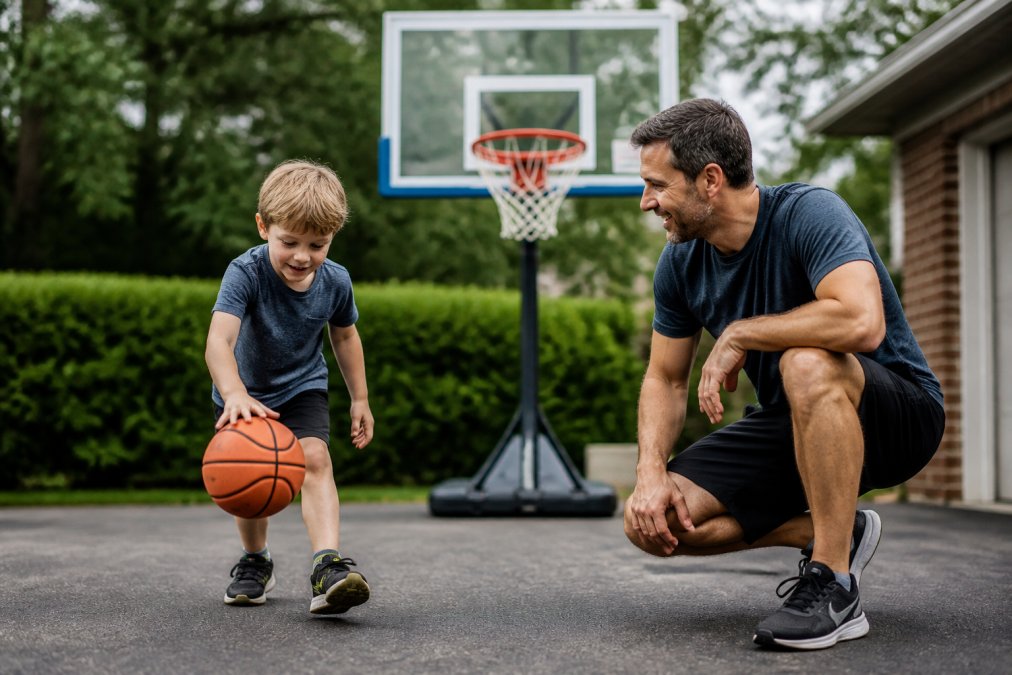
Here's the progression that works:
- Ball slaps and taps (30 seconds) to wake up the hands
- Waist circles around the body, both directions
- Stationary dribbling with one hand, then the other
- Walking dribble across the driveway
- Figure-eight dribbling through the legs, once they're ready
Step 2: Build Shooting Form and Passing Techniques
Proper shooting form starts with hand placement: shooting hand under the ball, guide hand on the side, elbow tucked in line with the hoop. For a young child, "elbow in, follow-through, hold your finish" is the whole lesson. Don't overload them with mechanics.
Shooting Form and Hand Placement
Have them shoot from close range, ideally with a lowered hoop or a small indoor hoop. The goal at this age is a repeatable motion, not makes. Celebrate the process, not just the result.
Chest Pass, Bounce Pass, and Overhead Pass
The chest pass, bounce pass, and overhead pass are the three foundational passes every young player should learn. Practice each against a wall or with a partner:
- Chest pass: ball at chest, push straight out, thumbs down on release
- Bounce pass: same motion, aimed to bounce two-thirds of the way to the target
- Overhead pass: ball above the head, step forward, snap the wrists
Step 3: Footwork, Defensive Stance, and Movement Skills
Footwork is the quiet skill that separates kids who look coordinated from kids who look lost. The triple threat position, where a player can shoot, pass, or dribble, teaches them to stay ready. The defensive stance, knees bent, feet wide, arms out, builds lateral movement and balance.
Fun Basketball Drills for Kids at Home (No Hoop Required)
Fun basketball drills for kids at home don't need a hoop at all. Most of the skill-building happens before the ball ever meets the rim.
Try these:
- Red light, green light dribbling: they dribble on "green," freeze on "red"
- Ball tag: you try to touch their ball while they protect it with their body
- Wall passing: count how many chest passes they can land in 30 seconds
- Balance holds: stand on one foot while passing the ball hand to hand
- Animal walks: bear crawls and crab walks build the same muscles used in a defensive stance
The most effective home practice sessions are short, playful, and consistent. A child who dribbles for ten minutes daily will out-develop a child who grinds through a one-hour session once a week.
Youth Basketball Practice Plans for Beginners
Youth basketball practice plans for beginners should follow a simple rhythm: warm-up, skill work, a game, and a cool-down. Kids learn through repetition wrapped in play, not through lectures.
Sample 45-Minute Practice Plan
| Time | Activity | Purpose |
|---|---|---|
| 0-5 min | Dynamic warm-up (jumping jacks, high knees) | Wake up the body |
| 5-15 min | Ball handling and dribbling drills | Build hand-eye coordination |
| 15-25 min | Passing and shooting form | Develop core techniques |
| 25-40 min | Small-sided game or relay race | Apply skills under mild pressure |
| 40-45 min | Cool-down and team cheer | Reinforce teamwork |
Adapt the length for younger kids. A 4-year-old's attention span won't stretch to 45 minutes, so split it into two shorter blocks.
Common Mistakes to Avoid When Teaching Basketball Fundamentals
The biggest mistake is treating skill development like a test. Kids who feel judged stop trying. Kids who feel encouraged keep coming back.
Other pitfalls to watch for:
- Correcting too many things at once. Pick one cue per session.
- Skipping the warm-up. Cold muscles and young joints don't mix.
- Ignoring the non-dominant hand. Dribbling with both hands is a long-term investment.
- Over-scheduling. Rest is part of development.
- Comparing siblings or teammates. Motivation dies fast when a child feels behind.
Frequently Asked Questions
How can I teach basketball to young children effectively?
Keep sessions short (15-20 minutes for ages 4-6) and focus on one skill at a time. Use a smaller ball and a lowered hoop so children can experience success. Celebrate effort over results, and turn drills into games. Repetition matters more than variety at this age, so repeat the same three or four activities across several weeks before adding new ones.
What are the 7 fundamentals of basketball?
The seven core fundamentals are: ball handling and dribbling, shooting form, passing (chest, bounce, and overhead), footwork and pivoting, defensive stance and lateral movement, rebounding, and court awareness or spacing. For young children, introduce these in order of physical readiness. Dribbling and footwork come first because they build hand-eye coordination and balance before shooting accuracy is realistic.
What basketball skill development for ages 4-7 actually looks like?
At ages 4-7, skill development means building athletic movement foundations: running, jumping, landing, balancing on one foot, and changing direction. Ball-specific skills include dribbling with the dominant hand, catching a pass with two hands, and taking a basic layup off one foot. A quality program uses games like red light green light dribbling and partner passing to teach these without formal drill lines.
How do you keep basketball practice fun for 4-year-olds?
Use games instead of drills. Set up obstacle courses with cones, play dribble tag, or have races to see who can make five bounce passes against a wall first. Rotate activities every 3-4 minutes to match short attention spans. End every session with a scrimmage or shooting game so kids leave excited. When fun basketball drills for kids at home feel like play, they ask to do them again.