 how-to
Track and Field Drills for Basketball Speed
Table of Contents
- Why Track and Field Drills Transfer to Basketball Speed
- Basketball Sprinting Drills Adapted from Track Technique
- Basketball Speed and Agility Drills for Court Movement
- Youth Basketball Speed Training Progressions
- Basketball Acceleration Drills for Linear Speed
- Common Mistakes and Technique Cues
- Warm-Up, Recovery, and Injury Prevention
- Measuring Progress and Benchmarking Speed
- Frequently Asked Questions
Last Updated: October 10, 2026
Why Track and Field Drills Transfer to Basketball Speed
Track and field drills for basketball speed build the fundamental mechanics that govern all human acceleration and deceleration. The connection is biomechanical, not coincidental.
Basketball demands three movement qualities that track training directly develops:
Explosive First-Step Acceleration Track sprinters spend decades perfecting the drive phase, the first 0-5 metres where maximum force is applied. In basketball, the first step determines who gets separation on offence or closes out on defence. Track mechanics teach players to drive their knees explosively upward, maintain a forward lean of 45 degrees during acceleration, and push through the balls of their feet rather than landing flat-footed. These cues transfer directly: a player who masters the track start gains an immediate advantage in a basketball first step.
Efficient Deceleration and Control Track athletes train extensively to slow down safely after sprinting. Basketball requires constant stopping, cutting to the basket, sliding on defence, recovering after a sprint. Poor deceleration causes injury and wastes energy.
Movement Economy and Reduced Fatigue Track coaches measure running economy, how much energy a sprinter uses to cover a given distance. Poor mechanics waste energy; good mechanics preserve it.
The key insight: track drills teach how to move, not just how fast to move.
Basketball Sprinting Drills Adapted from Track Technique
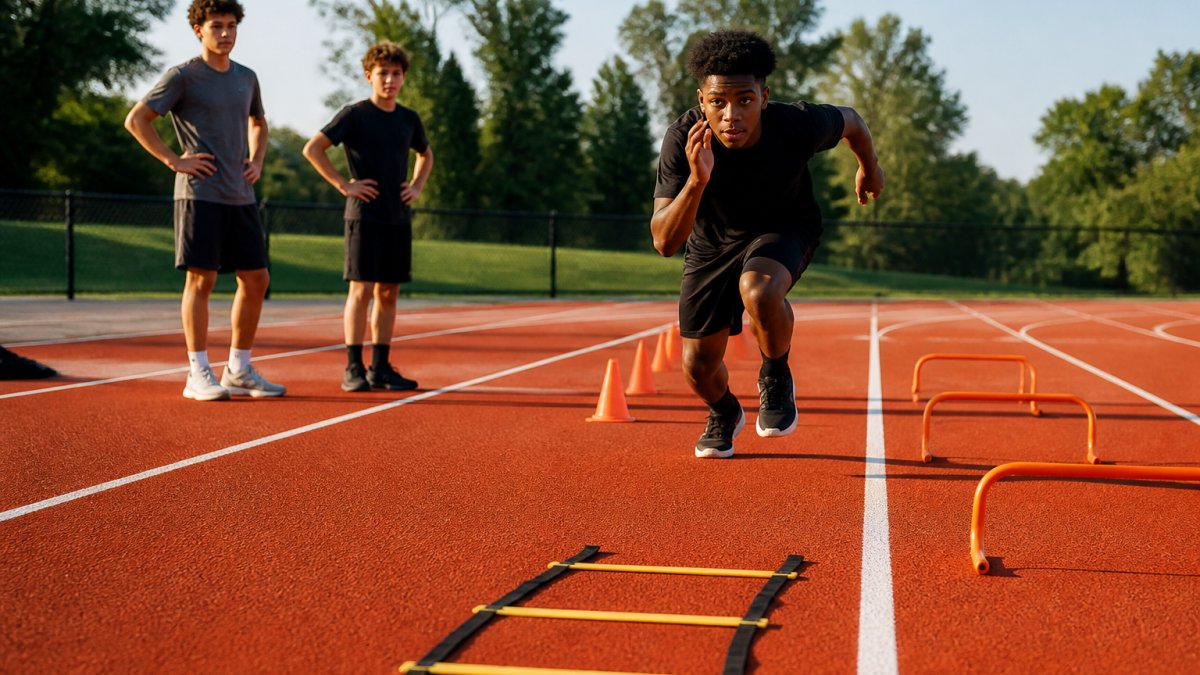
Sprinting mechanics form the foundation of basketball speed. The key is proper body position during acceleration and top-end speed phases.
Full-Court Sprint Mechanics
Full-court sprints teach players to maintain proper form over game-length distances. Start with feet shoulder-width apart. Drive your knees forward and up as you push off explosively. Your body should lean slightly forward during acceleration, then straighten as you reach top speed.
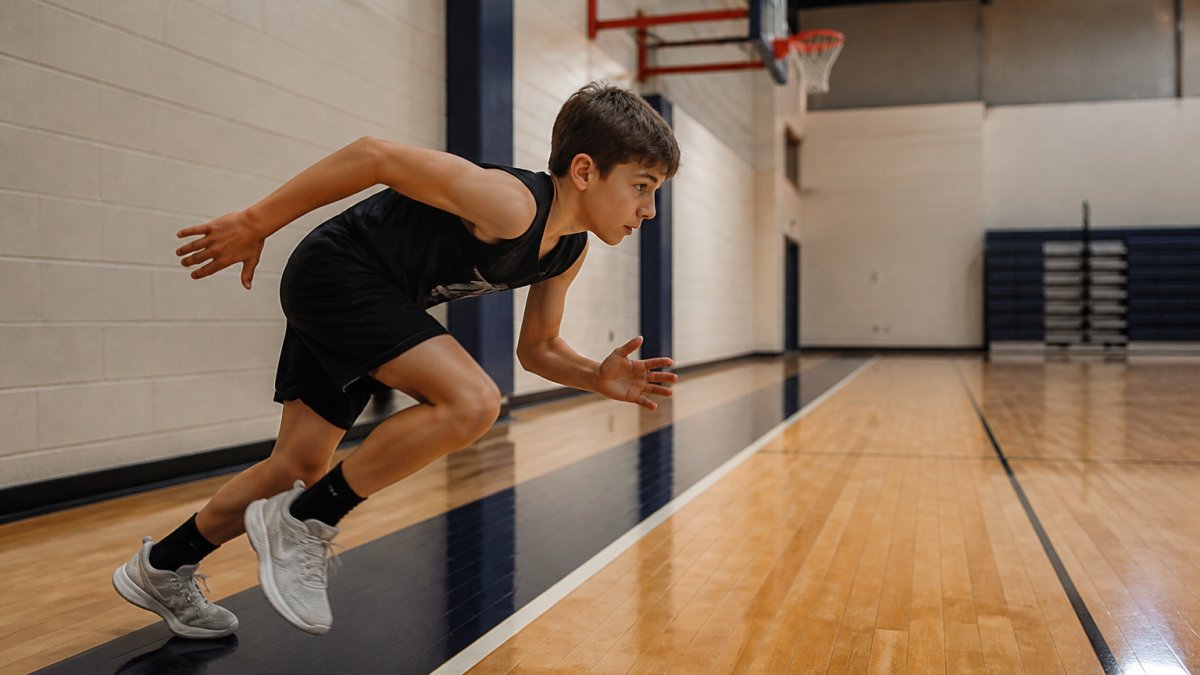
Run full-court sprints 2-3 times per week. Start from the baseline and accelerate to the opposite end. Focus on maintaining form, not just speed. Many players rush and lose proper mechanics when fatigued. Slow down if your form breaks down.
17-Second Sprint Intervals
The 17-second sprint interval matches basketball game demands. Most basketball plays last 10-20 seconds. Training at this duration builds sport-specific conditioning.
Sprint for 17 seconds at near-maximum effort. Walk or jog for 43 seconds to recover. Repeat 6-8 times. This 1:2.5 work-to-rest ratio allows near-maximum effort on each rep. Your nervous system stays fresh. Speed stays consistent across all reps.
Do 17-second intervals once per week. Pair them with other speed work on different days. This prevents overtraining while building explosive capacity.
Basketball Speed and Agility Drills for Court Movement
Court-specific drills teach players to accelerate, decelerate, and change direction under control. These drills bridge the gap between straight-line track speed and game-realistic movement.
T-Drill Variations and Box Agility
The T-drill develops change-of-direction ability and body control. Set up three cones in a T shape: one at the baseline (start), one 5 metres forward, and two cones 5 metres to each side.
Sprint forward to the top cone. Shuffle left to the left cone. Shuffle right, passing through the center, to the right cone. Shuffle back left through center. Backpedal to the start. Complete 4-6 reps with 60-90 seconds rest between efforts.
The box agility drill uses four cones in a square pattern, 3 metres apart. Sprint to each cone in sequence. Focus on tight, explosive cuts. Keep your body low during direction changes. Your feet should stop quickly before you accelerate again.
Lateral Shuffle and Defensive Slides
Lateral shuffles build side-to-side speed essential for defense. Stand in athletic position. Shuffle sideways 5-6 metres without crossing your feet. Keep your chest facing forward. Maintain low body position throughout.
Defensive slides combine lateral movement with forward-backward positioning. Start in defensive stance. Slide laterally while staying low. React to directional cues. Simulate closing out on shooters or staying in front of ball handlers. These drills teach reactive speed rather than planned movement.
Youth Basketball Speed Training Progressions
Young athletes need age-appropriate progressions. Younger players (ages 7-10) focus on coordination and movement patterns. Older youth (ages 11-16) can handle more intense speed work.
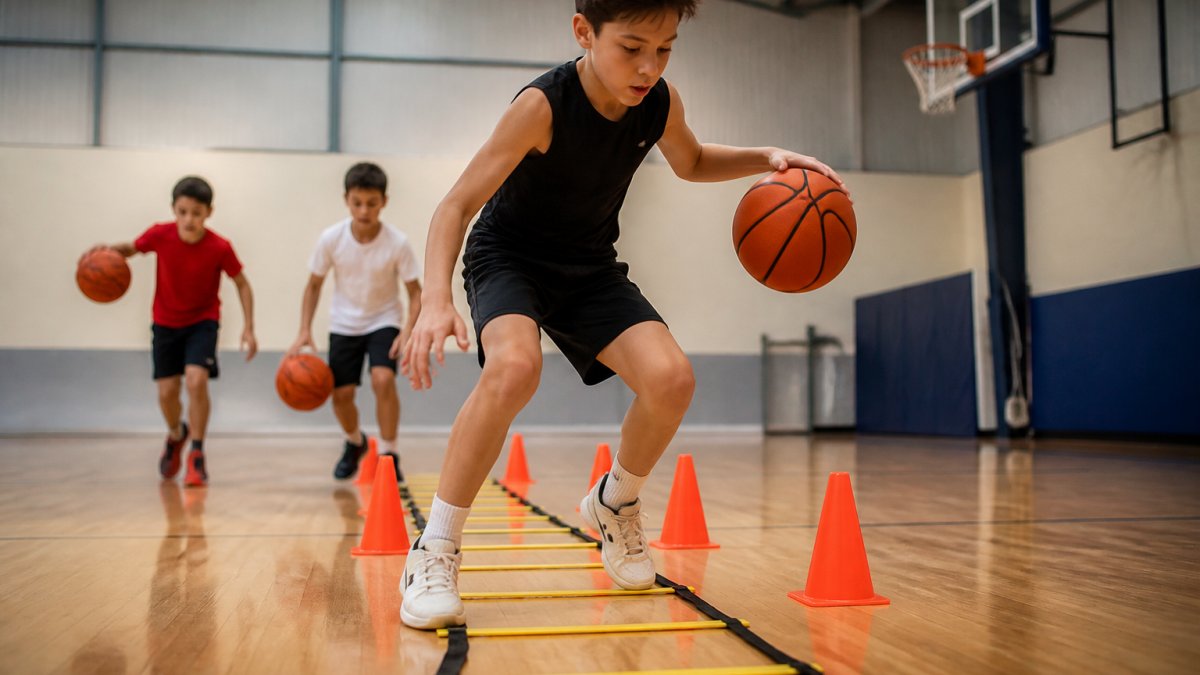
Ages 7-10 should emphasize footwork basics and coordination. Use ladder drills, balance work, and simple sprint mechanics. Keep sessions short and fun. Introduce one new drill per week.
Ages 11-13 can add more complex agility drills and moderate-intensity sprints. Introduce T-drills, box drills, and lateral shuffles. Add 17-second intervals once per week. Keep rest periods longer than adult training.
Ages 14-16 can handle advanced track-style training. Full-court sprints, multiple sprint intervals, and complex agility combinations become appropriate. At this age, proper technique remains critical, but intensity can increase.
Basketball Acceleration Drills for Linear Speed
Acceleration determines who gets the first-step advantage. The first 5-10 yards separate explosive players from average ones. These drills build the power and mechanics needed to win that battle.
High Knees and Plyometric Foundations
High Knees High knees build hip flexor strength and teach rapid knee drive, essential for acceleration.
- Drive one knee up toward your chest while pushing off the opposite foot
- Alternate rapidly, maintaining an upright posture
- Perform for 20 seconds at maximum frequency
- Rest 40 seconds
- Repeat 4-6 sets, 2-3 times per week
Bounding Bounding develops power across longer distances and teaches explosive hip extension.
- Take exaggerated steps, driving off one leg and landing on the other
- Cover 10-12 metres per set
- Focus on explosive takeoff, not landing distance
- Rest fully (2-3 minutes) between efforts
- Perform 4-6 sets, once per week
Progression: Beginners should bound for distance at controlled intensity. Intermediate athletes can add speed.
Coaching cue: "Stick the landing, then explode." Players often rush and lose control.
Box Jumps Box jumps teach explosive hip and ankle extension, the power source for quick acceleration.
- Stand in front of a box 30-45 cm high (beginners) to 60 cm high (advanced)
- Swing your arms and jump onto the box, landing softly with bent knees
- Step down carefully (do not jump down; this increases injury risk)
- Rest 90-120 seconds between reps
- Perform 3-5 reps per set, 2-3 sets, once per week
Progression: Start with lower box heights and focus on landing control. As strength improves, increase box height.
Coaching cue: "Land soft, stick it, then explode up." Poor landings cause knee strain.
Cone Drills and Acceleration Phases
5-10-15 Yard Acceleration Drill This drill teaches acceleration over the distances most relevant to basketball.
- Place cones at 5, 10, and 15 yards from the start
- Sprint to the 5-yard cone, decelerate, and stop
- Rest 30 seconds
- Sprint to the 10-yard cone, decelerate, and stop
- Rest 30 seconds
- Sprint to the 15-yard cone, decelerate, and stop
- Rest 2 minutes
- Repeat 3-4 sets, once per week
Focus: Explosive push-off at the start, maximum acceleration through 5 yards, then controlled deceleration. This mimics basketball movement: explosive start, rapid deceleration, change direction.
Coaching cue: "Explode out of the blocks. Brake hard at the cone." Many players coast or decelerate too gradually. Emphasize sharp stops.
Multi-Acceleration Drill This drill teaches repeated acceleration, critical in basketball where players accelerate multiple times per possession.
- Place four cones in a line, 5 yards apart (0, 5, 10, 15 yards)
- Sprint from 0 to 5 yards, decelerate and stop
- Backpedal to 0
- Sprint from 0 to 10 yards, decelerate and stop
- Backpedal to 0
- Sprint from 0 to 15 yards, decelerate and stop
- Rest 2-3 minutes
- Repeat 2-3 sets, once per week
Progression: Beginners perform this drill at 70-80% effort with longer rest. Intermediate athletes increase to 85-90% effort. Advanced athletes perform at 95%+ effort with minimal rest (90 seconds between sets).
Programming Acceleration Work
Acceleration drills demand high nervous system output. Follow these guidelines:
- Perform acceleration work once per week, on a day separate from agility or interval training
- Always warm up thoroughly: 5 minutes easy jogging, dynamic stretches, 2-3 minutes of movement prep
- Perform acceleration drills early in the session, when nervous system is fresh
- Use full recovery between efforts (2-3 minutes for sprints, 90-120 seconds for plyometrics)
- Do not perform acceleration work on consecutive days
- Monitor form; stop the session if form breaks down
Measuring Acceleration Progress Track 10-yard sprint time weekly. Set a cone 10 yards from the start. Sprint and time the effort from a standing start. Record the time. Most athletes improve 0.1-0.3 seconds within 4-6 weeks of consistent training. Improvement here directly transfers to faster first steps on the court.
Common Mistakes and Technique Cues
Most players rush their acceleration. They lean too far forward or don't drive their knees high enough. Slow down. Master proper form before adding speed.
Another mistake: ignoring the importance of deceleration. Stopping quickly matters as much as starting fast. Teach players to control their momentum. Land with bent knees. Keep your body upright during deceleration.
Poor footwork during direction changes costs speed. Players cross their feet or take too many steps to change direction. Use proper lateral shuffle technique. Keep your feet shoulder-width apart.
Watch for players who tire quickly. This often means poor running economy, not poor conditioning. Better mechanics reduce fatigue. Focus on form when athletes fatigue.
| Mistake | Cause | Fix |
|---|---|---|
| Excessive forward lean | Rushing acceleration | Drive knees up; lean gradually |
| Slow direction changes | Crossing feet or poor footwork | Practice lateral shuffles; use proper stance |
| Early fatigue | Poor running mechanics | Emphasize form; reduce volume initially |
| Inconsistent sprint times | Varying effort or form breakdown | Ensure adequate rest; watch form |
Warm-Up, Recovery, and Injury Prevention
Proper warm-up prepares muscles and nervous system for speed work. Start with 5 minutes of easy jogging. Add dynamic stretches: leg swings, walking lunges, inchworms.
Never skip the warm-up for speed training. Cold muscles don't produce maximum force. Injury risk increases significantly. Young athletes especially need thorough preparation.
Recovery between speed sessions prevents overtraining. Space high-intensity speed work 48 hours apart. Use easier days for skill work or low-intensity conditioning. Sleep matters tremendously. Young athletes need 8-10 hours nightly.
Strength training supports speed development. Focus on lower body: squats, lunges, and deadlifts. Strong legs produce faster acceleration. Add core work: planks, bird dogs, and pallof presses. Core stability improves direction change efficiency.
Measuring Progress and Benchmarking Speed
Track measurable improvements to stay motivated. Time full-court sprints weekly. Record the time from baseline to baseline.
Measure 10-yard sprint time. Set a cone 10 yards from the start. Sprint and time the effort. This measures acceleration specifically.
Count T-drill repetitions in a fixed time. Complete as many clean T-drill reps as possible in 5 minutes. Track the total.
Use video analysis to check form. Record sprints from the side. Look for proper knee drive, body lean, and foot placement.
Every player moves at their own pace, and we celebrate progress over perfection.
Basketball speed isn't about genetics alone, it's built through track and field drills for basketball speed and proven training techniques.
Frequently Asked Questions
How can track and field drills improve speed for basketball?
Track and field drills isolate the mechanics of acceleration, linear speed, and explosive power that basketball requires. Sprint workouts teach proper body position, stride length, and force production. Agility drills from track training sharpen change of direction and footwork. When adapted to court dimensions and basketball-specific movements, these drills build the foundational speed and quickness that translates directly to faster closeouts, defensive slides, and court transitions.
What sprint drills help basketball players accelerate faster?
High knees, bounding, and 17-second sprint intervals build acceleration from a standstill. Box agility drills and cone-based work teach explosive direction changes. Full-court sprints develop top-end speed over distance. Plyometric exercises like lateral bounds strengthen the explosive power needed for quick first steps. Start with high knees and progress to full sprints; younger athletes benefit from ladder drills to establish coordination before adding intensity.
How should young athletes warm up before sprint drills?
Begin with 5-10 minutes of light jogging or dynamic movement to elevate heart rate. Follow with dynamic stretches: leg swings, walking lunges, and arm circles. Include activation drills like lateral shuffles and high knees at 50% effort. Finish with 2-3 progressive accelerations at 75%, 85%, and 95% intensity to prepare the nervous system. Proper warm-up reduces injury risk and ensures athletes reach full speed capability during the main drill work.
How many sprint repetitions should a young basketball player do?
Young athletes (under 12) should perform 4-6 full-court sprints or 6-8 shorter shuttle runs per session, with full recovery between reps. Older youth (12-16) can handle 8-12 repetitions. Total session volume depends on age and training phase. Start conservatively and increase gradually over weeks. Quality matters more than quantity; poor form at high volume increases injury risk and reduces speed development. Rest 90-120 seconds between intense sprints.