 how-to
Essential Basketball Drills for Beginners at Home
Table of Contents
- Why Home Basketball Practice Matters for Beginners
- Beginner Basketball Ball Handling Drills to Build Foundation
- Basketball Drills Without a Hoop: Passing and Footwork
- Basketball Practice Routine for Beginners: A Complete Session
- At-Home Basketball Workout for Beginners: Adaptations for Small Spaces
- Common Mistakes to Avoid When Starting Out
- Progression and Measurable Benchmarks for Skill Development
- Conclusion: Your Path Forward
- Frequently Asked Questions
Last Updated: October 10, 2026
Why Home Basketball Practice Matters for Beginners
Starting basketball as a beginner can feel intimidating, but the truth is simple: consistent home practice builds confidence and skill faster than waiting for the next team session.
Players who practice between sessions develop better ball control, footwork, and game awareness.
Home practice removes pressure, no scoreboard, no coach watching mistakes, no teammates judging effort. That freedom lets beginners focus on repetition, form, and muscle memory. Even 15 minutes daily creates noticeable improvement within two weeks.
The best part? You don't need much space or equipment. A driveway, garage, or even a hallway works. A basketball is helpful but not always required. The goal is simple: develop the fundamentals that make every other skill possible.
Beginner Basketball Ball Handling Drills to Build Foundation
Ball handling is where everything starts. Before shooting, passing, or defense, a beginner must feel comfortable with the ball in their hands.
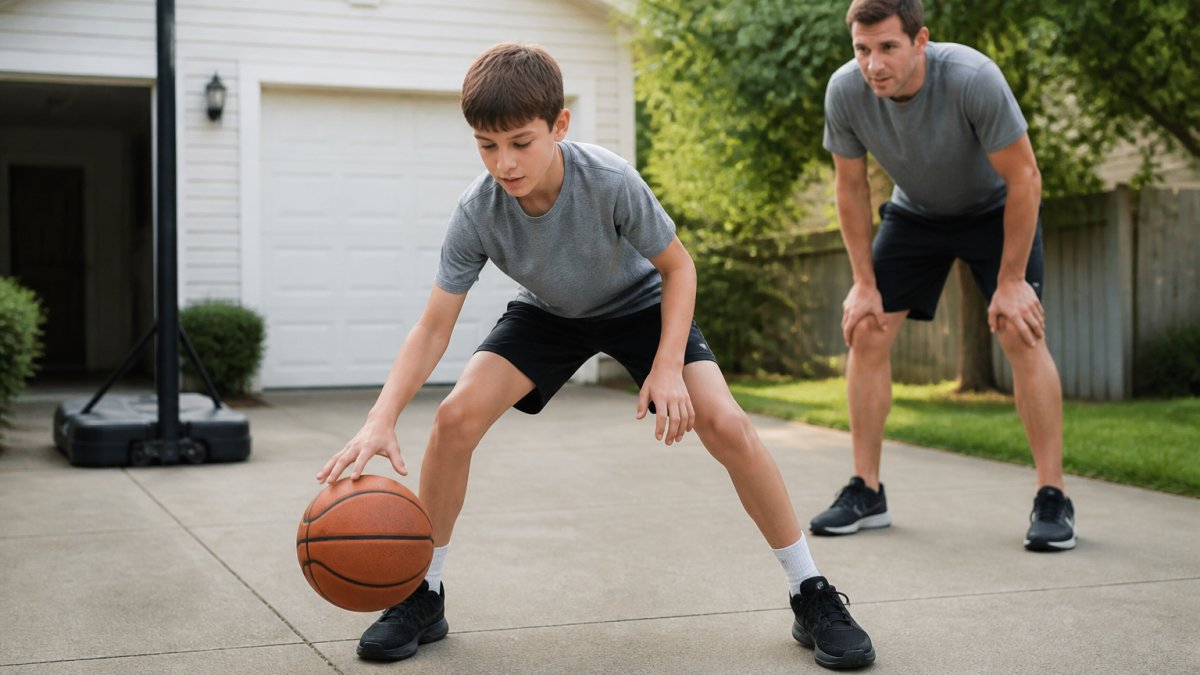
Stationary Dribbling Drills
Two-Hand Dribble:
- Stand with feet shoulder-width apart
- Bounce the ball with both hands alternating (right, left, right, left)
- Keep the ball at waist height
- Eyes forward, not down at the ball
- Do this for 30 seconds, rest, repeat 5 times
Common mistake: Looking down at the ball. Keep your eyes up even if you miss a few bounces.
Dominant Hand Dribble:
- Use only your strong hand (right if you're right-handed)
- Bounce continuously for 30 seconds
- Keep knees slightly bent
- Let the ball bounce to waist height, not higher
- Rest and repeat 5 times
After mastering this, switch to your weak hand. Spend extra time here because players who can dribble with both hands change the game completely.
Figure-Eight and Crossover Dribbles
Figure-Eight Dribble:
- Imagine a figure-eight pattern on the ground (like a sideways 8)
- Dribble the ball around the pattern, following the loops
- Move slowly at first, focusing on control
- Do this for 60 seconds, rest, repeat 3 times
This drill teaches you to dribble in curves, not just straight lines.
Crossover Dribble:
- Start with the ball in your right hand
- Bounce it hard across your body to your left hand
- Catch it with your left hand and dribble once
- Bounce it back across to your right hand
- Continue alternating for 30 seconds
Make the bounce quick and firm, a soft crossover gets picked off in games.
Between-the-Legs and Behind-the-Back Dribbling
These moves help you escape defenders. Start only after mastering the basics above.
Between-the-Legs Dribble:
- Stand with feet wider than shoulder-width
- Dribble the ball with your right hand
- Bounce it hard between your legs to your left hand
- Your left hand catches it on the other side
- Dribble once with your left hand, then bounce it back between your legs
- Continue for 30 seconds
This move takes practice.
Behind-the-Back Dribble:
- Dribble the ball with your right hand at your side
- Bounce it hard behind your back toward your left side
- Your left hand takes over and dribbles once
- Bounce it back behind your back to your right hand
- Continue alternating for 30 seconds
This move teaches you to feel the ball without seeing it. In games, defenders force you to move the ball away from your sight line.
Basketball Drills Without a Hoop: Passing and Footwork
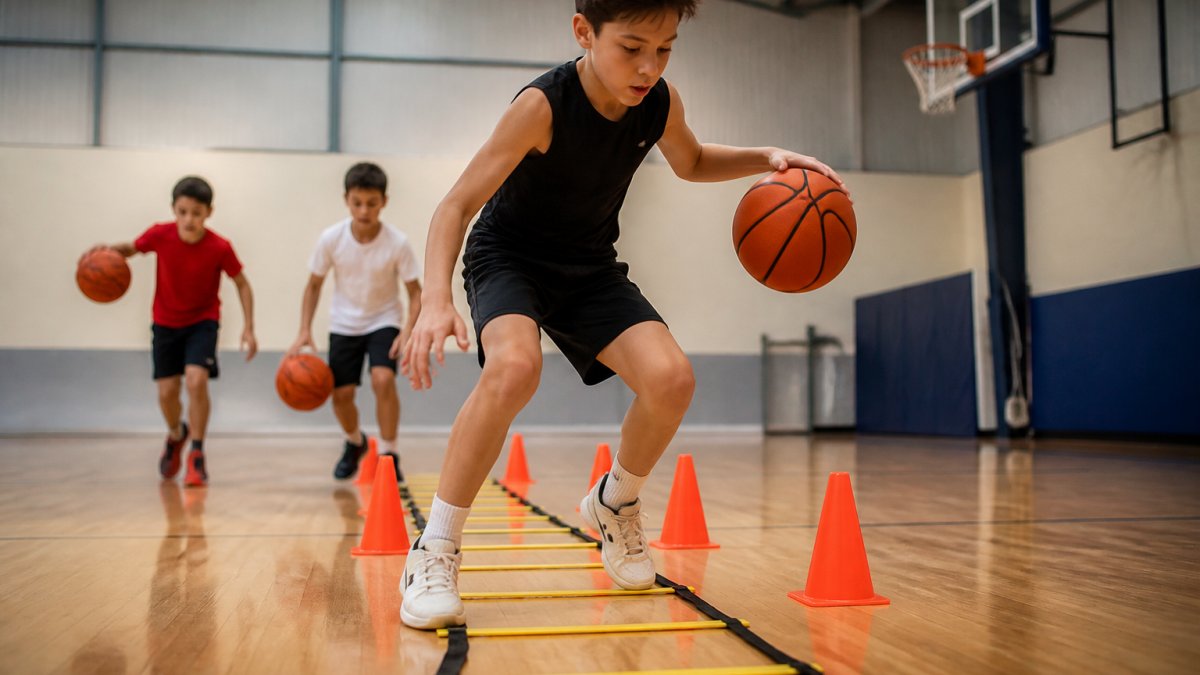
Not every home has a basketball hoop. These essential basketball drills for beginners at home focus on passing, footwork, and body control.
Wall-Passing Drills for Solo Practice
Basic Wall Pass:
- Stand 2 meters from a wall
- Hold the ball at chest height
- Pass the ball hard against the wall (two-handed chest pass)
- Catch it as it returns to you
- Do this 20 times, rest, repeat 3 times
As you improve, step back further. This drill teaches accurate passing and soft hands.
One-Hand Wall Pass:
- Stand 2 meters from the wall
- Pass with your right hand only
- Catch with both hands
- Do 10 passes with your right hand
- Switch to your left hand and do 10 more
Weak hand passing feels strange at first.
Wall-Passing Angles:
- Stand at an angle to the wall (not straight on)
- Pass the ball so it bounces off the wall at a different angle
- Move to catch it
- This teaches you to anticipate ball movement
This drill builds game awareness. In real games, passes come from angles, so you'll react faster when it matters.
Footwork and Body Control Exercises
Pivot Drill:
- Stand with your feet shoulder-width apart
- Hold the ball at chest height
- Keep your left foot planted (pivot foot)
- Rotate your body 180 degrees by moving your right foot
- Rotate back to the starting position
- Do 10 rotations, then switch pivot feet
- Do 10 more rotations
This teaches you to protect the ball. In games, pivoting gets you out of trouble when defenders press you.
Lateral Shuffle:
- Stand in athletic position (knees bent, ready to move)
- Step left with your left foot
- Bring your right foot to meet it
- Continue shuffling left for 5 meters
- Shuffle right for 5 meters
- Do this for 60 seconds
This drill builds lateral quickness for defense and quick direction changes.
High-Knee March:
- March in place, lifting each knee to hip height
- Do this for 30 seconds
- Rest for 15 seconds
- Repeat 4 times
High knees build explosive power and improve coordination.
| Drill | Time | Rest | Reps |
|---|---|---|---|
| Two-Hand Dribble | 30 sec | 15 sec | 5 |
| Crossover Dribble | 30 sec | 15 sec | 4 |
| Between-the-Legs | 30 sec | 20 sec | 3 |
| Wall Pass | 20 passes | 30 sec | 3 |
| Pivot Drill | 10 each foot | 20 sec | 2 |
| Lateral Shuffle | 60 sec | 20 sec | 3 |
Basketball Practice Routine for Beginners: A Complete Session
Knowing individual drills is one thing. Putting them together into a real practice is another. Here's how to structure 30 minutes at home.
Warm-Up and Mobility (5 minutes)
Start every practice with movement to prepare your body and prevent injury.
- Jog in place for 60 seconds
- Arm circles: 10 forward, 10 backward
- Leg swings: 10 forward-and-back each leg, 10 side-to-side each leg
- Walking lunges: 10 steps
- High-knee march: 30 seconds
Skill Work and Drill Progression (20 minutes)
This is where the real work happens. Pick 3-4 drills from the sections above and do them in order.
Sample 20-minute session:
- Stationary dribbling (two hands): 5 minutes
- Crossover dribble: 4 minutes
- Figure-eight dribble: 4 minutes
- Wall passing: 4 minutes
- Lateral shuffle: 3 minutes
Each drill should feel challenging but achievable. Find the middle ground between boredom and frustration.
Game-Based Practice and Cool-Down (5 minutes)
Game-Based Drill:
- Pretend you're in a game situation
- Dribble around your driveway or room, changing direction like you're avoiding defenders
- Do this for 3 minutes
- Then walk around slowly for 2 minutes to cool down
At-Home Basketball Workout for Beginners: Adaptations for Small Spaces
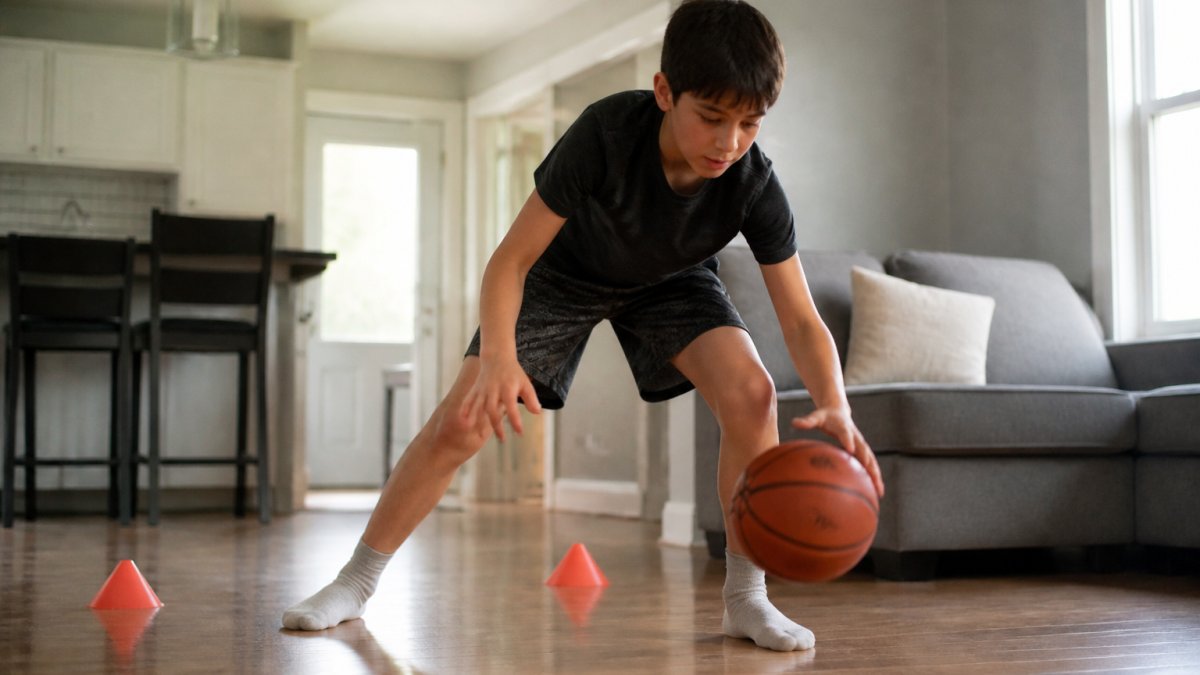
Not everyone has a full driveway. You can still practice essential basketball drills for beginners at home.
Limited Space Adaptations:
If you have only 2 meters of space:
- Skip the figure-eight dribble
- Do stationary dribbling and crossover drills instead
- Wall passing becomes even more valuable
- Focus on footwork drills (pivots, shuffles, high knees)
If you have 5 meters of space:
- Do all stationary drills
- Add the figure-eight dribble
- Add lateral shuffles
- Wall passing works great
If you have a full driveway (10+ meters):
- Do everything listed above
- Add dribbling while moving forward
- Add change-of-direction drills
Noise Considerations:
If bouncing disturbs neighbors:
- Practice during daytime hours
- Use a softer basketball (less bounce sound)
- Focus on footwork and body control drills instead
- Do wall passing with a softer touch
- Many footwork drills make almost no noise
Equipment Alternatives:
If you don't have a basketball, use a soccer ball or volleyball for dribbling patterns, do footwork drills without a ball, or practice wall passing with any ball.
Common Mistakes to Avoid When Starting Out
Beginners make predictable mistakes. Knowing these helps you avoid them.
Looking Down at the Ball: Keep your eyes forward to see defenders and teammates. Practice keeping your head up even when dribbling.
Bouncing Too High: Keep the ball at waist height, not chest height. Higher bounces give defenders time to steal.
Skipping the Weak Hand: Defenders will exploit this. Spend 40% of your practice time on your weak hand.
Rushing the Fundamentals: Master basics before cool moves. Spend two weeks on stationary dribbling before crossovers.
Practicing Without a Plan: Use a timer and track your progress. Random bouncing isn't practice.
Progression and Measurable Benchmarks for Skill Development
Week 1-2 Benchmarks:
- Can do 30 seconds of stationary dribbling without losing the ball
- Can do 10 crossover dribbles in a row
- Can make 5 wall passes without dropping the ball
Week 3-4 Benchmarks:
- Can do 60 seconds of stationary dribbling with eyes forward
- Can do 20 crossover dribbles in a row
- Can do 15 wall passes in a row
Week 5-8 Benchmarks:
- Can do 2 minutes of figure-eight dribbling with control
- Can do between-the-legs dribbles 5 times in a row
- Can do behind-the-back dribbles 5 times in a row
- Can do 30 wall passes in a row
Beyond 8 Weeks:
- Add speed to all drills
- Combine drills (dribble into a wall pass, for example)
- Practice game-speed movements
Track these benchmarks in a notebook to create accountability and show real progress.
Conclusion: Your Path Forward
Home practice is where basketball skills are built through consistent, focused repetition. Start with stationary dribbling, master it, then add crossovers and everything else.
Our programs for ages 4 to 16 emphasize skill development. The real magic happens between practices, when fundamentals become second nature.
You need a plan, a timer, and commitment. Practice 15 minutes daily for 30 days to see changes in ball handling, footwork, and confidence.
Ready to take your game to the next level? Join Tier 1 Sports and discover how our expertly tailored programs help young athletes develop essential skills in a supportive community. Whether you're just starting out or ready to compete, we have a pathway for you. Learn more about youth basketball development
Frequently Asked Questions
Can beginners practice basketball at home without a hoop?
Yes. Many essential basketball drills for beginners require no hoop at all. Dribbling, ball handling, footwork, and wall-passing drills build fundamental skills in any driveway or small space. A hoop helps with shooting practice, but it's not necessary to develop strong ball control, coordination, and body awareness. Start with these no-hoop drills and add shooting once you have access to a basket.
What basketball skills should beginners practice first?
Beginners should prioritize ball handling and footwork before anything else. Start with stationary dribbling to build hand-eye coordination and touch. Progress to moving dribbles, crossovers, and weak-hand work. Add basic passing and receiving drills using a wall. Shooting form comes later once dribbling and footwork are solid. This foundation prevents bad habits and accelerates overall skill development.
What age is best to start basketball training?
Children can start basketball as early as age 4 with age-appropriate introductory programs focused on coordination, ball familiarity, and fun. Ages 7-10 are ideal for structured skill development during the 'golden window' when motor skills develop rapidly. Competitive training typically begins around age 11. However, any age can benefit from beginner drills at home. The best time to start is when your child shows interest.