 how-to
Basketball Agility and Coordination for Children: A How-To Guide
Table of Contents
- Why Basketball Agility and Coordination Matter for Young Players
- Basketball Agility Drills for Kids: Foundation Movements
- Basketball Coordination Drills for Children: Hand-Eye and Body Control
- Youth Basketball Training by Age: Tailored Progressions
- Fun Basketball Drills for Young Players: Keeping Practice Engaging
- Safety, Supervision, and Injury Prevention in Youth Basketball Training
- A Complete Agility and Coordination Practice Session Plan
- Frequently Asked Questions
Last Updated: October 9, 2026
Why Basketball Agility and Coordination Matter for Young Players
Developing basketball agility coordination children builds the foundation for every court skill: body control, instant direction changes, and balance under pressure.
Young players with strong agility and coordination learn faster, make fewer mistakes, and stay confident when the game speeds up.
The "golden window" is ages 4 to 12, when children's brains are most responsive to movement patterns and spatial awareness.
Basketball Agility Drills for Kids: Foundation Movements
Agility drills teach young players to accelerate, decelerate, and change direction without losing control. Every defensive slide, cut, and escape starts with good footwork, so use simple patterns repeated often, quality over speed.
Lateral Shuffle and Change-of-Direction Work
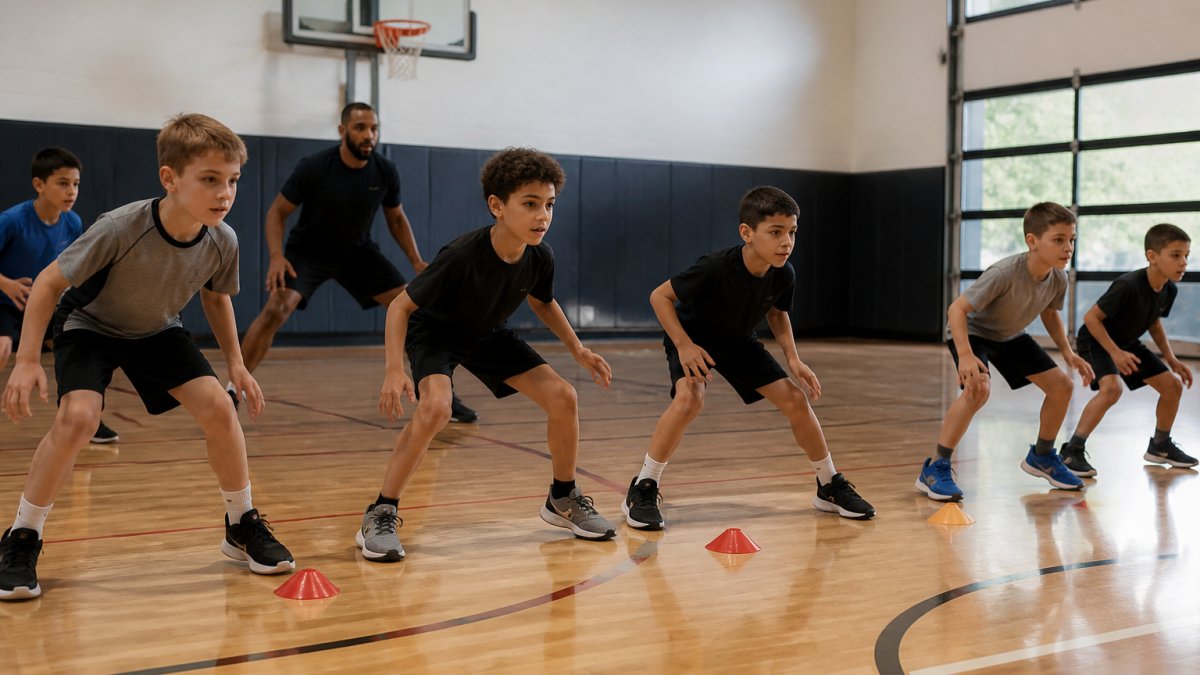
The lateral shuffle builds side-to-side speed and teaches kids to stay low and balanced, fundamental to defense.
How to perform a lateral shuffle:
- Stand with feet shoulder-width apart, knees slightly bent
- Step sideways with your lead foot, then bring your trailing foot to meet it
- Keep your chest facing forward the entire time
- Move 10-15 metres in one direction, then return
- Repeat 3-4 sets of each direction
Start slowly, focusing on balance and a square chest; speed comes with repetition.
Change-of-direction work teaches explosive stops and quick shifts, where agility becomes game-ready.
Try this simple drill:
- Mark two lines 5 metres apart
- Sprint from one line to the other, stopping hard at each line
- Plant your outside foot and push back in the opposite direction
- Complete 6-8 sprints per set, rest 30 seconds between sets
This teaches deceleration, which is often neglected. Kids who can stop quickly change direction faster than kids who can only accelerate.
Sprint and Acceleration Drills
Straight-line speed matters: fast breaks, defensive transitions, and pushing the ball up court all depend on acceleration.
Simple sprint progression:
- Start with 10-metre sprints from a standing start
- Have kids explode forward with maximum effort for the full distance
- Rest 45 seconds between sprints
- Complete 4-6 sprints per session
As kids improve, add a deceleration phase: sprint 10 metres, then slow down over the next 10, teaching body control at high speed.
Acceleration ladder drill:
- Sprint 5 metres at 75% effort
- Sprint 10 metres at 90% effort
- Sprint 15 metres at maximum effort
- Walk back to start and repeat 3 times
This teaches gradual speed-building, which is more game-realistic than starting at full speed.
Basketball Coordination Drills for Children: Hand-Eye and Body Control
Coordination connects brain to body, letting a player dribble while watching the court, pass without looking, and shoot under pressure. Young players need work with and without the ball: ball-handling builds hand-eye coordination, while movement drills build spatial awareness and body control.
Two-Ball Dribbling and Ball-Handling Progression
Two-ball dribbling forces kids to coordinate both hands independently, and players who master it develop better one-ball control and court awareness.
Two-ball dribbling progression:
Level 1 (Ages 6-8):
- Dribble two balls simultaneously, both hands at the same time
- Move forward slowly, focusing on rhythm and control
- Work for 30 seconds, rest 30 seconds, repeat 5-6 times
Level 2 (Ages 9-11):
- Alternate dribbles: right hand bounces while left hand rests, then switch
- Increase pace gradually as control improves
- Add movement: dribble in a circle, figure-8 pattern, or down the court
Level 3 (Ages 12+):
- Crossover dribble with two balls (both balls cross in front of the body simultaneously)
- High-low dribble (one ball bouncing high, one low, alternating)
- Add defensive pressure: a partner tries to knock the balls away while you maintain control
Start slow, control beats speed. A child dribbling two balls slowly with perfect technique learns more than one dribbling fast and losing the ball.
Two-ball drills are frustrating at first. Kids will drop balls. This is normal and necessary. Dropping the ball teaches the brain to adjust. Encourage persistence over perfection.
Coordination Without the Ball: Transfer to Game Skills
Many coordination skills transfer from non-ball drills to ball-handling, kids don't need the ball to improve coordination.
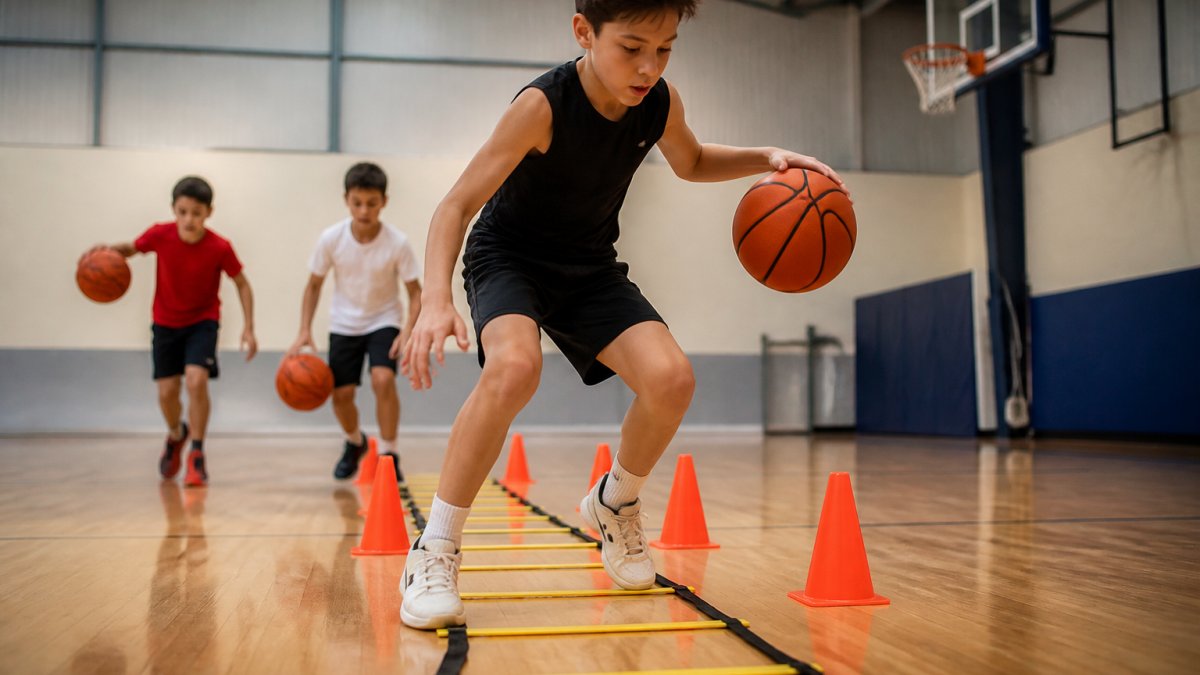
Footwork ladder drills build foot speed and coordination:
- Lay out an agility ladder (or mark one with tape)
- Run through the ladder with both feet in each square
- Progress to one foot per square
- Progress to lateral movement through the ladder
- Add upper-body movement: arms pumping, reaching, rotating
Balance and stability work:
- Single-leg stance holds (30 seconds per leg)
- Single-leg hops in place (10 hops per leg)
- Single-leg balance while catching a ball tossed by a partner
These drills improve proprioception (body awareness), helping a child stay balanced in traffic and recover quickly from off-balance movements.
Reaction and spatial awareness drills:
Have a partner call directions (left, right, forward, backward) and the child responds with a quick step or shuffle. Add a ball later: the child responds while dribbling.
Youth Basketball Training by Age: Tailored Progressions
Basketball agility and coordination develop differently at each age. A drill perfect for an 8-year-old may be too advanced or too simple for a 12-year-old, so match the drill to the child's stage.
Ages 4-6: Introduction and Basic Movement
At this age, the goal is simple: get kids comfortable moving and playing with a ball. Play and exploration matter more than formal agility training.
What to focus on:
- Running and stopping without falling
- Bouncing a ball without chasing it constantly
- Following simple directions
Sample session for ages 4-6 (20-30 minutes):
- Warm-up: Free play with the ball (5 minutes)
- Simple shuffle drill: side-to-side movement over 5 metres (3 sets of 30 seconds)
- Dribbling in a circle: walk while dribbling around a marked area (2-3 minutes)
- Relay races: short sprints with a ball, emphasizing fun over speed (5 minutes)
- Free play and games (10 minutes)
At this stage, the focus is on making basketball fun, kids who enjoy the game practice on their own time, where real development happens.
Ages 7-10: Building Footwork and Court Awareness
Now formal agility work becomes important. Kids' bodies are ready for more complex movements. Their brains can process spatial information better.
What to focus on:
- Lateral movement and change-of-direction work
- Footwork patterns (pivoting, stepping, cutting)
- Two-ball dribbling basics
Sample session for ages 7-10 (35-40 minutes):
- Warm-up: Dynamic stretching and light movement (5 minutes)
- Lateral shuffle drill: 3 sets of 15 metres each direction (5 minutes)
- Agility ladder footwork: 4-5 different patterns, 2 sets each (8 minutes)
- Two-ball dribbling: Level 1 progression (5 minutes)
- Change-of-direction sprints: 6-8 reps with 45-second rest (6 minutes)
- Game-like drill: 3v3 half-court game (8 minutes)
At this age, kids handle structure, understand instructions better, and start to see how drills connect to actual basketball.
Ages 11-16: Multidirectional Movement and Game Application
Older youth are ready for advanced agility work: higher intensity, more complex patterns, and game-speed movements.
What to focus on:
- Advanced change-of-direction work at game speed
- Multidirectional movement (forward, backward, lateral, diagonal)
- Complex ball-handling under pressure
Sample session for ages 11-16 (50-60 minutes):
- Warm-up: Dynamic stretching and activation (8 minutes)
- Sprint and acceleration ladder: 3 sets (6 minutes)
- Advanced agility ladder patterns: 5 different drills, 2 sets each (10 minutes)
- Two-ball dribbling: Levels 2-3 progression (8 minutes)
- 5-on-5 game with focus on agility in game situations (20 minutes)
- Cool-down and stretching (5 minutes)
At this stage, agility becomes integrated with game play. Drills are less isolated and more connected to actual basketball situations. Competitive players use this progression to prepare for rep tryouts and competitive leagues.
Fun Basketball Drills for Young Players: Keeping Practice Engaging
The biggest mistake in youth basketball is boring kids with repetitive drills, if practice isn't fun, kids stop showing up. Mix structured agility work with games and challenges so kids improve while having fun.
Game-Like Drills and Competitive Challenges
Agility relay races:
Divide kids into teams. Each child completes a lateral shuffle, then tags the next teammate.
Cone weaving races:
Set up cones in a straight line, 2 metres apart.
Follow-the-leader drills:
One child leads a group through random movements (sprints, shuffles, jumps, direction changes). Other kids follow exactly.
This teaches kids to react quickly and maintain control while watching another player.
One-on-one agility challenges:
Two kids face each other across a line.
Warm-Up and Conditioning That Feel Like Play
Kids hate traditional warm-ups. They love games that happen to warm them up.
Agility tag:
One child is "it." Others move around a marked area; when tagged, that child becomes "it." Add rules: everyone must move laterally only, or stay on one foot.
Dribbling tag:
Same game, but all kids dribble while moving. The child who is "it" tries to knock the ball away or tag the dribbler.
Follow-the-path:
Mark a path around the gym with cones or tape.
Safety, Supervision, and Injury Prevention in Youth Basketball Training
Agility training is intense. Kids are moving fast, changing direction quickly, and pushing their bodies hard.
Key safety principles:
Progression matters. Build from simple to complex movements.
Rest is part of training. Kids need adequate rest between sets and sessions.
Proper footwear is essential. Basketball shoes with good ankle support and grip reduce injury risk.
Hydration and nutrition matter. Kids training hard need water and proper fuel.
Teach proper technique first. Speed comes later.
A Complete Agility and Coordination Practice Session Plan
A well-designed practice combines warm-up, structured drills, game-like work, and cool-down. Here's a template to adapt for your child's age.
Sample 45-Minute Practice Structure
Warm-up (5 minutes):
- Free dribbling and movement around the court
- Light jogging and dynamic stretching
Agility Foundation Work (12 minutes):
- Lateral shuffle: 3 sets of 15 metres (5 minutes)
- Agility ladder footwork: 2 different patterns, 2 sets each (4 minutes)
- Rest and hydration (3 minutes)
Coordination and Ball-Handling (12 minutes):
- Two-ball dribbling progression appropriate to age (6 minutes)
- Dribbling in agility ladder or cone weaving (4 minutes)
- Rest (2 minutes)
Game-Like Application (12 minutes):
- 3v3 or 4v4 half-court game with focus on agility in game situations
- Emphasize movement and footwork over scoring
Cool-Down (4 minutes):
- Light walking and stretching
- Water and recovery
This structure balances skill work with game application. Kids improve their agility and coordination while playing basketball.
Progress Tracking and Measurable Outcomes
Progress tracking keeps kids motivated and shows real improvement.
What to track:
- Lateral shuffle speed: Time how long it takes to shuffle 15 metres. Track weekly or monthly.
- Change-of-direction accuracy: Count successful direction changes without losing balance. Aim for improvement each session.
- Two-ball dribbling control: Count how many consecutive dribbles without dropping a ball. Track progress over weeks.
Keep a simple log: date, drill, result.
| Drill | Week 1 | Week 4 | Week 8 | Progress |
|---|---|---|---|---|
| Lateral Shuffle (15m) | 8.2 seconds | 7.5 seconds | 6.8 seconds | Faster |
| Two-Ball Dribbles | 12 reps | 18 reps | 25 reps | Better control |
| Change-of-Direction | 4 of 6 successful | 5 of 6 successful | 6 of 6 successful | More consistent |
Real progress, tracked and visible, keeps kids engaged. They see themselves improving. They want to keep training.
Developing basketball agility and coordination for children takes time, consistency, and the right approach.
Whether your child is just starting out or preparing for competitive basketball, we have a program for their stage.
**Join Tier 1 Sports today and help your child discover their full potential on the court.
Frequently Asked Questions
At what age can children start basketball agility training?
Children as young as 4 can begin basic movement and coordination work through play-based activities. Ages 4-6 benefit most from fun, game-like drills that develop balance and spatial awareness without formal structure. From age 7 onward, more structured agility drills, like lateral shuffles and change-of-direction work, become appropriate as coordination improves. Always prioritize age-appropriate progressions and ensure movements match the child's developmental stage.
How often should children practice basketball agility and coordination drills?
Young players aged 4-10 benefit from 2-3 focused practice sessions per week, each 30-45 minutes long, with rest days to prevent overuse. Children aged 11-16 can handle 3-4 sessions weekly if pursuing competitive play. Consistency matters more than intensity at younger ages. Include warm-up drills, skill work, and game-like practice in each session. Always monitor for fatigue and adjust frequency based on the child's enthusiasm and recovery.
What makes basketball agility and coordination drills fun for young children?
The best drills feel like games, not exercises. Use competitive challenges (timed races, relay competitions), varied equipment (cones, agility ladders, multiple basketballs), and frequent changes to keep attention high. Celebrate effort and improvement rather than only results. Include partner drills and team-based activities to build community and social connection. Short drill cycles (2-3 minutes per drill) prevent boredom and allow children to experience success multiple times in one session.
How can I track my child's progress in basketball agility and coordination?
Track measurable outcomes: time to complete cone drills, number of consecutive dribbles without losing the ball, successful passes in a set time, and lateral movement speed. Use simple video recordings to compare footwork and body control over weeks. Document improvements in court awareness, does your child anticipate movement better? Can they transition smoothly between offense and defense? Progress in coordination without the ball (balance, pivoting, reaction time) often precedes visible ball-handling gains and signals readiness for the next skill level.