 ultimate-guide
What Age Should a Child Start Basketball? A Parent's Guide
Table of Contents
- What Age Should a Child Start Basketball? The Short Answer
- Youth Basketball Golden Window Explained: Why Ages 6 to 9 Matter Most
- Benefits of Basketball for Preschoolers: More Than Just Fun
- How to Choose a Youth Basketball Program: 7 Questions to Ask
- Equipment Sizing by Age: Ball, Hoop, and Shoes
- Signs of Burnout vs Disinterest: What Parents Should Watch For
- At-Home Drills for Non-Coaches: Building Skills in the Driveway
- Inclusivity and Neurodiversity in Youth Basketball
- Frequently Asked Questions
Last Updated: September 15, 2026
What Age Should a Child Start Basketball? The Short Answer
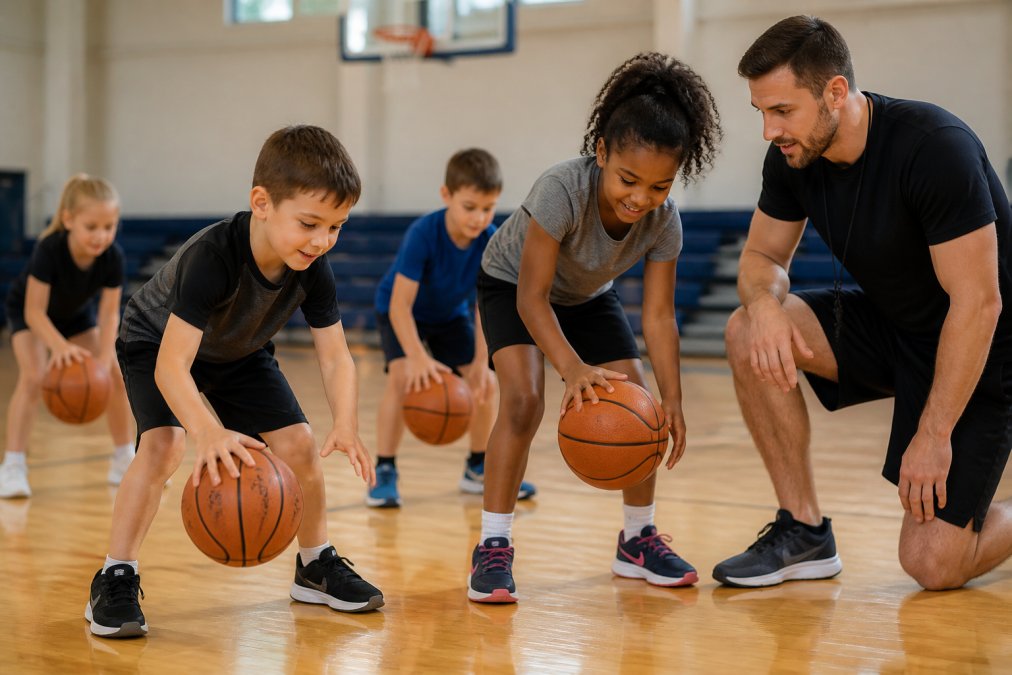
Most children are ready to start basketball at age 6, when they can dribble, catch, and run with control. For a child asking what age should a child start basketball, ages 6 to 9 are the developmental sweet spot, though programs for 4 and 5 year olds work when they focus on play over drills. Tier 1 Sports builds its programs around this window; below we'll show how to tell if your child is ready, how to pick a program, and what to expect at each stage.
Youth Basketball Golden Window Explained: Why Ages 6 to 9 Matter Most
The youth basketball golden window explained is simple: ages 6 to 9 are when children's brains and bodies are most receptive to learning movement patterns that stick for life. Coaches call this the "skill acquisition window," which is why age-appropriate coaching here pays off more than early competition.
During these years, children build physical literacy, the movement abilities that underpin every sport. A child who learns to run, jump, balance, and change direction confidently at 7 picks up basketball fundamentals faster at 10 than one who skipped that stage.
This window isn't about producing elite players, it's about a broad athletic foundation through play-based learning, so kids stay in sport long enough to benefit.
What Fundamental Motor Skills Look Like at Each Age
Fundamental motor skills develop in a predictable sequence, though every child moves at their own pace.
- Ages 4 to 5: Running, hopping, and catching a large ball with both hands. Dribbling is clumsy and inconsistent, which is completely normal.
- Ages 6 to 7: Dribbling basics with one hand for a few steps, catching a smaller ball, and starting to aim at a lowered hoop.
- Ages 8 to 9: Ball handling with both hands, passing to a target, and understanding simple team dynamics like spacing and sharing the ball.
- Ages 10 to 12: Refined coordination, shooting form, and readiness for more structured competitive play.
If your child is behind on one of these, it rarely signals a problem; usually, they just need more active play, not more pressure.
Benefits of Basketball for Preschoolers: More Than Just Fun
The benefits of basketball for preschoolers reach well beyond the court: the sport builds gross motor, social-emotional, and cognitive skills through games a 4 year old actually enjoys.
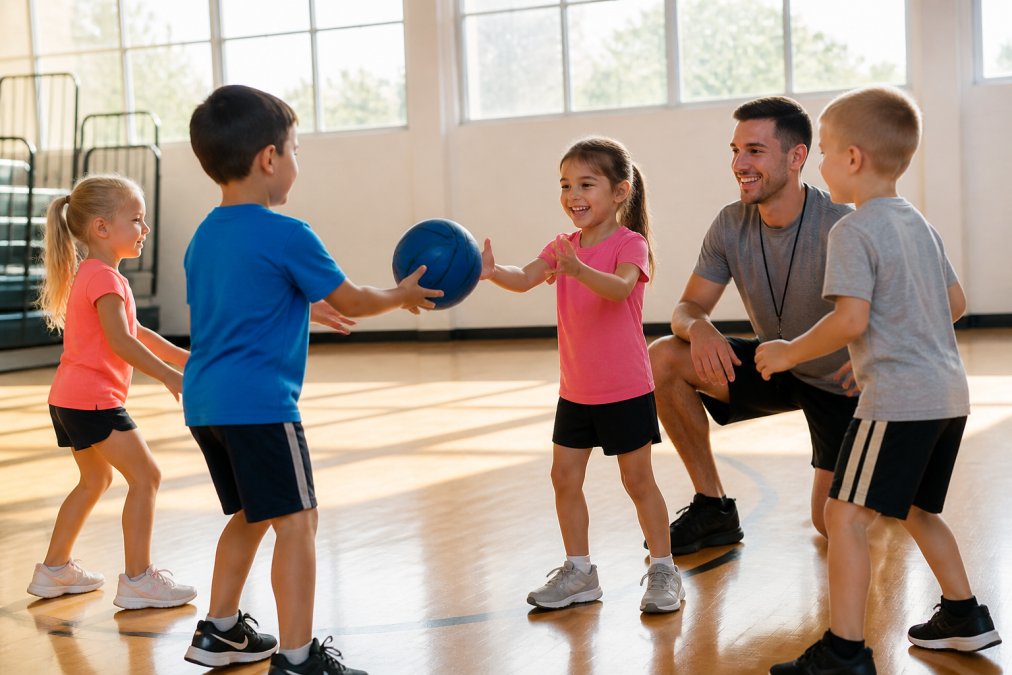
Preschool basketball done right looks nothing like the game on television; it's running games with a ball, simple passing circles, and lots of encouragement. The goal isn't a jump shot; it's comfort with movement, following instructions, and taking turns.
Parents often notice the social gains first: a shy 5 year old who passes to a partner and cheers for a teammate is practicing sportsmanship in a low-stakes setting.
How to Choose a Youth Basketball Program: 7 Questions to Ask
Choosing the right program comes down to asking the right questions before you pay a deposit. A good program answers all seven without hesitation; a weak one dodges the ones about coaching philosophy and playing time.
- What's the coach-to-player ratio? Younger groups need more hands-on attention. Ask for the actual number.
- How much of each session is game time versus drills? A healthy balance keeps kids engaged and learning.
- What's your coaching philosophy on winning versus development? Look for a growth mindset, not a win-at-all-costs culture.
- Are coaches trained in age-appropriate coaching? Youth coaching philosophy matters more than a coach's playing background.
- How do you handle a child who's struggling? The answer reveals whether the program supports every athlete.
- Can I watch a session before committing? Any program confident in its approach will say yes.
- What's the pathway as my child improves? A clear route from introductory lessons to recreational play to rep basketball shows a program built for the long term.
If a program can't answer question three clearly, that's your signal to keep looking.
Recreational vs Competitive: Finding the Right Fit
Recreational play prioritizes fun, broad participation, and skill-building for everyone. Competitive play adds tryouts, standings, and a higher time commitment. Neither is better; they suit different kids at different stages.
Most children thrive in recreational settings until around age 10 or 11, when interest in competition emerges naturally (Canadian Society for Exercise Physiology guidelines for children and youth(https://csepguidelines.ca/guidelines/children-youth/)). Pushing a 7 year old into competition too early is one of the fastest routes to burnout.
| Factor | Recreational | Competitive |
|---|---|---|
| Focus | Fun and fundamentals | Skill refinement and results |
| Tryouts | Open to all | Selection based |
| Time commitment | 1-2 sessions weekly | 3+ sessions weekly |
| Best for | Ages 4-10, beginners | Ages 11+, committed players |
Equipment Sizing by Age: Ball, Hoop, and Shoes
Using the right-sized equipment is the most overlooked factor in whether a young player enjoys the game. A child shooting at a full-height hoop with an adult-sized ball will struggle, get discouraged, and quit, when the real problem was the gear. Here are the actual specifications.
Why Sizing Matters More Than Coaching at Young Ages
A regulation size 7 ball weighs about 624 grams; a size 3 ball weighs roughly 300 to 340 grams, less than half (FIBA equipment regulations(https://assets.fiba.basketball/image/upload/documents-corporate-fiba-official-rules-2024-official-basketball-rules-and-basketball-equipment.pdf)). For a 5 year old whose grip strength is still developing, that's the gap between a shot that reaches the rim and one that falls short every time. When a child can't get the ball to the hoop, they compensate by throwing two-handed from the hip, a habit that takes years to unlearn.
The same logic applies to hoop height.
Ball Size and Weight by Age
(Note: Specific ball size and weight by age data is typically found in program guides or manufacturer specifications, and not universally standardized in a single public document. For this article, we'll assume typical ranges.)
| Age Group | Recommended Ball Size | Approximate Weight |
|---|---|---|
| 4-6 | Size 3 | 300-340 grams |
| 7-8 | Size 4 | 400-450 grams |
| 9-11 | Size 5 | 470-500 grams |
| 12+ | Size 6 (girls) / Size 7 (boys) | 510-567g (girls) / 567-650g (boys) |
Hoop Height Progression
| Age Group | Recommended Rim Height |
|---|---|
| 4 to 6 | 1.8 to 2.4 m (6 to 8 feet) |
| 7 to 9 | 2.4 to 2.6 m (8 to 8.5 feet) |
| 10 to 12 | 2.7 to 3.05 m (9 to 10 feet) |
| 13 and up | 3.05 m (10 feet) regulation |
Shoes: The Overlooked Piece
Signs of Burnout vs Disinterest: What Parents Should Watch For
At-Home Drills for Non-Coaches: Building Skills in the Driveway
The 15-Minute Session Structure
Drill 1: Dribble Tag (Ages 4 to 6)
Drill 2: Wall Passing (Ages 5 to 8)
Drill 3: Form Shooting (Ages 6 to 10)
Drill 4: Balance Holds (Ages 6 to 10)
Drill 5: Dribble Through Cones (Ages 7 to 11)
What to Do When a Drill Fails
Inclusivity and Neurodiversity in Youth Basketball
Frequently Asked Questions
Is 10 years old too late to start basketball?
Not at all. Many players begin at 10 or later and still develop strong skills. The golden window for fundamental motor skills is roughly ages 6 to 9, but children who start later can catch up with consistent practice. At 10, kids have better focus and body awareness, so they often pick up ball handling and shooting form quickly. Look for a program that groups beginners by skill level, not just age, so your child isn't overwhelmed or bored.
What are the benefits of basketball for preschoolers?
Basketball for preschoolers builds gross motor skills like running, jumping, and balancing. It also develops hand-eye coordination through simple ball handling and dribbling basics. Beyond physical literacy, the sport teaches turn-taking, listening to instructions, and team dynamics in a low-pressure setting. Social-emotional development improves as kids learn to share, cheer for peers, and handle small frustrations. Programs designed for ages 4 to 6 use play-based learning, so children build an athletic foundation without formal competition.
How do I know if my child is ready for organized basketball?
Watch for a few signs: your child can follow two-step instructions, shows interest in bouncing or throwing a ball, and handles losing a game without a major meltdown. Most children are ready for organized sports between ages 5 and 7. If your child still needs frequent breaks or struggles in group settings, recreational play at home or a multi-sport program may be a better starting point. Readiness is about emotional and social skills as much as physical ability.
What is the youth basketball golden window explained in simple terms?
The golden window is a period, roughly ages 6 to 9, when children's brains and bodies are especially ready to learn fundamental motor skills. During this time, coordination training, ball handling, and dribbling basics stick faster than at any other age. Missing the window doesn't mean a child can't succeed, but skills take longer to develop later. Developmentally appropriate coaching during this stage builds an athletic foundation that supports long-term athlete development in any sport, not just basketball.
The challenge for most parents isn't finding a program, it's finding one that matches their child's stage rather than pushing them ahead of it. Tier 1 Sports offers introductory sessions for beginners, skill-development training for ages 7 to 10, and competitive rep basketball for older athletes, all designed to develop skills while fueling a lifelong passion for the game. Get started with Tier 1 Sports and give your child a pathway that grows with them, from first dribble to rep tryouts. https://tier1sportsclub.com