 ultimate-guide
Youth Basketball Development Pathway Guide for Parents
Table of Contents
- Why a Structured Basketball Development Pathway Matters
- The LTAD Basketball Model: A Framework for Every Age
- Youth Basketball Skill Progression by Age Group
- House League vs. Rep: Choosing the Right Path
- Rep Basketball Tryout Preparation: A 6-Week Plan
- The Real Cost of Competitive Basketball: Budgeting and Fees
- Preventing Burnout and Protecting Your Child's Love of the Game
- Conclusion: Building a Lifelong Foundation
- Frequently Asked Questions
Last Updated: September 8, 2026
Why a Structured Basketball Development Pathway Matters
A youth basketball development pathway guide is only as useful as the plan behind it. Without structure, young players drift between drills and seasons without building the skills they need at the right time. The gap between recreational play and competitive success is rarely about talent; it is almost always about timing, repetition, and the right coaching at the right age.
The parents who feel confident are not the ones with the most athletic kids. They are the ones who understand what to expect at each stage and who have a clear plan for what comes next. This guide exists to give you that clarity.
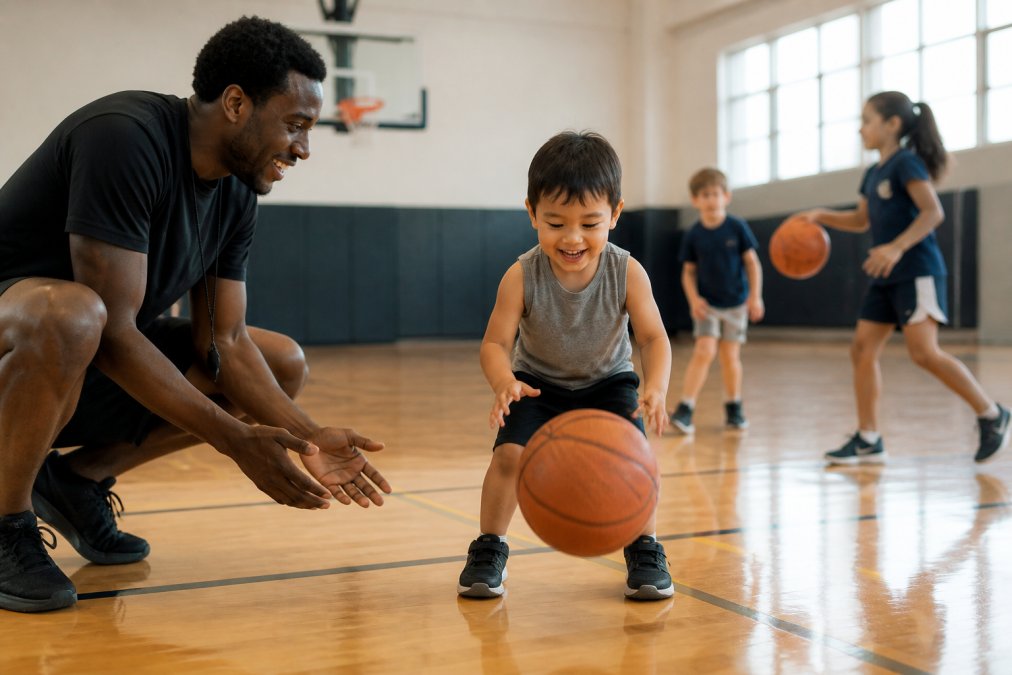
The most effective approach to long-term athlete development respects the biology of growth. Pushing a six-year-old to train like a twelve-year-old does not accelerate progress; it risks burn out and injury. A structured basketball development pathway aligns training with windows of readiness.
The LTAD Basketball Model: A Framework for Every Age
The LTAD basketball model, or Long-Term Athlete Development framework, is a common framework in youth sports planning. It was created to address a simple problem: too many young athletes were being trained like miniature adults. The model breaks development into stages that respect physical and cognitive growth, ensuring that training load matches the athlete's capacity, not their parents' ambition.
This framework is not a rigid rulebook. It is a guide for making decisions about what to emphasize, when to push, and when to hold back. For parents, understanding this model is the single best way to evaluate whether a program is actually developing your child or simply keeping them busy.
Ages 4-6: Fundamental Movement Skills and Fun
At this stage, the goal is not basketball. The goal is athletic literacy. Children aged four to six are developing fundamental movement patterns: running, jumping, balancing, and coordination. Basketball is simply the vehicle for teaching these skills.
A common mistake is enrolling a five-year-old in a program that emphasizes technical proficiency like proper shooting form or defensive slides. That is counterproductive. What a five-year-old needs is a program that keeps them moving, makes them love the gym, and builds the motor skill development that every future basketball skill will depend on. If a session ends with a child smiling and slightly tired, it was a success.
Ages 7-10: The Golden Window for Skill Acquisition
The years between seven and ten are often called the golden window for skill acquisition. During this period, the brain's plasticity is at its peak for learning new movement patterns. This is when fundamental basketball skills like dribbling, passing, and shooting should be introduced with proper technique and high repetition.
For a seven-year-old, this means the practice-to-game ratio should heavily favor skill work. It is the time to develop both hands, to learn footwork without the ball, and to build the coordination that makes sport-specific training effective later. Programs that focus on this age group should prioritize individual development over winning games.
Ages 11-16: Consolidation and the Competitive Stream
As players enter adolescence, the focus shifts from learning new skills to refining them under pressure. The competitive stream becomes a realistic option for players who have built a solid foundation. This is the stage where tactical awareness, physical conditioning, and the mental side of the game become as important as technical proficiency.
Players at this age are ready to understand their role within a team structure. The coaching curriculum should introduce more complex offensive and defensive concepts, and the training load increases accordingly. For parents, this is also the stage where the decision about house league versus rep becomes critical, and where the costs and time commitments grow significantly.
Youth Basketball Skill Progression by Age Group
A clear youth basketball skill progression chart helps parents track whether their child is on pace. While every child develops differently, there are general developmental milestones that indicate healthy progress.
| Age Group | Primary Focus | Key Skills to Master | Practice-to-Game Ratio |
|---|---|---|---|
| 4-6 | Movement & Fun | Running, jumping, catching, basic ball handling | 90% play / 10% drills |
| 7-10 | Skill Acquisition | Dribbling with both hands, proper layup footwork, passing | 70% skill / 30% games |
| 11-13 | Consolidation | Defensive stance, shooting mechanics, court awareness | 50% skill / 50% games |
| 14-16 | High Performance | Position-specific skills, tactical reads, physical conditioning | 40% skill / 60% games |
Progression is not linear. A player may excel at shooting at age nine but struggle with the physicality of the game at twelve. This is normal. The goal of a structured basketball development pathway is not to produce a perfect player at every checkpoint, but to ensure that no fundamental skill is left behind.
House League vs. Rep: Choosing the Right Path
The decision between house league and rep basketball can be a significant choice for sports parents. The gap between the two is not just about skill level; it is a chasm of cost, time, and coaching philosophy. Understanding the real trade-offs is the only way to make a choice that fits your family and your child's motivation, not your ambition.
The Real Differences Beyond the Tryout
House league typically runs one to two sessions per week, with games on weekends and a single practice. The season lasts roughly 12 to 16 weeks. Rep basketball often involves 2 to 3 practices per week, games every weekend, and a season that stretches 6 to 8 months, including tournaments. Fees and associated costs can be significant.
The Multi-Sport vs. Specialization Question
The evidence across youth sports governance consistently points to the benefits of multi-sport participation during the developmental years. Early specialization before age twelve increases the risk of overuse injuries and burnout, and it rarely produces better long-term outcomes (peer-reviewed research). A player who develops a broad athletic base in various sports can bring better footwork, body control, and resilience to the basketball court.
Here is the practical tension: rep basketball tryouts often happen in the spring, and the season runs through the summer and fall. If your child is also committed to a spring or summer sport, you will face a scheduling conflict. A common pattern is that families who force a choice too early end up with a child who quits both sports by age fourteen. The better approach is to look for a rep program that explicitly supports multi-sport athletes, or to delay the move to rep until your child is in grade seven or eight.
The 'Middle Path' That Most Clubs Do Not Offer
For a nine-year-old who wants to get serious but is not ready for rep tryouts, the options are often binary: stay in house league or jump to a rep team. A few organizations now offer a 'development league' or 'select' tier that sits between house and rep, typically with one extra practice per week, a higher skill focus, and a lower time commitment than full rep. If your club does not offer this, ask the coaching staff if they can recommend a neighboring club that does. The cost of this middle tier can be more than house league, but it is typically less than the rep budget.
A Decision Framework for Parents
Before you register for tryouts, ask yourself three questions. First, does your child talk about basketball when they are not playing it? Second, can they handle a loss without a meltdown? Third, are you prepared to spend 8 to 10 hours a week on travel and practices for the next 8 months? If the answer to any of these is 'no,' the rep stream is likely a year or two away. That is not a failure; it is a developmentally sound decision. The players who thrive in the competitive stream are the ones who chose it for themselves, not the ones who were pushed into it.
Rep Basketball Tryout Preparation: A 6-Week Plan
If your child is aiming for the competitive stream, preparation should begin weeks before tryouts, not days. A structured rep basketball tryout preparation plan builds confidence and ensures your child can showcase their skills under pressure. But before you start the plan, you need to know what you are preparing for and whether the program is worth the effort.
How to Vet a Rep Program Before Tryouts
A quality rep program will often publish its coaching philosophy, its practice-to-game ratio, and the certification level of its coaches. Before you pay the tryout fee, consider asking the club director these three questions:
- What is the coach's NCCP certification level? The National Coaching Certification Program (NCCP) has specific training for community and competition stream coaches. A rep coach should hold at least a 'Competition Introduction' certification. If the coach cannot name their certification level, that is a red flag.
- What is the practice-to-game ratio? A development-focused rep team often aims for a practice-to-game ratio that prioritizes skill development. If the schedule is heavy on games and light on practices, it may indicate a different program focus.
- What is the philosophy on playing time during the season? Some rep teams bench players who make mistakes in games. Others use games as a learning environment. Ask directly how the coach handles a player who is struggling. The answer will tell you more about the program than any brochure.
What Coaches Actually Evaluate at Tryouts
Coaches often look for players who are coachable, who play hard on defense, and who make their teammates better. A player who hustles and communicates can often stand out. The evaluation typically breaks down into four buckets:
- Skill execution: Can the player dribble with both hands under pressure? Can they finish a layup with either hand? Do they have a repeatable shooting form?
- Game awareness: Do they understand spacing? Do they cut without the ball? Do they make the extra pass?
- Physical effort: Do they sprint in transition? Do they box out on every possession? Do they dive for loose balls?
- Coachability: Do they make eye contact when instructions are given? Do they adjust after a correction? Do they encourage teammates?
The 6-Week Plan
Week 1-2: Fundamentals Refresh Focus on the basics. Ball handling drills with both hands, proper shooting form, and footwork. Your child should be able to execute these skills without thinking. Repetition builds the automaticity that holds up under pressure.
Week 3-4: Game Conditioning Tryouts are physically demanding. Introduce conditioning work that mimics the pace of a game: sprints, defensive slides, and jump stops. A tired player makes poor decisions. The goal is not to be the fastest player on the court; it is to be the player who is still making smart plays in the fourth quarter of a tryout scrimmage.
Week 5: Tactical Awareness Review common offensive and defensive sets. Coaches look for players who understand spacing and can communicate on the court. At the rep level, the game is faster, and players who hesitate are a liability. Practice calling out screens, switching on defense, and filling the correct lanes in transition.
Week 6: Scrimmage and Polish Play as many pickup games as possible. The goal is to get comfortable competing against unfamiliar players and to practice playing with a high motor. In the last few days before tryouts, cut the volume of training and prioritize rest. A well-rested player will outperform an overtrained one.
The Post-Tryout Conversation
If your child does not make the team, do not treat it as a failure. Ask the coach for specific feedback on what to work on. A quality program will provide written or verbal feedback. If they do not, that is information about the program's culture. Use the off-season to address the gaps and try again the following year. Many rep players did not make their team on the first attempt.
The Real Cost of Competitive Basketball: Budgeting and Fees
Financial planning for competitive basketball is rarely discussed but essential. Rep basketball fees vary widely by club and age group, and they cover only a portion of the true cost. Parents should budget for registration, travel, hotels, tournaments, and equipment. The total annual cost can be significant, and it often increases as the player moves up through the age groups.
Before committing, ask the club for a full breakdown of fees. Ask what is included and what is not. A transparent program will be happy to share this information. Also inquire about the coaching certification of the staff, as qualified coaches are often the greatest predictor of a positive experience. For a detailed look at what quality coaching entails, the National Coaching Certification Program standards outline the required training for coaches at each level.
Preventing Burnout and Protecting Your Child's Love of the Game
Burnout is the silent killer of youth sports careers. It does not happen overnight; it builds slowly through over-scheduling, excessive pressure, and a loss of fun. Protecting your child's love of the game is not just about preventing tears; it is about ensuring the long-term sustainability of their athletic journey.
Watch for warning signs. If your child stops talking about practice with excitement, if games feel like a chore, or if they are constantly tired, it is time to reassess. The research on early specialization is clear: children who play multiple sports and who take breaks during the year are less likely to burn out. According to Sport for Life's Long-Term Development resources, a balanced approach to training and competition is critical for keeping young athletes engaged over the long term.
A structured basketball development pathway should include time off. It should also include space for your child to simply play, without an adult dictating every drill. The players who last are the ones who genuinely enjoy the game.
Conclusion: Building a Lifelong Foundation
The goal of a basketball development pathway is not to produce a professional athlete. It is to build a foundation for a lifelong relationship with sport and physical activity. Whether your child plays at the highest level of the competitive stream or enjoys house league for years, the skills they learn, the discipline they develop, and the joy they find in the game are the real rewards.
At Tier 1 Sports in Halton Hills, we build our programs around the principles in this guide. From introductory sessions for ages 4-6 that focus on fundamental movement skills to rep basketball preparation for the competitive stream, every program is designed to meet your child where they are and help them take the next step. Our coaching philosophy prioritizes skill development within a supportive, community-based environment where mistakes are part of the process.
If you are ready to find the right pathway for your child, we invite you to explore our age-specific programs and see the difference that structured, passionate coaching makes. Get started with Tier 1 Sports and give your child the foundation they need to succeed, on and off the court.
Frequently Asked Questions
What are the stages of youth basketball development?
Most structured programs in Canada follow the Long-Term Athlete Development (LTAD) model. The key stages for basketball are: FUNdamentals (girls 6-8, boys 6-9) focusing on movement and basic skills; Learn to Train (girls 8-11, boys 9-12) emphasizing skill acquisition; Train to Train (girls 11-15, boys 12-16) building physical conditioning and tactical awareness; and Train to Compete (girls 15+, boys 16+). A good basketball development pathway aligns with these windows to maximize a player's potential.
At what age should a child start competitive basketball?
Rep basketball tryouts typically begin around age 9 or 10, but the right time depends on the child. Early specialization before age 12 is linked to higher burnout rates. A better approach is to build a strong skill foundation in house league or skill-development programs first. A structured basketball development pathway keeps players engaged through age-appropriate challenges, ensuring they enter the competitive stream with confidence and a love for the game.
How does the LTAD basketball model apply to training?
The LTAD basketball model guides what and how you train at different ages. For a 7-year-old, it means prioritizing fundamental movement patterns like running, jumping, and throwing over rigid drills. For a 13-year-old, the focus shifts to sport-specific training and tactical awareness. This long-term athlete development framework prevents burnout and injury by avoiding pushing young athletes too hard, too early. It's a blueprint for sustainable growth, not just short-term wins.
What is the difference between house league and rep basketball?
House league is recreational. The focus is on participation, fun, and learning the game's basics in a low-pressure environment. The practice-to-game ratio is typically lower, and everyone plays equal time. Rep basketball is the competitive stream. It demands a higher training load, travel, and financial commitment. Rep tryouts are required, and the focus shifts to technical proficiency, tactical awareness, and player progression. Choosing the right path depends on your child's goals and readiness.
How can parents support their child's basketball development at home?
Keep it simple and fun. For younger kids, focus on unstructured play: bouncing a ball in the driveway or playing tag. For ages 7-10, 15 minutes of daily skill work, like dribbling with both hands or shooting at a lowered hoop, is effective. Ask your coach for a specific individual development plan. Avoid drills that feel like punishment. Your role is to be their biggest fan, not their second coach. Praise effort and improvement, not just made shots.
What skills should a 10-year-old basketball player focus on?
At age 10, the priority is skill acquisition. Focus on ball-handling with both hands, proper footwork for pivoting, and the basics of a jump shot. It's also the time to build athletic literacy through other sports. This multi-sport approach reduces injury risk and develops coordination that transfers to basketball. Avoid early specialization. A solid foundation in these fundamental movement patterns is far more valuable than winning a league title at this age.
How do I know if a basketball program is high quality?
Look beyond the marketing. Ask about the coaching philosophy: is it about winning or player progression? Check if the curriculum follows a recognized basketball development pathway like LTAD. Ask about the practice-to-game ratio and the coach-to-player ratio. A program may have a clear plan for your child's age group and be transparent about costs. Watching a practice can help you see if kids are engaged and if coaches provide positive, corrective feedback. A supportive environment is key to long-term retention.