 how-to
Youth Basketball Skill Development Drills: A Step-by-Step Guide
Table of Contents
- Why Youth Basketball Skill Development Drills Matter
- Essential Basketball Practice Plan for Youth
- Fundamental Ball Handling and Dribbling Drills
- Youth Basketball Shooting Mechanics and Form
- Defensive Footwork and Stance Training
- Best Basketball Training for Intermediate Players
- Transitioning from Recreational to Competitive Play
- [Building Basketball IQ and Court Vision](#building-basketball-iq and-court-vision)
- Conditioning, Warm-Up, and Injury Prevention
- Drills for Limited Space and Home Practice
Last Updated: August 17, 2026
Why Youth Basketball Skill Development Drills Matter
Youth basketball skill development drills form the foundation of every young player's athletic journey. Without structured practice, even naturally talented athletes plateau quickly. The players who advance fastest aren't always the most gifted, they're the ones whose coaches and parents prioritize skill-building drills.
These drills teach hand-eye coordination, footwork, and basketball IQ in ways that scrimmages alone cannot. They build fundamental competencies like ball handling, shooting mechanics, and defensive stance that carry through every level of play. The window for motor skill development is critical: children aged 7-10 are in the "golden window," when their nervous systems are particularly responsive to skill training.
Essential Basketball Practice Plan for Youth
A well-designed basketball practice plan balances skill work, game-like situations, conditioning, and enjoyment. Too many programs lean heavily into drills and neglect game time; others skip drills entirely and wonder why their players can't execute under pressure.
Setting Up Your Practice Structure
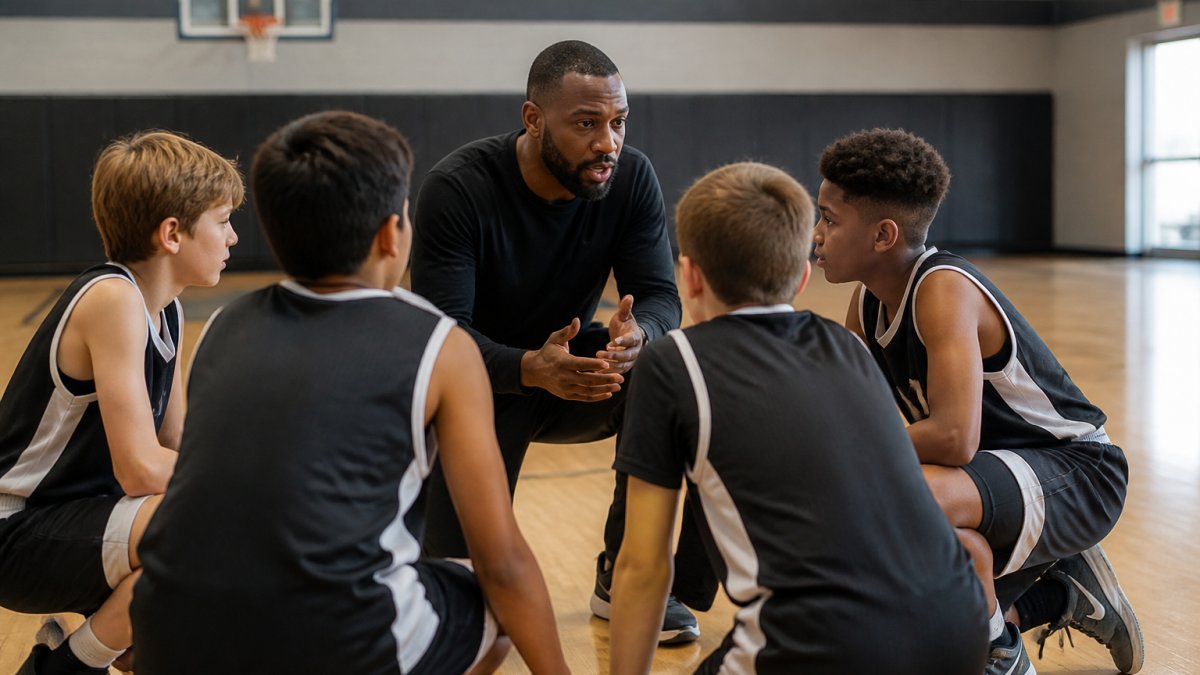
A 60-minute practice should follow this rhythm: warm-up and mobility work (10 minutes), fundamental drills (20-25 minutes), game-speed drills (15-20 minutes), small-sided games (10-15 minutes), and cool-down.
Start every practice with dynamic warm-up: light jogging, arm circles, leg swings, and lateral slides. Young players who warm up properly absorb skill instruction better and execute with better form.
The next 20-25 minutes should focus on fundamental drills: ball handling progressions, shooting mechanics, or defensive footwork. Follow with 15-20 minutes of game-speed drills: layup finishes, pick-and-roll execution, or transition offense and defense. Finish with 10-15 minutes of small-sided games: 3-on-3 or 4-on-4. Games keep passion alive while reinforcing drilled skills.
Balancing Drills and Game Time
A balanced approach dedicates roughly 40% of practice time to structured drills and 60% to game-like situations and actual games. This ratio keeps young players engaged while ensuring skills develop.
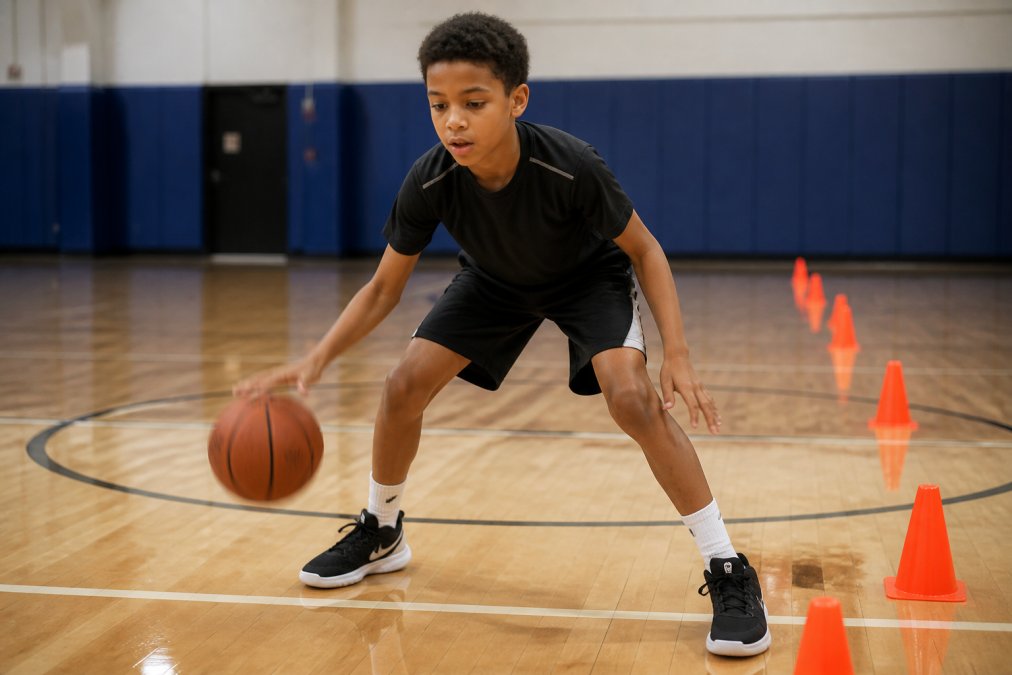
Fundamental Ball Handling and Dribbling Drills
Ball handling is the gateway skill in basketball. Every young player, regardless of age or position, needs consistent dribbling work.
Beginner Dribbling Progression
Start with stationary dribbling before adding movement. Young players aged 5-7 should begin with the most basic progression.
Drill 1: Stationary Dribble with Both Hands Have players stand with feet shoulder-width apart and dribble in place using only their right hand for 30 seconds, then switch to their left. Eyes should stay up, not on the ball. Repeat for 3-4 sets per hand.
Drill 2: Figure-8 Dribble Players dribble around their legs in a figure-8 pattern, moving the ball side to side without looking down. This develops hand-eye coordination and teaches players to feel the ball rather than watch it. Do 2-3 minutes of continuous work.
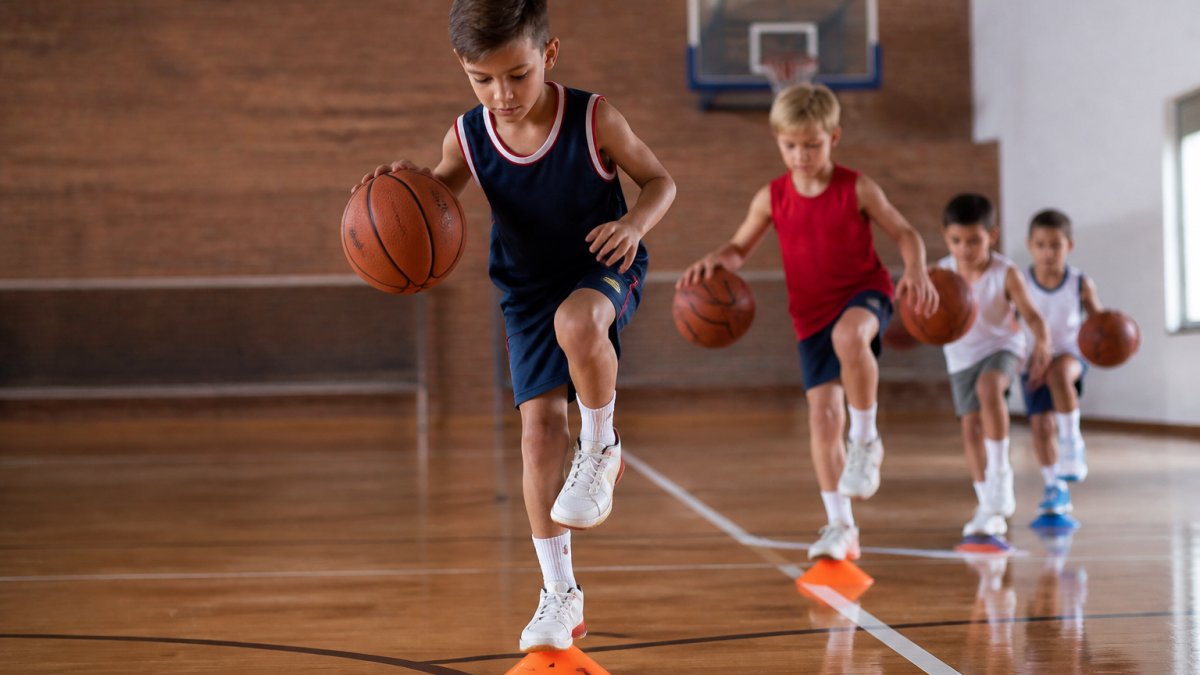
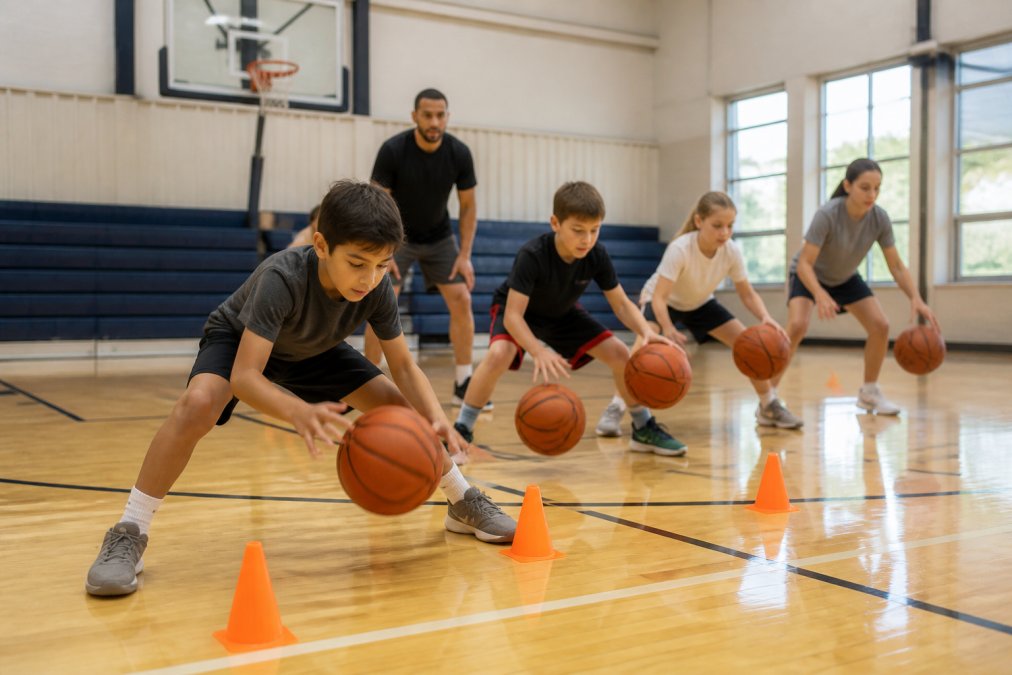
Drill 3: Cone Weaving Set up 4-5 cones in a straight line, 2.4 to 3 meters apart. Players dribble through the cones using their right hand on the way out and their left hand on the way back. Complete 5-6 passes through the course.
Drill 4: Crossover Dribble Series Players dribble in a straight line, then perform a crossover while maintaining speed. Start at half speed, then progress to game speed. Keep the ball low and tight to the body. Complete 4-5 crossovers, rest, repeat for 3 sets.
Advanced Change of Direction Drills
Once players master stationary and basic movement dribbling, introduce change of direction work.
Drill 5: Between-the-Legs Dribble Players dribble forward, bounce the ball between their legs from front to back, and catch it with their opposite hand while continuing forward. Start walking, progress to jogging, then sprinting. Do 5-6 reps per set, 2 sets.
Drill 6: Speed Dribble with Acceleration Players dribble the length of the court at 50% speed for the first half, then accelerate to game speed for the second half. This teaches pace change and explosive movement. Complete 4-5 full-court trips.
Drill 7: One-Dribble Pull-Up Players start at the three-point line, take one dribble forward, and pull up for a jump shot. This combines dribbling with shooting and teaches the transition from ball handling to finishing. Make 5 shots from each side of the court.
Youth Basketball Shooting Mechanics and Form
Shooting is the most visible skill in basketball. Bad shooting habits formed at age 8 are remarkably difficult to break at age 16, so teach proper mechanics early.
Building Proper Shooting Foundation
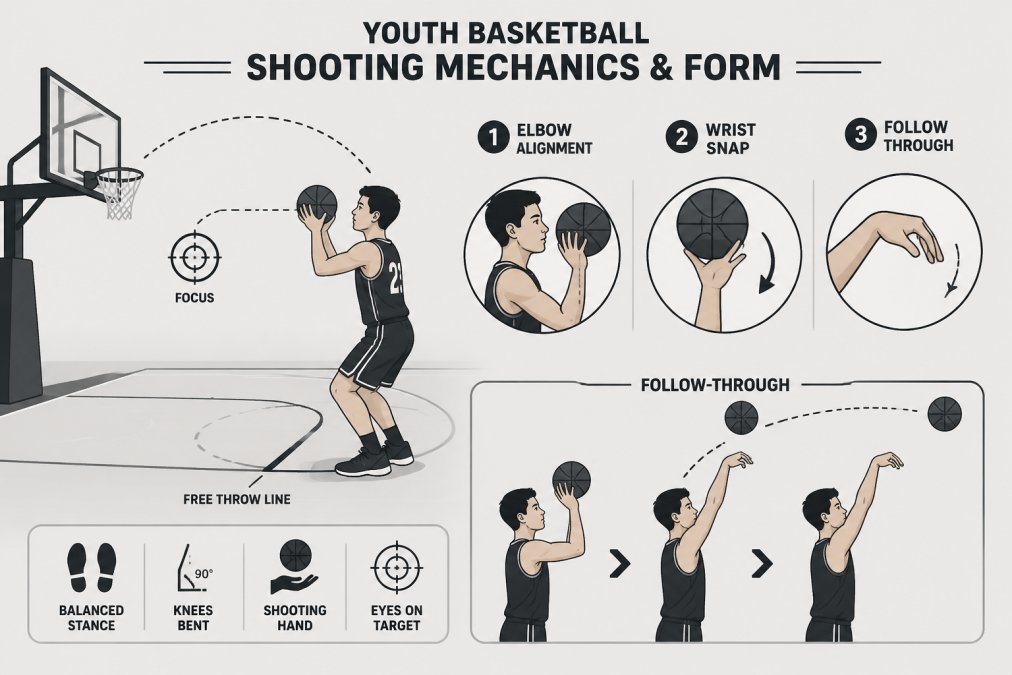
Proper shooting form has five components: feet, knees, elbow, release, and follow-through.
Feet and Stance: Feet should be shoulder-width apart, with shooting-side foot slightly forward for balance and stability.
Knee Bend: Players should bend their knees to roughly 45 degrees. The legs generate power, not the arms.
Elbow Position: The shooting elbow should be underneath the ball, creating a 90-degree angle.
Release and Follow-Through: The ball should leave the fingertips at the peak of the jump. The wrist should snap downward, creating backspin.
Drill 8: Form Shooting Players shoot from 2.4 to 3 meters away with no defenders. Focus on pure mechanics, not making shots. Shoot 10 shots, rest, and repeat for 3-4 sets. Correct form errors immediately.
Drill 9: Shooting Off the Catch A partner passes the ball to the shooter, who catches it and immediately shoots without dribbling. This teaches quick release and readiness. Complete 10 shots from five different spots around the three-point line, 2 sets.
Drill 10: Shooting After a Dribble Players catch a pass, take one dribble, and shoot. This combines ball handling with shooting mechanics. Complete 10 reps from multiple spots, 2 sets.
Layup and Finishing Drills for Game Situations
Layups are the highest-percentage shot in basketball. Young players must master layup form before moving to more advanced finishing techniques.
Drill 11: Stationary Layup Form Players stand under the basket and shoot a layup using proper form: two-foot takeoff, ball at shoulder height, soft touch off the glass. Do 10 reps per side, 2 sets.
Drill 12: One-Step Layup Players start 2.4 to 3 meters from the basket, take one dribble, and finish with a layup. Focus on timing the jump with the last dribble and using the glass. Complete 5 reps from each side, 2 sets.
Drill 13: Full-Speed Layup from Transition Players start at half court, dribble at full speed toward the basket, and finish with a layup. This teaches game-speed execution. Complete 5 reps per side, 2 sets.
Drill 14: Contested Layup A defender plays light pressure as the offensive player drives and finishes. This teaches young players to finish despite contact. Start with passive defense, progress to active defense. Complete 5 reps, rest, repeat.
Defensive Footwork and Stance Training
Defense is often neglected in youth basketball, but defensive fundamentals determine competitive success. The foundation of good defense is stance: feet shoulder-width apart, knees bent, back straight, and hands active.
Drill 15: Defensive Slide Players assume a defensive stance and slide laterally without crossing their feet. Slide 9 meters in one direction, rest, repeat. Do 4-5 sets per direction. This builds the lateral quickness needed for on-ball defense.
Drill 16: Closeout and Recovery A player starts in a defensive stance at the baseline. A coach or partner passes the ball to a spot 6 meters away. The defender sprints to closeout without fouling, then recovers to a low stance. Complete 8-10 reps per set, 2 sets.
Drill 17: One-on-One Defense A defender guards an offensive player who tries to drive to the basket. The defender's job is to force the offense to make a decision and contest shots. Complete 5 reps, then switch roles. Do 2-3 sets.
Drill 18: Defensive Pressure in Transition Three offensive players push the ball up against two defenders. The defenders must communicate, cover space, and contest shots. This teaches defensive footwork under game-like pressure. Complete 5 possessions, then rotate. Do 3-4 sets.
Best Basketball Training for Intermediate Players
Intermediate players have mastered fundamentals and are ready for more complex skill work. This is the group aged 9-12 who want to get serious about the game.
Transitioning from Recreational to Competitive Play
The jump from recreational to competitive basketball requires faster decision-making, better conditioning, and stronger fundamentals executed under pressure. Intermediate players should spend more time on game-speed drills and less time on stationary fundamentals. Conditioning becomes more important at this level: complete 15-20 minutes of conditioning work per practice through sprints, shuttle runs, agility ladder work, or conditioning games.
Building Basketball IQ and Court Vision
Basketball IQ separates good players from great ones. It's the ability to read the defense, make quick decisions, and execute the right play at the right time.
Drill 19: Read and React Passing Set up a half-court scenario with three offensive players and two defenders. The offense must move the ball and find the open player. Defenders can move but cannot steal. Complete 5 possessions, then rotate. Do 3-4 sets.
Drill 20: Pick-and-Roll Decision Making A ballhandler executes a pick-and-roll against a defender. The ballhandler must decide: drive, pull up, or pass to the rolling big. Vary the defense to force different decisions. Complete 10 reps per set, 2 sets.
Drill 21: Three-on-Three Full Court Three offensive players push the ball up against three defenders. The offense must score; the defense must stop them. This combines all elements: ball handling, shooting, passing, defense, and conditioning. Complete 5 possessions per set, 4-5 sets.
Drill 22: Transition Offense Three offensive players start with the ball at one end of the court and push against two defenders. If they score, they play defense against the next group. This teaches fast-break decision-making. Complete 5 possessions per set, 3-4 sets.
Conditioning, Warm-Up, and Injury Prevention
Young athletes are resilient but not indestructible. Injury prevention during youth basketball training is essential. A young player sidelined by injury loses months of development.
Proper warm-up prepares the body for intense work and reduces injury risk. Every practice should start with 10 minutes of dynamic warm-up: light jogging, arm circles, leg swings, lateral slides, and sport-specific movements. Follow with gentle stretching of major muscle groups.
Conditioning work should be progressive. Young players aged 7-10 need basic conditioning: short sprints and agility work. Players aged 11-16 can handle more intense conditioning: longer sprints, shuttle runs, and sport-specific drills performed at high intensity.
Drill 23: Suicide Sprints Players start at the baseline and sprint to the first free-throw line, back to baseline, to the half-court line, back to baseline, to the far free-throw line, back to baseline, and finally to the far baseline. Complete 3-4 reps with full rest between sets.
Drill 24: Agility Ladder Work Set up an agility ladder on the court. Players move through the ladder using various footwork patterns: single-foot hops, double-foot hops, lateral steps, and crossover steps. Complete 2-3 passes through the ladder per set, 2-3 sets.
Drill 25: Core Strength Work Young players need strong cores to maintain proper posture and prevent injuries. Include planks, side planks, dead bugs, and bird dogs. Hold each position for 20-30 seconds, rest, repeat. Do 2-3 sets.
Drill 26: Stretching and Mobility End every practice with 5-10 minutes of static stretching and mobility work. Focus on hamstrings, hip flexors, quadriceps, shoulders, and lower back. Hold each stretch for 20-30 seconds.
Drills for Limited Space and Home Practice
Not every young player has access to a full court. Limited space doesn't mean limited progress.
Drill 27: Wall Ball Work Players stand 1 meter from a wall and pass the ball into it, catching the return pass. Vary the height and angle of passes. This builds hand-eye coordination and passing accuracy. Do 2-3 minutes of continuous work.
Drill 28: Dribble in Place with Obstacles Set up 2-3 cones or chairs in a small area. Players dribble around the obstacles without moving more than 3 meters in any direction. This develops ball control and spatial awareness in tight spaces. Complete 3-4 minutes of continuous work.
Drill 29: Shooting at a Hoop If a hoop is available, shooting is the best use of limited space. Players can practice form shooting, shooting off the catch, and shooting after a dribble. Shoot 50-100 shots per session, focusing on form over makes.
Drill 30: Footwork Drills Without a Ball Defensive slides, lateral shuffles, jump rope, and agility ladder work require minimal space. Young players can build foot speed and agility in a small area. Combine these drills into a 15-20 minute home workout.
Youth basketball skill development requires structure, consistency, and the right drills. The programs that produce the best results prioritize fundamentals, balance drills with game time, and adapt training to each player's age and skill level. Tier 1 Sports has designed its youth programs around these principles. Whether your child is just picking up a basketball for the first time or working toward competitive rep play, structured skill development drills make all the difference.
The best time to start is now. Young players who develop strong fundamentals at ages 7-10 have a massive advantage by the time they reach competitive levels. Tier 1 Sports offers programs tailored to every age and skill level, from introductory sessions for young beginners to advanced training for competitive athletes. Our coaches understand the developmental windows that matter most and design practice plans that maximize progress while keeping young players engaged and passionate about basketball. Join us and give your young athlete the foundation they need to succeed.
Frequently Asked Questions
What are the most important basketball skills for youth players to learn?
The fundamental skills form the foundation for all basketball development: ball handling builds confidence and court control, shooting mechanics create scoring opportunities, defensive stance and footwork establish defensive capability, and passing accuracy develops court vision. Hand-eye coordination, footwork, and basketball IQ tie these together. Starting with these fundamentals ensures young players develop proper technique early, which prevents bad habits and accelerates skill progression as they advance.
How should I structure a basketball practice plan for youth?
A balanced youth basketball practice plan typically runs 60 minutes and includes: 10-minute warm-up focusing on coordination and agility, 20-25 minutes of fundamental skill drills (ball handling, shooting, footwork), 15-20 minutes of team-oriented drills (passing, transition, defensive pressure), and 10-15 minutes of game-speed intensity or modified games. This structure maintains engagement while building individual development and teamwork. Adjust timing based on age: younger players (4-6) need shorter, more playful sessions; older youth (11-16) benefit from longer, skill-specific repetition.
How often should youth basketball players practice to improve?
Skill development requires consistent repetition. Young players aged 7-10 benefit from 2-3 practice sessions weekly, while intermediate and competitive players aged 11-16 should aim for 3-4 sessions per week to see measurable improvement in shooting mechanics, footwork, and basketball IQ. Between formal practices, 15-20 minutes of home drills focusing on ball handling or shooting form accelerates progress. Consistency matters more than intensity; regular, focused practice builds muscle memory and confidence better than sporadic long sessions.
What drills help improve basketball dribbling for beginners?
Start with stationary dribbling: the two-ball dribble (one ball in each hand) builds hand-eye coordination, while figure-eight dribbling around the legs develops control. Progress to movement drills like cone weaving (changing direction around markers) and the zigzag drill (dribbling in a zigzag pattern at game speed). These drills emphasize keeping your head up, using your fingers (not your palm), and maintaining proper spacing. Beginner players should focus on controlled repetition rather than speed; proper form now prevents bad habits later.
This article was written using GrandRanker