 how-to
Balancing Rep Basketball and School Work: A How-To Guide
Table of Contents
- Why Balancing Rep Basketball and School Work Matters
- Assess Your Current Schedule and Commitments
- Time Management for Student Athletes: Build Your Framework
- Communicating with Teachers About Sports Commitments
- Create a Consistent Study Routine That Fits Your Training Schedule
- Manage Burnout and Protect Your Mental Health
- Nutrition and Recovery for Cognitive Performance
- How Parents Can Support This Balance
- Frequently Asked Questions
Last Updated: October 3, 2026
Why Balancing Rep Basketball and School Work Matters
Balancing rep basketball and school work means protecting your academic future while pursuing excellence on the court. Training happens several nights a week, games consume weekends, and school demands don't pause for playoffs.
Poor time management tanks grades and burnout ends athletic careers. Done right, this balance builds discipline that extends far beyond basketball.
The athletes who succeed treat time management like a skill they develop, not something that just happens. This guide shows you exactly how.
Assess Your Current Schedule and Commitments
Before building a new system, map what you're actually doing. Most student-athletes overestimate free time and underestimate how long tasks take.
Start here:
- Write down every rep basketball commitment (practice days, game times, travel)
- List all school obligations (classes, homework, projects, exams)
- Add extracurricular activities and social commitments
- Track sleep and meals
Look at what remains. Many athletes discover they have less flexibility than they thought, one might have 12 hours of free time weekly, another has 4. The difference changes everything about what schedule works.
Identify your peak energy times, morning or evening, right after school or after dinner. Your brain's rhythm matters more than any app. Document one typical week exactly as it happens; this baseline becomes your foundation.
Time Management for Student Athletes: Build Your Framework
Time management for student athletes works best when it matches your actual life. The framework has three parts: blocking time into categories, prioritizing ruthlessly, and protecting recovery.
Time Blocking and the Pomodoro Technique
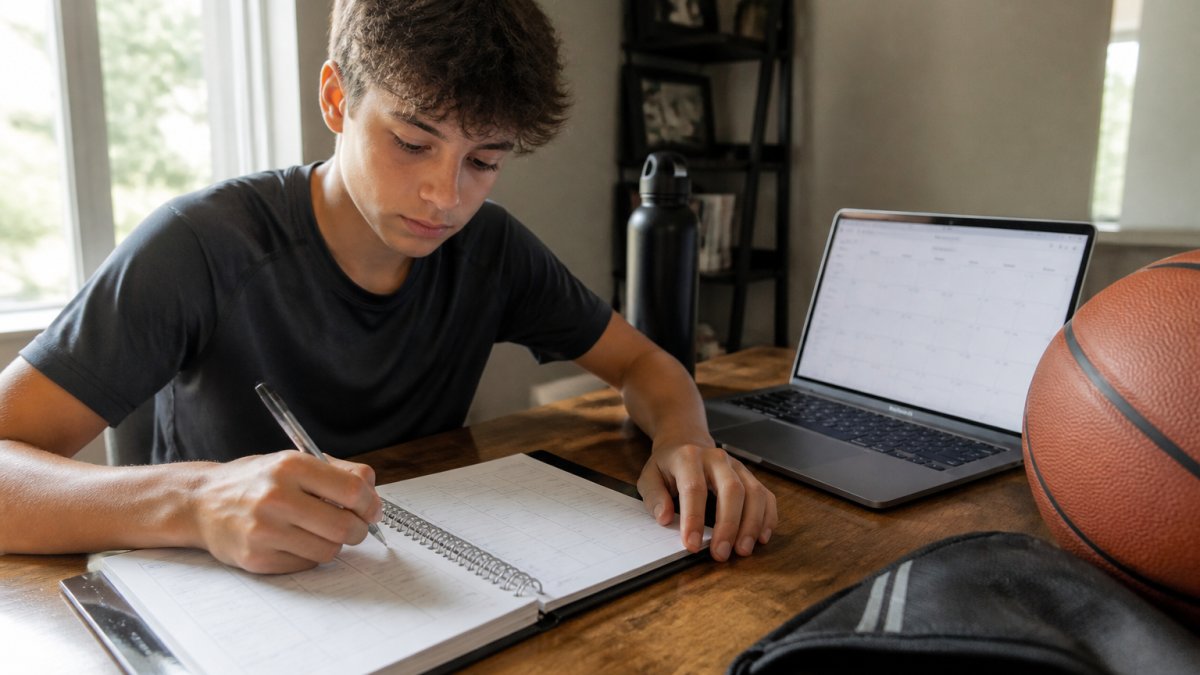
Time blocking means assigning specific hours to specific activities. Instead of a vague "study tonight," you schedule 6:00-6:45 PM for math homework and 7:00-7:30 PM for reading.
Your brain knows what's coming and you're not deciding in the moment, decisions drain energy.
The Pomodoro Technique pairs well with time blocking: work in 25-minute focused sprints, then take a 5-minute break. After four sprints, take a longer 15-30 minute break. The structure removes the need to motivate yourself repeatedly.
Prioritizing Tasks During High-Demand Weeks
Tournament weeks and exam periods destroy normal schedules. During crunch times, you can't do everything.
Rank your tasks this way:
Must-dos (do today):
- Assignments due tomorrow
- Tests happening this week
- Required practices and games
Should-dos (do this week):
- Reading ahead for next week's lessons
- Projects not due for two weeks
- Non-urgent homework
Nice-to-dos (skip if time is tight):
- Extra practice outside rep basketball
- Social activities
- Organizing your desk
During normal weeks, you hit all three tiers. During crunch weeks, you protect the must-dos and drop the nice-to-dos without guilt. Most students fail by trying to do everything and ending up doing nothing well. Picking what matters most is the skill that separates students who balance both commitments from those who burn out.
Communicating with Teachers About Sports Commitments
Teachers aren't your enemy, but they don't know your schedule unless you tell them.
Have this conversation early:
- Introduce yourself in the first week of class
- Mention you're on a rep basketball team with competition travel
- Ask about their policy on missed assignments due to games
- Show that you're serious about both commitments
Say: "I'm on a competitive basketball team that travels for tournaments. I want to stay on top of my work.
Provide a team schedule early in the semester, highlighting game weekends and tournament dates. This gives your teacher the information they need to help you.
When you miss class for a game, send an email that day or the next: "I was at our tournament this weekend.
Create a Consistent Study Routine That Fits Your Training Schedule
Consistency beats intensity. A student who studies 30 minutes daily learns more than one who crams for four hours once a week. Your study routine needs to work around rep basketball, it probably can't be "study after dinner" if dinner is 8:30 PM after practice.
Find your study window, right after school, before breakfast, or Sunday afternoon. Once you find it, protect it. Same time, same place, every single day. Your brain starts preparing for focus as soon as you sit down.
Use Short Breaks for Focused Study Sessions
Use the gaps: 15 minutes between classes to review notes, 20 minutes after school to read one chapter section, 10 minutes on the bus to quiz yourself. These micro-sessions add up, four 15-minute gaps daily equals an hour of studying. Have material ready in advance; don't waste time deciding what to study.
Digital Tools and Apps for Organization
Pick a tool that keeps everything in one place: Google Calendar (free, syncs across devices), Notion (customizable), or Todoist (task management). Don't overthink the choice, pick one you'll actually use. A simple calendar you check daily works better than a fancy system you ignore. Review it every Sunday night to plan which days are heavy and adjust your study sessions accordingly.
Manage Burnout and Protect Your Mental Health
Burnout is a psychological state where chronic stress depletes your emotional and physical resources (pubmed.ncbi.nlm.nih.gov). For student-athletes, it happens when demands exceed your capacity to recover. Unlike a single bad day, burnout builds quietly and requires systematic prevention or recovery.
Recognizing Burnout Before It Becomes Critical
Burnout has three stages. Catching it early makes recovery exponentially easier.
Stage 1: Early Warning (weeks 1-4)
- You're tired more often, but sleep doesn't fully fix it.
- Basketball feels like an obligation, not something you enjoy.
- You're irritable with teammates or family over small things.
- Concentration slips; you read a paragraph three times and retain nothing.
- You're slightly sick more often (cold, sore throat, minor injuries).
One or two changes prevent escalation: a lighter week, a conversation with your coach, or a mental health check-in.
Stage 2: Moderate Burnout (weeks 5-12)
- Dread replaces anticipation. You don't want to go to practice.
- Sleep is broken or excessive; you can't find the right amount.
- Grades drop noticeably even though you're trying.
- You withdraw from friends or skip social activities to be alone.
- Motivation is gone. You're going through motions.
You need structured intervention. Talking to a coach, counselor, or parent is no longer optional.
Stage 3: Severe Burnout (weeks 13+)
- You're considering quitting basketball or school.
- Physical symptoms emerge: headaches, stomach issues, persistent fatigue.
- Anxiety or low mood is constant.
- You can't focus on anything for more than a few minutes.
- You feel hopeless about your situation.
Professional support (school counselor, therapist, or doctor) is essential. Willpower alone won't fix this.
Prevention: The Recovery Protocol
The best burnout management is prevention. Student-athletes who build recovery into their schedule rarely reach Stage 2.
Weekly recovery structure:
-
One full rest day per week (no basketball, no intense studying): Your nervous system needs a break from high-demand activities. Choose a day with no games or major deadlines and use it for light activity, time with friends, or sleeping in.
-
One lighter practice week per month: Talk to your coach about a week where intensity drops by 20-30%. This prevents cumulative fatigue that leads to burnout.
-
Sleep non-negotiable: You need 8-10 hours on training nights. If your schedule makes that impossible, you're overcommitted. Sleep deprivation accelerates burnout faster than almost anything else.
-
Nutrition consistency: Eating poorly during high-stress weeks tanks your mood and energy. Prep meals on Sunday so you're not making decisions when exhausted. Protein, vegetables, and whole grains stabilize blood sugar and mood.
-
One non-basketball activity you enjoy: Music, art, gaming, or time outdoors, something purely for enjoyment, not performance. Protecting a small space for something else keeps you grounded.
What to Do If You're Already Burned Out
Immediate (this week):
- Tell a parent, coach, or school counselor. Don't carry this alone.
- Reduce one commitment temporarily, take a week off from extra training or ask a teacher for a deadline extension. You're pausing, not quitting.
- Sleep more. Go to bed 30 minutes earlier for three nights.
- Do one thing purely for enjoyment.
Short-term (next 2-4 weeks):
- See a school counselor or therapist. Most schools offer free sessions.
- Work with your coach on a modified training plan. Most coaches have seen this before.
- Communicate with teachers. Letting them know you're managing stress helps them be flexible on deadlines.
- Establish the weekly recovery structure: one rest day, one lighter week per month, protected sleep. Maintaining this discipline requires a long-term perspective on energy management, a skill that remains essential even when balancing work and training in other demanding areas of life.
Ongoing:
- Check in with yourself weekly. On Sunday, ask: "Am I enjoying basketball? Am I sleeping enough? Do I feel hopeful?" Make small adjustments before problems worsen.
- Keep talking to someone, a counselor, coach, or parent. Regular check-ins catch problems early.
When to Seek Professional Help
If you're in Stage 2 or Stage 3, or if the recovery protocol isn't working after two weeks, talk to a mental health professional. Many schools have counselors on staff; if not, ask your doctor for a referral. The strongest athletes know when to ask for help.
The Long View
Burnout prevention is easier than recovery. One lighter week per month, one full rest day per week, and protected sleep prevent most burnout. The students who thrive at both basketball and school are systematic about recovery.
Nutrition and Recovery for Cognitive Performance
Poor nutrition directly impacts focus, memory, and decision-making. Eat protein with every meal to stabilize energy, eggs and toast work better than cereal alone. Drink water; dehydration impairs concentration. Sleep is non-negotiable. You can't train hard, study hard, and sleep four hours. Most teenagers need 8-10 hours; if you're training intensely, you need more recovery. If rep basketball schedules make early sleep impossible, protect your morning sleep instead. The day after a game, your body is depleted, plan easier schoolwork for those days.
How Parents Can Support This Balance
Parents play a bigger role than many realize. Here's what helps:
Normalize the conversation. Ask about both equally, "How was practice?" and "How did the test go?" This signals that both matter.
Help with logistics. Meals, transportation, laundry.
Don't push harder. Let your athlete own the balance. Pushing usually backfires.
Connect with coaches and teachers. Knowing what's happening in both areas helps you support better.
Celebrate both wins. A good game and a good grade both deserve recognition.
The best parents step back and let their athlete develop independence.
Balancing rep basketball and school work requires discipline, planning, and honest conversations about what matters.
The framework in this guide works. Time blocking works. Communicating with teachers works. Protecting your mental health works.
Frequently Asked Questions
How can you balance schoolwork and rep basketball effectively?
Balancing rep basketball and school work requires a structured approach: use time blocking to schedule study sessions, training, and rest; communicate proactively with teachers about your athletic commitments; prioritize high-impact tasks during busy weeks; and build recovery time into your routine. The key is consistency, small daily efforts compound into academic and athletic success. Many student-athletes find that having a written schedule prevents last-minute cramming and reduces stress.
What time management strategies work best for student-athletes?
Effective time management for student athletes includes the Pomodoro Technique (25-minute focused work blocks), time blocking (assigning specific hours to study, training, and rest), and prioritization matrices (ranking tasks by urgency and importance). Use digital tools like Google Calendar or Asana to visualize your week. Schedule study sessions during your most alert hours, often the morning or right after school, rather than late at night when fatigue impacts retention.
How do you communicate with teachers about basketball travel and competitions?
Communicating with teachers about sports requires early notice and professionalism. At the start of the season, provide teachers with your competition schedule. For each absence, email teachers at least one week in advance explaining the dates and what work you'll complete beforehand. Offer to submit assignments early or arrange alternative deadlines. Show that you're taking your academic responsibilities seriously, and most teachers will work with you. This proactive approach prevents missed deadlines and demonstrates self-discipline.
What are signs of burnout in young competitive athletes, and how do you prevent it?
Burnout signs include persistent fatigue, declining grades, loss of motivation for basketball, irritability, and sleep problems. Prevent burnout by building in genuine rest days (at least one per week with no practice or study), varying your study environments, setting realistic goals for both academics and athletics, and maintaining social connections outside sports. Mental health matters as much as physical recovery. If you're feeling overwhelmed, talk to a coach, parent, or school counselor, early intervention prevents serious burnout.