 comparison
Best Indoor Basketball Shoes for Toddlers: 2026 Review
Table of Contents
- Best Indoor Basketball Shoes for Toddlers: What Parents Need to Know First
- Quick Comparison: Top Toddler Basketball Shoes
- Toddler Basketball Shoe Size and Fit: Getting It Right
- Non-Marking Shoes for Indoor Basketball: Why the Sole Matters
- Basketball Shoes vs. Running Shoes for Kids: Key Differences
- Indoor Basketball Shoes for Beginners: Features That Help Young Players
- Care, Cleaning, and Replacement for Toddler Basketball Shoes
- Conclusion: Choosing the Right Indoor Basketball Shoes for Toddlers
- Frequently Asked Questions
Last Updated: October 15, 2026
Best Indoor Basketball Shoes for Toddlers: What Parents Need to Know First
Finding the best indoor basketball shoes for toddlers comes down to three things: a non-marking rubber sole, a snug heel hold, and enough toe room for growing feet. Everything else is marketing.
Basketball shoes for toddlers are not simply scaled-down adult shoes. They are built with softer cushioning, more flexible soles, and wider openings so small feet can get in and out without a fight.
Here is what most guides get wrong: they treat toddlers as small kids. A 3-year-old's foot is still mostly cartilage, and the arch has not formed yet.
Below, we break down sizing, sole types, and the features that genuinely help young players, so you can buy once and buy right.
Quick Comparison: Top Toddler Basketball Shoes
The toddler basketball shoe market is small, and most of what is sold as "basketball" footwear for this age is really a cross-trainer with a basketball label. The three models below are the ones that consistently show up in toddler and baby sizing, and each suits a different stage of play.
| Model | Listed Price | Sizing | Outsole | Closure | Best For |
|---|---|---|---|---|---|
| Nike Kids' Basketball range | From $55 | Toddler 0-3 | Non-marking rubber on most models | Hook-and-loop strap over elastic laces | First pair for a real gym floor |
| Nike Team Hustle D 12 | Not listed | Toddler and baby sizes | Anti-slip traction sole | Hook-and-loop strap | Grip on smooth gym floors |
| Nike S.T. Dynamite (Little Kids') | $55 | Little kids | Non-marking rubber | Lace-up with strap | Lower-cost starter option |
A few things to read off that table before you buy:
- Toddler sizing is the first filter. A shoe listed only in "little kids" or "youth" sizes will not fit a 2- or 3-year-old, no matter how good the outsole is. The Nike kids' basketball shoe range is one of the few lines that explicitly separates toddler sizing from older kids' sizing, which is why it anchors this list.
- Closure matters more than cushioning at this age. A hook-and-loop strap over an elastic lace lets a toddler put the shoe on with minimal help and keeps the midfoot locked without a tight lace. Lace-only models are harder for small hands to tighten and easier to leave loose.
- Weight is a real variable. Toddler basketball shoes typically run lighter than youth models because the midsole foam is thinner. A shoe that feels heavy in your hand will feel heavier on a 30-pound child's foot by the third quarter.
- "Basketball shoe" on the label is not proof of indoor suitability. A shoe can carry that label and still have a sole built for pavement. Check the outsole description, not the category name.
What most reviews miss is that the best toddler basketball shoe is the one your child can put on, keep on, and move in. Traction and support only matter once those three are true.
Toddler Basketball Shoe Size and Fit: Getting It Right
Toddler basketball shoe size and fit matter more than brand. A well-fitted budget shoe beats a poorly fitted premium one every time.
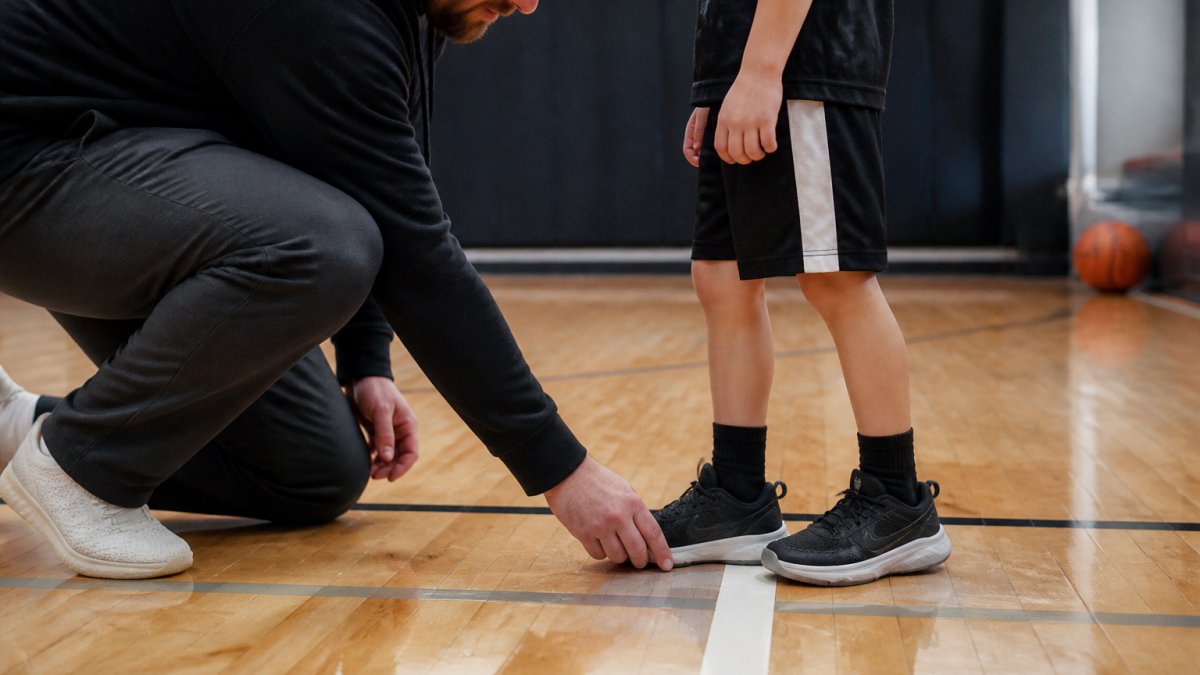
Start with the thumb rule: press your thumb between the longest toe and the front of the shoe. You want roughly the width of your thumb, no more. If you can fit two fingers, the shoe is too big.
Three fit checks to run in the store:
- Heel hold. Pinch the back of the shoe while your child walks. The heel should not slide up and down.
- Width. Toddler feet are wide and flat. If the sides bulge, go up a width, not a length.
- Bend point. The shoe should flex where the foot bends, near the ball of the foot, not in the middle.
For a first season, a mid-top cut gives useful ankle coverage without restricting movement. Low-top shoes are lighter but offer less lateral support during quick side-to-side steps.
Non-Marking Shoes for Indoor Basketball: Why the Sole Matters
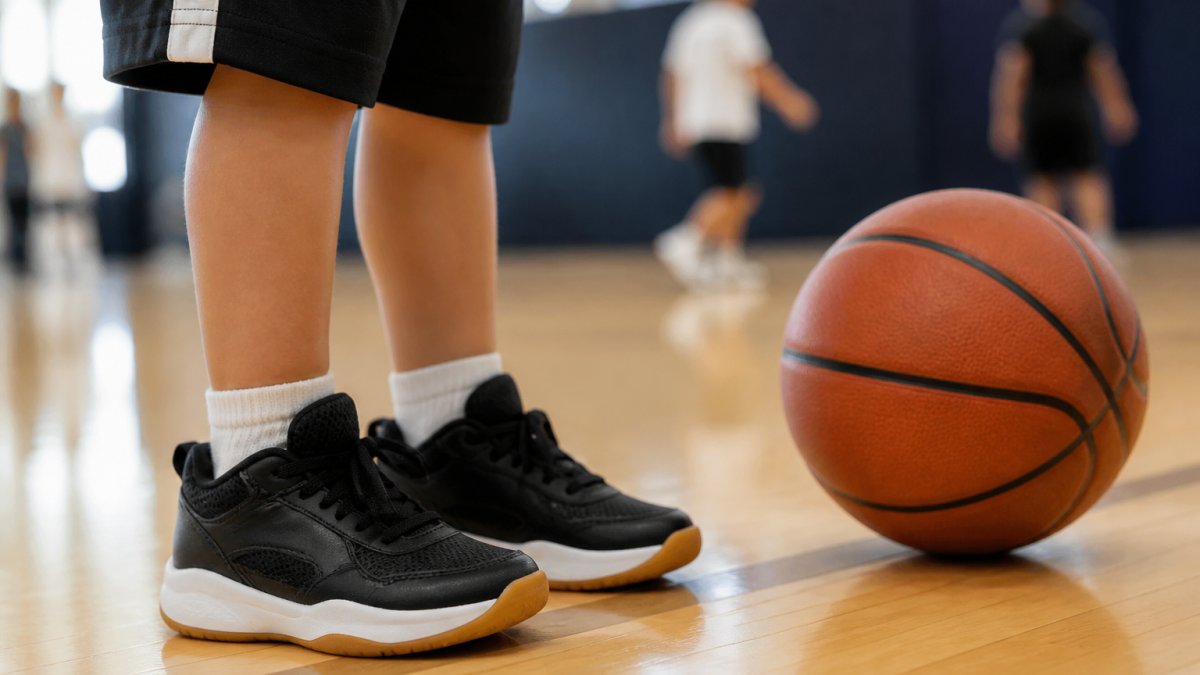
Non-marking shoes for indoor basketball use a rubber compound that will not leave scuff marks on gym floors. Most indoor facilities require them, and many will ask your child to sit out without them.
The reason is simple. Gym floors are coated with a clear finish that protects the wood. Black or dark rubber soles leave streaks that cost money to remove.
Grip pattern matters just as much as the compound. A herringbone or multi-directional tread bites into a clean floor and releases dust. A flat, shallow pattern slides.
Three things to check before you buy:
- The outsole says "non-marking" or "indoor"
- The tread has visible depth and direction changes
- The rubber feels tacky, not hard and shiny
If your child plays on a driveway or playground, a separate pair makes sense. Outdoor surfaces grind down indoor soles fast, and the Canadian Paediatric Society guidance on active play supports having proper footwear for organized sport.
Basketball Shoes vs. Running Shoes for Kids: Key Differences
Basketball shoes vs. running shoes for kids is not a style question. The two are engineered for opposite directions of movement.
Running shoes are built for straight-line speed. They have a thick, cushioned heel and a flexible forefoot that rolls forward. That design is excellent for track and field. It is poor for basketball.
Basketball shoes are built for lateral movement. They have a wider base, a flatter sole, and a sturdier upper that resists rolling when a player cuts sideways. That is what keeps a small ankle stable during quick movements and jumps.
| Feature | Basketball Shoes | Running Shoes |
|---|---|---|
| Sole shape | Flat, wide base | Curved, cushioned heel |
| Best movement | Side-to-side, jumping | Straight ahead |
| Ankle support | Mid-top or high-top options | Low cut |
| Outsole | Non-marking rubber for courts | Tread for pavement |
A toddler in running shoes on a gym floor is more likely to slip during a change of direction. The shoe simply is not designed to hold that line.
Indoor Basketball Shoes for Beginners: Features That Help Young Players
Most guides treat a beginner as a small older kid. A toddler is not that.
Features that actually help a toddler
- A flexible forefoot. The shoe should bend where the toes bend, near the ball of the foot. A stiff sole forces the foot to compensate at the ankle and can affect how the arch develops. Test it by pressing the front of the shoe up with one hand while holding the heel with the other.
- A secure midfoot strap. Hook-and-loop straps let toddlers tighten their own shoes, which builds independence and reduces the chance of a loose shoe mid-session. Elastic laces under the strap are a common pairing because they hold tension without needing to be tied.
- A padded collar and heel counter. The collar protects the ankle bone from rubbing during repeated stops. The heel counter should feel firm when you pinch it; a soft counter lets the heel slide, which is a common cause of blisters and rolled ankles.
- A wide toe box. Toddler feet are wide and flat. A narrow toe box pinches the toes and can push the big toe inward over time. If the sides of the shoe bulge when your child stands, the shoe is too narrow, not too short.
- A non-marking outsole with visible tread depth. On a clean gym floor, a shallow or smooth pattern slides. Herringbone or multi-directional tread bites and releases dust.
Features to skip
Carbon plates, air units, and anything marketed for "explosiveness" are designed for adult athletes. They add weight, reduce flexibility, and do nothing for a child who is still learning to run and stop.
When a general athletic shoe is enough
If your toddler is playing casually at home or in a parent-and-tot class on a multipurpose floor, a well-fitting general athletic shoe with a non-marking sole will usually do the job.
Caregiver wearability
The closure system is the feature parents feel every single session. Ranked from easiest to hardest for a toddler to manage:
- Hook-and-loop strap over elastic laces, easiest; the child can pull the shoe on and press the strap.
- Hook-and-loop strap over standard laces, easy, but the laces still need to be tied once.
- Lace-up only, hardest; most toddlers cannot tie, and loose laces are a trip hazard.
If your child is in a program where they need to change shoes independently, the strap-over-elastic design is the one that causes the fewest delays and the fewest loose-shoe incidents.
Care, Cleaning, and Replacement for Toddler Basketball Shoes
Toddler basketball shoes need replacing during active growth, or sooner if the sole wears smooth.
Cleaning routine that works:
- Wipe the outsole after each session to remove dust and preserve grip
- Air-dry shoes overnight, away from direct heat
- Hand wash mesh uppers with mild soap and cold water
- Never put basketball shoes in a dryer; heat breaks down the cushioning foam
Check for replacement when the tread pattern disappears at the pivot points, when the heel counter feels soft, or when your child's thumb no longer fits at the toe. Any one of those signals means it is time for a new pair.
A simple rule: if the shoe has lost its grip or its shape, it has lost its job.
Conclusion: Choosing the Right Indoor Basketball Shoes for Toddlers
The right pair comes down to fit, a non-marking sole, and enough stability for side-to-side movement. Brand matters far less than those three basics.
If you want your child to start basketball on the right foot, a supportive program makes as much difference as the shoe. Tier 1 Sports offers age-specific programs from 4 to 16, with a focus on skill development and a genuine passion for the game. Our pathways run from introductory sessions through to competitive rep basketball, all in a supportive community setting. Get started with Tier 1 Sports and help your young athlete realize their potential on the court.
Frequently Asked Questions
Do toddlers need special shoes to play basketball indoors?
Toddlers can play in regular sneakers, but basketball shoes for toddlers offer better grip and support for quick stops and direction changes on a gym floor. Look for a non-marking rubber sole, a secure midfoot fit, and enough cushioning for jumping. If your child is just starting out in a recreational program, a dedicated basketball shoe helps them move safely and confidently on the court.
How should basketball shoes fit a toddler?
Leave about a thumb's width of space between the longest toe and the front of the shoe. The heel should stay locked in place when your child walks, and the widest part of the foot should feel snug but not tight. Toddler basketball shoe size and fit matter because feet grow quickly, so measure every few months and avoid shoes that are too long, which can cause tripping.
Can toddlers wear running shoes for indoor basketball?
Running shoes are built for forward motion, while basketball shoes vs. running shoes for kids differ in lateral support and traction. Running shoes have softer, more flexible soles that can slip during side-to-side movements on a court. For indoor basketball, a shoe with a non-marking outsole and a wider base gives toddlers the stability they need during quick movements and jumps.
What features matter most in indoor basketball shoes for beginners?
For indoor basketball shoes for beginners, prioritize a non-marking rubber sole with a grip pattern that holds on smooth gym floors. Look for a secure midfoot strap or lace-up closure, moderate cushioning in the heel and forefoot, and a low- or mid-top cut that allows ankle flexibility. Lightweight materials help toddlers move freely without feeling weighed down during play.
How often should toddler basketball shoes be replaced?
Check the fit monthly and replace shoes when the toe space disappears or the heel starts slipping. Worn-down tread or a compressed midsole also signal it's time for new shoes. Rotating between two pairs can extend the life of each, especially if your child plays indoors several times a week.