 How-to
How to Run a Productive Basketball Tryout for Beginners
Last Updated: October 23, 2026
Quick Summary
A productive basketball tryout for beginners is a structured 75 to 90 minute session that measures every child on skill, effort, and coachability using the same drills and scoring. Run timed stations of 5 to 8 minutes, score each player on a 1-to-5 sheet during the drill, and keep lines under six players.
- Run a 75 to 90 minute schedule: 10 minutes warm-up, 45 minutes stations, 20 minutes small-sided play, 10 minutes cool-down.
- Weight evaluation as 40 percent skill, 30 percent effort, and 30 percent coachability.
- Assign one coach per 8 to 10 players and keep groups at no more than 12.
- Score players during the drill, not from memory, and write one short note per player.
- Send every family a short follow-up within 48 hours, selected or not.
Table of Contents
- Why a Beginner Basketball Tryout Needs a Plan, Not Just a Whistle
- Basketball Tryout Drills for Beginners That Reveal Real Skill
- Building a Basketball Tryout Schedule That Fits Your Court Time
- A Basketball Tryout Scoring Sheet That Keeps Every Coach Consistent
- Basketball Tryout Evaluation Criteria for Beginners: What Actually Matters
- Small-Sided Play, Live Game Assessment, and Conditioning
- Tryout Logistics, Group Management, and Fair Communication
- Conclusion
- Frequently Asked Questions
Why a Beginner Basketball Tryout Needs a Plan, Not Just a Whistle
A productive basketball tryout is a structured session that measures beginners on skill, effort, and coachability in a set time, using the same drills and scoring for every child.
Beginners do not show their real ability in a scrimmage. They show it in short, repeatable drills where nerves settle and the basics come out.
That is why a plan matters more than a whistle. The Coaching Association of Canada's coach training resources stress planning and fair evaluation for youth sport, and a tryout is no different.
Below is a coach-ready plan: timed drills, a simple scoring sheet, group management, and fair communication.
Basketball Tryout Drills for Beginners That Reveal Real Skill
The best basketball tryout drills for beginners are short, simple, and repeated. Each station tests one skill in 5 to 8 minutes, with every child getting the same number of reps. Keep lines short and kids moving.
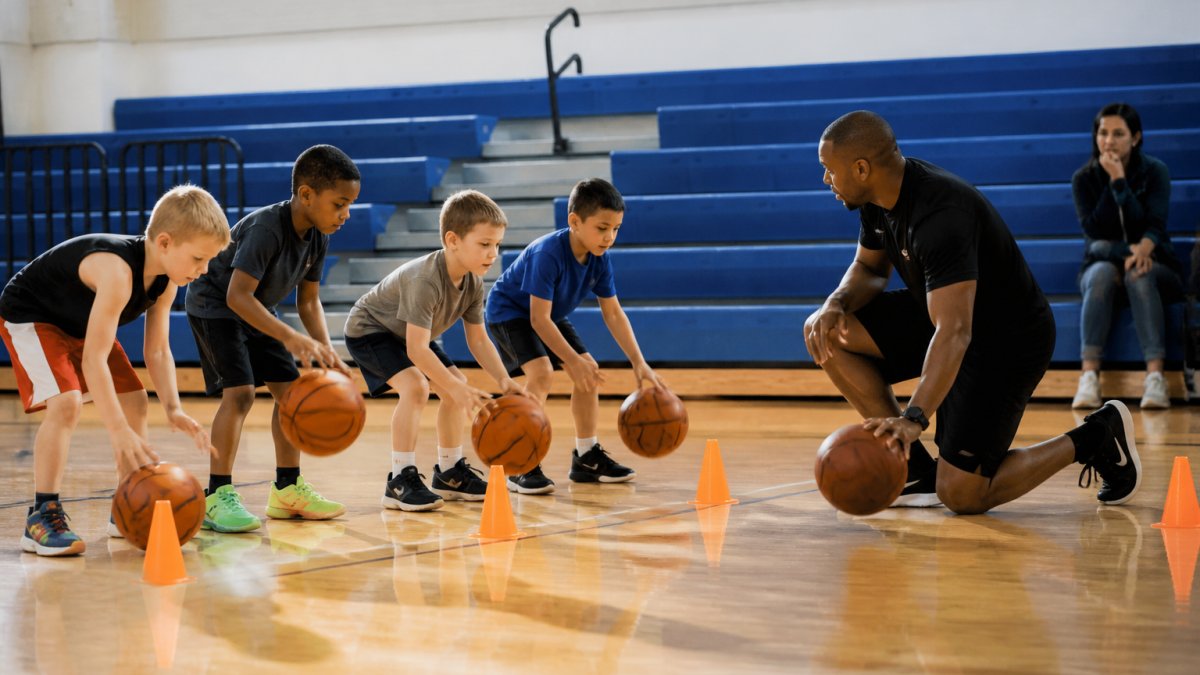
Ball-Handling and Dribbling Stations
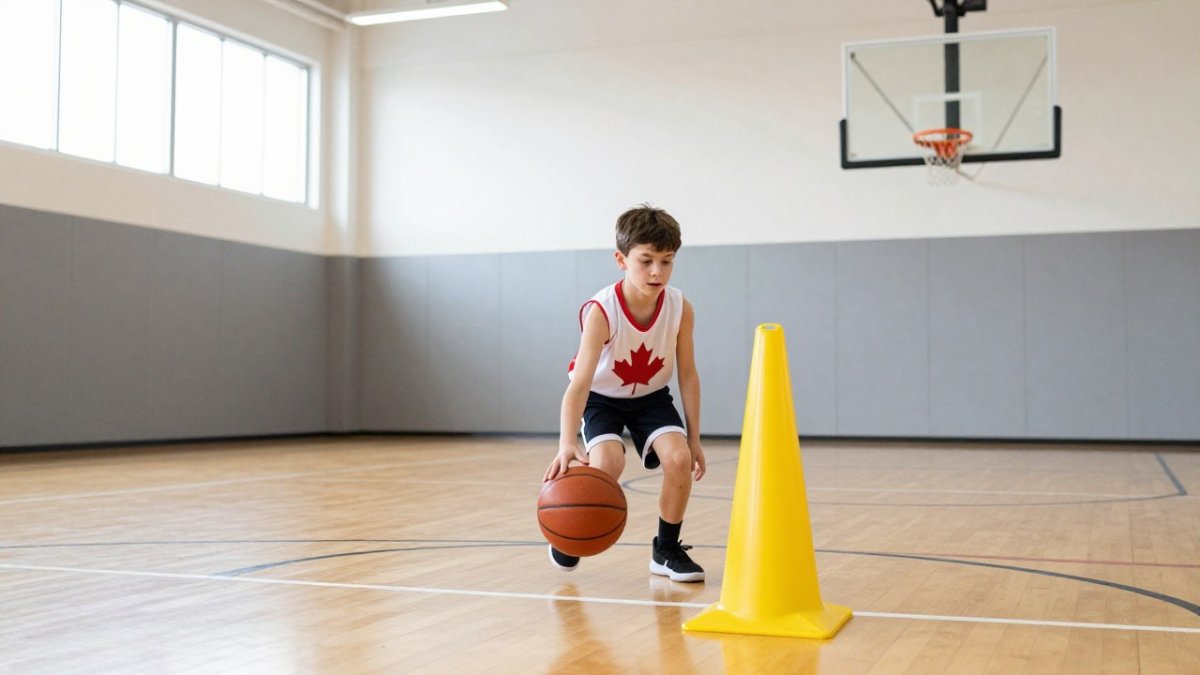
Set up a cone course and have each player dribble through it with both hands. Watch the head, not just the ball: beginners who keep their eyes up are already ahead.
Score three things:
- Control: does the ball stay close?
- Weak hand: can they use both hands?
- Head up: do they watch the cones or the floor?
A common mistake is testing only the strong hand. Weak-hand dribbling tells you more about coachability than anything else at this age.
Shooting, Layups, and Finishing Around the Basket
Run three-line layups with both hands, then free throws and close-range finishes. Look for footwork and form, not makes: a beginner with clean footwork will improve fast, while one who chunks shots needs more reps. Count makes, but score the process.
Passing, Catching, and Defensive Footwork
Pair players for chest and bounce passes, then run lane slides and a simple defensive shell drill. Soft hands matter here, and so does listening: if a player adjusts after one correction, mark it as a strong sign of coachability.
Building a Basketball Tryout Schedule That Fits Your Court Time
A beginner basketball tryout schedule should run 75 to 90 minutes: 10 minutes of warm-up, 45 minutes of stations, 20 minutes of small-sided play, and 10 minutes for cool-down and parent questions. That fits most single-gym bookings. But a block of times is not a plan, what makes a schedule productive is the equipment list, rotation mechanics, and group math most tryout guides skip.
The Timed Plan, With Transitions Built In
Here is a sample plan you can copy. Each station block includes a 1-minute transition, so coaches do not lose two minutes per rotation to wandering and water breaks.
| Time | Activity | Coach Focus | Setup |
|---|---|---|---|
| 0-10 min | Warm-up and name games | Settle nerves, watch movement | Open floor, one ball per pair |
| 10-11 min | Transition and station briefing | Explain each station once | Cones pre-set |
| 11-20 min | Ball-handling station | Control, weak hand, head up | 6 cones per lane |
| 20-21 min | Rotate | Whistle, 60 seconds | , |
| 21-30 min | Shooting and layups | Footwork, form | 2 racks of balls, 4 spots |
| 30-31 min | Rotate | Whistle, 60 seconds | , |
| 31-40 min | Passing and catching | Soft hands, listening | 1 ball per pair |
| 40-41 min | Rotate | Whistle, 60 seconds | , |
| 41-50 min | Defensive footwork | Lane slides, stance | 4 lanes marked |
| 50-52 min | Water and regroup | Hydration, reset | , |
| 52-70 min | Small-sided games | Decision-making, hustle | Half court, pinnies |
| 70-80 min | Cool-down and questions | Communication, next steps | , |
Adjust by roster size. With 30 or more kids, add a second coach per station and rotate in two groups. Never let a line run longer than six players: a line of six means a rep roughly every 90 seconds, while a line of ten means a child stands still for three minutes and stops paying attention.
Equipment and Court Setup Checklist
Set up before the first player arrives. A tryout that starts with coaches hunting for cones loses ten minutes and the room's attention.
- 12 to 16 cones (enough for two dribble lanes and a defensive slide lane)
- One ball per pair at passing and shooting stations, plus two spare balls
- Two ball racks or bins, positioned at the shooting station
Mark station boundaries with tape or cones before warm-up, and use wall padding or a stage as a natural boundary so players do not drift.
Group Math and Rotation Mechanics
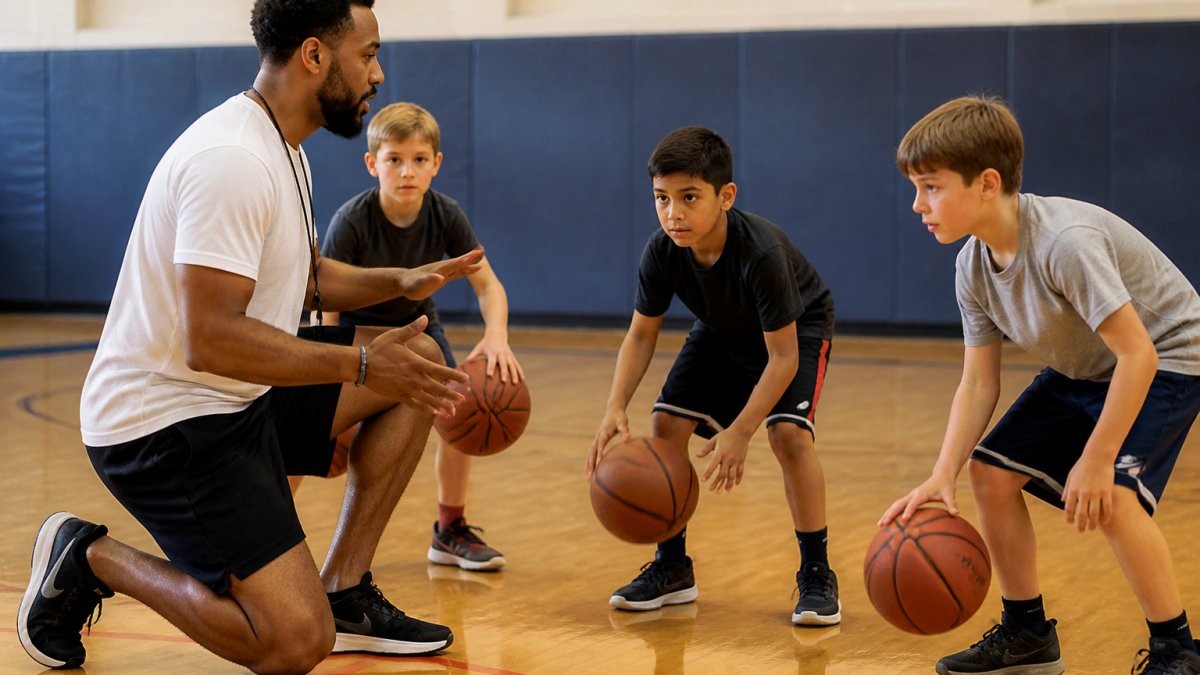
Group size drives everything. A workable rule for beginners is one coach per 8 to 10 players at a station, with groups of no more than 12. With 36 players and four stations, run three groups of 12; with 24, run three groups of 8.
Assign roles before the session:
- One station coach per station, responsible for running the drill and scoring the players in front of them
- One floating coach for behavior, safety, and bathroom escorts
- One check-in volunteer at the table
The clock coach is the most underrated role. When one person owns the whistle, stations stay tight and the schedule holds.
Contingencies That Save the Session
- Late arrivals: check them in at the table, hand them a pinnie, and slot them into the nearest station rather than restarting a rotation.
- Short on coaches: cut to three stations and lengthen small-sided play; live play needs the fewest adults per child.
- Small gym or shared court: run stations in half-court lanes and keep small-sided games to 3-on-3 on one basket.
A schedule is only productive if it survives contact with a real gym full of beginners. Build in the transitions, name the roles, and the plan holds.
A Basketball Tryout Scoring Sheet That Keeps Every Coach Consistent
A basketball tryout scoring sheet is a one-page form that rates each player on the same skills, on the same scale, at every station, turning opinion into a comparable record.
| Category | What to Watch | Score (1-5) |
|---|---|---|
| Ball control | Dribbles with both hands, head up | |
| Shooting form | Footwork, release, balance | |
| Passing | Accuracy, soft hands | |
| Defense | Stance, slides, effort | |
| Coachability | Adjusts after one correction | |
| Hustle | Runs, recovers, competes |
Two rules keep the sheet fair. First, score during the drill, not from memory later. Second, write one short note per player. A number without a note is hard to defend.
Basketball Tryout Evaluation Criteria for Beginners: What Actually Matters
Beginner basketball tryout evaluation criteria should weigh skill, effort, and coachability equally. At this age, raw talent matters less than how a child responds to coaching: a kid who listens and tries hard will pass a kid with better handles and a bad attitude. But weights alone do not make it fair, fair evaluation needs observable anchors for each score, accommodations for beginners who have never been coached, and a selection conversation you can defend to every family.
Skill, Effort, and Coachability: The Three Columns
Think of your evaluation as three columns: skill (ball handling, shooting, passing, defense), effort (hustle, recovery, compete level), and coachability (listening, adjusting, communication).
Weight them like this:
- Skill: 40 percent
- Effort: 30 percent
- Coachability: 30 percent
Why so much weight on effort and coachability? Because beginners improve fast. The child who takes a correction and applies it is the one who grows most over a season.
Observable Anchors for Each Score
A 1-to-5 scale means nothing if two coaches read it differently. Anchor each number to something you can see. A workable beginner rubric:
| Score | Skill anchor | Effort anchor | Coachability anchor |
|---|---|---|---|
| 1 | Cannot dribble or catch without losing the ball | Walks between drills, stops early | Does not respond to instruction |
| 2 | Controls the ball only with strong hand, eyes down | Tries intermittently, slow to recover | Listens but does not adjust |
| 3 | Uses both hands with some control, occasional head up | Runs drills, recovers after a miss | Adjusts after two or three corrections |
| 4 | Controls both hands, head up most of the time | Sustains effort, competes in live play | Adjusts after one correction |
| 5 | Clean control, head up, uses weak hand under pressure | Sets the pace, recovers instantly | Asks questions, applies correction immediately |
Score during the drill, not from memory later, and write one short note per player. A number without a note is hard to defend; a note turns a score into a story you can share with a family.
Evaluating Beginners Fairly: Potential Over Prior Coaching
The biggest fairness risk in a beginner tryout is rewarding prior access. A child with private coaching will look polished; a child who has only played at recess may look raw but improve faster across the session. Two adjustments help:
- Score improvement, not just level. Note where a player started and where they finished. A child who went from losing the ball to dribbling a cone course by the end of the session is showing coachability, which is the trait you are trying to measure.
- Separate "has been taught" from "can be taught." A clean layup with poor listening is a lower ceiling than a messy layup with fast adjustment.
- Account for growth and age spread. Beginners in the same age group can differ by a foot in height and two years in coordination. Compare players to the rubric, not to each other.
From Scores to a Roster: A Defensible Selection Process
Once the sheets are in, average each player's scores across the coaches who watched them. Then follow a short, consistent process:
- Rank by total score within each age group.
- Flag any player whose scores split widely between coaches (for example, a 2 from one and a 4 from another) and discuss the notes before deciding.
- Set a roster size before the tryout, not after, so the number does not drift toward favorites.
- Record the decision and the one-sentence reason for each player, selected or not.
That record is what lets you communicate decisions honestly and consistently, and it is what protects the program if a family asks why.
Communicating Decisions and Feedback
Tell parents the timeline up front: when decisions go out, how they will hear, and what happens next. Send a short follow-up to every family within 48 hours, selected or not. For players not selected, name one thing they did well and one concrete next step, a skill to practice or a program to join.
For coaches preparing those harder conversations, our guide on how to handle basketball tryout rejection as a parent is worth sharing with families.
Small-Sided Play, Live Game Assessment, and Conditioning
Small-sided games are the closest thing to a real test of beginner potential. Run 3-on-3 on a half court for short bursts. Watch court awareness, passing, and how kids move without the ball.
Conditioning should stay light at a beginner tryout. You are checking athleticism, not running a fitness test. A simple shuttle run and some lateral movement tells you enough.
What to watch in live play:
- Do they call screens or ask for the ball?
- Do they help on defense?
- Do they pass when pressured?
These translatable skills matter more than a highlight layup.
Tryout Logistics, Group Management, and Fair Communication
Good logistics make a tryout feel fair, and fair tryouts build trust with families. Start with clear registration, staggered arrival times, and a check-in table, and group kids by age, not by reputation.
For coaches preparing those harder conversations, our guide on how to handle basketball tryout rejection as a parent is worth sharing with families.
Conclusion
Running a beginner tryout is hard when the gym is loud, the lines are long, and every parent is watching.
At Tier 1 Sports, we build tryouts and training around exactly that approach.
Get started with Tier 1 Sports and give your beginners a tryout that measures what matters. Readers whose beginners need more preparation can explore PREP FOR REP.
Frequently Asked Questions
How long should a beginner basketball tryout last?
A beginner basketball tryout works best at 90 to 120 minutes. That gives you time for a warm-up, four or five short drill stations, a small-sided game block, and a brief cool-down without rushing anyone. For players aged 7 to 10, keep it closer to 90 minutes, since attention fades after an hour of structured activity. Build in a five-minute water break at the halfway point and keep each station to roughly 10 to 12 minutes so every player touches the ball repeatedly.
What should coaches look for when evaluating beginners fairly?
Use basketball tryout evaluation criteria that separate skill from potential. Score ball handling, shooting form, passing, and defensive footwork on a simple 1 to 5 scale, then add separate scores for effort, coachability, and communication. Beginners rarely arrive polished, so weight coachability and hustle heavily. A player who listens, corrects quickly, and calls screens is often more coachable than one with a better handle. Record scores during the session, not after, so memory does not bias the roster decision.
What should players bring to a beginner basketball tryout?
Ask players to bring court shoes, a water bottle, and a reversible jersey or a light and dark shirt so teams are easy to split. Bring your own supply of basketballs in a range of sizes, since beginners will not own the right size. For ages 7 to 10, a size 5 ball is easier to control. Label every ball and cone, and print a basketball tryout scoring sheet for each coach before the session starts so nothing is improvised on the floor.
How do you help nervous beginners feel confident at a tryout?
Open with a warm-up game instead of a drill line, so nobody stands still and feels watched. Explain each basketball tryout drill once, demonstrate it, then let players run it before you correct anything. Pair nervous players with a buddy at each station and keep coaching language positive: name what they did well, then give one adjustment. Close by telling every player what happens next and when they will hear back. Clear communication lowers anxiety more than any pep talk.