 How-to
How to Coach Youth Basketball Team Defense
Last Updated: November 5, 2026
Quick Summary
To learn how to coach youth basketball team defense, teach a repeatable low stance and no-crossed-feet slides first, then build on-ball containment, help and recover, and simple communication calls. Run a 30 to 45 minute defensive block that moves from stance and slides to shell drill and 3-on-3 live play.
- Teach three checks in ready position: see ball and player, hands high, feet moving.
- On-ball defense contains the ball handler and forces them toward the sideline or baseline.
- Teach help defense as three steps: see the ball, step into the gap, sprint back.
- Teach only three calls at first: Ball, Help and Shot.
- Track deflections, stops, forced turnovers, defensive rebounds and successful closeouts instead of points allowed.
Table of Contents
- Start With a Defensive Stance Every Player Can Repeat
- On-Ball Defense: Teaching Kids to Contain the Ball Handler
- How to Teach Help Defense in Basketball Without Confusing Young Players
- Youth Basketball Defensive Drills That Transfer to Games
- Fix Breakdowns and Track Whether Defense Is Improving
- Find the Right Program for Your Young Defender
- Frequently Asked Questions
Start With a Defensive Stance Every Player Can Repeat
When you learn how to coach youth basketball team defense, it starts with one fundamental, repeatable skill: the stance.
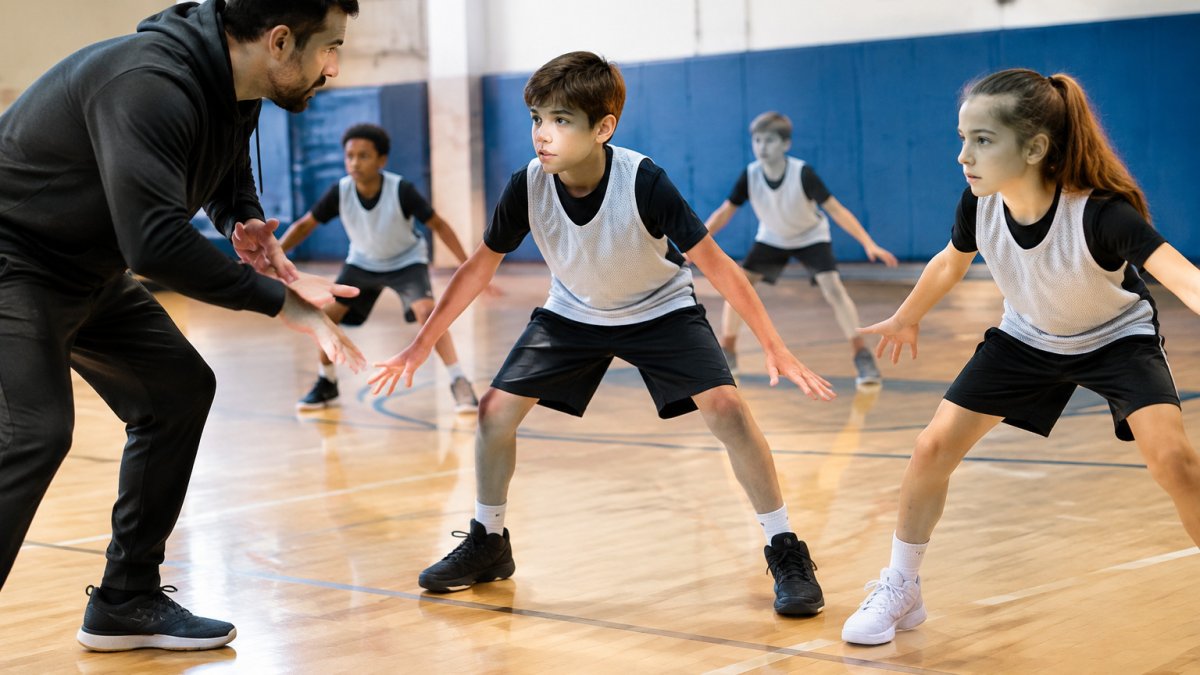
Defensive stance is the balanced body position a player holds before moving: feet wide, knees bent, hips low, chest up and hands active.
- Feet slightly wider than shoulders
- Knees bent, never locked
- Hips low, back flat
A common mistake is letting kids bob upright between reps. Fix it with a simple cue: "Low and steady." If they can see over their own toes, they are too high.
The ready position: feet, hips and hands
Ready position is the stance a defender holds when their player does not have the ball yet. Feet stay active with small hops, hips stay low, and hands stay visible to jump a passing lane.
Teach three checks before every rep:
- Can the player see the ball and their player at the same time?
- Are their hands high enough to tip a pass?
- Are their feet moving, or are they flat-footed?
Kids who stand still in ready position get beaten on the first cut. Kids who bounce lightly on their toes stay in the play.
Footwork and defensive slides that hold up in games
Defensive slides are short, controlled sideways steps a defender uses to stay in front of the ball handler without crossing their feet.
The big rule: never cross your feet. Crossing turns a slide into a stumble, and a stumble is a blow-by.
For a deeper breakdown of footwork basics to teach defensive slides correctly, see our guide on basketball footwork for young players.
On-Ball Defense: Teaching Kids to Contain the Ball Handler
The goal of on-ball defense is not to steal the ball.
Teach containment with three rules:
- Stay in front. Keep your chest between the ball and the basket.
- Force a direction. Send the dribbler toward the sideline or baseline, not the middle.
- Keep your hands active. One hand up to contest, one hand low to poke at the ball.
The stick hand is the hand on the ball handler's strong side, held up to discourage the drive. The other hand stays low for balance and reach.
Watch out: young defenders love to reach. Reaching pulls them out of stance and gives the offense a free lane. Reward containment in drills, not steals.
How to Teach Help Defense in Basketball Without Confusing Young Players
Help defense is simple when you teach it as one idea: when your player does not have the ball, you are a helper first.
Teach the help and recover cycle in three steps:
- See the ball. Eyes on the ball handler, not just your player.
- Step into the gap. Slide toward the paint to block the drive.
- Sprint back. Once the ball is passed, sprint to your player with high hands.
The most common mistake is a slow recovery. Kids help, then jog back, giving the offense an open shot.
For coaches with quiet teams, our communication strategies for youth basketball coaches help players talk on defense as naturally as they talk on offense.
Youth Basketball Defensive Drills That Transfer to Games
The best youth basketball defensive drills look like the game, not like a line. If players stand waiting for a turn, they are not learning defense. Small-sided, game-like reps build real habits.
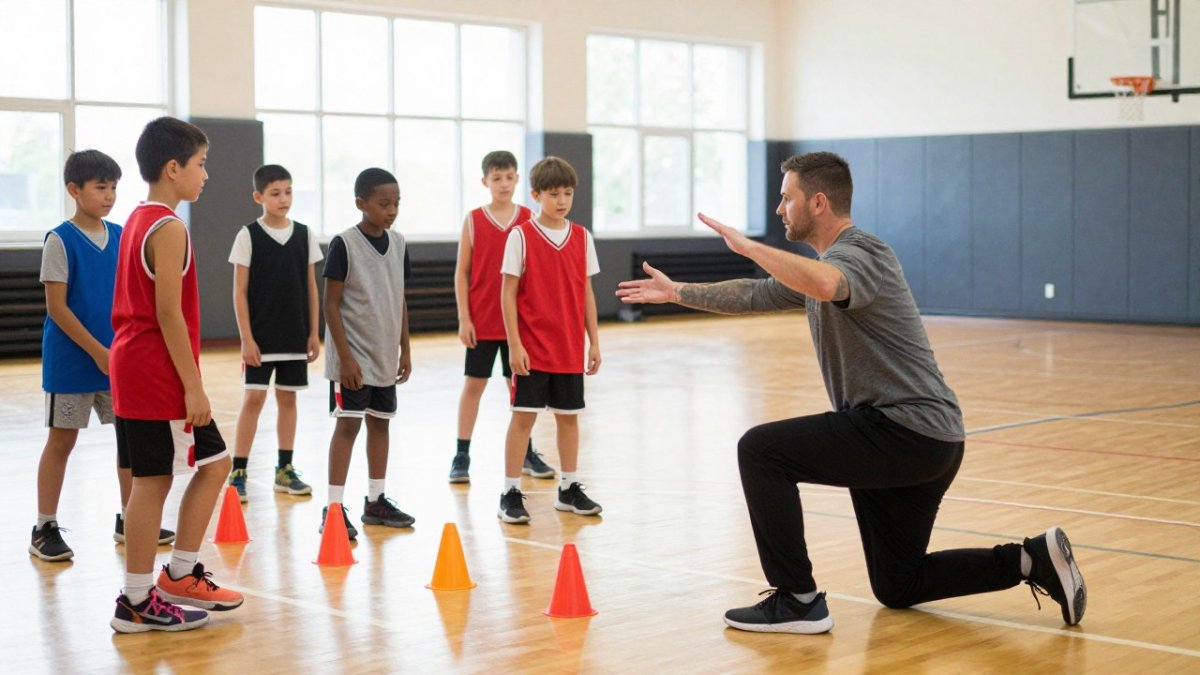
Watch out: coaches often run the shell drill before players can hold a stance or slide without crossing their feet. If the foundation is missing, the shell drill becomes a slow walk-through that teaches nothing. Check the stance block before advancing to team positioning.
Fix Breakdowns and Track Whether Defense Is Improving
Most defensive problems have a simple cause. Find the cause, fix the drill, then check again. Do not guess.
Use this troubleshooting list to match the symptom to the correction:
- Getting beat off the dribble: Stance too high, or feet crossing. Re-drill slides with the "low and steady" cue and the no-crossed-feet rule. If the problem persists, check whether the defender is reaching, reaching pulls them out of stance and gives the offense a free lane.
- Open shooters on the wing: Slow closeouts. Re-drill closeout sprints with high hands. A closeout that arrives late is worse than no closeout, because it gives the shooter a free look and the defender is out of position to help.
- Easy layups in the paint: No help. Re-drill help and recover. Check whether the helper is stepping into the gap or just watching the ball. If the helper steps but recovers slowly, make the sprint back the loudest coaching point.
How to diagnose before you correct
Before changing a drill, watch one possession and ask three questions: Did the defender hold a stance? Did they stay in front? Did they communicate? The first broken link is the one to fix.
A common pattern is a coach who blames effort when the real problem is a missing rule. Check the rule before you raise your voice. If players do not know the rule, they cannot follow it.
Measure improvement without overemphasizing wins
A youth coach can track improvement with simple stats charted on one page: deflections, stops, forced turnovers, defensive rebounds, and successful closeouts.
A stop is a possession where the defense prevents a score. A deflection is any touch on the ball that changes its path.
Watch out: coaches often track only points allowed, which depends on opponent skill and shooting luck.
Find the Right Program for Your Young Defender
Building a young defender takes patience, simple rules and a lot of game-like reps. That work does not happen in one practice, it happens across a season of small, repeated lessons.
At Tier 1 Sports, we build those lessons into every session. You can explore skills and drills for ages 7 to 12 or browse all available basketball programs to find the right fit.
Visit the Tier 1 Sports website to learn more about our programs for your young player.
Frequently Asked Questions
How do you teach team defense to youth basketball players?
Start with one simple rule per concept and repeat it every practice. Teach the defensive stance and slides first, then on-ball containment, then help defense using the shell drill. Keep instructions short, demonstrate rather than lecture, and let players learn through small-sided games. Young players absorb team defense best when they hear the same three or four terms every week and see them applied in game-like reps rather than isolated lines.
Should youth basketball teams play man-to-man or zone defense?
Man-to-man defense is the better foundation for most youth teams because every player learns to guard the ball, move their feet and help a teammate. Zone defenses can be useful later, but they hide individual weaknesses and slow down skill development. Check your league rules first, since some youth leagues restrict zones at certain age levels. Once players can contain the ball and rotate in help, a zone becomes a useful change-up rather than a crutch.
What defensive skills should young basketball players learn first?
Begin with the ready position: feet wider than shoulders, knees bent, back straight and hands active. Add defensive slides and stopping under control before introducing closeouts. Only after players can stay in front of a ball handler should you teach help defense and rotations. For ages 4 to 6, keep it to stance, slides and simple chase games. Ages 7 to 10 can handle closeouts and basic shell positioning, while ages 11 to 16 are ready for rotations, communication and transition defense.
How long should a youth basketball team spend practicing defense?
Aim for roughly a third of each practice, around 20 to 30 minutes in a 60 to 75 minute session. Split it into a short stance and footwork warm-up, one focused drill on the skill of the week, and a small-sided game where defense is scored. Defensive habits fade when practice is all offense, but long drill lines also kill effort. Short, game-like reps with a scoreboard keep young players engaged and make defensive effort something they want to repeat.