 Listicle
Indoor Basketball Training Games for Kids: 7 Fun Drills
Last Updated: October 22, 2026
Quick Summary
Indoor basketball training games for kids turn a small gym, basement, or rec room into a real practice space. Games like Dribble Tag, Red Light Green Light, and Wall-Target Shooting build dribbling, passing, and shooting skills through play rather than line drills. A 45-minute plan uses seven of these games with minimal equipment.
- Ball handling comes first indoors because a player can practice crossovers and pivots in a two-metre square.
- Wall-Target Shooting scores two points for a clean follow-through and runs 5 to 8 minutes.
- Partner Pass-and-Move aims for 20 consecutive clean passes using chest, bounce, and one-hand push passes.
- For beginners aged 5 to 9, build confidence before competition and keep instructions to one cue at a time.
- The 45-minute plan opens with a 5-minute warm-up and closes with 6 minutes of free dribble and recap.
Table of Contents
- Why Indoor Basketball Training Games Work for Young Players
- Indoor Basketball Drills for Kids: Dribbling and Ball Handling
- Basketball Games for Kids at Home: Small-Space Shooting and Passing
- Basketball Games Without a Hoop: No-Equipment Skill Builders
- Basketball Drills for Beginners Ages 5-9: Building Confidence First
- Safety and Space Setup for Indoor Basketball Practice
- A 45-Minute Indoor Practice Plan for Kids
- Conclusion: Turning Small Spaces into Big Skill Gains
- Frequently Asked Questions
Why Indoor Basketball Training Games Work for Young Players
Indoor basketball training games for kids turn a small gym, basement, or rec room into a real practice space. At Tier 1 Sports, we help players aged 4 to 16 build dribbling, passing, and shooting skills through games rather than line drills, fostering engagement. Games work because young players learn movement patterns by reacting, not by repeating. A child chasing a partner during Dribble Tag changes direction and switches hands dozens of times without thinking about it. That is skill development disguised as play.
Indoor Basketball Drills for Kids: Dribbling and Ball Handling
Ball handling is the first skill to build indoors because it needs the least space. A player can practice low dribbles, crossovers, and pivots in a two-metre square. The two games below cover both control and change of direction.
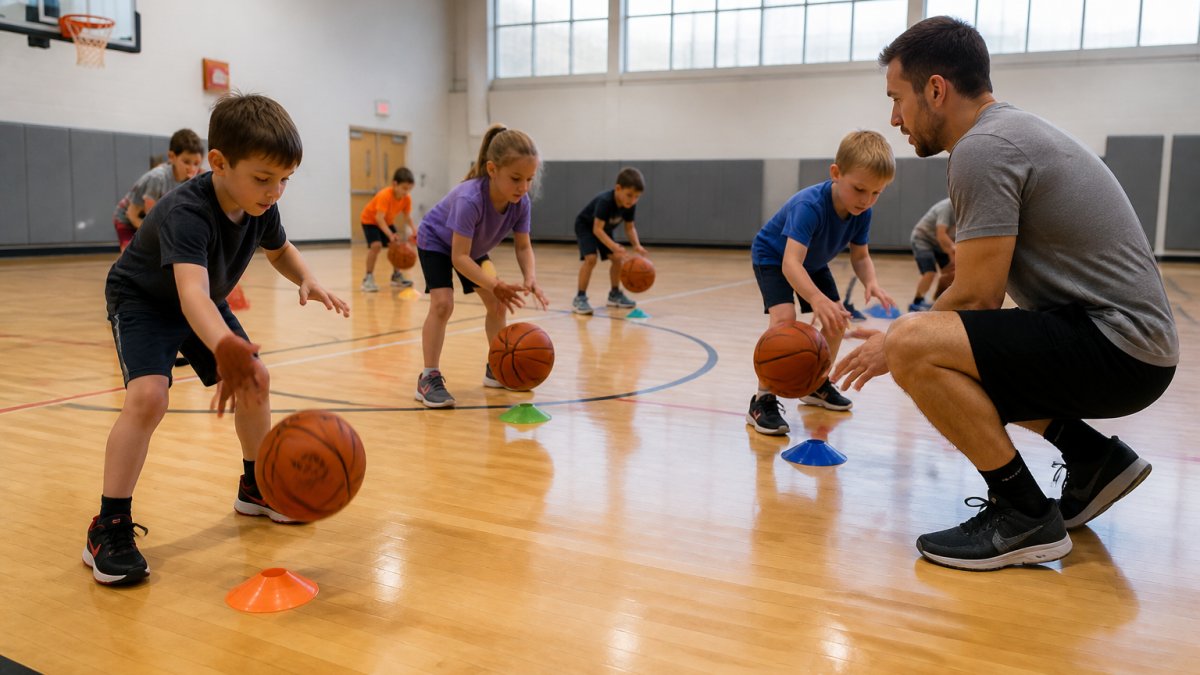
Dribble Tag
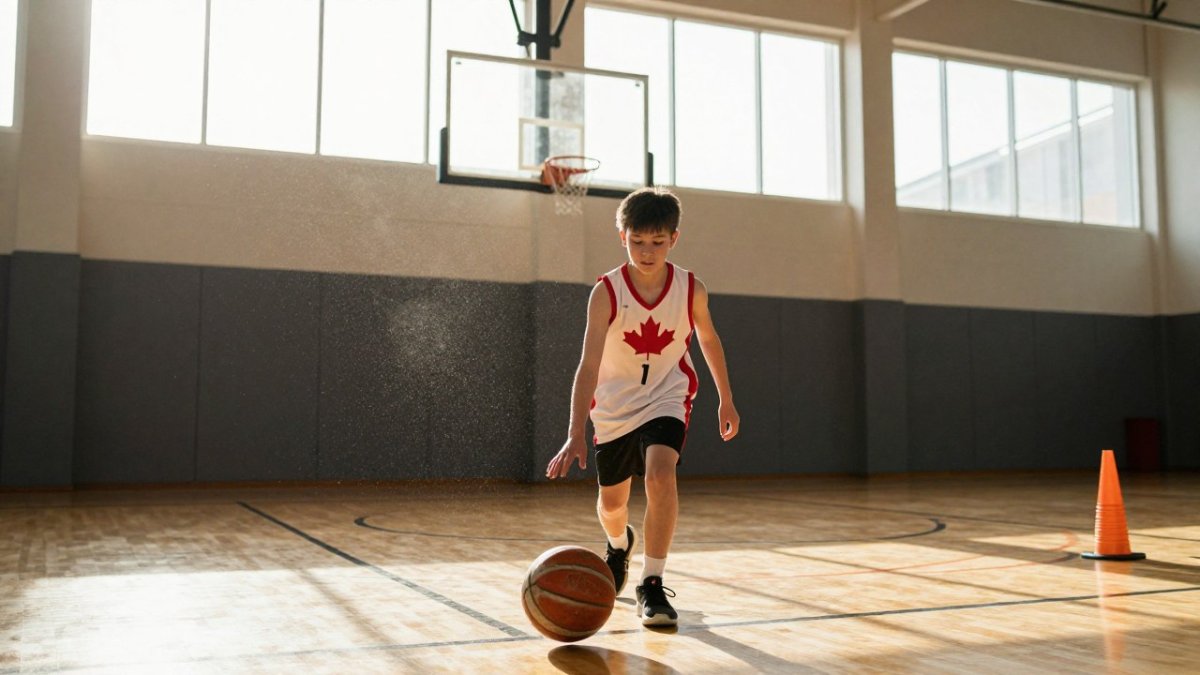
Dribble Tag is a freeze-and-chase game where every player must keep dribbling while trying to tag others. Set up a boundary with cones or tape. One player is "it" and dribbles while chasing. Anyone tagged freezes with the ball on their hip until a teammate dribbles past to unfreeze them. Use a soft ball for beginners, and cap the space at half a court so nobody sprints into a wall.
Red Light, Green Light
Red Light, Green Light teaches stopping under control, which is the foundation of pivoting and jump stops. Players dribble on "green light." On "red light," they stop and hold a pivot stance with the ball protected by the guard arm. Add "switch hands" and "change direction" calls for older groups. This game builds the exact footwork that later becomes a clean jump stop in traffic.
Basketball Games for Kids at Home: Small-Space Shooting and Passing
You do not need a full court to train shooting form and passing accuracy at home. A doorway, a wall, and a soft ball cover both skills. The key is to pick games with a clear target, a simple rule, and a measurable goal so players can run them without a coach narrating every rep. The three games below work in a hallway, basement, or rec room and need only tape, a soft ball, and a partner.
Wall-Target Shooting (Form First)
Setup: Place a strip of tape on a wall at roughly the height of the player's shoulders when standing two metres away. Use a soft ball or a mini basketball. Mark a shooting line on the floor with tape.
Rules: The player shoots from behind the line using proper form, elbow under the ball, follow-through, and balance. Score one point for hitting the tape, two points for hitting it with a clean follow-through (coach or partner confirms).
Duration: 5-8 minutes. Player count: 1-4, rotating every five shots. Skill goal: Consistent release point and follow-through. For older players, move the line back one step every five makes.
Partner Pass-and-Move
Setup: Two players stand three metres apart with one soft ball. Mark a passing lane with tape or cones.
Rules: Players pass back and forth using a chest pass, then a bounce pass, then a one-hand push pass. After each pass, the receiver takes one dribble and passes back. Count consecutive clean passes; a drop or a bad pass resets the count. Aim for 20 in a row.
Duration: 6-8 minutes. Player count: 2-6 in pairs. Skill goal: Accuracy and pace. For beginners, shorten the distance to two metres and allow a two-hand catch.
Doorway Bank Shots
Setup: Use a doorway with a soft ball and a small target (a laundry basket or a taped square on the door). Stand one metre back.
Rules: Players shoot bank shots off the door frame or taped square. Score one point for a make, two for a bank shot that goes in cleanly. First to 10 wins. Rotate shooters every three attempts.
Duration: 5-8 minutes. Player count: 1-4. Skill goal: Close-range touch and aim. For older players, move the target higher and add a dribble before the shot.
For all three games, check the floor for slip hazards and keep players two metres apart during passing drills. Use a soft ball for beginners and a standard size 5 ball for players aged 9 and up.
Basketball Games Without a Hoop: No-Equipment Skill Builders
Some of the best indoor games need no hoop at all. These games build footwork, tracking, and body control using household items, and they scale from a preschooler in a hallway to an older child in a basement. Each game below includes setup, rules, duration, player count, and a simple skill goal so you can run it and assess progress immediately.
Balloon Basketball
Setup: Inflate one balloon per player. Mark a small court with tape or furniture. No hoop needed, players tap the balloon upward and move it toward a designated wall or line.
Rules: Players keep the balloon in the air using one hand at a time, moving toward the target line. A dropped balloon means the player restarts from their starting spot.
Duration: 5-7 minutes. Player count: 2-6. Skill goal: Tracking and timing. For ages 5-7, allow two hands and a larger balloon. For ages 8-10, require alternating hands and add a pivot before each tap.
Laundry Basket Shooting
Setup: Place a laundry basket on a stable chair or low table. Mark shooting spots with tape at one, two, and three metres.
Rules: Players shoot a soft ball into the basket from each spot. Score one point from the closest spot, two from the middle, three from the farthest. Take three shots per spot, then rotate. First to 10 points wins.
Duration: 6-8 minutes. Player count: 1-4. Skill goal: Aim and arc. For beginners, use a larger basket and a softer ball. For older players, require a dribble before each shot.
Hula-Hoop Islands
Setup: Scatter four to six hula hoops or colored discs on the floor as "islands." Leave one metre between hoops.
Rules: Players dribble from island to island, stopping inside a hoop with a pivot stance before moving to the next. A coach or parent calls "switch" to change direction.
Duration: 6-8 minutes. Player count: 2-6. Skill goal: Stopping under control and changing direction. For ages 5-7, walk between islands and use a soft ball. For ages 8-10, add a crossover at each island.
For all three games, clear breakables, check the floor for slip hazards, and keep players two metres apart during movement. Use a soft or lightweight ball for young players and stop the game if players start colliding.
Basketball Drills for Beginners Ages 5-9: Building Confidence First
For beginners aged 5 to 9, confidence comes before competition. A common mistake is introducing scoring too early, which makes a missed shot feel like failure instead of a rep. Start with games where everyone succeeds: dribbling in open space, passing to a partner, and shooting from close range with a soft ball. Keep instructions to one cue at a time. Once a player can dribble with their head up and stop under control, add light defense and simple scoring. Skill level should drive the progression, not age alone.
Safety and Space Setup for Indoor Basketball Practice
Indoor practice safety starts with the room. Clear breakables, cover sharp corners, and check that the floor is not slippery. Use a soft or lightweight ball for young players, and keep walls clear of glass. Space players at least two metres apart during dribbling games to prevent collisions. Warm up for five minutes with light movement and dynamic stretches before any fast-paced game. Stop a game the moment players start crashing into each other, and reset the boundaries.
A 45-Minute Indoor Practice Plan for Kids
Here is a ready-made session you can run in a small indoor space. Times are flexible for younger groups.
| Phase | Activity | Time | Focus |
|---|---|---|---|
| Warm-up | Light movement and dynamic stretches | 5 min | Prepare joints and muscles |
| Ball handling | Red Light, Green Light | 8 min | Stopping and pivoting |
| Dribbling | Dribble Tag | 10 min | Change of direction, switch hands |
| Passing | Partner pass-and-move | 8 min | Accuracy and teamwork |
| Shooting | Close-range target shots | 8 min | Form and follow-through |
| Cool-down | Free dribble and recap | 6 min | Confidence and fun |
Rotate stations every few minutes and keep water breaks short. For ages 5 to 9, cut each block by a minute or two and add more free-play time.
Conclusion: Turning Small Spaces into Big Skill Gains
Running indoor basketball training games for kids takes a little setup and a lot of patience, but the payoff is real skill growth in a space you already have. If you want expert coaching and a supportive community behind that progress, Tier 1 Sports offers programs tailored for specific age groups from 4 to 16, with both recreational and competitive rep basketball pathways. Our coaches focus on skill development and a lifelong passion for the game. Get started with Tier 1 Sports and watch your player realize their potential.
Frequently Asked Questions
What are some fun indoor basketball games for kids?
Dribble Tag, Red Light Green Light, and Balloon Basketball are three favorites that work in a small space. Dribble Tag has players dribbling while trying to tag others' balls. Red Light Green Light teaches stopping and pivoting on command. Balloon Basketball replaces a heavy ball with a balloon and a laundry basket as the target, which keeps young players safe and slows the game down enough for beginners to follow the rules.
How can kids practice basketball indoors at home?
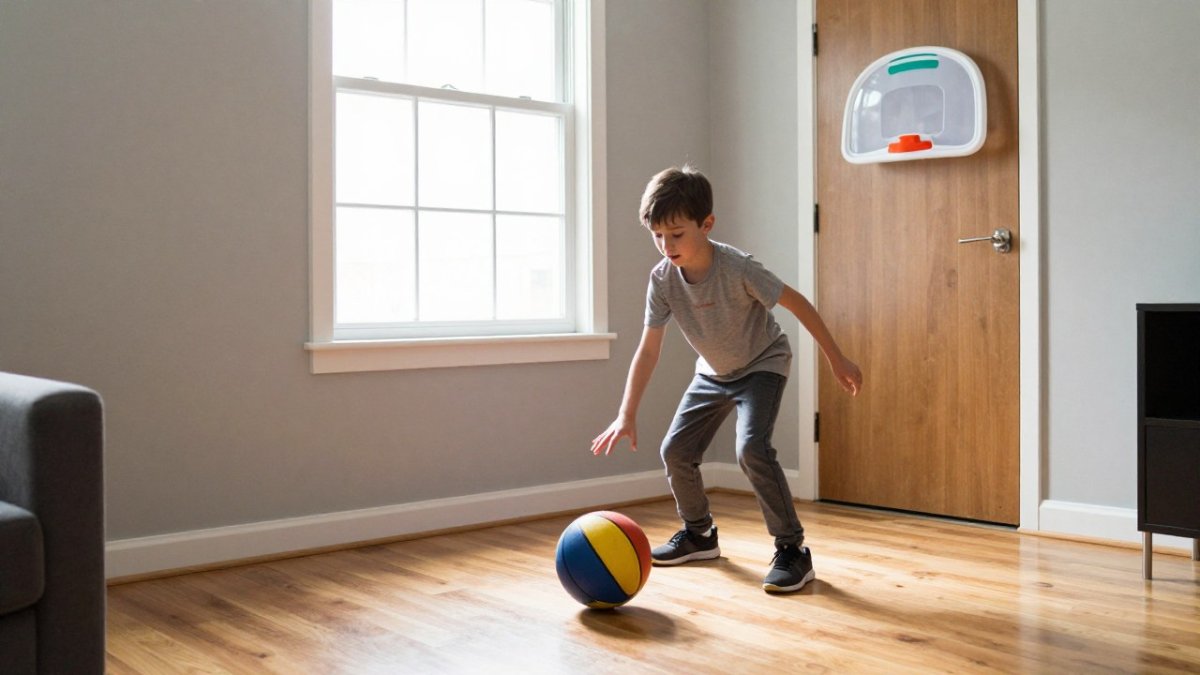
Clear a 3-by-3 metre area, move breakables away, and use a soft or mini ball. Set up a laundry basket or a small indoor hoop as the target. Focus on one skill per session: dribbling with both hands, passing to a wall target, or shooting form close to the basket. Ten to fifteen minutes of focused indoor basketball games for kids is enough for ages 4 to 6, and 20 to 30 minutes suits ages 7 to 10.
What basketball games can kids play without a hoop?
Plenty of skill work needs no hoop at all. Games that build ball handling and teamwork with nothing but a ball and open floor, or using plastic bottles as pins, or wall passing drills for catching and footwork, keep practices moving when the room is small or the hoop is occupied.
How long should a basketball practice be for kids?
Ages 4 to 6 do best with 30 to 40 minutes, ages 7 to 10 with 45 to 60 minutes, and ages 11 and up with 60 to 75 minutes. Keep each game or drill to 5 to 10 minutes and rotate before attention drops. A short warm-up, three or four skill games, and a fun finishing activity fits most indoor sessions without pushing young players past their focus limit.
How can you make indoor basketball practice safe?
Check the floor for slip hazards, keep at least one metre of clear space around walls and furniture, and use a soft or mini ball for tight rooms. Remove jewelry and tie shoelaces before starting. Set rules for safe distances during shooting and passing games, and give each player their own marked lane during dribbling drills to prevent collisions. A quick two-minute warm-up before fast-paced games also lowers the risk of strains.