 How-to
How to Improve Weak Hand Dribbling for Youth Players
Last Updated: November 8, 2026
Quick Summary
Improve weak hand dribbling by giving the off hand more reps than the strong hand, starting with 5-10 minutes of stationary pound and V-dribbles each session. Build up through a six-stage progression from walking dribbles to game speed, holding each stage for at least three sessions. Short daily weak-hand work beats one long weekly session.
- Do 3 sets of 20 seconds of pound dribbles per hand, keeping the ball on the fingertips.
- In every weak-hand drill, give the off hand at least twice the reps of the strong hand.
- Hold each progression stage for at least three sessions before moving to the next.
- For players under 12, cap continuous weak-hand work at 10 minutes per session.
- Use a two-miss rule in scrimmages so players must use the weak hand on two possessions.
Table of Contents
- Why the Weak Hand Decides How Far a Young Player Goes
- Stationary Dribbling Drills for Youth That Build Fingertip Control
- Two-Ball Drills and Off-Hand Passing to Break the One-Hand Habit
- Basketball Off-Hand Development: Moving From Stationary to Game Speed
- Building a Youth Basketball Training Schedule Around the Weak Hand
- Common Mistakes, Hand Fatigue and the Mental Block Around the Off-Hand
- Finding a Program That Trains Both Hands From Day One
- Frequently Asked Questions
Why the Weak Hand Decides How Far a Young Player Goes
Most young players stall at the same spot, and it rarely has anything to do with size or speed. It comes down to how to improve weak hand dribbling for youth, because a player who can only go one way is easy to guard. A player who dominates with the right hand in practice can get shut down the moment a defender learns to shade left.
The weak hand is the difference between a player who reacts and a player who dictates. Coaches at every level look for two-way ball handling before they look at anything else.
The Confidence Gap That Keeps Kids on One Side
The problem is rarely physical. Young players avoid the off-hand because it feels clumsy, and that discomfort becomes a habit. They dribble right in games, then work right in practice, and the gap widens every week.
The Coaching youth basketball guidance from USA Basketball makes a simple point: fundamentals are built through repetition, and the non-dominant hand needs more of it, not less. Confidence follows competence. Kids trust a hand that has done the work.
Stationary Dribbling Drills for Youth That Build Fingertip Control
Stationary dribbling drills are the fastest way to build a weak hand, because they remove the pressure of defenders and let a player focus on feel. Start every session with 5-10 minutes of these before anything else.
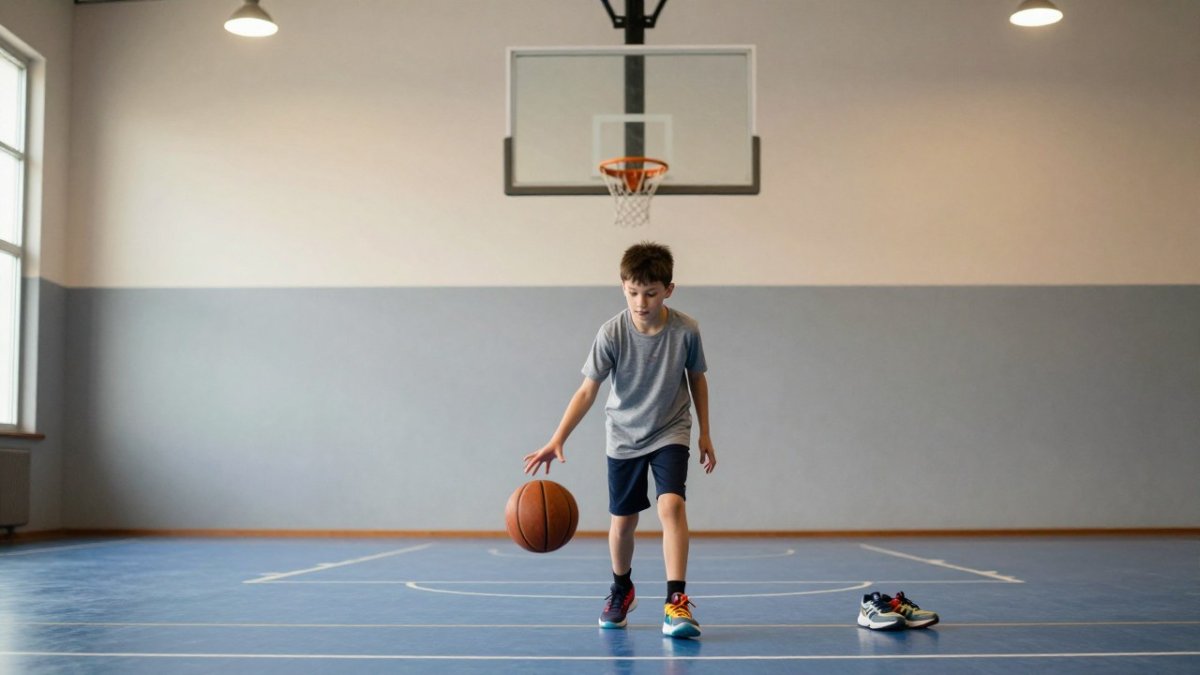
Pound dribble: Dribble hard with the off-hand at knee height. Keep the ball off the palm and on the fingertips. Do 3 sets of 20 seconds per hand.
V-dribble: Push the ball forward and pull it back in a V shape, staying low. This teaches dribble control and hand-eye coordination.
Pound Dribble and V-Dribble Progressions
Build in layers. A young player who can pound dribble with the weak hand can start adding a crossover, then a between-the-legs move. Our guide on how to improve youth basketball dribbling breaks down the full progression for players still learning the basics.
Watch out: kids tend to dribble too high when they get tired, which kills control. Keep the dribble low and the eyes up.
Two-Ball Drills and Off-Hand Passing to Break the One-Hand Habit
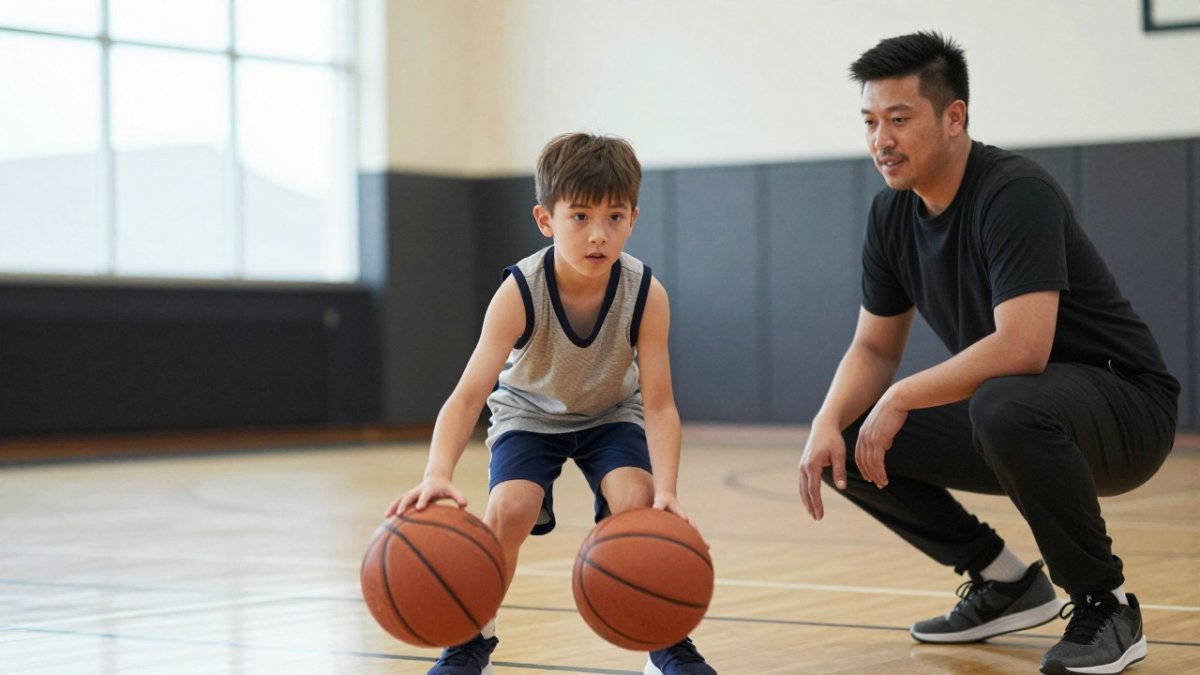
Two-ball drills force the off-hand to work without a safety net. A player cannot favor one side when both hands are busy. Start with both balls bouncing at the same time, then alternate.
Off-hand passing matters just as much. Wall passes with the weak hand build the same muscle memory that game passing demands. For players ready to add a related off-hand skill, our step-by-step guide to a faster crossover for youth players pairs well with this work.
Basketball Off-Hand Development: Moving From Stationary to Game Speed
Stationary reps build the foundation, but game-speed handling is where it pays off. The mistake most young players make is jumping from a slow pound dribble straight into a live defender. That gap is where confidence collapses. Build a bridge instead, with a progression that adds one variable at a time.
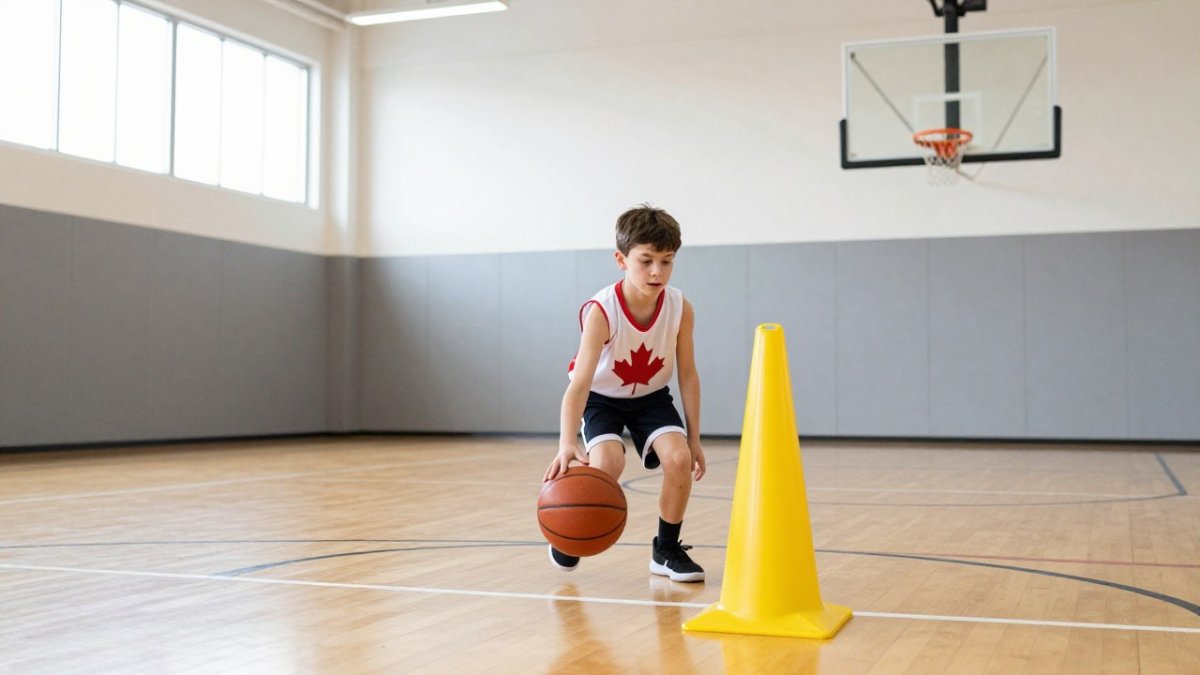
Stage 1, Walk and dribble. Dribble with the weak hand only while walking the length of a driveway or half-court. Keep the dribble at knee height and the eyes up. Do 4 lengths. This adds movement without speed.
Stage 2, Jog and dribble. Same drill at a jog, still weak hand only. Do 4 lengths. If the ball starts bouncing above the waist, slow down, control first, speed second.
Stage 3, Change of pace. Dribble weak hand at a jog, then push into a two-step burst, then back to the jog. Do 6 bursts over half-court. This teaches the hand to control the ball when the body accelerates, which is the exact moment young players lose the dribble.
Stage 4, Guided defender. Add a parent or coach at half speed, no stealing, just shading the weak-hand side. Dribble weak hand for 20 seconds, then switch. Do 3 rounds. The defender should mirror the player's speed, not pressure the ball.
Stage 5, Live half-speed. Defender can now reach for the ball at half speed. Player must keep the weak hand alive and protect the ball with the off arm. Do 4 rounds of 20 seconds.
Stage 6, Game speed. Full-speed weak-hand dribbling in a one-on-one setting, but only for short bursts, 10 to 15 seconds at a time. Young players cannot sustain game speed with the off hand for long, and that is normal.
Youth coaches often run a progression like this over four to six weeks. Do not rush the early stages; a player who skips Stage 2 will wobble at Stage 5.
This is also where home-based and court-based training split. Stages 1-3 can be done in a driveway, garage, or basement with a single ball. Stages 4-6 need a partner and enough space to move, so they belong on a court or in a park.
The youth sports development resources from the Government of Canada note that skill acquisition in children comes from consistent, progressive practice rather than occasional bursts. Short daily reps beat one long weekly session.
Watch out: kids tend to speed up before they have control, then blame the weak hand when the ball gets away. Hold each stage for at least three sessions before moving on.
Building a Youth Basketball Training Schedule Around the Weak Hand
A youth basketball training schedule should give the weak hand more reps than the strong one, not equal time. Here is a simple weekly structure that works at home or on a court:
| Day | Focus | Duration | Where |
|---|---|---|---|
| Monday | Stationary pound and V-dribble, weak hand | 15 min | Home |
| Wednesday | Two-ball drills and wall passes | 20 min | Court |
| Friday | Game-speed weak hand dribbling | 20 min | Court |
| Weekend | Full practice or game | 60 min | Court |
Duration
Keep sessions short and consistent. Hand fatigue is real for young players, so stop if grip or control fades.
Common Mistakes, Hand Fatigue and the Mental Block Around the Off-Hand
The biggest mistake is treating the weak hand as an afterthought. Players spend most of practice on what already works, then wonder why the off-hand never improves. Flip that ratio: in every weak-hand drill, the off hand should get at least twice the reps of the strong hand. A 2:1 ratio is a simple rule young players can remember.
The second mistake is practicing the weak hand only when fresh. Young players default to the strong hand late in a session when they are tired, which means the weak hand never learns to function under fatigue, the exact condition games demand. Put weak-hand work early in the session, then finish with a short fatigue block: 30 seconds of weak-hand pound dribbles after a sprint, once per session.
The mental block is just as common and rarely addressed. Kids avoid the off-hand in games because a mistake feels embarrassing. Coaches who punish weak-hand errors teach players to hide the weakness, not fix it. A better approach is to reward attempts: count weak-hand drives in a scrimmage and praise the attempt even when the ball is lost.
A useful mechanism is the "two-miss rule." In practice scrimmages, a player must use the weak hand on at least two possessions before falling back on the strong hand. This removes the internal debate, the player stops asking "should I?" and just does it. Over a few weeks, the weak hand stops feeling like a risk.
Hand fatigue is real for young players and is the most overlooked injury risk in high-repetition ball handling. The wrist and finger flexors are small muscles, and a 9-year-old doing 200 pound dribbles in a session will show sloppy form before they show soreness. Signs to watch for: the dribble creeping up above the waist, the palm flattening onto the ball, or the player shaking out the hand between reps.
Build rest into the plan. A simple structure is 40 seconds of work, 20 seconds of rest, for no more than 10 minutes of continuous weak-hand work per session for players under 12. Older players can extend to 15 minutes. Never push through fatigue to hit a rep count, sloppy mechanics get baked into muscle memory and take longer to fix than the reps were worth.
Watch out: a player who complains of wrist or finger soreness the day after a session is a sign the volume was too high, not that the player is weak. Cut the rep count by a third for the next session and rebuild gradually.
Finding a Program That Trains Both Hands From Day One
A good program does not wait until a player is "ready" to work the weak hand. It builds both hands into every drill from the first session. That is how basketball fundamentals stick.
At Tier 1 Sports, our Skills and Drills program builds both hands into weekly fundamentals work for ages 7-12 in a fun, encouraging setting. If you are deciding on private coaching, our guide on how to choose private basketball skills training for children walks through what to look for. You can also explore available programs for ages 4-17, from beginner to competitive.
The weak hand will not fix itself, and a player who only goes one way hits a ceiling fast. Tier 1 Sports builds both hands into every session, with age-specific programs, a focus on fundamentals, and a supportive club culture that lets kids take risks without fear. Get started with Tier 1 Sports and watch your young player become a two-way threat.
Frequently Asked Questions
How long does it take to improve weak hand dribbling?
Most youth players notice real control gains in six to eight weeks of consistent work, roughly three short sessions a week. Muscle memory builds through repetition, not long sessions, so 15 focused minutes beat an hour of half-effort. Expect the first two weeks to feel awkward, with the ball bouncing off the foot or hand. Keep the drills slow and deliberate until the pound dribble stays low and even, then add speed. Players who train the off-hand daily in short bursts progress fastest.
What are the best daily drills for weak hand dribbling?
Start with 50 weak-hand pound dribbles at knee height, then 50 V-dribbles in front of the body. Add figure-eight dribbles around each leg and a low crossover sequence at walking pace. Finish with 20 weak-hand layups off one dribble. Keep each drill under two minutes and rest between sets. Stationary dribbling drills for youth work best when done daily, even briefly, because short frequent reps build fingertip control faster than one long weekly session.
Why is it important for youth players to be ambidextrous on the court?
A player who can only dribble right gets forced to the weak side by defensive pressure, which limits drives, passing angles and court vision. Two-hand control opens the crossover, the rebound and dribble transition, and both-direction layup finishing. Coaches at the rep level look for players who can handle pressure on either side. Basketball off-hand development also builds overall basketball IQ, because players see more options when they are not locked into one direction.
What are common mistakes when training the weak hand?
The biggest mistake is training the weak hand only when it fails in a game, which teaches the player to avoid it. Second is going too fast too soon, which produces sloppy mechanics and bad muscle memory. Third is looking down at the ball, which kills hand-eye coordination and court vision. Fourth is skipping the warm-up, which leads to hand and wrist fatigue. Slow, deliberate reps with eyes up, done consistently, fix all four.