 How-to
7 Simple Basketball Agility Exercises for 6 Year Olds
Last Updated: October 25, 2026
Quick Summary
Basketball agility for 6 year olds is built with short, simple drills like line hops, cone weave dribbles, defensive slide tag, and mirror drills. Run two or three drills per session for a few minutes each, resting 30 to 60 seconds between sets, rather than all seven at once.
- Line hops are done as two sets of 10 hops with a 30-second rest between sets.
- The cone weave dribble uses four or five cones set about a metre apart.
- Defensive slide tag runs three rounds of 20 seconds with 40 seconds of rest.
- The 12-minute home session uses two agility drills, one ball skill, and a game.
- Keep every activity under three minutes and rest frequently at this age.
Table of Contents
- Why Basketball Agility Matters for 6-Year-Olds
- 7 Simple Basketball Drills for 6 Year Olds That Build Agility
- Basketball Agility Drills for Kids: Setup, Dosage, and Progression
- Basketball Drills for Kids at Home: No-Hoop Options
- A Complete Basketball Practice Plan for 6 Year Olds
- Safety, Supervision, and Developmental Readiness
- Next Step: Finding the Right Program for Your 6-Year-Old
- Frequently Asked Questions
Why Basketball Agility Matters for 6-Year-Olds
Basketball agility is the ability to stop, start, and change direction quickly while staying balanced, the foundation for every other skill at six.
Six is a special age. Kids learn movement patterns fast, and those patterns stick.
Most parents focus on shooting first. But a six-year-old who cannot shift their weight or stop on balance will struggle with every shot.
The Golden Window for Motor Skills
Coordination and balance develop fastest in the early school years, the golden window for motor skills, when young players build the wiring for quick feet, body control, and reaction speed.
ParticipACTION's guidance on physical literacy in children explains why movement skills learned early carry into every sport. According to their research, developing fundamental movement skills in early childhood is crucial for lifelong physical activity and overall well-being.
For a deeper look at how coordination develops, see our guide on basketball agility and coordination for children.
7 Simple Basketball Drills for 6 Year Olds That Build Agility
These seven drills need almost no equipment. Each one takes a few minutes. Run two or three per session, not all seven at once. Short bursts beat long grinds at this age.
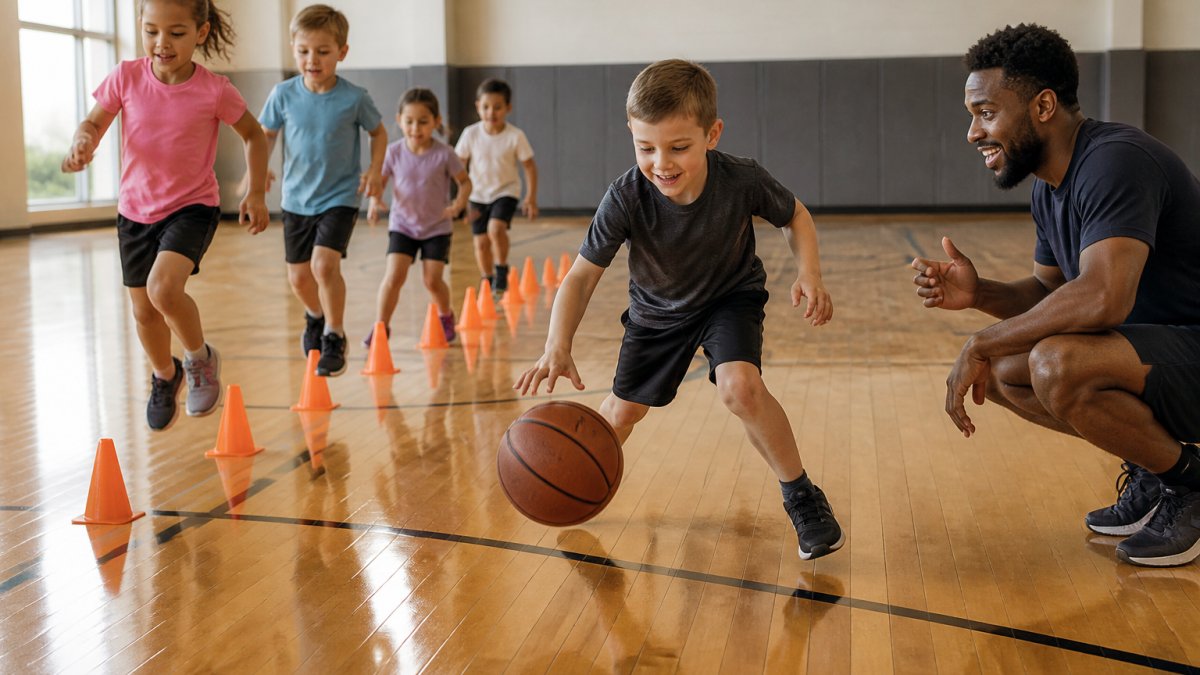
A few rules apply to every drill. Work on a clear, non-slip surface, gym floor, driveway, or short grass, in shoes with grip, with at least two metres of clear space.
1. Line Hops
Setup: Find a floor line or lay a strip of tape about one metre long.
Dosage: Two sets of 10 hops, with a 30-second rest between sets. Total time: about two minutes.
Easier: Hold your child's hand for balance, or hop in place first without crossing the line.
No tape? Use a seam in the floor, a jump rope laid straight, or a line of socks.
2. Cone Weave Dribble
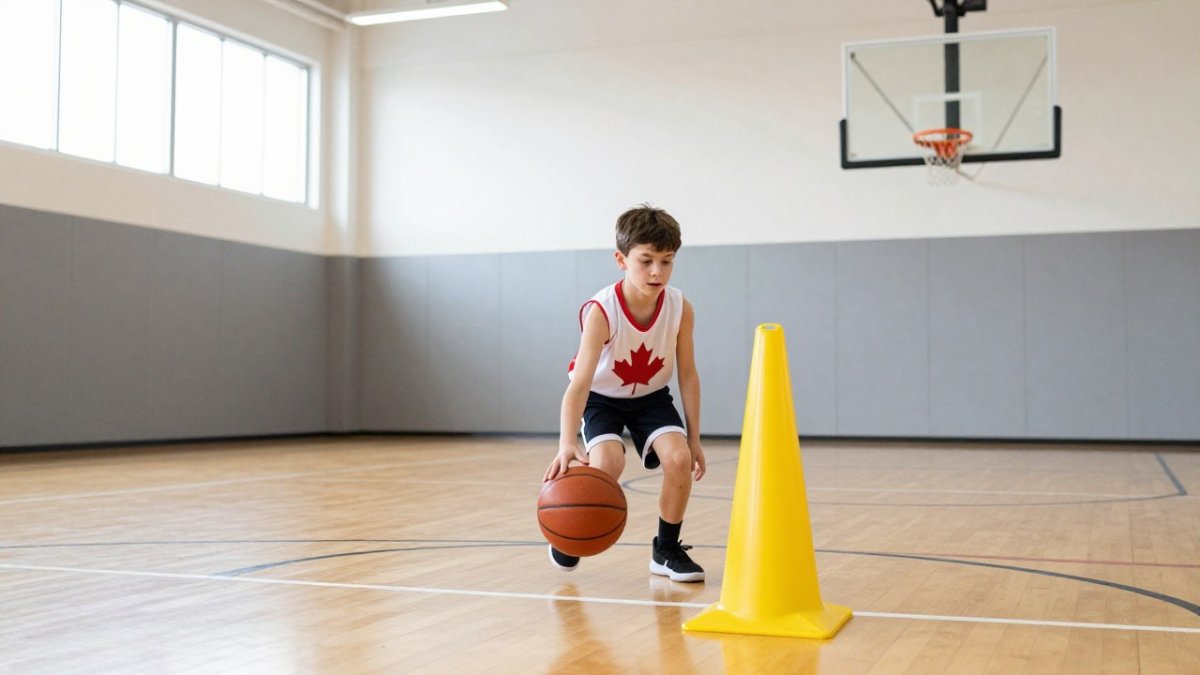
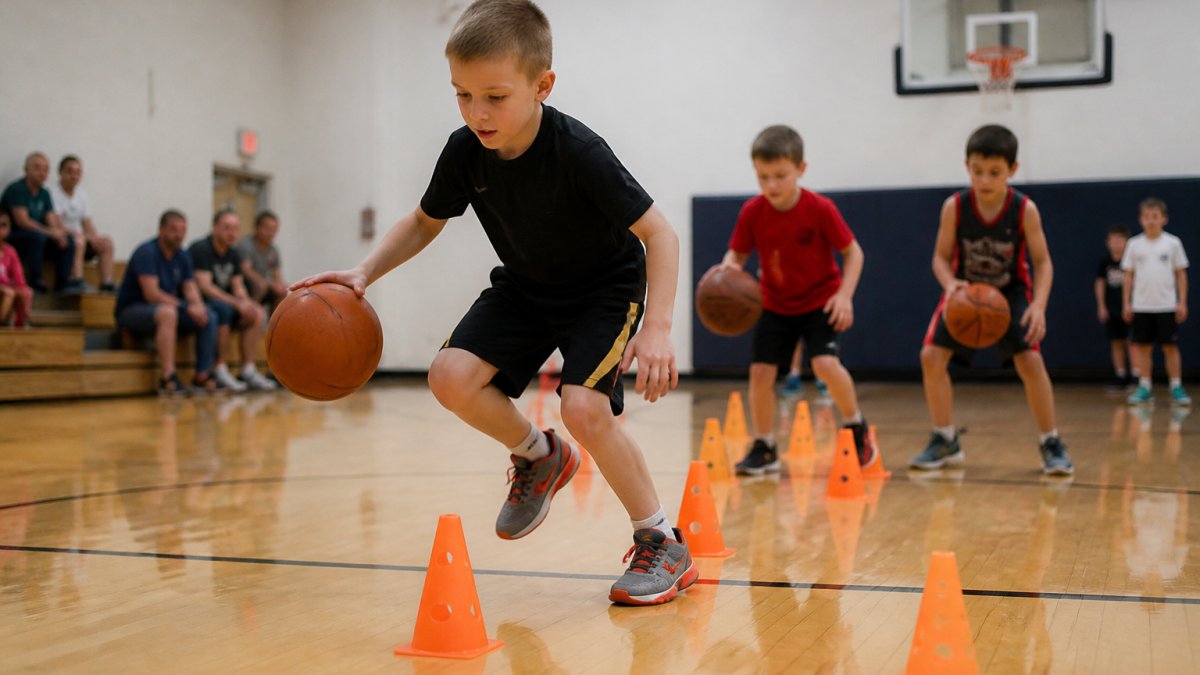
Setup: Set four or five cones in a straight line, about a metre apart. No cones? Use plastic cups, water bottles, or rolled-up socks.
How to do it: Dribble through the cones with one hand, then back with the other.
Dosage: Three trips through the cones, resting 45 seconds between trips. Total time: about three minutes.
Easier: Walk the weave while dribbling, or use a larger, lighter ball.
Harder: Add a crossover at each cone, or time the trips once control is solid.
3. Defensive Slide Tag
Setup: Mark a small square with cones, about three metres wide. Use shoes, bags, or chalk if you have no cones.
Dosage: Three rounds of 20 seconds, with 40 seconds of rest between rounds. Total time: about three minutes.
Easier: You tag at half speed, or the child slides only in one direction per round.
Harder: Add a ball for them to hold in front while sliding, or widen the square slightly.
Why it works: This is the best drill for lateral movement.
4. Mirror Drill
Setup: Stand facing your child, about two metres apart. No equipment needed.
How to do it: You move left, right, forward, or back; your child copies as fast as they can.
Dosage: Two rounds of one minute each, with a one-minute rest between rounds. Total time: about four minutes.
Easier: You move only side to side, at walking pace.
Harder: Add a ball for the child to hold while mirroring, or mix in small hops.
5. Wall Passing Quick Feet
Setup: Find a flat wall and a ball.
How to do it: Your child passes against the wall and catches it, doing two quick alternating foot taps between passes. Keep passes sharp and taps light.
Dosage: Two sets of 15 passes, with a 45-second rest between sets. Total time: about three minutes.
Easier: Use a lighter ball and stand closer to the wall; skip the foot taps for the first set.
Harder: Increase the distance to three metres, or do four taps between passes.
Why it works: This pairs passing with quick feet, building hand-eye coordination while the feet keep moving.
6. Jump Stop and Pivot
Setup: Open floor space, no equipment needed. Mark a start line with tape or a shoe.
How to do it: Jog three steps, jump, and land on both feet with knees bent, then pivot on one foot to face a new direction. Repeat, alternating the pivot foot.
Dosage: 10 reps, alternating the pivot foot, with a short rest after every five reps. Total time: about two minutes.
Easier: Walk instead of jog, and pivot without the jump first.
Harder: Add a ball to hold at chest height during the jump stop.
Why it works: The jump stop is a core fundamental skill.
7. Ball Drop Reaction Race
Setup: You hold a ball at chest height. Your child stands one step away on a clear surface.
Dosage: 10 drops per round, two rounds, with a one-minute rest between rounds. Total time: about three minutes.
Easier: Drop from waist height and stand closer.
Harder: Drop from shoulder height, or use a smaller ball.
Why it works: This drill trains reaction time and first-step quickness.
Basketball Agility Drills for Kids: Setup, Dosage, and Progression
Basketball agility drills for kids work best in short, repeated bursts. A six-year-old's attention span is short, and their body needs rest between efforts: ten to twenty seconds of work, then a break.
Here is a simple reference for planning each drill:
| Drill |
|---|
| Time per Set |
| Sets |
| Equipment |
| Main Skill |
| Line Hops |
| 10-15 sec |
| 2 |
| Tape or floor line |
| Quick feet, balance |
| Cone Weave Dribble |
| 30-45 sec |
| 3 |
| 4-5 cones, ball |
| Ball control, footwork |
| Defensive Slide Tag |
| 20 sec |
| 3 |
| Cones |
| Lateral movement |
| Mirror Drill |
| 60 sec |
| 2 |
| None |
| Reaction, change of direction |
| Wall Passing Quick Feet |
| 45 sec |
| 2 |
| Wall, ball |
| Coordination, passing |
| Jump Stop and Pivot |
| 20 sec |
| 10 reps |
| None |
| Body control, balance |
| Ball Drop Reaction Race |
| 30 sec |
| 2 |
| Ball |
| Reaction, quickness |
How to progress: Start slow. Add speed only when your child can do the drill with control, then add reps, not time. Pushing speed too early teaches sloppy habits.
Basketball Drills for Kids at Home: No-Hoop Options
You do not need a hoop to build agility. Every drill above works in a driveway, basement, or park. Basketball drills for kids at home should set up in two minutes.
A few tips for home sessions:
- Keep sessions to 15-20 minutes.
- Warm up with jumping jacks or a short jog.
- Use tape on the floor instead of cones if you have none.
For more indoor, no-hoop games, our guide to indoor basketball training games for kids has seven extra drills you can rotate in.
A Complete Basketball Practice Plan for 6 Year Olds
Most six-year-olds do best with short, frequent sessions. A 10-15-minute session at home, three or four times a week, builds more than a single 45-minute grind. Here is the short version a parent can fit in before dinner.
The 12-Minute Home Session
This is the core plan. It uses two agility drills, one ball skill, a quick game, and a cool-down. Total time: about 12 minutes, plus water breaks.
- Warm-up (2 min): Jog in place, 10 jumping jacks, arm circles. Keep it light, raise the heart rate, don't tire them out.
- Agility block (3 min): Pick one drill from the list above; line hops or defensive slide tag work well as openers. Run two sets with a 30-second rest between.
- Water break (30 sec): A few sips, not a full bottle.
- Ball skill (3 min): Cone weave dribble or wall passing quick feet. Two sets, slow and controlled.
- Game time (2 min): Defensive slide tag or ball drop reaction race. End on a win, let them catch the last ball or escape the last tag.
- Cool-down (1 min): Slow walking and gentle arm and leg stretches. Ask what they enjoyed most.
The 12-minute session is the default. If your child is engaged and asking for more, add one extra drill. If they are distracted or tired, stop after the game. Leaving them wanting more is the goal.
The Longer 30-Minute Version
When you have more time, a weekend morning or a park visit, stretch the same structure:
- Warm-up (5 min): Jogging, jumping jacks, arm circles, and a few easy line hops.
- Agility block (8 min): Two drills, two sets each, with 45-second rests.
- **Water break (1 min).
- Ball-handling block (8 min): Cone weave dribble and wall passing, plus free dribbling in space.
- Game time (5 min): Defensive slide tag or a simple one-on-one game with a parent.
- Cool-down (3 min): Slow walking, light stretching, and a recap of one thing they did well.
What to Skip at This Age
Six-year-olds do not need long conditioning blocks, heavy strength work, or repetitive shooting drills with long lines. Keep every activity under three minutes, rest frequent, and the ball in their hands as much as possible. If a drill means waiting more than 30 seconds, it is the wrong drill.
Adjusting on the Day
If your child is yawning or losing focus, cut the session short. If they are bouncing with energy, add one game. If they are frustrated after a missed catch, switch to a fun drill immediately; do not push through.
For more indoor, no-hoop games to rotate into these sessions, our guide to indoor basketball training games for kids has seven extra drills you can swap in.
Safety, Supervision, and Developmental Readiness
Safety comes down to three things: space, supervision, and rest. Clear hard objects, keep an adult watching at all times, and let kids rest between bursts.
Six-year-olds are still building balance and body control. They fall. That is normal.
Watch out: pushing a child to train through pain or fatigue is the fastest way to build a bad relationship with the sport.
If you are wondering whether your child is ready, our guide on basketball training for 5 year olds breaks down age-appropriate expectations for the year below.
Next Step: Finding the Right Program for Your 6-Year-Old
Agility drills at home build a great base. A good program adds coaching, other kids, and real game time.
At Tier 1 Sports, our Ball For Fun program is built for ages 4-6.
You can explore the Ball For Fun program for your six-year-old. Or browse all available programs by age and skill level to find the right fit.
Frequently Asked Questions
Is basketball good for a 6-year-old?
Yes. At six, children are in a key window for developing coordination, balance, and quickness. Basketball agility exercises like line hops and defensive slides build these skills while being fun. The sport also teaches listening, taking turns, and teamwork. Keep sessions short (20-30 minutes) and focus on play rather than competition. Many community programs, including those at Tier 1 Sports, offer introductory sessions designed specifically for this age group.
How long should a basketball practice be for a 6-year-old?
Aim for 30-45 minutes total, including warm-up and water breaks. Young children have short attention spans, so break practice into 5-7 minute stations with quick transitions. A good rule is 3-5 minutes per drill, then rotate. Always finish with a fun game or free play. The sample practice plan covers agility, dribbling, passing, and shooting.
Can 6-year-olds practice basketball without a hoop?
Absolutely. Many foundational skills, including agility, footwork, dribbling, and passing, need no hoop at all. Use cones, tape lines, or household items for obstacles. Wall passing and ball-control drills work in a driveway or basement. When you do introduce shooting, a lowered hoop (adjustable to about 1.8 to 2.4 metres) helps proper form. The at-home section above lists several no-hoop options.
What equipment do children need for beginner basketball drills?
Very little. A properly sized basketball (size 3 for ages 4-6, about 56 centimetres in circumference) is the main item. Cones or small markers, painter's tape for lines, and a wall for passing are enough. Agility ladders are optional; you can use tape on the floor instead. Comfortable athletic shoes and a water bottle complete the list. No specialized agility equipment is required for the exercises .
Your six-year-old does not need perfect form or a jump shot. They need to move, play, and enjoy the game. That is where real skill starts. At Tier 1 Sports, we build that foundation with age-tailored programs, encouraging coaching, and a community that fuels a lifelong passion for basketball. Get started with Tier 1 Sports and help your child realize their full potential on the court.